How Do Rice Importers Meet USA Regulatory Requirements?
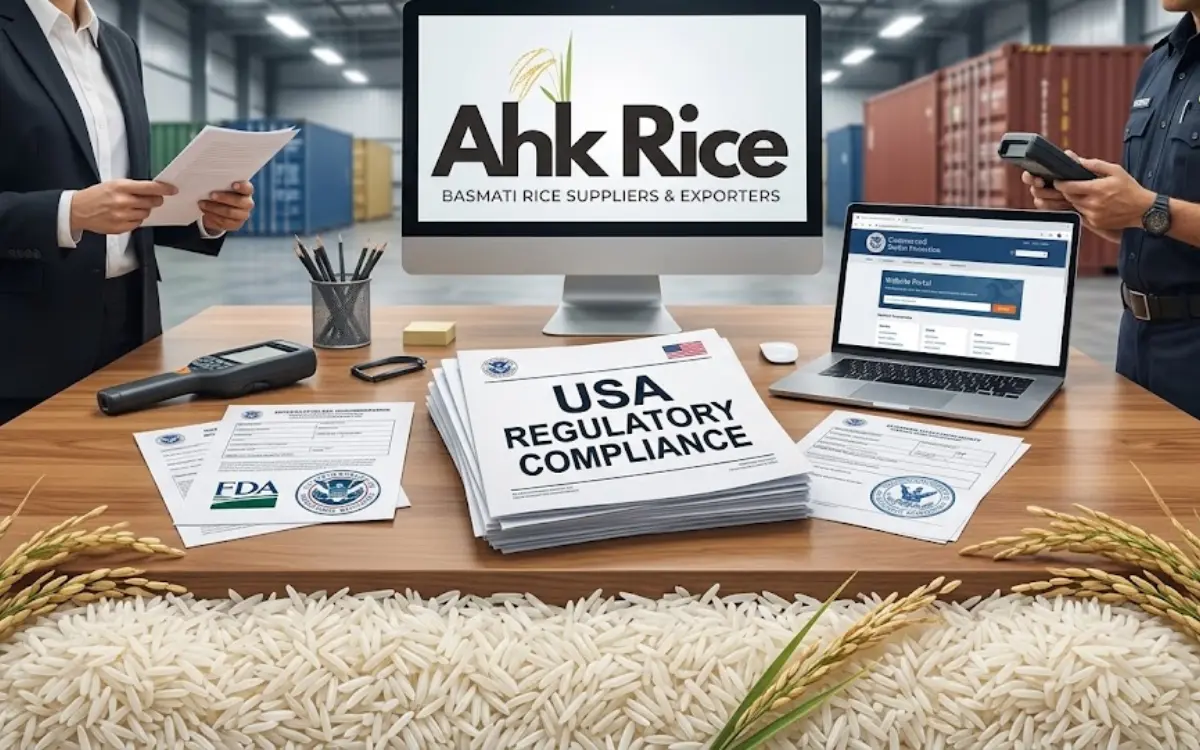
U.S. rice importers meet regulatory requirements most effectively through a coordinated compliance model that connects FDA requirements, FSVP verification, customs entry, food labeling, supplier documentation, product testing, and shipment records before the rice reaches a U.S. port. The key distinction is between export documentation and the U.S. importer’s legal responsibilities.
For buyers evaluating why compliance affects purchasing decisions:
Import compliance as part of rice purchasing decisions provides the broader procurement context before supplier selection. FDA states that imported food must meet U.S. requirements for safety, sanitation, and labeling, and imported food remains subject to inspection at entry.
For Pakistani Basmati buyers, the compliance process starts before container loading. A supplier needs accurate product specifications, traceability, quality records, export documents, and applicable certificates. The U.S. importer then manages its own FDA, FSVP, customs, labeling, and entry obligations.
As a practical sourcing option, AHK Rice’s Pakistan rice export service connects Pakistani Basmati processing, grading, packaging, documentation, and shipment coordination for international buyers. AHK Rice is based in Punjab and supplies 1121, Super Kernel, and 1509 Basmati varieties.
What are the available solutions for meeting U.S. rice import requirements?
U.S. rice importers meet regulatory requirements by combining FDA food-facility and prior-notice rules, FSVP verification, compliant labeling, customs entry, applicable plant-health controls, supplier records, and shipment testing. The strongest approach connects exporter documentation with importer-side verification before commercial container loading.
What does FDA require from rice importers?
The U.S. Food and Drug Administration regulates imported human food entering interstate commerce. FDA requires imported food to be safe, sanitary, and properly labeled. Food facilities involved in manufacturing, processing, packing, or holding covered food generally require FDA registration.
Prior Notice is another core requirement. FDA must receive advance notification for covered food shipments before arrival. The filing can occur through CBP’s Automated Broker Interface or FDA’s Prior Notice System Interface. The timing depends on transportation mode. For ocean shipments, FDA must receive and confirm Prior Notice at least eight hours before arrival.
The Foreign Supplier Verification Program (FSVP) places responsibility on the U.S. importer to verify that foreign suppliers produce food in accordance with applicable U.S. safety requirements. Supplier documentation therefore becomes a procurement requirement rather than a simple export formality.
What does the exporter provide?
A Pakistani exporter normally prepares commercial and shipment documentation such as the commercial invoice, packing list, bill of lading, certificate of origin, and applicable phytosanitary or fumigation documentation.
A phytosanitary certificate addresses plant-health requirements. It does not replace FDA food-safety or FSVP obligations.
APHIS states that plant and plant-product import requirements depend on the commodity and country of origin, with current requirements searchable through its Agricultural Commodity Import Requirements database.
What does product verification add?
Third-party inspection adds independent evidence. Buyers can verify moisture, broken grains, foreign matter, grain length, appearance, packaging, and other contractual specifications before shipment.
Laboratory testing also creates a stronger evidence trail for contaminants and residues. This is particularly relevant for rice because FDA maintains specific regulatory guidance for contaminants, including inorganic arsenic in certain rice products. The FDA action level for inorganic arsenic in infant rice cereals is 100 µg/kg, or 100 ppb.
The correct testing program depends on the product, intended use, specification, and applicable U.S. requirements. Importers need product-specific verification rather than applying one generic test panel to every rice shipment.
How do different approaches compare?
Available solutions range from importer-managed compliance to broker-led filing, supplier-supported documentation, third-party inspection, and integrated export programs. Each method covers different risks. Importers select the model according to shipment volume, product complexity, private-label requirements, expertise, and tolerance for regulatory risk.
| Attribute | Importer-managed | Customs broker-led | Supplier-supported | Third-party verified | Integrated program |
|---|---|---|---|---|---|
| Regulatory control | High | Medium | Medium | High | High |
| Documentation coordination | Buyer | Broker | Exporter + buyer | Shared | Shared |
| Quality verification | Buyer | Limited | Supplier | Independent | Multi-stage |
| FSVP support | Buyer-led | Administrative support | Evidence support | Evidence support | Structured evidence |
| Upfront cost | Lower | Medium | Medium | Higher | Medium–High |
| Operational complexity | High | Medium | Medium | Medium | Lower after setup |
| Best fit | Experienced importers | Small import teams | Regular buyers | High-risk or premium lots | Repeat commercial programs |
The comparison shows why no single method fits every importer.
An experienced U.S. food company with established compliance personnel can manage supplier verification, documentation, laboratory testing, and customs coordination internally. This creates control but requires staff, procedures, records, and regulatory knowledge.
A smaller distributor can use a customs broker for entry-related work while retaining responsibility for its own FSVP and supplier controls. A broker simplifies customs administration but does not automatically become responsible for every food-safety obligation.
Supplier-supported compliance is useful when the exporter maintains organized product specifications, inspection reports, certificates, lot information, and export records. This reduces document chasing between the buyer, supplier, broker, and freight forwarder.
Third-party verification creates another control layer. SGS, Bureau Veritas, Intertek, or another qualified inspection organization can verify agreed specifications before loading. This is particularly useful for premium Basmati contracts where grain appearance and consistency directly affect retail positioning.
An integrated program combines these elements into one repeatable workflow.
Which method works best for different U.S. rice importers?
The best method depends on the importer’s operating model. Small distributors benefit from supplier-supported documentation plus an experienced customs broker. Private-label brands need stronger label and specification control. High-volume importers gain from supplier verification, laboratory testing, inspection, and FSVP procedures.
Which approach fits a small rice distributor?
A small distributor typically benefits from a broker-supported and supplier-supported model.
The buyer establishes the product specification, verifies the foreign supplier, confirms FSVP responsibilities, approves packaging, and retains compliance records. The customs broker manages applicable entry processes.
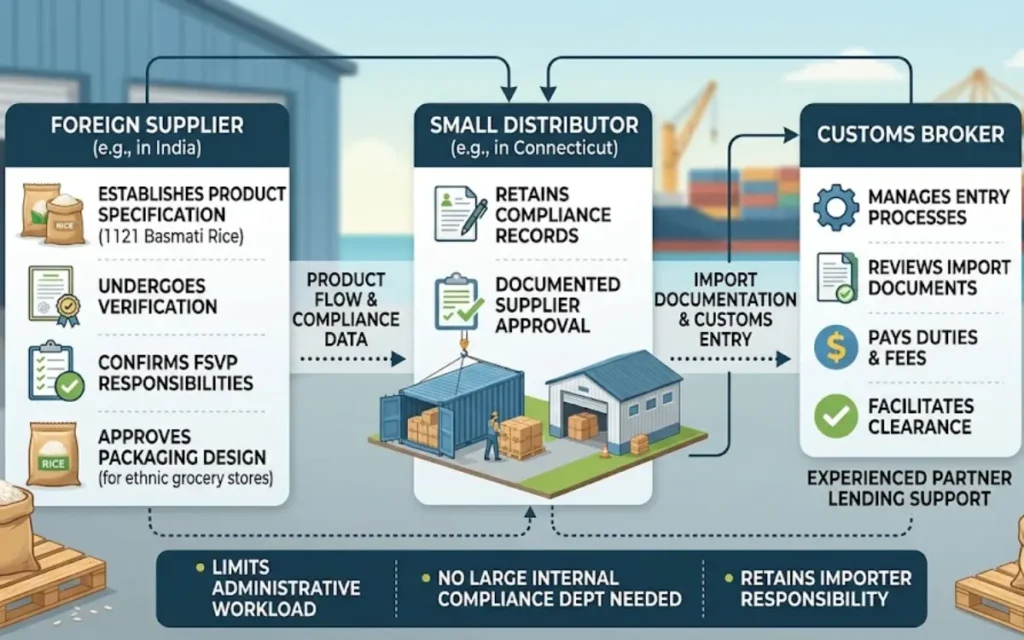
This model limits administrative workload without removing importer responsibility.
For example, a Connecticut distributor importing one or two containers of 1121 Basmati for ethnic grocery stores can use a documented supplier, independent pre-shipment inspection, and an experienced customs broker instead of building a large internal compliance department.
Which approach fits a private-label brand?
Private-label importers require stronger control over packaging and labeling.
The product specification needs to cover rice variety, processing grade, net quantity, country-of-origin information, importer details where applicable, package configuration, and approved artwork.
The packaging file should be approved before commercial production. A supplier should not change the approved product specification or packaging without buyer authorization.
Which approach fits a high-volume importer?
High-volume importers benefit from a repeatable compliance system.
The buyer can establish an approved supplier list, standard product specifications, laboratory protocols, inspection requirements, document checklists, and shipment reconciliation procedures.
Every container then follows the same process.
This approach becomes particularly valuable when an importer purchases 1121 White, 1121 Sella, Super Kernel, and 1509 under different purchase orders. Each grade needs its own specification and commercial identity even when the supplier remains the same.
What are the advantages and disadvantages of each compliance approach?
Compliance approaches differ mainly in control, cost, documentation depth, and accountability. Self-managed programs provide maximum buyer control but require internal expertise. Broker-supported programs reduce filing work. Supplier-integrated programs improve document coordination. Third-party verification adds evidence for quality, testing, and conformity.
What are the advantages of importer-managed compliance?
The main advantage is direct control.
The importer controls supplier qualification, laboratory requirements, FSVP records, product specifications, and documentation standards.
The disadvantage is operational complexity. Staff need to understand FDA requirements, maintain records, monitor supplier performance, and coordinate with customs brokers and freight providers.
This approach works best for established food importers with dedicated compliance teams.
What are the advantages of broker-supported compliance?
A customs broker provides specialized support for import entry and customs procedures.
This reduces administrative workload and helps prevent common entry errors.
The limitation is scope. A broker does not automatically assume responsibility for the importer’s FSVP program, product safety, supplier verification, or labeling compliance.
The importer still needs its own regulatory control system.
What are the advantages of supplier-supported compliance?
A capable exporter can provide specifications, certificates, inspection records, packing details, origin documents, and shipment information from one source.
This creates a cleaner document chain.
The risk is over-reliance on supplier claims. The importer needs independent verification where the commercial risk justifies it.
What are the advantages of third-party inspection?
Independent inspection creates objective shipment-level evidence.
For example, an importer purchasing 25 metric tons of premium 1121 Basmati can specify a maximum broken percentage, moisture range, grain length, packaging configuration, and visual quality criteria. A pre-shipment inspection can then compare the commercial lot against those requirements.
The disadvantage is additional cost and coordination. Inspection does not replace FDA or FSVP compliance.
How do U.S. market regions compare for Pakistani Basmati rice?
U.S. regional demand changes the preferred Basmati grade, logistics route, inventory strategy, and landed-cost calculation. Northeast buyers commonly prioritize premium aromatic grades for established South Asian retail channels, while West Coast buyers combine premium grades with strong Asian and multicultural distribution demand.
For a practical 2026 comparison, the Northeast can be represented by New York/New Jersey distribution, while the West Coast can be represented by Los Angeles/Long Beach distribution.
Current indicative Pakistan FOB quotations place premium 1121 White and Super Kernel around $1,165–$1,205 per metric ton, while 1121 Sella is around $1,135–$1,175 per metric ton. These are indicative market quotations, not fixed contract prices.
The regional difference appears more clearly in freight and inventory planning. A current August 2026 public freight indication shows Karachi-to-New York 40-foot-high-cube FCL pricing around $7,519–$8,155, while Karachi-to-Long Beach is around $7,542–$8,183 on comparable public rate pages. Transit estimates are approximately 27 days to New York and 35–40 days to Los Angeles. Rates change by sailing, equipment, Incoterm, and booking date.
| Market region | Preferred Pakistani grades | Indicative FOB price/MT | Freight indicator | Shelf-life planning |
| Northeast U.S. | 1121 White, 1121 Sella, Super Kernel | $1,135–$1,205 | Higher/lower by sailing | 12–24 months, specification dependent |
| West Coast U.S. | 1121 White, 1121 Steam, Super Kernel | $1,135–$1,205 | Higher/lower by sailing | 12–24 months, specification dependent |
Shelf life is not a single universal number for every rice grade. It depends on processing, moisture, packaging, storage conditions, pest protection, and the manufacturer’s declared specification. Importers should use the supplier’s documented shelf-life statement and storage conditions rather than assume a fixed period.
The commercial comparison therefore needs three separate numbers: FOB product price, transportation cost, and warehouse inventory cost.
A lower FOB quotation does not automatically produce the lowest landed cost.
What should importers check before approving a Pakistani Basmati supplier?
A sound decision framework ranks regulatory readiness first, then product specification, documentation quality, landed cost, and repeatability. Price alone is insufficient. The supplier demonstrates consistent grade performance, accurate records, suitable packaging, controlled logistics, and evidence supporting the importer’s compliance responsibilities.
| Decision factor | What to evaluate | Strong decision signal |
| Regulatory readiness | FDA-related supplier information, FSVP evidence, applicable certificates | Complete and traceable records |
| Product specification | Variety, grain length, broken percentage, moisture, purity | Approved sample matches production |
| Documentation | Invoice, packing list, origin, phytosanitary and shipping records | Documents match physical shipment |
| Landed cost | FOB, freight, inspection, packaging, duties and local charges | Comparable total-cost calculation |
| Repeatability | Production consistency, inspection results, delivery history | Same specification across repeat orders |
Why does product specification come before price?
Rice is not purchased only by weight.
A distributor sells a specific cooking experience. Grain length, aroma, elongation, texture, broken percentage, moisture, and appearance influence consumer acceptance.
AHK Rice states that its Punjab operation covers paddy sourcing, cleaning, de-husking, whitening, grading, color sorting, controlled drying, packaging, and export documentation.
For a buyer comparing 1121 and Super Kernel, the decision therefore needs to include product performance alongside price.
Why does documentation affect total cost?
Documentation errors create operational friction.
A mismatch between the invoice, packing list, product description, quantity, lot information, or shipping records can delay reconciliation and increase administrative work.
FDA also emphasizes that imported food is subject to inspection and can be detained when it fails applicable requirements.
A compliant procurement program therefore treats documentation as part of product quality.
Why does repeatability matter?
The first shipment establishes a benchmark. The second shipment tests whether the supplier can reproduce it.
A distributor selling 1121 Basmati needs the next container to perform like the approved sample. A change in grain length, broken percentage, moisture, aroma, or packaging creates commercial risk even when the shipment clears customs.
Repeatability turns a supplier from a one-time vendor into a scalable supply partner.
What is the practical 2026 compliance workflow for U.S. rice importers?
The practical workflow starts with product classification and supplier qualification, followed by specification approval, supplier verification, testing, compliant packaging, document reconciliation, FDA Prior Notice, FSVP procedures, customs entry, and post-arrival recordkeeping for repeatable import control.
A practical workflow looks like this:
- Define the rice specification. Identify variety, processing type, grain dimensions, broken percentage, moisture, packaging, quantity, and intended market channel.
- Qualify the exporter. Review company identity, processing capability, certifications, export history, quality systems, and documentation procedures.
- Approve a sample. Compare the sample against commercial requirements before confirming bulk production.
- Confirm regulatory responsibilities. Establish which obligations belong to the U.S. importer, customs broker, exporter, laboratory, and logistics provider.
- Verify production. Confirm that commercial production follows the approved sample and specification.
- Test and inspect. Use laboratory testing and third-party inspection when required by the buyer’s risk profile or contract.
- Approve packaging and labeling. Check the finished artwork, net quantity, product identity, origin information, and other applicable U.S. labeling elements.
- Reconcile export documents. Match the invoice, packing list, certificates, lot information, container number, and bill of lading.
- Complete Prior Notice and entry requirements. FDA requires Prior Notice for covered food imports before arrival.
- Maintain FSVP and shipment records. The importer retains the evidence supporting its supplier-verification process.
- Evaluate arrival performance. Record product condition, delivery timing, documentation accuracy, customer feedback, and claims.
- Use the first shipment as the repeat-order benchmark. Subsequent orders should reproduce the approved specification and documentation workflow.
This process separates three concepts that buyers often combine: food compliance, product quality, and commercial logistics. They interact, but they are not interchangeable.
For a U.S. importer, however, supplier capability is only one part of the compliance structure. The buyer still needs to establish its own U.S. import process.
Source compliant Pakistani Basmati rice for Connecticut distribution when the purchasing decision requires a supplier that aligns product specifications, documentation, packaging, and export requirements.”
For example, a phytosanitary certificate does not prove FSVP compliance. A third-party inspection does not replace Prior Notice. FDA registration does not guarantee that every shipment will pass inspection. A customs broker does not remove the importer’s regulatory responsibility.
The strongest procurement model connects each control to the party responsible for completing it.
What should rice importers prioritize when choosing a compliant Pakistani supplier?
U.S. importers should prioritize documented regulatory readiness, measurable rice specifications, reliable export documentation, appropriate testing, transparent landed-cost calculations, and repeat shipment consistency. The supplier’s role is to provide evidence and execution; the importer remains responsible for applicable U.S. import obligations.
For Pakistani Basmati, this distinction is especially important because premium varieties such as 1121, Super Kernel, and 1509 serve different commercial positions.
1121 suits buyers seeking extra-long grain presentation and premium positioning. Super Kernel provides a traditional aromatic Basmati profile. 1509 provides a cost-oriented long-grain option with strong cooking performance.
AHK Rice operates from Punjab and describes an integrated supply process covering these varieties, processing, grading, color sorting, custom packaging, quality checks, and export documentation. Its stated certifications include ISO 22000:2018, HACCP, ISO 9001:2015, GMP, and Halal.
For a U.S. importer, however, supplier capability is only one part of the compliance structure. The buyer still needs to establish its own U.S. import process.
Frequently Asked Questions
What are the main U.S. requirements for importing rice?
U.S. rice imports require compliance with FDA food-safety and labeling requirements, FSVP verification, customs entry procedures, Prior Notice, and applicable plant-health requirements.
What is FSVP for rice importers?
FSVP requires the U.S. importer to verify that its foreign rice supplier produces food according to applicable U.S. food-safety requirements and maintains supporting records.
Does a Pakistani rice exporter need FDA registration?
Foreign food facilities that manufacture, process, pack, or hold food for U.S. consumption generally require FDA registration when covered by the applicable rules.
Is a phytosanitary certificate required for Pakistani rice?
Phytosanitary requirements depend on the specific commodity and applicable U.S. plant-health rules. Importers should verify current APHIS requirements before shipment.