How Do Export Licenses Support Reliable International Rice Trade?
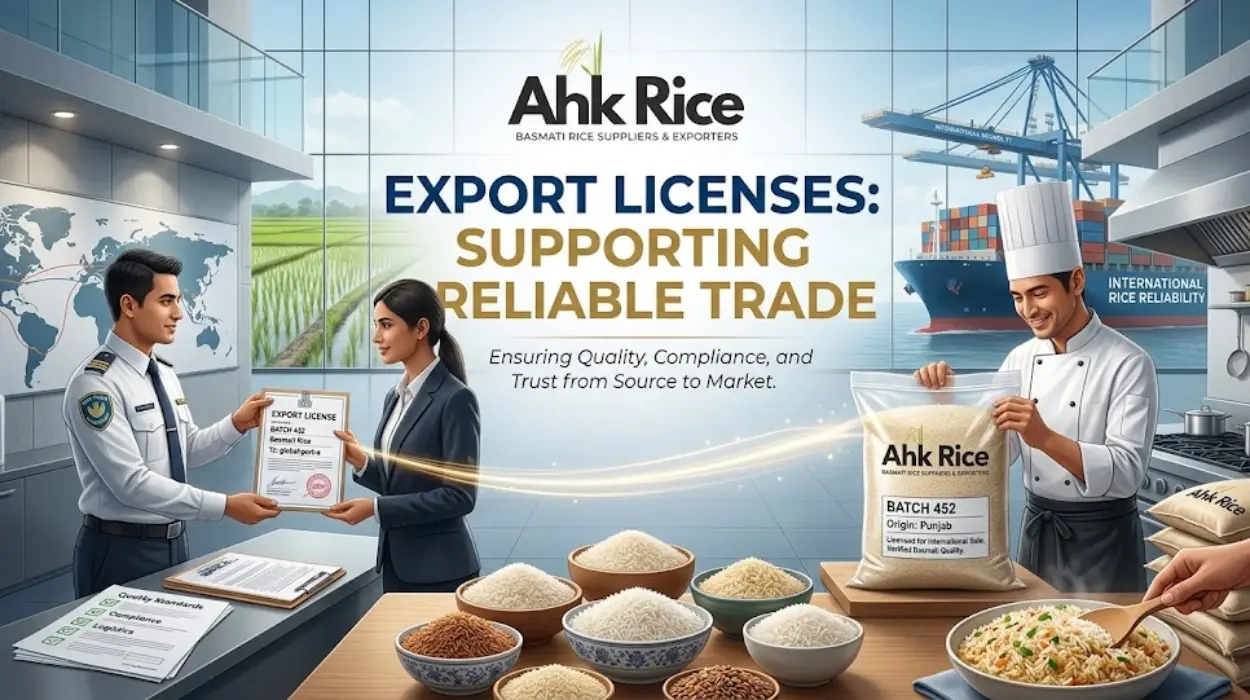
Export licensing and trade credentials support reliable rice trade by proving that an exporter is legally established, properly registered, document-ready, and capable of completing regulated shipments. For New Jersey importers, the strongest approach combines Pakistan-side authorization, traceable export documentation, product compliance, and U.S. importer verification.
International rice trade does not depend on a single document called an “export license.” In Pakistan, reliability comes from a connected compliance structure involving business registration, Pakistan Single Window (PSW) subscription and trader registration, Customs procedures, relevant regulatory certificates, and Rice Exporters Association of Pakistan (REAP) membership. Importers evaluating these credentials can use the educational framework in:
Why New Jersey importers review export license credentials to understand what each document demonstrates.
For 2026, Pakistan’s export framework continues to operate under the Export Policy Order 2022, while the Ministry of Commerce has issued rice-specific measures during the year, including the Drawback of Local Taxes and Levies for Rice Order 2026 and February 2026 notifications concerning rice export FOB values.
What are the available solutions for verifying a rice exporter?
The most reliable verification model combines Pakistan-side trader registration, REAP membership, PSW transaction capability, shipment certificates, product specifications, and destination-market compliance rather than relying on one license document. This layered approach connects exporter identity, commodity control, customs clearance, and buyer-side import responsibilities.
A Pakistan Single Window subscription is the digital entry point for cross-border trade services. PSW registration connects the trader with Customs and other government organizations responsible for licenses, permits, certificates, and related approvals. PSW states that its subscription process requires business identification information such as CNIC, NTN, and SECP registration for companies.
A Single Declaration (SD) is the electronic export declaration used to submit clearance information through PSW. It consolidates information for Customs and relevant government agencies and reduces repeated submissions. The exporter or authorized customs agent must be registered with PSW, and an active bank account with an Authorized Dealer is required for filing an export SD.
REAP, the Rice Exporters Association of Pakistan, is the industry association representing rice exporters. REAP states that its membership became compulsory for rice exporters through Ministry of Commerce policy. Its current 2026 membership renewal documentation also requests evidence such as bank certificates showing export performance, tax documentation, and sales-tax registration where applicable.
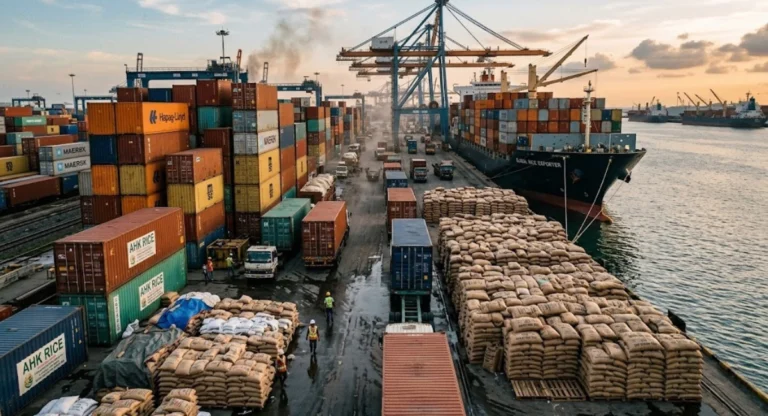
The next layer is the shipment document set. Depending on the destination and transaction, this can include the commercial invoice, packing list, certificate of origin, phytosanitary or health-related certificates where applicable, inspection reports, and transport documents. PSW provides electronic channels for regulatory certificates and certificates of origin through participating government agencies.
For U.S. trade, exporter credentials do not replace U.S. importer responsibilities. The Foreign Supplier Verification Program (FSVP) is a U.S. FDA requirement under which covered food importers verify that foreign suppliers produce food in accordance with applicable U.S. food-safety requirements.
How do different export verification approaches compare?
A basic document check confirms legal identity, while a transaction-level audit confirms operational capability. The strongest approach combines both with product testing, shipment history, destination compliance, and document consistency because reliable international trade depends on repeated execution rather than registration alone.
| Attribute | Basic License Check | PSW & Customs Verification | Full Exporter Due Diligence | Best Use |
|---|---|---|---|---|
| Legal identity | Business documents | Verified trader profile | Business, tax and registration review | New supplier screening |
| Export capability | Claimed capability | Active export filing structure | Past shipment evidence | Recurring contracts |
| Rice-sector standing | Not established | Government transaction access | REAP membership and export history | Rice-specific sourcing |
| Product compliance | Specification sheet | Regulatory documents | Lab reports, inspection and certificates | Premium Basmati |
| Shipment documentation | Sample documents | Transaction-linked filing | Complete document trail | Container imports |
| Destination compliance | Limited | Pakistan-side compliance | U.S., GCC or other market requirements | International distribution |
| Reliability evidence | Registration only | Transaction readiness | Repeat shipments and performance records | Long-term supply |
The comparison matters because a document can be authentic while still providing limited evidence about supply performance. A registered exporter may have the legal ability to trade but still lack the production planning, packaging capacity, inspection controls, or shipment history required by a large importer.
A stronger verification process therefore checks whether the exporter can connect the company, mill, product, documents, banking trail, and shipment. This creates traceability across the complete transaction.
For example, an importer purchasing 54 metric tons of 1121 Basmati should be able to connect the purchase order to the agreed grade, packing format, inspection specification, commercial invoice, packing list, export declaration, and transport documents. A mismatch between these records creates more risk than the absence of a decorative certificate.
Which rice grades and markets benefit most from documented export credentials?
Premium 1121 Basmati requires the strongest specification control, while Super Kernel and 1509 serve different commercial positions. New Jersey favors documented U.S.-compliant supply, while GCC markets emphasize durable grades such as Sella for foodservice and traditional rice dishes.
AHK Rice supplies 1121, Super Kernel, and 1509 Basmati rice from Punjab with end-to-end processing, custom packaging, and export documentation. The relevant grade should be selected according to the buyer’s cooking requirements, customer segment, shipment distance, and compliance specifications.
1121 Basmati is positioned as an extra-long premium grain. White, Steam, and Sella processing provide different cooking characteristics. Current 2026 indicative FOB Karachi pricing places 1121 Sella around $1,135–$1,175 per MT, while 1121 Steam is around $1,160–$1,200 per MT and 1121 White around $1,165–$1,205 per MT. These figures are indicative and should not be treated as fixed contract prices.
Super Kernel Basmati has a shorter grain profile than 1121 but retains strong aroma and premium Basmati positioning. Current indicative FOB Karachi pricing is approximately $1,165–$1,205 per MT for export-grade Super Kernel.
1509 Basmati provides another commercial option where buyers require long-grain Basmati performance with a different price and processing position. Its suitability should be evaluated against the importer’s required grain length, cooking result, broken percentage, moisture specification, and target retail or foodservice segment.
U.S. Northeast market: New Jersey and surrounding distribution
New Jersey importers typically require stronger documentation around the foreign supplier because the rice enters the U.S. food system. FDA states that imported food must comply with U.S. requirements, and food facilities involved in production, storage, or handling generally need FDA registration while incoming shipments require Prior Notice.
For U.S. buyers, 1121 Steam, 1121 Sella, and Super Kernel can serve premium ethnic retail, restaurants, wholesalers, and foodservice channels. Current July 2026 indicative Pakistan FOB prices for the U.S. market show 1121 Sella at approximately $1,135–$1,175/MT, 1121 Steam at $1,160–$1,200/MT, and 1121 White at $1,165–$1,205/MT, before destination freight and other landed costs.
Shelf life is commonly specified around 24 months from packaging when rice is stored in cool, dry conditions, although the contractual shelf-life statement should always follow the actual product specification and packaging.
GCC market: Saudi Arabia and Gulf distribution
Saudi Arabia and other GCC markets place strong commercial value on Sella and Golden Sella Basmati because parboiling produces firmer grains with strong separation after cooking. These characteristics suit dishes such as kabsa and mandi.
For Saudi Arabia, indicative July 2026 pricing for 1121 Sella is approximately $1,313–$1,353/MT CNF Jeddah or Dammam, including an indicative $178/MT freight component from Karachi. The corresponding FOB range is $1,135–$1,175/MT.
The shelf-life comparison remains close to the U.S. market because the same underlying rice can carry a 24-month specification when properly processed, packed, and stored. The greater difference is logistics exposure. A Saudi shipment can reach the market faster than a U.S. Northeast shipment, while a New Jersey program normally carries a longer ocean-transit window and therefore requires stronger document coordination before arrival.
| Market region | Preferred grades | Indicative price per MT | Typical stated shelf life | Main documentation priority |
| U.S. Northeast | 1121 Steam, 1121 Sella, Super Kernel | $1,135–$1,205 FOB Karachi | Up to 24 months | FDA, FSVP, supplier and shipment records |
| GCC / Saudi Arabia | 1121 Sella, Golden Sella, Steam | $1,313–$1,353 CNF Jeddah/Dammam for 1121 Sella | Up to 24 months | Origin, health/quality, destination-market documents |
The two prices are not directly equivalent because the U.S. figures are FOB Karachi while the Saudi figures are CNF destination prices. Freight, insurance, port costs, duties, taxes, and local charges must be separated before comparing landed cost.
What are the pros and cons of different export-license verification methods?
Basic registration checks are fast but incomplete; document-based verification provides stronger evidence but requires more review; transaction and facility audits take more time but provide the clearest picture of operational reliability. Importers should match verification depth to order value and risk.
A basic credential check is efficient for initial supplier screening. It can establish whether the company has recognizable business and trade credentials. Its weakness is limited operational evidence. It does not prove that the exporter can maintain the same grade across six, ten, or twenty containers.
A document-trail review provides stronger evidence. The importer can compare the exporter’s business identity, REAP status, PSW capability, certificates, invoices, packing lists, inspection reports, and previous shipment records. The disadvantage is administrative effort. The importer must check consistency across multiple documents rather than reviewing a single certificate.
A facility and process audit provides the deepest evaluation. The buyer can review milling, sorting, packing, laboratory controls, storage, pest management, traceability, and dispatch procedures. This approach is valuable for private-label programs and recurring annual contracts. Its disadvantage is cost and scheduling.
A sample-and-test program focuses directly on the rice. The buyer can establish requirements for grain length, moisture, broken kernels, foreign matter, purity, cooking performance, and packaging. Testing does not replace exporter verification, but it confirms whether the physical product matches the commercial specification.
A destination-compliance review is essential for markets such as the United States. FDA makes the U.S. importer responsible for applicable food-import compliance, while FSVP requires covered importers to evaluate foreign suppliers and conduct appropriate verification activities. FDA continues to inspect FSVP compliance in 2026, including inspections documented during the year.
Which method works best for different rice-importing cases?
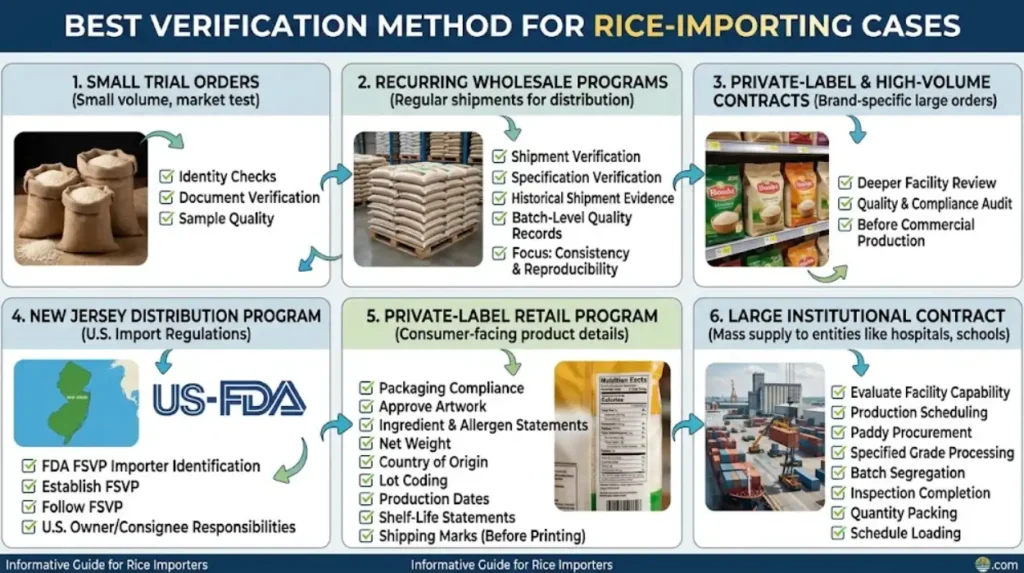
Small trial orders need identity and document checks; recurring wholesale programs need shipment and specification verification; private-label and high-volume contracts require deeper facility, quality, and compliance review before commercial production begins.
For a first container, the buyer should verify exporter identity, PSW capability, REAP standing, product specification, sample approval, packaging details, and required export documents.
For a recurring wholesale program, the importer should add historical shipment evidence and batch-level quality records. The objective is consistency. A supplier must reproduce the agreed product rather than deliver one acceptable sample.
For a New Jersey distribution program, the verification process should include U.S. importer responsibilities. FDA identifies the FSVP importer as the U.S. owner or consignee in the relevant circumstances, and the importer must establish and follow the applicable FSVP.
For a private-label retail program, packaging compliance becomes equally important. The importer should approve artwork, ingredient and allergen statements where applicable, net weight, country-of-origin information, lot coding, production dates, shelf-life statements, and shipping marks before printing.
For a large institutional contract, facility capability and production scheduling become decisive. The buyer should evaluate whether the exporter can procure the required paddy, process the specified grade, segregate batches, complete inspection, pack the required quantity, and load containers according to schedule.
What decision factors should importers use before selecting an export-licensed rice supplier?
Importers should rank legal status, destination compliance, product consistency, documentation, capacity, shipment history, and total landed cost before choosing a supplier. Price should remain a commercial factor, but it should not outweigh evidence that the exporter can repeatedly meet the contract.
| Decision factor | What to verify | Why it matters |
| Legal registration | Business, NTN, PSW and trader credentials | Establishes exporter identity |
| Rice-sector standing | REAP membership and export history | Confirms industry participation |
| Product specification | Variety, grain length, broken %, moisture and purity | Prevents quality disputes |
| Destination compliance | FDA/FSVP or GCC requirements | Reduces entry and compliance risk |
| Documentation | Invoice, packing list, origin and applicable certificates | Supports customs clearance |
| Production capacity | Milling, sorting, packing and storage capability | Protects recurring supply |
| Commercial economics | FOB/CNF price, freight, insurance and local costs | Determines actual landed cost |
The most important distinction is between permission to export and ability to execute an export contract. A license or registration addresses legal eligibility. Reliable trade requires the additional controls that connect the legal exporter to the correct rice, correct documents, correct shipment, and correct destination requirements.
For New Jersey importers, that distinction is particularly important because Pakistan-side export credentials and U.S.-side food-import compliance operate together. FDA requires covered FSVP importers to verify foreign suppliers through risk-based procedures, maintain records, and take corrective action when required.
For AHK Rice, a useful evaluation framework is therefore not simply “Does the exporter have a license?” It is “Can the exporter demonstrate a complete, traceable export process from product specification and processing through regulatory documentation, customs filing, packing, loading, and destination-market compliance?”
That approach gives importers a practical way to compare Pakistani Basmati suppliers in 2026. It also separates low-price offers from suppliers that can support repeatable international trade programs. Explore:
Import Licensed Pakistani Basmati Rice into New Jersey with AHK Rice
Frequently Asked Questions
How does an export license support reliable international rice trade?
An export license or related trade authorization establishes that a rice exporter is legally registered and able to conduct international trade. It supports buyer due diligence but should be reviewed alongside PSW, Customs, tax, and product documentation.
What is Pakistan Single Window (PSW)?
Pakistan Single Window (PSW) is Pakistan’s digital trade platform that connects traders with Customs and participating government agencies. Exporters use it for electronic declarations, regulatory processes, and related trade documentation.
Is REAP membership important for Pakistani rice exporters?
Yes. The Rice Exporters Association of Pakistan (REAP) represents Pakistan’s rice-exporting industry, and its membership and renewal requirements provide an additional credential for buyers evaluating rice exporters.
What documents should a New Jersey rice importer request?
A New Jersey importer should review the exporter’s business credentials, commercial invoice, packing list, certificate of origin, applicable phytosanitary or health certificates, product specifications, inspection reports, and shipment documentation.
Does an export license guarantee rice quality?
No. Export authorization establishes trading eligibility, not product quality. Buyers should separately verify variety, grain length, moisture, broken percentage, purity, packaging, laboratory results, and approved samples.
What Pakistani Basmati grades can international buyers source?
Common commercial grades include 1121 Basmati, Super Kernel Basmati, and 1509 Basmati. Each can be supplied in different processing formats, including White, Steam, Sella, or Creamy Sella depending on the product specification.
How do U.S. import requirements differ from Pakistan export requirements?
Pakistan-side credentials establish the exporter’s ability to conduct the export transaction, while U.S. requirements govern food entry and importer responsibilities. Covered U.S. food importers must also comply with applicable FDA requirements, including the Foreign Supplier Verification Program (FSVP).
What should buyers check besides an export license?
Buyers should evaluate legal registration, PSW capability, REAP standing, export history, production capacity, product specifications, quality testing, documentation, packaging controls, and destination-market compliance.
Why should New Jersey importers verify export credentials before placing an order?
Credential verification reduces the risk of dealing with an improperly documented supplier. It also helps the importer establish whether the exporter can provide consistent product specifications and the documents needed for customs and food-import procedures.
Does a verified exporter guarantee on-time shipment?
No. Export credentials do not guarantee shipment performance. Importers should also evaluate production capacity, inventory planning, container availability, previous shipment records, processing timelines, and document preparation procedures.