Why Should Alabama Importers Calculate Rice Lead Times Accurately?
Alabama rice importers should calculate lead time accurately because imported Basmati rice passes through production, processing, packaging, documentation, port handling, ocean transportation, U.S. entry, and inland delivery before reaching a warehouse. Each stage consumes time and affects inventory availability.
For an Alabama importer, rice lead time is the total elapsed time between placing a purchase order and receiving the shipment at the planned destination. It is not the same as ocean transit time. A realistic calculation includes supplier production scheduling, milling, quality inspection, export documentation, container loading, vessel movement, customs procedures, and domestic transportation.
This distinction matters because Pakistani rice supply depends on agricultural production, processing capacity, export scheduling, and international logistics. USDA’s July 2026 Pakistan update forecasts 2026/27 rice production at 9.1 million metric tons and rice exports at 4.9 million metric tons. The same report identifies logistics challenges affecting Pakistan’s rice exports.
Alabama buyers therefore need a lead-time model that follows the physical movement of rice rather than relying on a single shipping estimate.
What Is Rice Lead Time for an Alabama Importer?
Rice lead time is the complete period required to move a specified rice order from purchase confirmation through production, processing, export clearance, international transportation, U.S. entry, inland delivery, and warehouse receipt in Alabama.
A purchase order starts the commercial process. The supplier then confirms the rice variety, grade, quantity, packaging, specifications, and production schedule.
For Pakistani Basmati rice, the product can include 1121 Basmati, Super Kernel, and 1509 Basmati. Each variety follows the same broad export chain, but production availability, processing requirements, packaging, and order volume affect the time required.
A useful calculation is:
Total lead time = production time + processing time + inspection time + documentation time + port time + ocean transit + U.S. clearance + inland delivery
For example, an importer purchasing 20 metric tons of 1121 Steam Basmati cannot calculate lead time from vessel sailing to Alabama alone. The supplier must first allocate the rice, process it, pack it, inspect it, prepare export documents, load the container, and deliver it to the port.
The Alabama destination also matters. A shipment entering through a U.S. Gulf port still requires domestic transportation to the importer’s warehouse. Therefore, the final warehouse receipt date is the useful planning date.
How Does Pakistani Basmati Rice Move From Farm to Alabama?
Pakistani Basmati rice moves through cultivation, harvesting, drying, milling, sorting, grading, inspection, packaging, container loading, export clearance, ocean transportation, U.S. import procedures, and inland delivery before reaching an Alabama warehouse.
Basmati rice is cultivated mainly in Punjab, Pakistan, where the agricultural environment supports long-grain aromatic rice production. Varieties such as 1121, Super Kernel, and 1509 enter the commercial supply chain after harvesting and preparation.
The process begins with paddy procurement. Paddy is the harvested rice grain with its outer husk intact. Suppliers source paddy according to variety, moisture condition, maturity, and quality requirements.
The paddy is then dried to reach suitable milling conditions. Excess moisture increases storage and processing risks, while excessive drying can affect milling yield.
Milling removes the husk and separates edible rice from other material. Modern processing also uses cleaning and sorting systems to remove stones, foreign material, immature grains, and other unwanted particles.
Rice then passes through grading and sorting. Optical sorting separates grains according to visible characteristics. Mechanical grading separates rice according to dimensions and quality specifications.
The selected rice is inspected against the buyer’s specification. Typical parameters include grain length, moisture, broken percentage, foreign matter, damaged grains, and purity.
The finished rice is packed according to the agreed commercial format. Packaging can include retail bags, institutional packs, or bulk formats.
The packed shipment is then prepared for export documentation and container loading. The container moves through the export port process before international transportation begins.
After arrival in the United States, the shipment passes through import procedures before inland transportation to Alabama.
What Are the Main Components of Rice Lead Time?
The main lead-time components are order confirmation, production allocation, processing, quality inspection, packaging, documentation, container loading, port handling, ocean transit, U.S. clearance, and inland transportation to the Alabama receiving location.
Production allocation determines when the supplier can assign the required rice to the order. This depends on available stock, paddy availability, processing capacity, and the buyer’s specification.
Processing includes cleaning, milling, sorting, grading, and other required operations. A custom specification takes more planning than an immediately available standard specification.
Quality inspection follows processing. The supplier checks whether the shipment meets the agreed specification. Examples include grain length, moisture percentage, broken grains, purity, and packaging condition.
Documentation is another component. Export shipments require commercial and shipping documents that support customs and logistics processes. Missing or incorrect information can interrupt the planned movement of cargo.
Container loading connects factory operations with port logistics. The shipment must be packed, loaded, sealed, and moved according to the export schedule.
Ocean transit represents only one portion of total lead time. Vessel schedules, transshipment arrangements, port congestion, and routing influence the actual duration.
U.S. entry adds another planning component. Imported food must comply with U.S. requirements. FDA states that imported food must meet the same legal requirements as domestically produced food, and facilities handling imported food must satisfy applicable registration requirements. Prior Notice is also required for applicable food shipments.
Finally, inland transportation moves the released container from the U.S. entry point to the Alabama warehouse.
Why Does Accurate Lead-Time Calculation Improve Rice Inventory Planning?
Accurate lead-time calculation lets Alabama importers set reorder points, safety stock, purchase dates, warehouse capacity, and customer commitments around the actual time required to replenish imported rice rather than an incomplete ocean-transit estimate.
Inventory planning depends on knowing when the next shipment will become available.
Suppose an Alabama distributor sells 50 metric tons of Basmati rice each month. A supplier schedule that appears to require 30 days becomes a serious planning issue when the actual end-to-end replenishment period is 45 days.
The importer needs enough stock to cover consumption during the complete replenishment cycle.
A basic reorder-point model is:
Reorder point = average daily demand × lead time + safety stock
If daily demand is 1.7 metric tons and calculated lead time is 40 days, demand during lead time equals approximately 68 metric tons.
The calculation changes if the lead time is 50 days. Demand during that period becomes approximately 85 metric tons.
That 17-metric-ton difference represents inventory that must be available before the next shipment arrives.
Accurate lead time therefore connects purchasing with warehouse capacity. It also helps distributors plan promotional activity, restaurant contracts, retail replenishment, and seasonal demand without assuming that imported rice can be replaced immediately.
Which Factors Change Pakistani Rice Lead Times in 2026?
Pakistani rice lead times in 2026 depend on production availability, order specifications, processing capacity, packaging requirements, inspection, documentation, vessel schedules, port conditions, international logistics, U.S. entry procedures, and inland transportation to Alabama.
Production conditions are an important starting point. USDA’s July 2026 Pakistan report reduced the country’s 2026/27 rice production forecast to 9.1 million metric tons because of lower planted area. It forecasts 4.9 million metric tons of rice exports for 2026/27.
Export logistics also affect planning. USDA specifically reported logistical challenges affecting Pakistan’s rice exports in July 2026.
Order specifications create another variable. A standard specification available in finished inventory follows a different schedule from a custom order requiring specific grain dimensions, moisture limits, broken percentages, packaging, or private labeling.
Packaging also affects production scheduling. A buyer requiring 5 kg retail bags has different preparation requirements from a buyer purchasing bulk commercial packs.
Inspection and documentation add administrative stages. U.S. food imports must meet applicable FDA requirements, and prior notice must be submitted before covered food shipments arrive. For waterborne shipments, FDA guidance specifies that prior notice must be received and confirmed no less than 8 hours before arrival at the U.S. port.
Transportation conditions then determine how quickly the shipment moves from the export port through the U.S. logistics network to Alabama.
Which Rice Products and Grades Affect Lead-Time Planning?
Rice variety, grade, processing method, packaging, and specification determine how the order enters the production schedule. Alabama importers commonly evaluate 1121 Basmati, Super Kernel, and 1509 Basmati according to grain length, processing style, broken percentage, moisture, purity, and intended use.
1121 Basmati is known for exceptionally long grains and is commonly supplied in white and parboiled or steam-processed forms.
Super Kernel Basmati is another long-grain Basmati category used across foodservice, wholesale, and retail applications.
1509 Basmati provides another long-grain option and is available in processing formats such as Steam and Creamy Sella.
Processing terminology affects the finished product. White rice is milled rice without the parboiling process used for Sella products. Steam and Sella processing changes the grain’s physical and cooking characteristics.
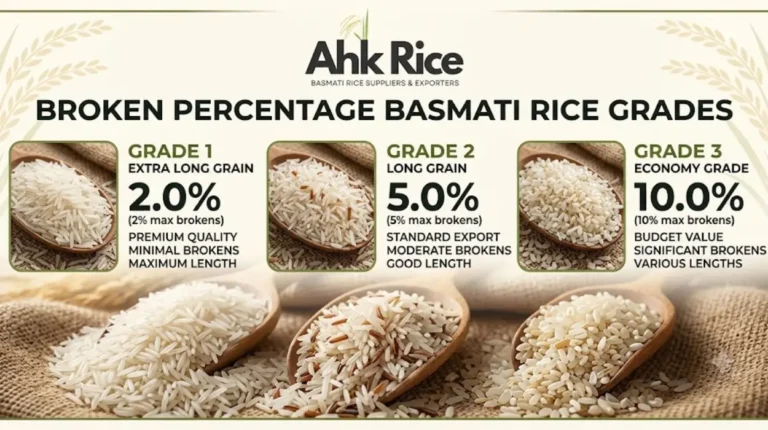
Grades can also be separated by commercial specifications. Examples include premium grades, standard commercial grades, and specifications with defined broken-grain limits.
For an importer, the important point is that a product name alone does not establish lead time. The complete purchase specification determines the production requirement.
Which Certifications and Compliance Documents Matter for U.S. Rice Imports?
U.S. rice imports require compliance with applicable food laws and import procedures, while certifications such as HACCP, ISO 22000, BRCGS, Halal, or laboratory reports serve specific buyer, market, or supply-chain requirements rather than replacing legal import compliance.
FDA compliance is central to imported food. FDA states that imported foods must be safe, sanitary, and truthfully labeled, and that applicable foreign facilities must be registered.
Foreign Supplier Verification Program requirements also form part of the U.S. food-import framework for covered foods. The U.S. importer has responsibilities for verifying that foreign suppliers produce food in a manner consistent with applicable U.S. food-safety requirements.
Certifications are separate from basic import compliance. HACCP is a preventive food-safety system. ISO 22000 is a food-safety management standard. BRCGS is a recognized food-safety and quality standard used by many commercial buyers. Halal certification addresses Islamic dietary requirements.
Laboratory analysis can document product attributes such as moisture, microbiological results, pesticide residues, or other parameters specified by the buyer.
These documents affect lead time when they must be obtained before shipment. A buyer that requires a certificate of analysis for every lot needs to include testing and document preparation in its purchasing schedule.
Where Do Alabama Importers Use Rice Lead-Time Calculations?
Alabama importers use rice lead-time calculations for wholesale distribution, restaurant supply, retail replenishment, foodservice contracts, private-label programs, seasonal purchasing, safety-stock planning, and recurring container orders that depend on predictable inventory arrival.
Wholesale distributors use lead times to schedule replenishment before existing stock reaches its reorder point.
Restaurants use them when imported Basmati rice supports recurring menu demand. A distributor supplying multiple restaurants needs sufficient inventory to cover consumption during the next shipment cycle.
Retailers use lead-time calculations when planning shelf availability. Private-label programs require additional coordination because packaging, artwork, labeling, production, inspection, and shipment preparation must align.
Foodservice buyers also need lead-time information when a contract specifies recurring quantities. For example, a buyer ordering one 20-metric-ton container every month needs a production and shipping schedule that supports continuous replenishment.
Seasonal purchasing creates another use case. Importers can increase safety stock before periods when demand rises or logistics become less predictable.
What Are the Common Mistakes When Calculating Rice Lead Times?
The most common mistakes are treating ocean transit as total lead time, ignoring production scheduling, excluding documentation, using one fixed transit figure, overlooking U.S. entry procedures, and failing to connect lead time with actual warehouse demand.
The first mistake is starting the clock when the vessel sails. Production and export preparation already consumed time before sailing.
The second mistake is using one generic number for every rice product. A ready-stock shipment and a custom-packaged order have different operational requirements.
The third mistake is excluding inspection and documentation. Compliance records, laboratory reports, certificates, and shipping documents require coordination.
The fourth mistake is assuming the arrival date equals warehouse availability. Cargo still needs U.S. entry processing and inland movement after reaching the country.
The fifth mistake is ignoring demand. A 10-day difference in lead time has a different inventory impact for a buyer consuming 5 metric tons per month than for a buyer consuming 100 metric tons per month.
The correct approach is to calculate each stage separately and then combine the stages into one end-to-end lead-time model.
How Should Alabama Importers Build an Accurate Rice Lead-Time Model?
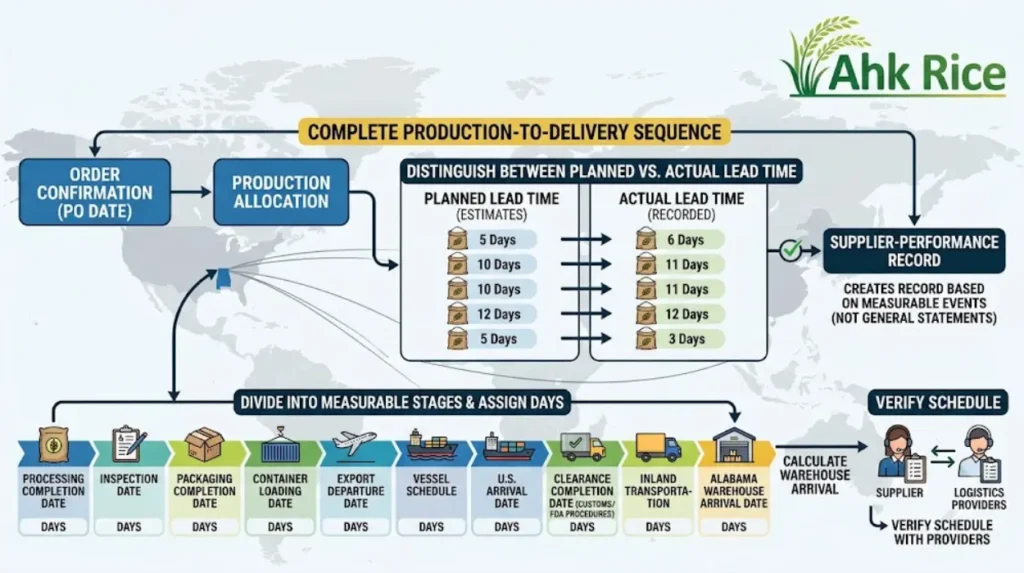
Alabama importers should divide the order into measurable stages, assign days to each stage, verify the schedule with the supplier and logistics providers, then calculate warehouse arrival using the complete production-to-delivery sequence.
A practical model begins with the purchase-order date.
The importer records the expected production start date, processing completion date, inspection date, packaging completion date, container loading date, export departure date, vessel schedule, U.S. arrival date, clearance completion date, and Alabama delivery date.
Each date should have an operational basis.
For example:
Order confirmation → production allocation → processing → inspection → packaging → container loading → export departure → ocean transit → U.S. arrival → customs/FDA procedures → inland transportation → Alabama warehouse
The model should also distinguish between planned lead time and actual lead time. After every shipment, the importer can compare the planned number of days with the actual number.
That creates a supplier-performance record based on measurable events rather than general statements such as “fast shipping.”
The next stage of this subject is understanding exactly:
How production time connects with shipping time, because the two periods determine the total replenishment cycle. This distinction is especially important when an importer compares suppliers using delivery commitments rather than vessel schedules alone.
Frequently Asked Questions
Why should Alabama rice importers calculate lead times accurately?
Accurate lead-time calculations help Alabama importers plan inventory, reorder points, safety stock, warehouse capacity, customer commitments, and delivery schedules based on the complete import cycle.
What is rice lead time?
Rice lead time is the total time from purchase-order confirmation until the shipment reaches the importer’s Alabama warehouse. It includes production, processing, documentation, shipping, U.S. entry, and inland delivery.
What factors determine Pakistani rice lead time?
Key factors include rice availability, production scheduling, milling, grading, packaging, inspection, documentation, container loading, port handling, ocean transit, U.S. import procedures, and inland transportation.
Is ocean transit the same as total rice lead time?
No. Ocean transit represents only one stage of the import cycle. Production, processing, export preparation, port handling, U.S. clearance, and transportation to Alabama also consume time.
Which Pakistani Basmati rice varieties can Alabama importers source?
Common Pakistani Basmati varieties include 1121 Basmati, Super Kernel Basmati, and 1509 Basmati. Each can have different processing, grading, packaging, and specification requirements.
How does rice production affect import lead time?
Production affects lead time because the supplier must allocate suitable paddy or finished rice, process the required quantity, complete grading and sorting, conduct inspections, and prepare the order for shipment.
How does packaging affect rice lead time?
Packaging requirements influence production scheduling. Standard bulk packaging generally requires different preparation from retail bags, private-label packaging, or customized commercial packs.
What U.S. compliance requirements affect rice import timing?
Applicable FDA requirements, facility registration, food-safety controls, labeling, Prior Notice, and importer responsibilities can affect the import process. Required documentation should be prepared before shipment arrival.
How can Alabama importers calculate rice lead time?
Importers should add production, processing, inspection, packaging, documentation, container loading, port handling, ocean transit, U.S. entry, and inland delivery days to calculate the complete warehouse-to-warehouse replenishment period.
How does lead time affect rice inventory planning?
Lead time determines how much inventory an importer needs while waiting for the next shipment. Longer lead times increase demand coverage requirements and can require higher reorder points or safety stock.