How Do Indonesian Restaurants Evaluate Pakistan Super Kernel Steam Rice Quality?
Indonesian restaurants evaluate Pakistan Super Kernel Steam Rice by combining grain specifications, cooking performance, purity, moisture, breakage, aroma, consistency, documentation, and landed cost rather than choosing a supplier based on price alone. For buyers assessing:
Pakistan Super Kernel Steam Rice export supply for Indonesia, the first product decision is whether the specification remains stable from sample to commercial shipment. Super Kernel is a traditional Pakistani Basmati variety associated with Punjab and typically measures around 7.0–7.2 mm in export specifications. Steam processing changes the grain structure, producing firmer, more separate cooked grains suitable for restaurant dishes that require visual consistency and controlled texture.
Before comparing suppliers, restaurant buyers should understand the product category and its cooking behavior. The educational article:
Why Pakistan Super Kernel Steam Rice could fit Indonesian restaurant demand, should be placed in the second paragraph because it explains the product before the reader reaches supplier evaluation. The evaluation then moves from variety identity to physical quality, processing, cooking performance, food safety, price, shelf life, and supply reliability.
What are the available solutions for evaluating Super Kernel Steam Rice?
Indonesian restaurants have three practical evaluation solutions: specification-sheet screening, physical sample and cooking trials, and independent pre-shipment verification. The strongest procurement method combines all three because documents confirm measurable limits while cooking tests confirm actual restaurant performance.
The first solution is document-based specification screening. A restaurant or importer requests the supplier’s product specification, Certificate of Analysis, crop information, processing description, packing details, and available inspection documentation. This quickly eliminates rice that does not meet the restaurant’s basic requirements.
The second solution is sample-based cooking evaluation. This is more important for restaurants because laboratory specifications cannot fully describe cooked texture. A sample should be washed, soaked if required by the restaurant’s normal procedure, cooked using the restaurant’s standard equipment, rested, and evaluated immediately and after holding.
The third solution is third-party pre-shipment inspection. An independent inspection company checks the commercial lot against agreed specifications before loading. The inspection can cover moisture, broken grains, foreign matter, grain appearance, packaging, weight, and other contractual parameters.
For Super Kernel Steam Rice, the combination matters because supplier specifications vary. Current Pakistani export listings commonly place Super Kernel around 7.0–7.2 mm, with moisture limits around 12–13.5% and broken-grain limits around 1–3%, depending on the contracted grade.
A restaurant should therefore avoid treating “Super Kernel” as a complete quality specification. The variety name identifies the rice, but the commercial grade determines the actual tolerance for moisture, breakage, chalkiness, purity, polishing, and other attributes.
How do Indonesian restaurants compare Super Kernel Steam Rice quality?
Restaurants compare Super Kernel Steam Rice through seven measurable attributes: grain length, broken percentage, moisture, purity, chalkiness, processing finish, and cooking performance. These attributes connect the physical specification with yield, appearance, texture, food cost, and customer experience.
| Quality attribute | What the buyer checks | Restaurant importance | Typical evaluation target |
|---|---|---|---|
| Grain length | Average raw kernel length | Controls plate appearance | About 7.0–7.2 mm |
| Broken grains | Percentage of broken kernels | Influences presentation and yield | ≤2–3% |
| Moisture | Moisture percentage at shipment | Influences storage and cooking consistency | ≤12–13% |
| Purity | Variety consistency and foreign material | Protects product identity and food quality | Contract-specific |
| Chalky grains | White/chalky kernel percentage | Affects visual uniformity | ≤3% commonly specified |
| Processing | Steam treatment, polishing, sorting | Controls firmness and appearance | Double/silky polished where specified |
| Cooking performance | Expansion, separation, aroma, texture | Determines restaurant suitability | Separate, aromatic, stable after cooking |
The table should be read as a procurement framework rather than a universal international standard. Pakistani suppliers publish different specifications for Super Kernel. For example, one current export specification lists 7.20 mm average grain length, maximum 13.5% moisture, and maximum 2% broken grains, while another Pakistani mill lists 7.0–7.2 mm, maximum 13% moisture, and maximum 2% broken grains. AHK Rice’s Indonesia-specific Super Kernel Steam specification lists 7.0–7.2 mm, moisture at or below 12%, broken grains at or below 3%, and chalky grains at or below 3%.
This variation explains why Indonesian restaurants should compare written specifications instead of relying on product names.
Grain length matters because restaurants use rice visually. A biryani, pulao, or plated rice dish requires kernels that remain recognizable after cooking. Broken grains can produce a less uniform appearance and can increase the proportion of small pieces in the cooked batch.
Moisture matters for both storage and cooking. A controlled moisture specification reduces variation between shipments and gives the buyer a measurable acceptance criterion. Restaurants should compare moisture at the same point in the supply chain because moisture can change during storage and transportation.
Processing also matters. Steam treatment stabilizes the grain structure and produces a firmer cooked texture. AHK Rice describes its Super Kernel Steam Rice as steam-processed with a white appearance, double/silky polishing, and a specification of up to 12% moisture and 3% broken grains.
Cooking performance is the final validation. A rice sample can meet every physical specification and still perform differently under a restaurant’s water ratio, cooking equipment, holding time, and recipe.
Which cooking method works best for Indonesian restaurants?
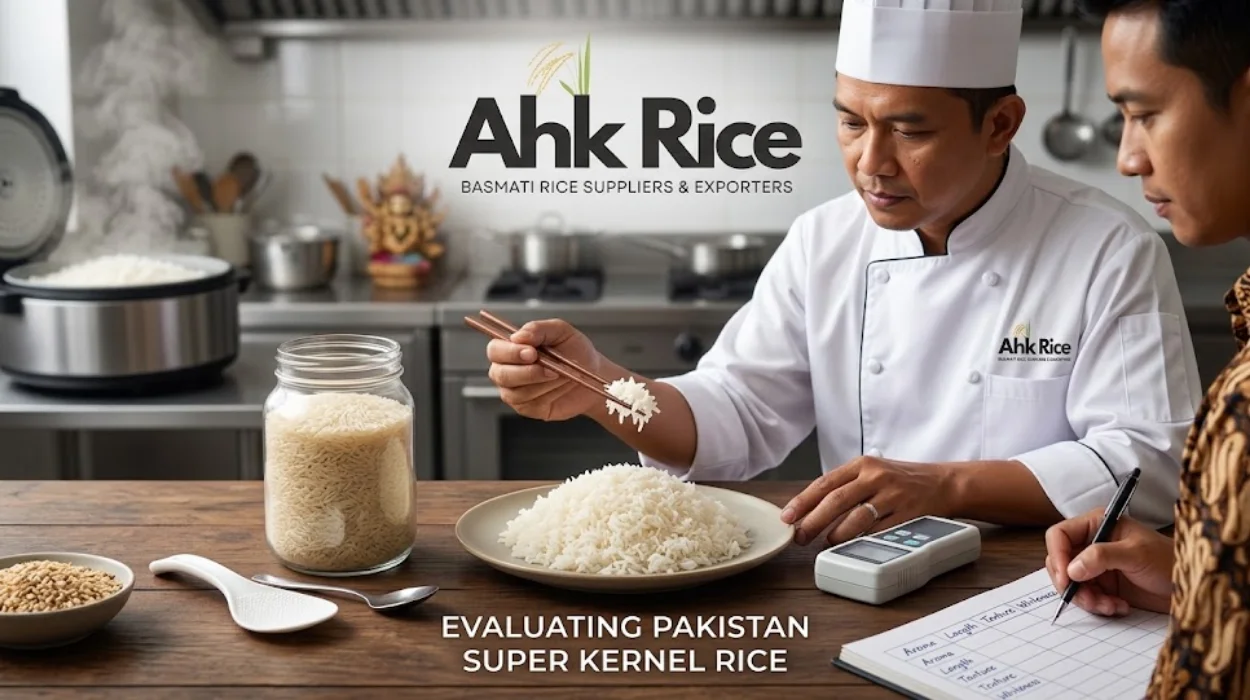
The best evaluation method is a controlled restaurant cooking trial using the same water ratio, cooking equipment, batch size, holding period, and serving method used in normal operations. This reveals texture, aroma, separation, expansion, yield, and holding stability.
A controlled cooking test should begin with a fixed sample weight, such as 1 kg. The restaurant should record the amount of water, soaking duration, cooking temperature, cooking time, resting period, and final cooked weight.
The first observation is grain separation. Steam rice should maintain distinct kernels rather than becoming excessively sticky. The second is texture. Restaurants should determine whether the grain remains firm enough for their dish without becoming hard.
The third is aroma. Super Kernel is valued for traditional Basmati aroma, so the cooked sample should be evaluated before spices, sauces, or strong ingredients dominate the sensory profile. Pakistani suppliers describe Super Kernel as an aromatic Punjab-grown Basmati variety with a distinct fragrance.
The fourth factor is cooked yield. If 1 kg of raw rice produces a higher usable cooked quantity without excessive breakage, the restaurant can calculate a more accurate food cost.
The fifth factor is holding performance. Restaurants should hold the cooked rice under their normal service conditions and inspect it after 30, 60, and 120 minutes. This is particularly useful for buffet operations and high-volume service.
A sample approval should therefore record both laboratory-style specifications and actual kitchen results. The final commercial specification should reflect the approved sample rather than a generic product description.
How do different approaches compare for Indonesian restaurant procurement?
Specification-only purchasing is fastest but least representative of kitchen performance. Sample testing gives stronger evidence but tests only a small quantity. Third-party inspection provides commercial-lot verification. A combined specification, sample, and inspection model offers the strongest control.
| Evaluation approach | Main strength | Main weakness | Best use |
| Specification sheet | Fast supplier screening | Does not prove cooking performance | Initial shortlist |
| Sample cooking test | Shows real restaurant behavior | Sample may not represent every shipment | Supplier approval |
| Laboratory analysis | Measures objective attributes | Does not fully predict kitchen results | Quality verification |
| Third-party inspection | Checks commercial shipment | Adds cost and coordination | Pre-shipment control |
| Combined system | Controls both product and shipment | Requires more planning | Recurring imports |
For a first purchase, the sample cooking test has the highest practical value because restaurants sell cooked rice rather than raw kernels. For recurring imports, third-party inspection becomes more valuable because the buyer must confirm that subsequent shipments remain aligned with the approved specification.
The most effective system is therefore sequential. Screen the supplier first. Approve a physical sample second. Define the commercial specification third. Inspect the shipment fourth. Compare the delivered lot with the approved sample after arrival.
Which method works best for Jakarta and Greater Jakarta restaurants?
Jakarta and Greater Jakarta buyers benefit from a specification-led purchasing model that prioritizes consistent grain appearance, aroma, cooking separation, and dependable bulk supply. Super Kernel Steam is suitable when restaurants need premium Basmati character without requiring the extra-long profile of 1121.
Jakarta restaurants serving biryani, pulao, rice platters, and South Asian cuisine can evaluate Super Kernel Steam against their menu economics. The 7.0–7.2 mm raw grain profile provides a recognizable long-grain appearance while maintaining the traditional aromatic identity associated with Pakistani Basmati.
For this market segment, buyers should prioritize low breakage, consistent moisture, aroma retention, and cooked separation. Restaurants with centralized kitchens should also test whether the same cooking formula performs consistently across multiple production batches.
The price comparison should begin with FOB rather than an assumed Indonesian landed price. Current August 2026 indicative Pakistani FOB listings place Super Kernel Basmati around US$1,165–US$1,205 per metric ton. This is an export benchmark, not a final Jakarta purchase price. Freight, insurance, duties, port charges, inspection, customs, inland delivery, and commercial terms must be added before calculating landed cost.
Which method works best for Surabaya and East Java restaurants?
Surabaya and East Java buyers should use the same core specification controls but place greater emphasis on shipment planning, storage conditions, batch consistency, and landed cost because recurring restaurant supply depends on maintaining quality from Pakistan through Indonesian distribution.
For a Surabaya restaurant group, the evaluation should extend beyond the sample. The buyer should examine packaging strength, container loading, documentation, shipment timing, and storage suitability.
The product should arrive with a specification that can be checked against the purchase contract. Moisture, broken percentage, grain length, purity, and appearance should have agreed limits.
The commercial price should again be compared using the same FOB benchmark. At the August 2026 indicative level of US$1,165–US$1,205/MT, a US$40/MT spread exists between the low and high ends before logistics and destination costs.
This means a restaurant should not select a supplier simply because the quoted FOB figure is lower. A cheaper rice that produces lower cooked yield, higher breakage, or inconsistent batches can create a higher cost per serving.
What are the pros and cons of Super Kernel Steam Rice for restaurants?
Super Kernel Steam Rice offers aromatic Basmati character, firm cooked structure, separated grains, and a specification-controlled purchasing model. Its main limitations are higher procurement cost than economy rice and the need for sample testing because restaurant cooking results vary by recipe and equipment.
The main advantage is cooked grain separation. Steam processing supports a firmer structure, which is valuable for restaurant kitchens handling large batches.
The second advantage is aroma. Super Kernel is associated with traditional Basmati fragrance, giving restaurants a differentiated rice profile compared with standard non-aromatic long-grain rice.
The third advantage is commercial specification control. Buyers can define measurable limits for moisture, broken grains, chalkiness, grain length, and packaging.
The main disadvantage is price positioning. Super Kernel Basmati sits above many non-Basmati rice categories. The August 2026 indicative FOB range of US$1,165–US$1,205/MT demonstrates that the restaurant must evaluate the premium through cooked yield and menu positioning rather than raw purchase price alone.
Another limitation is regulatory and import complexity. Indonesia’s rice import framework includes technical verification and documentation requirements. Indonesian government information states that rice imports can require technical verification or tracing at the port of loading, while import documentation includes product specifications and shipment details.
Indonesia also distinguishes special rice categories from general consumption rice. Government information has identified Basmati as a special-rice category, which makes the regulatory classification relevant when restaurants source imported Basmati through an authorized importer.
How should restaurants compare shelf life between rice grades?
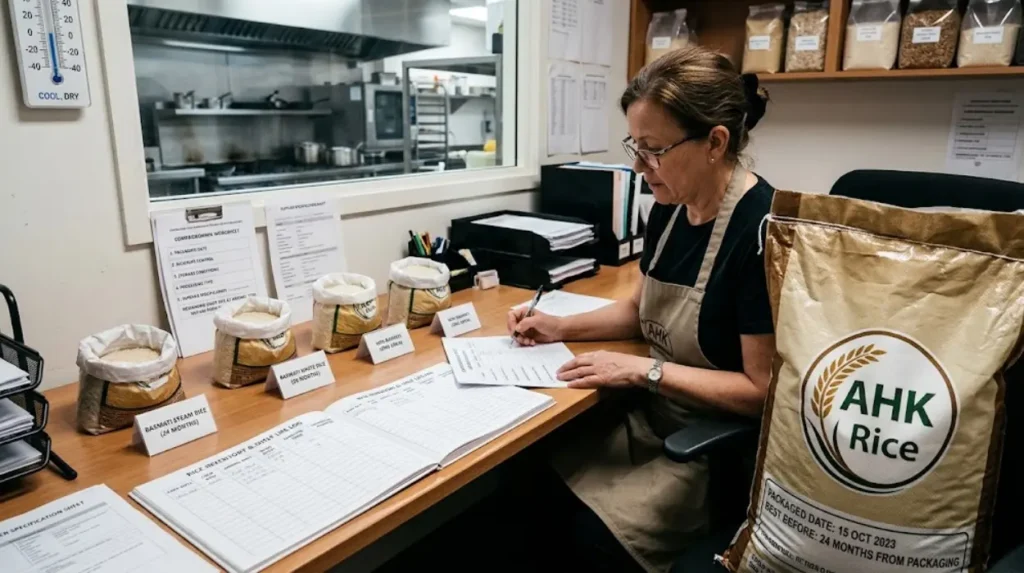
Shelf life should be compared through packaging date, moisture control, storage conditions, processing type, and supplier specification rather than treating one universal shelf-life figure as applicable to every shipment. Properly packed dry rice can remain commercially usable for extended periods when stored under controlled conditions.
For procurement, restaurants should request the supplier’s stated shelf life and storage conditions on the technical specification or packaging documentation.
A useful commercial benchmark is up to 24 months from packaging for properly packed dry rice when the product is stored in a cool, dry environment away from direct sunlight. Published Pakistani rice specifications commonly state 24 months for packaged Basmati products.
The comparison should therefore focus on remaining shelf life at arrival. A shipment with 24 months declared shelf life but significant time spent in transit and distribution provides less usable inventory life than freshly packed rice.
Steam and white rice should also be evaluated under the same packaging conditions. Restaurants should track packing date, crop year, arrival date, warehouse entry date, and expected consumption date.
What decision factors should Indonesian restaurants use before approving a supplier?
Indonesian restaurants should approve Super Kernel Steam Rice only after confirming product identity, measurable specifications, cooking performance, price, shelf life, regulatory documentation, shipment controls, and supplier consistency. The decision should use the same criteria for every shortlisted supplier.
| Decision factor | Question to answer | Approval signal |
| Product specification | Does the rice meet the required grain, moisture, and breakage limits? | Written specification matches purchase requirement |
| Cooking performance | Does the approved sample perform in the restaurant kitchen? | Separate grains, acceptable aroma and texture |
| Commercial cost | Does the rice deliver acceptable cost per cooked serving? | Landed cost supports menu margin |
| Documentation | Can the importer complete Indonesian requirements? | Complete and consistent documents |
| Supply consistency | Can future shipments match the approved sample? | Batch controls and pre-shipment verification |
This framework prevents price from becoming the dominant decision factor. It also creates a repeatable supplier scorecard for restaurant groups with multiple locations.
For Indonesian buyers, the regulatory side should be incorporated before commercial commitment. Indonesia and Pakistan maintain a Preferential Trade Agreement framework with tariff schedules covering imports from Pakistan, but the applicable treatment depends on the specific tariff classification and current rules.
On the Pakistan side, rice exporters also operate within an updated 2026 export framework. Pakistan’s Ministry of Commerce lists 2026 measures covering rice export valuation and the Drawback of Local Taxes and Levies for Rice Order 2026.
The buyer should therefore compare the supplier’s commercial offer with the required export and import documentation before approving the shipment.
What is the final evaluation framework for Indonesian restaurants?
The strongest evaluation framework starts with specifications, validates those specifications through restaurant cooking trials, confirms the commercial shipment through inspection, and calculates landed cost against cooked yield. This connects rice quality directly with restaurant operations, customer experience, and procurement economics.
A restaurant should first define the required Super Kernel Steam specification. The specification should include grain length, moisture, broken grains, chalky grains, purity, polishing, packaging, and crop information.
The second step is sample approval. The sample should be cooked using the restaurant’s actual process rather than a generic laboratory recipe.
The third step is commercial pricing. The buyer should compare FOB, freight, destination charges, duties, inspection costs, inland logistics, and other landed-cost components.
The fourth step is shipment verification. The commercial lot should be checked against the approved specification before shipment.
The fifth step is post-arrival evaluation. The restaurant should compare the delivered rice with the approved sample and record cooking yield, breakage, texture, aroma, and holding performance.
This approach gives Indonesian restaurants a stronger basis for comparing Pakistan Super Kernel Steam Rice suppliers in 2026. The objective is not simply to identify rice that looks good in a specification sheet. The objective is to identify a specification that performs consistently in the restaurant, remains commercially viable after import costs, and can be reproduced across future shipments.
For readers moving from evaluation into supplier selection, the decision-focused article:
AHK Rice Pakistan Super Kernel Steam Rice Supply for Indonesian Restaurants should be linked immediately after this final evaluation section or in the final paragraph, because that is where informational intent transitions into commercial procurement intent.
Frequently Asked Questions
How do Indonesian restaurants evaluate Pakistan Super Kernel Steam Rice quality?
Indonesian restaurants evaluate Super Kernel Steam Rice through grain length, moisture, broken percentage, purity, chalkiness, processing quality, aroma, texture, grain separation, cooked yield, and holding performance.
What grain length should Indonesian restaurants expect from Super Kernel Steam Rice?
Super Kernel Steam Rice commonly has a raw grain length of approximately 7.0–7.2 mm, depending on the supplier’s contracted specification and grading standard.
Why is moisture important when evaluating Super Kernel Steam Rice?
Moisture affects storage stability, cooking consistency, and product condition during transportation. Restaurants should establish a maximum moisture level in the purchase specification and verify it through quality documentation or inspection.
What broken percentage is acceptable for Super Kernel Steam Rice?
Commercial specifications commonly set broken grains around 2–3%, although the exact tolerance depends on the contracted grade. Restaurants should compare suppliers using the same agreed specification.
How does steam processing affect Super Kernel Rice?
Steam processing changes the grain structure and produces a firmer cooked kernel. This supports better grain separation and makes the rice suitable for restaurant dishes requiring consistent texture and presentation.
How should restaurants test Super Kernel Steam Rice before bulk purchasing?
Restaurants should conduct a controlled cooking trial using their normal equipment, water ratio, soaking process, cooking time, resting period, and holding conditions. The results should be compared with the approved sample specification.
What cooking characteristics should Indonesian restaurants check?
Restaurants should evaluate grain separation, aroma, texture, expansion, cooked yield, appearance, and holding stability. These factors determine whether the rice performs consistently in actual restaurant service.
Is Super Kernel Steam Rice suitable for Indonesian restaurants?
Super Kernel Steam Rice can suit Indonesian restaurants that require aromatic Basmati characteristics, firm cooked grains, and good separation. The final decision should be based on the restaurant’s menu, cooking process, specification requirements, and landed cost.