Why Could Pakistan Super Kernel Steam Rice Fit Indonesian Restaurant Demand?
Pakistan Super Kernel Steam Rice is a long-grain, parboiled-style rice product made from Super Kernel Basmati paddy and processed in Pakistan for consistent grain appearance, cooking performance, and bulk food use. Its suitability for Indonesian restaurants depends on grain specifications, cooking behavior, grade, packaging, and import requirements.
What is Pakistan Super Kernel Steam Rice?
Pakistan Super Kernel Steam Rice is a premium long-grain rice produced from Super Kernel Basmati paddy, steam-processed to improve grain strength, reduce cooking breakage, and deliver separate cooked grains for restaurant dishes and bulk foodservice applications.
Super Kernel is a Basmati rice variety associated with Pakistan’s Punjab rice-growing region. Basmati describes an aromatic rice group known for long grains, fragrance, and post-cooking elongation. Super Kernel is commercially recognized for its long grain, aroma, and cooking quality.
The production base is concentrated in Punjab, especially areas within the Basmati-growing belt. The crop depends on fertile alluvial soils, irrigation, suitable temperatures, and the monsoon-linked growing cycle.
Steam processing changes the physical behavior of the grain. Paddy is cleaned, soaked, heated, steamed, dried, milled, sorted, and graded. The resulting rice has stronger kernels than conventional raw-milled white rice.
The term “steam” also creates an important distinction from ordinary white Super Kernel. Steam processing uses controlled heat and moisture before final milling. It is not simply a description of cooking the rice.
For Indonesian restaurants, this distinction matters because commercial kitchens need rice that performs consistently across repeated cooking batches. Restaurants serving biryani, rice platters, grilled-meat meals, catering portions, and buffet dishes need predictable grain expansion and low breakage.
How is Pakistan Super Kernel Steam Rice produced?
Super Kernel Steam Rice passes through paddy procurement, cleaning, soaking, steaming, drying, milling, optical or mechanical sorting, grading, quality inspection, packaging, and export preparation before reaching an Indonesian commercial kitchen.
1. Paddy procurement
The process begins with Super Kernel Basmati paddy sourced from suitable growing areas in Pakistan. Paddy is evaluated for variety identity, moisture, impurities, grain condition, and milling potential.
The raw material determines much of the final product’s physical performance. Mixed varieties can create differences in grain length, aroma, cooking time, and appearance.
2. Cleaning
Harvested paddy contains materials such as stones, dust, straw, immature grains, and foreign matter. Cleaning equipment removes these materials before processing.
Destoning equipment separates heavier mineral particles. Screens separate materials by size. Aspirators remove lighter particles.
3. Soaking
The cleaned paddy is soaked under controlled conditions. Water enters the grain and prepares the kernel for heat treatment.
Soaking requires control of time and temperature. Excessive moisture creates processing problems. Insufficient hydration prevents uniform heat penetration.
4. Steaming
Hydrated paddy enters the steaming stage. Heat gelatinizes starch inside the grain structure and strengthens the kernel.
This process reduces the tendency of properly processed grains to break during subsequent milling. It also produces the characteristic cooked appearance associated with parboiled or steam-processed rice.
5. Drying
After steaming, the paddy requires controlled drying. Moisture is reduced to a suitable level for milling and storage.
Rapid or uneven drying can create internal stress. Controlled drying helps maintain kernel integrity.
6. Milling
The dried paddy passes through husking and milling equipment. The husk is removed first. Further milling removes bran layers and produces the edible rice kernel.
The milling sequence must protect whole kernels because excessive mechanical stress increases broken rice.
7. Sorting and grading
Milled rice passes through grading equipment. Separators remove broken kernels and other size variations.
Optical sorting can identify contrasting materials and defective grains. Length graders classify kernels according to physical dimensions.
8. Quality inspection
Quality control evaluates parameters such as grain length, moisture, broken percentage, foreign matter, damaged kernels, color, and cooking performance.
A commercial specification should define these parameters numerically. “Premium quality” alone does not establish a measurable purchasing standard.
9. Packaging and export preparation
Finished rice is packed according to the buyer’s required format. Commercial formats include 5 kg, 10 kg, 20 kg, 25 kg, and 50 kg bags, depending on the distribution model.
Bulk restaurant supply normally favors larger foodservice packs because they reduce packaging frequency and handling cost.
What are the key quality components of Super Kernel Steam Rice?
Restaurant-grade Super Kernel Steam Rice quality is determined by measurable characteristics including grain length, broken percentage, moisture, purity, foreign matter, damaged kernels, uniformity, aroma, cooking expansion, packaging integrity, and shipment consistency.
Grain length
Grain length affects plate presentation and perceived quality. Long grains create a different visual result from medium- or short-grain rice.
Super Kernel is selected for its long-grain characteristics. Buyers should verify actual specification values through a laboratory report or approved pre-shipment sample rather than relying only on variety names.
Broken percentage
Broken rice consists of kernels that are shorter because of mechanical or processing damage. A lower broken percentage produces a more uniform finished appearance.
Restaurants serving premium rice dishes generally require a controlled broken percentage because excessive broken grains alter texture and presentation.
Moisture
Moisture influences storage stability, milling behavior, and cooking performance. A commercial specification should state the permitted moisture range.
Moisture should be measured using calibrated equipment. The result should be recorded in the inspection documentation.
Purity
Purity indicates how closely the shipment conforms to the declared rice variety and specification. Examples include varietal purity, foreign-material control, and removal of contrasting grains.
High purity supports consistent cooking because a mixed shipment can contain kernels with different absorption and expansion characteristics.
Cooking performance
Cooking tests reveal characteristics that laboratory measurements alone cannot show. Restaurants can evaluate water absorption, cooking time, grain separation, elongation, aroma, softness, and broken grains after cooking.
A practical test uses the same recipe, water ratio, cooking equipment, soaking time, and resting period used in the restaurant.
Packaging
Packaging protects the product from moisture, contamination, physical damage, and handling losses.
Restaurant buyers should check bag material, stitching or sealing, net weight, product identification, lot information, origin declaration, and storage instructions.
What benefits does Super Kernel Steam Rice offer Indonesian restaurants?
Super Kernel Steam Rice provides Indonesian restaurants with long-grain presentation, strengthened kernels, controlled breakage, aromatic characteristics, repeatable cooking behavior, and foodservice packaging options that support rice dishes served individually, in buffets, and through catering operations.
One benefit is grain separation. Properly steam-processed rice can produce distinct cooked kernels when the water ratio and cooking process are controlled.
Another benefit is structural strength. Heat treatment changes the starch structure and improves kernel resistance during processing and cooking.
A third benefit is visual presentation. Long grains create a different plate appearance from the shorter grains commonly used in many Indonesian rice dishes.
A fourth benefit is batch consistency. A defined product specification allows a restaurant to reproduce cooking results across multiple deliveries.
A fifth benefit is operational control. Restaurants can establish a standard recipe based on one approved sample. The kitchen can then monitor cooking time, water absorption, expansion, and final texture.
These benefits do not remove the need for proper kitchen testing. Rice quality and cooking results depend on both product specifications and cooking conditions.
Which Indonesian restaurant dishes can use Super Kernel Steam Rice?
Super Kernel Steam Rice fits foodservice applications that require long, separate grains and predictable batch cooking, including biryani-style dishes, rice platters, grilled-meat meals, buffet rice, catering portions, fried-rice preparation, and mixed rice menus.
Biryani-style dishes
Long-grain aromatic rice is commonly selected for dishes where grain separation and visual elongation matter. Super Kernel Steam Rice can support this format when cooking parameters are standardized.
Rice platters
Restaurants serving rice with grilled chicken, beef, seafood, or vegetables can use long-grain rice as a neutral base. The grain shape creates a distinct presentation.
Buffet service
Buffet operations need rice that maintains acceptable structure during holding. Excessive softness and breakage can reduce product quality during extended service.
Catering
Catering kitchens prepare large quantities under time pressure. A standardized rice specification helps the kitchen plan water ratios, cooking capacity, portion sizes, and production timing.
Fried-rice applications
Steam-processed rice can also be used in fried-rice production after suitable cooking and cooling. The final result depends on moisture control and kitchen technique.
Which grades of Super Kernel Steam Rice should buyers understand?
Super Kernel Steam Rice can be specified through different commercial quality levels based on grain length, broken percentage, purity, moisture, damaged kernels, and other measurable tolerances rather than treating every Super Kernel shipment as an identical grade.
Commercial rice grades can differ between exporters and destination-market specifications. Therefore, Indonesian restaurant buyers should request a written specification sheet before comparing quotations.
Typical commercial distinctions include whole-kernel premium grades and specifications allowing controlled quantities of broken grains. Examples of specification variables include 100% sortex, 5% broken, 10% broken, moisture limits, and foreign-matter limits.
The phrase “100% sortex” should also be understood correctly. Sortex describes sorting technology and does not automatically establish every quality parameter.
A specification should identify:
- Variety: Super Kernel Basmati
- Processing: Steam
- Broken percentage
- Moisture percentage
- Average grain length
- Foreign matter tolerance
- Damaged or discolored grain tolerance
- Purity requirement
- Packaging weight
- Country of origin
- Lot or batch identification
The buyer should compare equivalent specifications. A lower price is not meaningful if the competing products have different broken percentages, moisture limits, sorting standards, or packaging.
Which markets import Pakistani Basmati rice?
Pakistani Basmati rice serves international markets across the Middle East, Europe, North America, Africa, and Asia, with import demand shaped by restaurant consumption, retail distribution, ethnic-food channels, foodservice requirements, and local rice preferences.
Pakistan’s Basmati export network includes countries such as Saudi Arabia, the United Arab Emirates, the United States, the United Kingdom, European markets, and other destinations.
Indonesia requires a separate market assessment because its domestic rice market is large and local rice varieties dominate everyday consumption. Imported Basmati therefore serves specific segments rather than representing a universal replacement for domestic rice.
Potential commercial segments include Indian and Pakistani restaurants, South Asian cuisine, Middle Eastern restaurants, premium foodservice, specialty grocery channels, hotels, catering businesses, and distributors serving international cuisine.
Indonesian restaurants should therefore evaluate Super Kernel Steam Rice according to the dish being prepared and the customer segment being served.
For a detailed evaluation framework covering measurable restaurant requirements, buyers can use the later-stage guide on:
How Indonesian restaurants evaluate Pakistan Super Kernel Steam Rice quality.
What certifications and documents apply to rice exports to Indonesia?
Rice shipments require product, exporter, food-safety, customs, packaging, and shipment documentation that matches both Pakistani export procedures and Indonesian import requirements, with exact requirements determined by the importer, product classification, shipment structure, and Indonesian authorities.
The documentation process starts before loading. Exporters prepare commercial documents such as commercial invoices, packing lists, certificates of origin, shipping documents, and applicable inspection or phytosanitary documentation.
Food products entering Indonesia are subject to Indonesian import and food-control requirements. The Indonesian importer remains responsible for completing applicable local registrations, permits, customs procedures, and food-safety requirements.
On the Pakistan side, exporters operate within the country’s customs and trade documentation framework. Export processing can involve Pakistan Single Window and customs procedures through the relevant systems.
Certifications should not be treated as interchangeable. HACCP, ISO 22000, BRCGS, Halal certification, phytosanitary certificates, certificates of origin, laboratory reports, and other documents serve different purposes.
The correct document set depends on the transaction. Buyers should therefore establish a documentary checklist before commercial production begins.
What common misconceptions exist about Super Kernel Steam Rice?
The main misconceptions are that Super Kernel automatically means identical quality, steam rice is the same as every Sella product, longer grain guarantees better cooking, and a variety name alone establishes purity, grade, certification, or restaurant performance.
The first misconception is that every Super Kernel shipment performs identically. Processing conditions, crop quality, grading, storage, and specification tolerances affect performance.
The second misconception is that grain length alone determines quality. Grain length affects appearance, but moisture, broken percentage, purity, cooking behavior, and structural integrity also matter.
The third misconception is that steam processing eliminates cooking problems. Kitchen water ratios, soaking, heat intensity, cooking vessels, holding time, and resting conditions still affect the final result.
The fourth misconception is that a certificate proves every aspect of product quality. Each certificate addresses a defined requirement. A food-safety certification does not replace a product specification or cooking test.
The fifth misconception is that Indonesian restaurant demand should be assessed only through consumer preference. Procurement also depends on landed cost, packaging, documentation, storage, replenishment, cooking yield, and consistency.
How should an Indonesian restaurant assess Super Kernel Steam Rice before adoption?
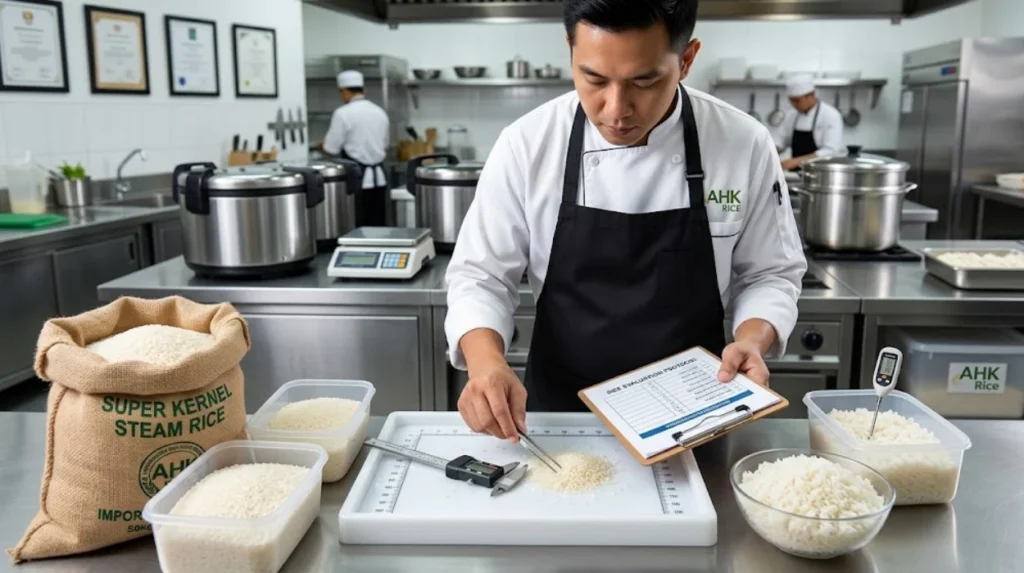
An Indonesian restaurant should assess Super Kernel Steam Rice through a documented sample test covering physical specifications, cooking yield, grain separation, aroma, texture, breakage, packaging, storage behavior, documentation, and repeat-batch consistency before changing its regular rice specification.
The first step is to establish the restaurant’s target dish. A biryani operation requires different cooking characteristics from a fried-rice kitchen.
The second step is to define measurable specifications. Record grain length, broken percentage, moisture, purity, packaging weight, and required certifications.
The third step is to conduct a controlled cooking trial. Use the same cooker, recipe, water ratio, cooking time, and holding conditions used in normal production.
The fourth step is to calculate yield. Measure the quantity of dry rice and the final cooked output. This reveals the commercial effect of water absorption and grain expansion.
The fifth step is to repeat the test with another batch. One successful sample does not establish long-term consistency.
The final step is to compare the approved specification with each shipment’s documentation and inspection results.
This specification-led approach turns Super Kernel Steam Rice from a generic imported rice product into a measurable foodservice ingredient. It also gives Indonesian restaurants a clear basis for evaluating quality, cooking performance, supply continuity, and purchasing decisions in 2026.
Frequently Asked Questions
What is Pakistan Super Kernel Steam Rice?
Pakistan Super Kernel Steam Rice is a long-grain aromatic rice produced from Super Kernel Basmati paddy in Pakistan. Steam processing strengthens the grain and supports separate cooked kernels.
Where is Super Kernel Basmati Rice grown in Pakistan?
Super Kernel Basmati is primarily associated with Pakistan’s Punjab rice-growing areas, where suitable soil, irrigation, climate, and seasonal conditions support Basmati cultivation.
How is Super Kernel Steam Rice processed?
The process includes paddy procurement, cleaning, soaking, steaming, drying, husking, milling, sorting, grading, quality inspection, and packaging before export.
What is the difference between Super Kernel Steam and Super Kernel White Rice?
Super Kernel Steam Rice undergoes controlled heat and moisture treatment before milling. Super Kernel White Rice is conventionally milled without the same steam-processing stage, producing different grain characteristics.
Why is Super Kernel Steam Rice suitable for restaurants?
Its long grains, aromatic profile, stronger kernels, controlled breakage, and ability to produce separate cooked grains make it suitable for restaurant dishes, buffets, catering, and rice platters.
What grades of Super Kernel Steam Rice are available?
Commercial grades can differ by broken percentage, grain length, purity, moisture, sorting level, damaged-grain tolerance, and other specification limits. Buyers should compare written specifications rather than variety names alone.
What does 100% Sortex mean in Super Kernel Rice?
100% Sortex generally refers to intensive optical sorting intended to remove contrasting or defective grains. It does not independently define moisture, broken percentage, grain length, or every other quality parameter.
What quality parameters should Indonesian restaurants check?
Restaurants should check grain length, broken percentage, moisture, purity, foreign matter, damaged grains, aroma, cooking time, expansion, texture, packaging, and batch consistency.