How Do Rice Exporters Meet UK Packaging Requirements for Imports?
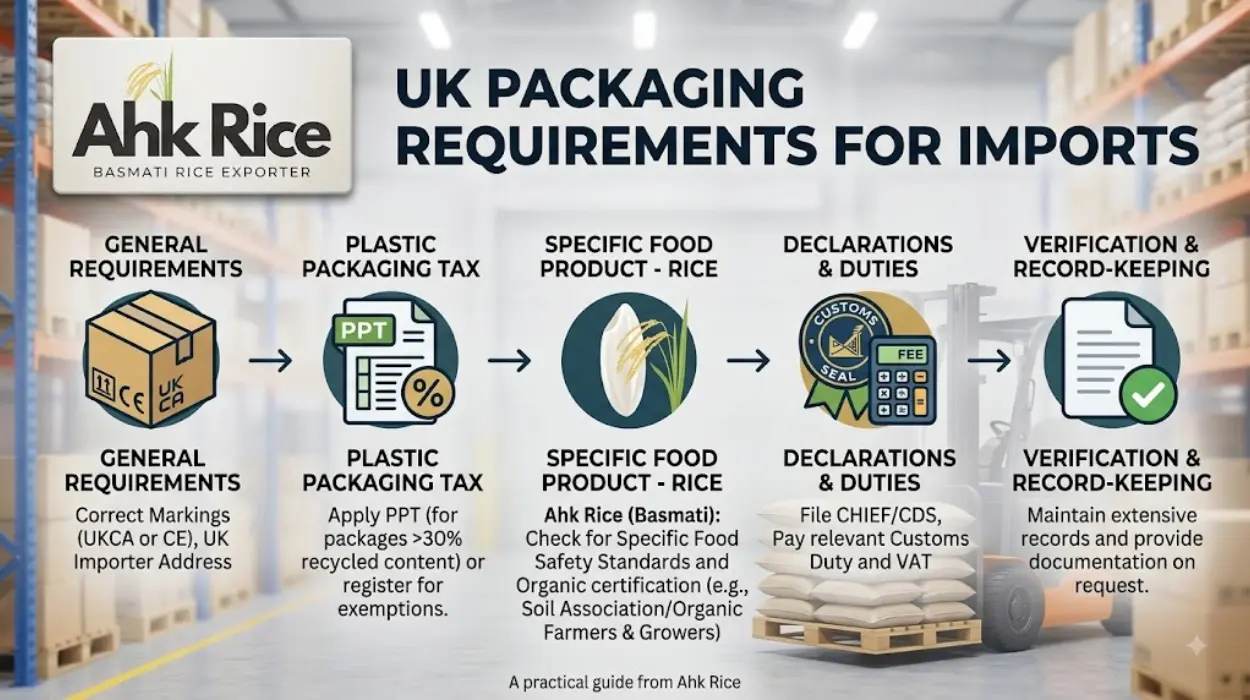
Rice exporters meet UK packaging requirements by combining food-safe packaging, accurate product labelling, traceable batch information, correct net quantity, suitable storage instructions, and importer details. Here is why: UK rules cover both the packaging material and the information presented to buyers.
UK importers therefore need more than a strong rice bag. They need a specification-controlled export process that connects rice grade, packaging format, labelling, documentation, inspection, and shipment preparation. For background, readers can first review the UK Basmati rice import requirements guide before comparing packaging solutions.
What packaging solutions are available for UK Basmati rice imports?
Food-grade PP bags, laminated retail bags, woven sacks, and private-label packaging provide the main solutions for UK Basmati rice imports. The correct option depends on pack size, retail presentation, handling requirements, brand ownership, and whether the shipment targets wholesale or consumer sales.
Which packaging formats are commonly used?
Woven polypropylene bags suit wholesale distribution because they provide strength during loading, container handling, and warehouse movement. Common commercial formats include 25 kg and 50 kg bags.
Laminated polypropylene bags provide stronger print presentation and additional barrier performance. They suit branded wholesale products and distributors requiring clearer retail-facing presentation.
Retail laminated pouches suit consumer channels. Typical pack sizes include 1 kg, 2 kg, 5 kg, and 10 kg. The final format should match the retailer’s specification and shelf presentation.
Private-label packaging allows the UK buyer to control the brand identity while the exporter manages filling, sealing, inspection, and export preparation. This model works well for supermarket suppliers and ethnic grocery distributors.
Food-contact suitability remains essential. UK guidance states that food packaging must be suitable for food use. Certain materials also require documented compliance evidence from the packaging supplier.
What information must appear on the package?
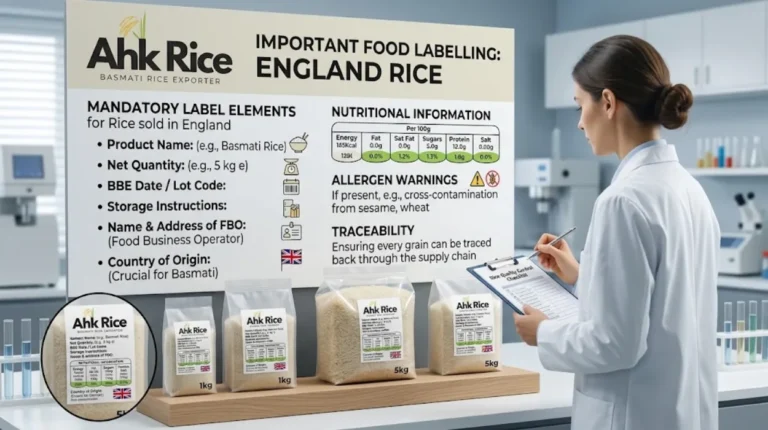
UK prepacked-food labels must provide mandatory information such as the food name, date marking, net quantity, required warnings, origin information where required, lot identification, storage conditions, and cooking instructions where necessary.
A single-ingredient rice product can have a simpler ingredients declaration than a mixed product. Rice sold as 100% Basmati rice still requires the other applicable mandatory information.
Net quantity must use metric units such as grams or kilograms. The quantity must also appear clearly enough for consumers to understand the product weight.
Importer or food-business information also matters. UK guidance requires a business name and address for the responsible food business or importing business on the packaging or label.
Packaging selection establishes the first compliance layer, while the next layer concerns the rice specification inside the package.
How do UK packaging approaches compare with GCC packaging requirements?
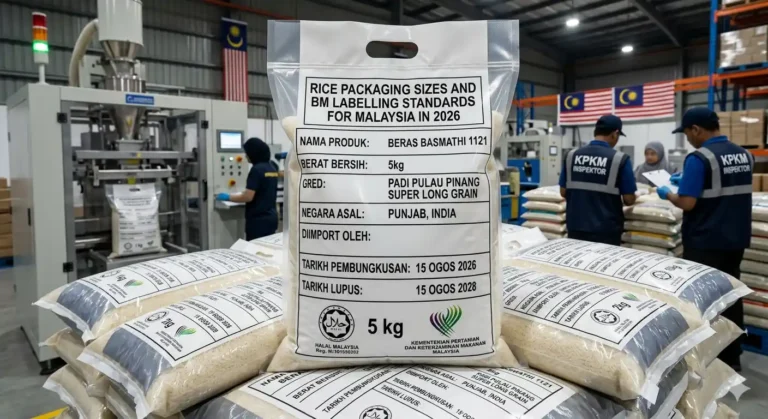
UK packaging places stronger emphasis on consumer-facing labelling and documented food information, while GCC buyers commonly prioritise pack strength, grade, cooking performance, and commercial presentation. The difference affects packaging design, label preparation, and supplier coordination.
UK retail packaging must communicate mandatory food information clearly. UK rules also specify presentation requirements, including minimum text size for mandatory information.
GCC wholesale packaging commonly focuses more heavily on large commercial packs, durable handling, grade selection, and storage performance. Premium Gulf buyers frequently evaluate 1121 Basmati, Super Kernel, and aged rice specifications.
The comparison becomes clearer when buyers examine the product and commercial requirements together.
| Attribute | UK Market | GCC Market |
|---|---|---|
| Primary channel | Retail, wholesale, foodservice | Wholesale, retail, hospitality |
| Preferred premium grades | 1121, Super Kernel | 1121, Super Kernel, aged Basmati |
| Common commercial packs | 1–10 kg retail, 25–50 kg wholesale | 5–50 kg |
| Main packaging priority | Label compliance and presentation | Strength and handling |
| Label focus | Mandatory consumer information | Buyer and destination requirements |
| Indicative FOB price | Around US$1,135–1,205/MT for premium 1121 | Around US$1,135–1,205/MT origin benchmark |
| Storage target | Common commercial planning: 12–24 months | Common commercial planning: 12–24 months |
Current Pakistan FOB indications place premium 1121 Basmati around US$1,135–1,205 per metric tonne, depending on specification and shipment terms. These figures represent origin pricing, not UK or GCC landed cost.
UK retail pricing demonstrates the value added after import, packaging, distribution, and retail operations. Tesco currently lists several 10 kg Basmati products between approximately £19 and £31, depending on brand and specification.
GCC retail pricing also varies significantly by brand and grade. Carrefour UAE currently lists 5 kg premium Basmati products around AED 54–79, while other Basmati products sell below that range.
Shelf life also requires a specification rather than a generic claim. AHK Rice project material identifies practical commercial ranges of approximately 12–18 months for Steam and 18–24 months for Golden Sella under appropriate storage.
UK importers therefore gain more value from matching packaging with distribution speed and storage conditions. GCC buyers gain more value from matching packaging with warehouse handling and hospitality demand.
With the regional comparison established, exporters can now evaluate the actual packaging workflow.
How do rice exporters prepare packaging for UK import compliance?

Exporters prepare UK-compliant rice packaging through specification approval, food-contact verification, label review, filling, sealing, batch identification, inspection, and final documentation checks. Each stage connects the physical bag with the commercial shipment specification.
What steps should an exporter follow?
- Confirm the rice grade. Define the variety, grain length, broken percentage, moisture, purity, crop year, and processing type.
- Confirm the pack size. Select 1 kg, 2 kg, 5 kg, 10 kg, 25 kg, 40 kg, or 50 kg according to the buyer’s distribution model.
- Verify food-contact materials. Obtain appropriate supplier evidence for packaging materials requiring documented compliance.
- Prepare the label. Include the food name, net quantity, date marking, lot information, storage instructions, origin information where required, and responsible business details.
- Verify the artwork. Check spelling, weights, dates, product descriptions, batch fields, and required declarations before printing.
- Fill the bags. Pack the approved rice grade into the agreed packaging format.
- Seal the bags. Close each package securely to reduce exposure to moisture, contamination, and handling damage.
- Mark the batch. Apply traceable lot or batch identification to connect the finished package with production records.
- Inspect the shipment. Check weight, seals, print quality, packaging damage, rice appearance, and specification compliance.
- Prepare export documents. Match the packing list, commercial invoice, certificate documents, and shipment details with the physical cargo.
This process matters because a compliant label cannot correct an incorrect product specification. Packaging compliance begins with the rice specification and continues through shipment documentation.
UK rice imports also require attention to border controls. Certain rice consignments can fall under specific controls for pesticide residues, aflatoxins, and ochratoxin A under GB import restrictions.
Importers should therefore confirm the current commodity controls before dispatch. Packaging compliance and food-safety compliance operate together.
Which packaging method works best for different UK buyers?
Retailers benefit most from printed consumer-ready bags, wholesalers benefit from durable commercial sacks, and private-label distributors benefit from customised laminated packaging. The best method depends on the buyer’s sales channel and inventory cycle.
Which packaging suits supermarkets?
Supermarket supply requires clear consumer information and strong visual presentation. A 5 kg or 10 kg printed laminated bag can combine retail branding with mandatory information.
Retail buyers also need consistent pack weights. A shipment with inconsistent weights creates avoidable receiving and inventory problems.
Which packaging suits wholesalers?
Wholesale distributors often prioritise handling efficiency over premium artwork. A durable 25 kg or 50 kg woven PP bag can reduce packaging cost while supporting warehouse movement.
Wholesale packaging also suits restaurant suppliers. Larger bags reduce unit handling and support high-volume kitchen operations.
Which packaging suits private-label importers?
Private-label buyers need packaging that reflects their own brand. The exporter must therefore coordinate artwork, product specifications, packaging material, print approval, filling, sealing, and batch marking.
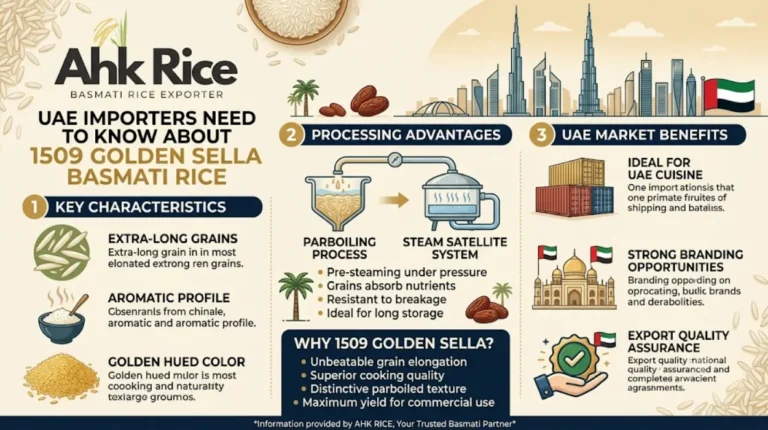
AHK Rice supplies 1121, Super Kernel, and 1509 Basmati varieties with custom packaging and an end-to-end export process. The exporter can therefore connect the selected rice grade with the buyer’s packaging specification.
The first product mention is the appropriate place to evaluate the AHK Rice export and packaging service as a complete sourcing solution.
Packaging choice becomes commercially meaningful only after the buyer matches the format with the intended market.
What are the advantages and disadvantages of each UK packaging approach?
Retail packaging maximises presentation, wholesale packaging improves handling economics, and private-label packaging creates brand control. Each approach also introduces different cost, artwork, minimum-order, and compliance considerations.
| Packaging approach | Main advantage | Main disadvantage | Best example |
|---|---|---|---|
| Retail laminated bag | Strong shelf presentation | Higher artwork and printing requirements | 5 kg supermarket rice |
| Woven PP bag | Strong handling performance | Limited premium presentation | 25 kg wholesale rice |
| Private-label bag | Brand ownership | Requires artwork approval | Supermarket own-label |
| Bulk commercial bag | Lower unit packaging cost | Less consumer-ready | Foodservice distributor |
| Custom laminated bag | Strong barrier and presentation | Higher production planning | Premium Basmati brand |
Retail packaging creates stronger consumer visibility but requires more detailed artwork control. Wholesale packaging reduces packaging complexity but provides less retail differentiation.
Private-label packaging creates stronger brand ownership. However, every artwork change can affect production planning and printed-material procurement.
Custom packaging works best for repeat orders. A buyer ordering consistent monthly volumes can spread packaging setup costs across multiple shipments.
These trade-offs show why the cheapest bag is not always the lowest-cost packaging solution.
What decision factors should UK importers use before selecting rice packaging?
UK importers should evaluate legal label content, food-contact suitability, pack size, material strength, branding, storage conditions, cost, traceability, and supplier quality control before approving packaging. A structured decision process reduces rework and shipment disputes.
| Decision factor | Low-priority situation | High-priority situation |
|---|---|---|
| Label compliance | Bulk trading | Supermarket retail |
| Packaging strength | Controlled warehouse | Multiple handling points |
| Pack size | Single wholesale format | Multiple retail channels |
| Branding | Commodity distribution | Private-label sales |
| Traceability | Spot purchase | Long-term supply contract |
Label compliance becomes the highest priority for consumer-facing retail products. The importer must verify mandatory information before packaging enters production.
Packaging strength becomes critical during repeated loading and unloading. Larger wholesale bags require stronger construction because each unit carries more product weight.
Pack size affects both logistics and sales velocity. A retailer selling household packs needs different economics from a restaurant distributor buying 25 kg sacks.
Branding becomes important when the importer owns the retail identity. Artwork approval should therefore occur before printing begins.
Traceability becomes critical for repeat procurement. Lot identification allows the buyer to connect retail packages with the corresponding production and shipment records.
UK packaging compliance therefore works best as part of a specification-controlled procurement system.
What should UK buyers check before approving a packaged Basmati shipment?
Buyers should approve the rice specification, packaging material, label artwork, net quantity, lot identification, food-contact evidence, documentation, and final sample before commercial loading. Approval should cover the complete finished package rather than rice alone.
A practical approval file should contain the final product specification and approved packaging artwork. The buyer should also retain the agreed pack size and label version.
The rice specification should identify variety, grade, grain length, moisture, broken percentage, purity, crop year, and processing method. These specifications establish what the package actually contains.
The packaging specification should identify material, dimensions, weight tolerance, closure method, printing requirements, and artwork version. These details prevent packaging substitutions during production.
The final inspection should compare the packed product against the approved specification. The exporter should verify the physical package before loading the container.
UK importers should also distinguish packaging compliance from border food controls. Rice may face additional controls based on commodity, origin, and current risk classifications.
Packaging Extended Producer Responsibility adds another commercial consideration for businesses placing packaging on the UK market. Current UK EPR rules can make organisations importing or supplying packaging responsible for packaging-waste obligations and related costs.
The UK importer should therefore establish which party carries the applicable packaging reporting and compliance responsibility. The exporter can provide packaging material data to support that process.
What is the best overall approach for UK-compliant Basmati rice?
The strongest approach combines specification-controlled Basmati rice, food-safe packaging, accurate UK labelling, traceable batch marking, inspection, and coordinated export documentation. This approach reduces compliance risk while preserving product quality and commercial flexibility.
A UK supermarket buyer should prioritise consumer-ready 5 kg or 10 kg packaging with approved artwork and complete mandatory information.
A wholesale distributor should prioritise durable 25 kg or 50 kg packaging with consistent weights and traceable batch identification.
A private-label importer should prioritise custom packaging, artwork control, repeatable rice specifications, and production planning.
AHK Rice supplies Pakistani Basmati rice from Punjab across 1121, Super Kernel, and 1509 varieties. Its stated model combines processing, grading, sorting, custom packaging, inspection, and export coordination.
The final procurement decision should compare more than price. Buyers should compare rice specification, packaging quality, label readiness, inspection controls, documentation, and shipment consistency.
A packaging supplier can provide a bag. A specification-controlled rice exporter connects the bag with the product, documentation, inspection, and export process.
Frequently Asked Questions
What information must appear on UK rice packaging?
UK prepacked rice labels generally require the food name, net quantity, date marking, lot identification, storage conditions, required origin information, and responsible food-business details. Additional information applies where the product requires specific warnings or cooking instructions.
Does rice packaging need to be food grade in the UK?
Yes. Packaging intended to contact food must be suitable for food use. Certain materials require documented evidence demonstrating compliance with applicable food-contact requirements.
What packaging size is best for UK Basmati rice?
The correct size depends on the sales channel. Retailers commonly use consumer packs such as 1 kg, 2 kg, 5 kg, and 10 kg, while wholesalers and foodservice buyers commonly use larger commercial bags.
Do UK rice importers need private-label packaging?
No. Private-label packaging is a commercial strategy rather than a universal legal requirement. It becomes valuable when the importer sells rice under its own brand.
What Basmati grades can Pakistani exporters supply to the UK?
Pakistani exporters supply several Basmati specifications. AHK Rice supplies 1121, Super Kernel, and 1509 varieties, with processing and packaging adapted to buyer requirements.
Does UK EPR apply to imported rice packaging?
EPR can apply to organisations that import or supply packaging in the UK. The responsible business must assess its obligations using current UK packaging rules and packaging data requirements.
What should a UK importer check before shipment?
The importer should check the rice specification, packaging material, label artwork, net weight, batch identification, food-contact evidence, inspection records, export documents, and applicable UK import controls before loading.
What is the difference between UK and GCC rice packaging?
UK retail packaging places strong emphasis on mandatory consumer information and label presentation. GCC commercial packaging often places greater emphasis on durable handling, larger pack sizes, grade selection, and hospitality requirements.
SEO Metadata
Primary keyword: UK rice packaging requirements for imports
Secondary keywords: UK Basmati rice packaging requirements, rice packaging requirements UK, UK rice import packaging, Basmati rice labelling UK, food packaging for rice imports, UK rice importer requirements, private label Basmati rice UK, UK food packaging compliance
Meta title: UK Rice Packaging Requirements for Imports
Meta description: Learn how rice exporters meet UK packaging requirements, including food-safe materials, labelling, net quantity, traceability, private-label packs, EPR, and import controls.
Recommended BOFU internal link placement: Add the BOFU article link in the final commercial section, immediately after the sentence discussing buyers comparing rice specification, packaging quality, inspection, documentation, and shipment consistency. Use a natural anchor such as “source UK-compliant packaged Basmati rice from AHK Rice” and link it to the live BOFU URL for Import UK-Compliant Packaged Basmati Rice from AHK Rice.