Why Does Packaging Compliance Matter for Northern Ireland Rice Imports?
Packaging compliance matters because Northern Ireland rice imports must meet food-labelling, food-contact, traceability, and import-control requirements before sale. Pakistani rice also falls under high-risk food controls, making correct packaging and supporting documents part of import compliance.
What Is Packaging Compliance for Northern Ireland Rice Imports?
Packaging compliance means meeting Northern Ireland rules for food labels, packaging materials, traceability, origin, dates, quantity, storage, and import controls. Pakistani rice requires additional attention because rice from Pakistan is subject to specific high-risk controls.
Packaging compliance covers the physical pack and the information printed on it. The requirements apply to prepacked food sold in Northern Ireland.
Food labels must remain clear, permanent, visible, understandable, and accurate. Misleading descriptions can breach food-labelling rules.
A retail rice bag therefore needs more than a product name. The packaging communicates the food identity, quantity, origin, storage requirements, dates, and responsible food business information.
Northern Ireland also follows specific EU food-law requirements under the Windsor Framework. Food placed on the Northern Ireland market must meet applicable EU food-safety requirements.
Packaging compliance also connects with import controls. Pakistan-origin rice is listed as high-risk food of non-animal origin under Regulation 2019/1793. The listed hazards include aflatoxins, ochratoxin A, and pesticide residues in the relevant control framework.
The packaging therefore becomes part of a larger compliance system covering the product, shipment, importer, laboratory evidence, and official controls.
With the definition established, the next question is how packaging compliance operates across an imported rice shipment.
How Does Packaging Compliance Work for Imported Rice?
Packaging compliance works through product identification, approved food-contact materials, accurate labelling, traceability, inspection, and supporting import documents. Each element connects the rice pack with its origin, specification, and responsible food business.
How Is Rice Identified on the Package?
Rice packaging starts with the correct product identity. The name must describe the food accurately.
Examples include Basmati rice, long-grain rice, brown rice, parboiled rice, and broken rice. UK tariff guidance classifies rice under heading 1006 according to processing and product type.
The pack should also identify the net quantity. Packaged food must show quantities using recognised units such as grams or kilograms.
How Does Origin Information Support Compliance?
Country-of-origin information helps consumers understand where the rice originates. Pakistani Basmati rice should therefore identify Pakistan accurately.
Origin information also supports traceability. The official HRFNAO certificate guidance requires the country where the food was grown or harvested for products presenting risks from mycotoxins or pesticide residues.
How Does Food-Contact Packaging Matter?
Food-contact packaging means material that directly touches food. Rice bags, inner liners, plastic films, coatings, and certain containers fall within this concept.
Northern Ireland applies EU food-contact-material legislation. Packaging materials must comply with applicable rules governing materials that contact food.
Packaging therefore needs both physical suitability and regulatory suitability. A strong bag that uses unsuitable food-contact material still creates a compliance problem.
The process connects product identity with packaging material and documentation, leading directly to the key compliance components.
What Are the Key Components of Compliant Rice Packaging?
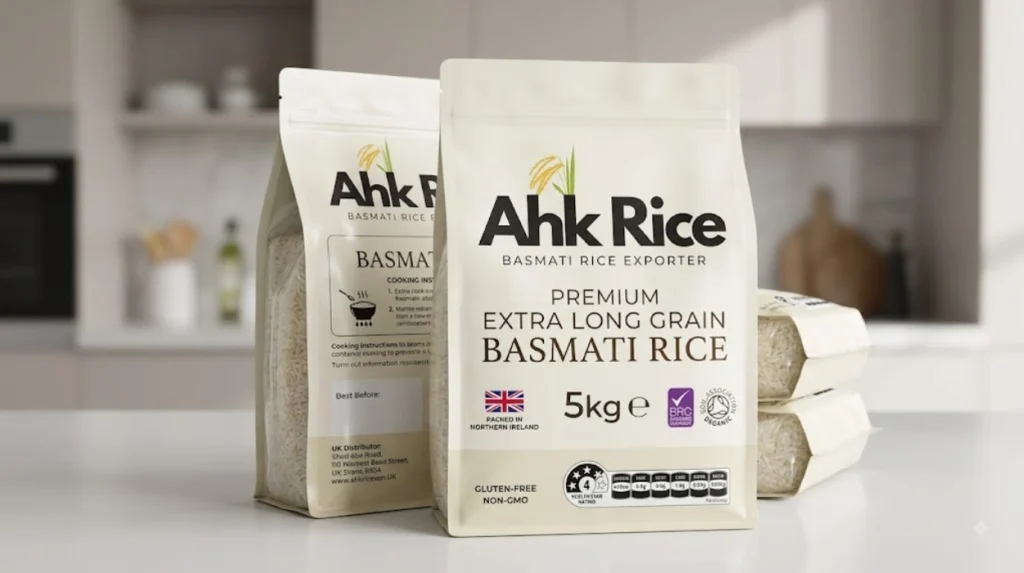
The key components are product name, ingredients, allergens where applicable, net quantity, origin, date marking, storage instructions, cooking information, importer details, lot identification, and suitable food-contact packaging.
What Information Must a Rice Label Show?
| Packaging component | Purpose |
|---|---|
| Product name | Identifies the food |
| Net quantity | States the packed weight |
| Country of origin | Identifies product origin |
| Best-before date | Communicates quality duration |
| Lot or batch code | Supports traceability |
| Storage conditions | Protects product quality |
| Cooking instructions | Explains preparation |
| Business address | Identifies the responsible operator |
| Nutrition declaration | Provides required nutrition information |
The exact label depends on the product and selling format. Prepacked food has specific mandatory information requirements.
Rice containing only rice does not normally require a conventional multi-ingredient ingredients list. A blended or flavoured rice product requires the appropriate ingredient declaration.
Allergen information becomes relevant when an allergenic ingredient is present. Food businesses must provide legally compliant allergen information for applicable products.
What Role Does Traceability Play?
Traceability connects the finished package with its production and shipment records. A lot code provides a practical reference for identifying a specific production batch.
Traceability supports recalls, complaints, inspections, and quality investigations. A distributor can connect a retail bag to commercial documents and shipment records.
Packaging therefore functions as a physical traceability point. The printed code should correspond with the supplier’s production and export records.
With the packaging components established, the next question is why these requirements matter commercially and legally.
What Benefits Does Packaging Compliance Provide?
Compliant packaging reduces border problems, supports traceability, protects food quality, communicates mandatory information, and gives importers reliable control over product identity from shipment through retail distribution.
How Does Compliance Support Border Clearance?
Correct packaging helps inspectors identify the product and match the physical shipment with its documentation. Consistent product names, lot codes, quantities, and origins reduce identification discrepancies.
Pakistan-origin rice receives particular attention because it falls within the high-risk food framework. Northern Ireland importers must ensure applicable EU food-safety requirements are met.
How Does Compliance Protect Consumers?
Accurate labels give consumers information needed to store and prepare food correctly. Storage instructions become important for products requiring defined conditions.
Nutrition information also forms part of prepacked-food labelling requirements. In Northern Ireland, the Food Standards Agency is responsible for nutrition labelling, while district councils enforce the regulations.
How Does Compliance Improve Traceability?
Lot identification creates a connection between retail packaging and shipment records. Importers can use this information during quality investigations.
Examples include identifying a production batch, checking laboratory results, verifying shipping documents, and managing a product withdrawal.
The benefits show why packaging is more than a retail presentation layer. The next section explains where compliant packaging becomes especially important.
Where Is Packaging Compliance Used in Northern Ireland Rice Trade?
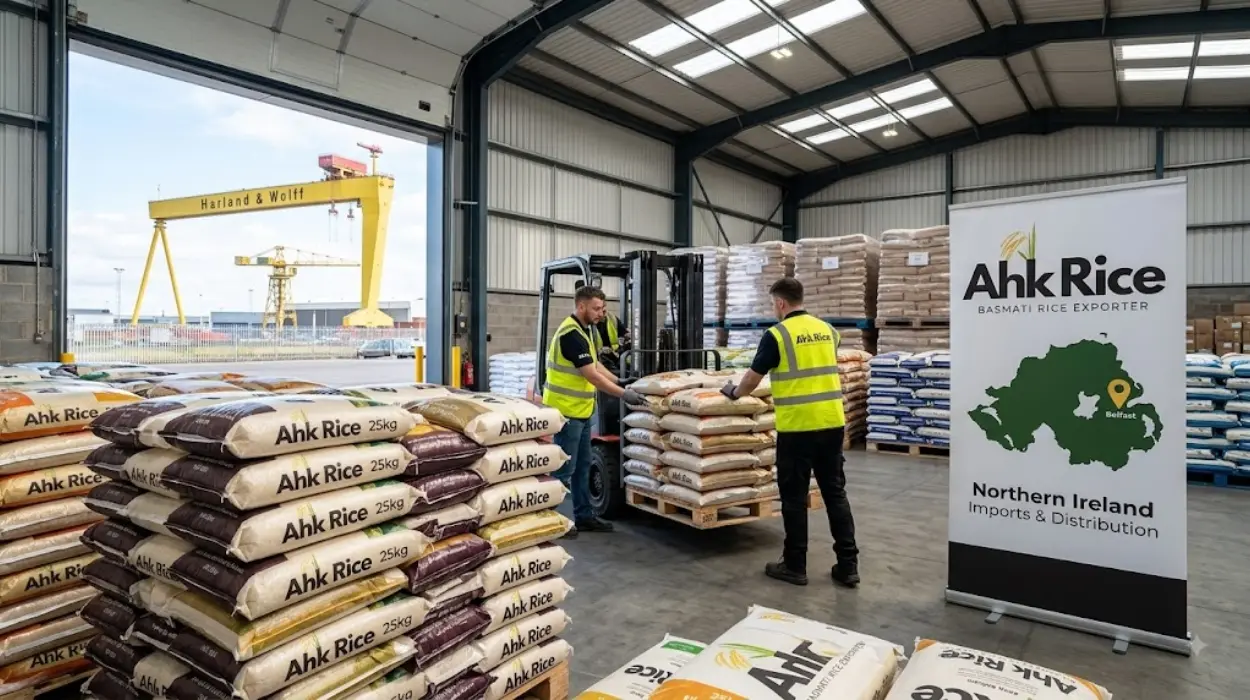
Packaging compliance applies across retail rice bags, wholesale sacks, food-service packs, private-label products, repacked rice, and imported consignments entering Northern Ireland through regulated supply chains.
How Does Retail Rice Packaging Apply?
Retail rice requires consumer-facing information. Common pack formats include 1 kg, 2 kg, 5 kg, and 10 kg bags.
Retail packaging needs clear product identification, net quantity, date marking, storage information, origin information where required, and responsible business details.
How Does Wholesale Packaging Apply?
Wholesale rice uses larger formats designed for distributors, caterers, restaurants, and food-service operators. Examples include 20 kg and 25 kg sacks.
Wholesale packaging still requires accurate identification and traceability. Commercial scale does not remove food-labelling responsibilities.
How Does Private-Label Packaging Apply?
Private-label rice places the retailer or brand owner’s identity prominently on the package. The responsible food business and importer information must remain compliant.
For food sold in Northern Ireland, the relevant business address must be a physical address. An email address or telephone number alone does not satisfy the address requirement.
How Does Pakistani Rice Enter the Compliance System?
Pakistan-origin rice falls within Northern Ireland’s HRFNAO controls. Businesses importing this food need to register appropriately and use authorised points of entry for relevant high-risk goods.
Import controls can involve official checks, documentation, sampling, and laboratory evidence depending on the applicable regulatory listing.
These use cases show how packaging requirements differ by selling format while remaining connected to the same compliance framework.
What Are the Common Packaging Problems for Northern Ireland Rice Imports?
Common problems include incorrect origin statements, missing importer information, inaccurate weights, unclear dates, unsuitable packaging materials, inconsistent lot codes, and confusion between GB and Northern Ireland requirements.
Is Packaging Only About the Bag Material?
No. Packaging compliance includes both the physical material and the information displayed on the pack.
A compliant food-contact material does not make an inaccurate label compliant. The product description, quantity, origin, date, and business information must also satisfy applicable requirements.
Does UK Packaging Compliance Automatically Cover Northern Ireland?
No. Northern Ireland has specific food-law arrangements. EU food law continues to apply to relevant food placed on the Northern Ireland market under the Windsor Framework.
This distinction matters for importers sourcing rice directly from Pakistan and for businesses moving high-risk rice through Great Britain into Northern Ireland.
Does Packaging Replace Import Documentation?
No. Packaging supports identification but does not replace official import documentation.
HRFNAO movements into Northern Ireland can require commercial documentation and, depending on the applicable category, official certificates, laboratory analysis, and border procedures.
Is a Quality Certificate the Same as Legal Compliance?
No. Commercial certifications and legal compliance serve different functions.
Certifications such as HACCP, ISO 22000, and BRCGS can demonstrate structured food-safety controls. They do not automatically replace mandatory government requirements.
Official certificates and laboratory evidence address specific regulatory controls. Certification schemes generally provide additional assurance about management systems and production controls.
The common misconceptions show why importers should treat packaging, documentation, certification, and border controls as connected but separate requirements.
What Should Importers Check Before Accepting Rice Packaging?
Importers should check the product identity, country of origin, net weight, dates, lot code, storage information, responsible business address, food-contact material, supporting documents, and applicable Northern Ireland import controls.
What Should a Packaging Compliance Check Include?
Use this sequence before accepting a shipment:
- Confirm the rice name against the commercial specification.
- Confirm the country of origin against production and export records.
- Confirm the net quantity against the packing specification.
- Confirm the date marking against the approved shelf-life specification.
- Confirm the lot code against batch records.
- Confirm the importer address against the responsible food business.
- Confirm storage instructions against product requirements.
- Confirm packaging material for food-contact suitability.
- Confirm laboratory evidence against applicable HRFNAO controls.
- Confirm import documents against the shipment and destination.
This check connects the physical bag with the wider compliance file.
For Pakistani Basmati rice, product documentation should also align with the declared variety and specification. Common Pakistani varieties include 1121, Super Kernel, and 1509 Basmati.
A specification can include grain type, processing grade, broken percentage, moisture, packaging format, crop information, and intended market.
The final compliance check brings packaging together with product, documents, and import controls.
Why Should Packaging Be Planned Before Rice Is Shipped?
Packaging should be planned before dispatch because label corrections, unsuitable materials, missing documents, and incorrect specifications become harder to resolve after loading and border movement.
Packaging planning starts with the destination market. Northern Ireland requirements should be reviewed before printing bags or loading finished rice.
The product specification should then match the packaging artwork. A 1121 Basmati product should not carry inconsistent variety information across its bag, invoice, packing list, and certificate.
The importer should also verify the responsible business details before production. Northern Ireland food products require the appropriate NI or EU business address rules for the responsible food business.
Laboratory and regulatory requirements should also be checked before dispatch. Pakistan-origin rice appears within the high-risk control framework, so import planning must account for the applicable controls.
Packaging compliance therefore begins before the container leaves Pakistan. The final package should match the product, documents, importer requirements, and destination rules.
Understanding these requirements creates the foundation for evaluating how exporters actually build compliant shipments. The next-stage topic, how rice exporters meet UK packaging requirements for imports, naturally follows from this compliance framework.
Frequently Asked Questions
What packaging information is required for rice in Northern Ireland?
Rice packaging generally needs the food name, net quantity, date marking, origin where required, lot identification, storage information, preparation instructions where necessary, nutrition information, and responsible business address.
Is Pakistani rice subject to special import controls in Northern Ireland?
Yes. Pakistan-origin rice is listed under the high-risk food of non-animal origin framework. Applicable controls address risks including aflatoxins, ochratoxin A, and pesticide residues.
Does the rice bag need the country of origin?
Country-of-origin information is required in circumstances defined by food-labelling rules, including situations where packaging could otherwise mislead consumers about origin. Pakistani-origin rice should therefore use accurate origin information.
Does Northern Ireland follow the same food rules as Great Britain?
Northern Ireland has distinct arrangements. Applicable EU food law continues to apply to food placed on the Northern Ireland market under the Windsor Framework.
Are food-contact materials important for rice packaging?
Yes. Packaging that contacts rice must comply with applicable food-contact-material requirements. Northern Ireland applies relevant EU food-contact legislation to materials placed on its market.