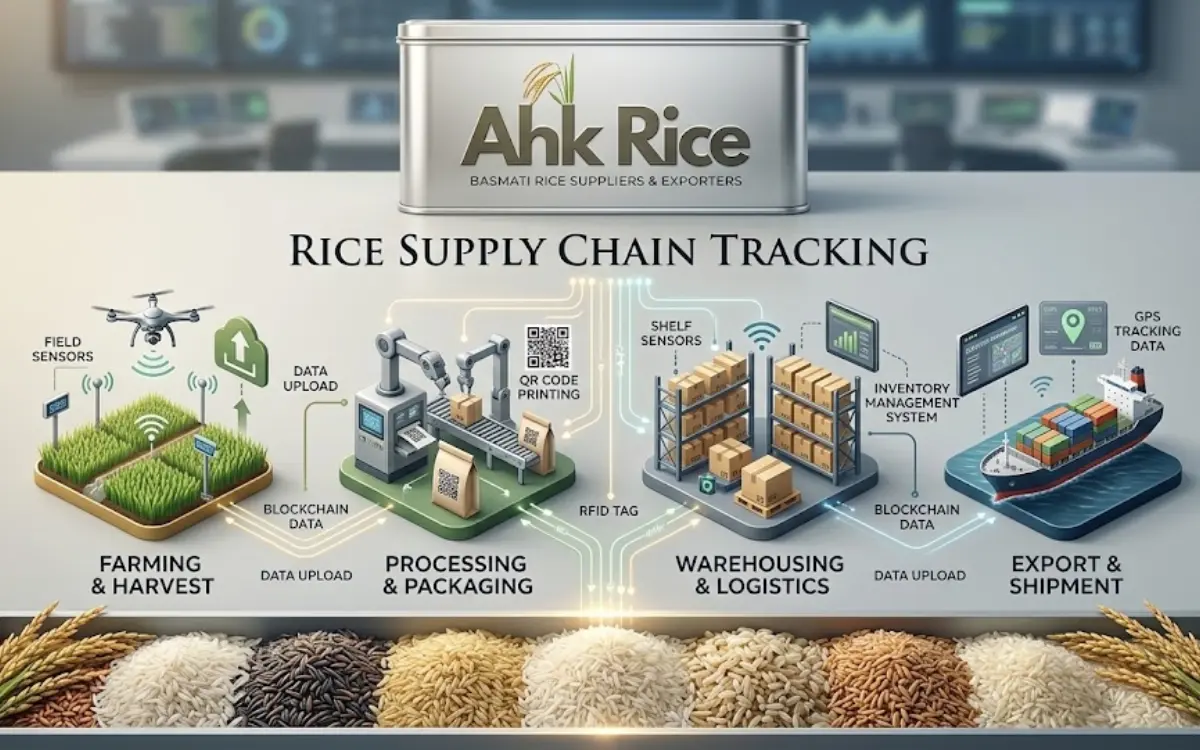
How Do Rice Exporters Track Products from Farm to Shipment?
The most effective rice traceability system combines farm or supplier lot identification, batch records, processing-stage controls, laboratory testing, packaging codes, export documentation, and shipment records. Manual records work for small operations, while integrated digital traceability provides stronger visibility, faster verification, and better control across international shipments.
International buyers increasingly evaluate rice suppliers on more than grain length and price. They need evidence that the rice in a container matches the approved variety, grade, crop, processing history, test results, packaging specification, and export documents.
For a deeper explanation of why these records matter, see:
Why product traceability is important in international rice trade.
In 2026, traceability also has a stronger regulatory dimension. EU food law requires businesses to identify where food came from and where it went, while the European Commission describes traceability as the ability to follow food through production, processing, distribution, and sale. In the United States, FDA traceability requirements focus on defined Critical Tracking Events and Key Data Elements for foods covered by the Food Traceability List; FDA’s 2026 updates also tested whether companies could retrieve records electronically within 24 hours.
What are the available solutions for tracking rice from farm to shipment?
Rice exporters use four main traceability approaches: paper records, spreadsheets, integrated ERP systems, and coded digital systems using barcodes, QR codes, or other machine-readable identifiers. The strongest model connects supplier lots, processing batches, quality tests, packaging, containers, and shipping documents.
1. Manual paper traceability
Manual traceability uses purchase registers, farmer records, milling sheets, laboratory reports, packing lists, and shipment files.
A typical record begins with a paddy purchase receipt. The exporter assigns a lot number. The lot moves through cleaning, de-husking, grading, polishing, sorting, packing, and loading.
This method has a low technology cost. It also creates a high administrative burden.
The main weakness is retrieval speed. Finding every record connected to one container requires staff to search multiple files. Handwritten corrections also create version-control problems.
2. Spreadsheet traceability
Spreadsheet systems improve visibility by putting supplier, lot, batch, quality, packaging, and shipment information into structured digital records.
An exporter can create columns for:
- Supplier or farmer group
- Paddy lot number
- Variety
- Crop year
- Processing date
- Milling batch
- Moisture
- Broken percentage
- Foreign matter
- Laboratory results
- Packing batch
- Container number
- Seal number
- Bill of lading
- Destination
This approach works for exporters with moderate shipment volumes. It becomes difficult when multiple people edit different files.
3. ERP-based traceability
An enterprise resource planning system connects procurement, inventory, production, quality control, packaging, sales, and logistics.
The system can assign a unique batch identity and maintain relationships between input and output lots. A processor can then determine which paddy lots contributed to a finished rice batch.
ERP systems provide stronger operational control than isolated spreadsheets. They also require implementation, staff training, data governance, and system maintenance.
4. Barcode and QR-code traceability
Barcodes and QR codes connect physical rice units with digital records.
A batch code printed on a carton, retail bag, pallet, or container record can identify the relevant production information. The system becomes more useful when every transaction records the movement of that identifier.
GS1 standards provide a common framework for identifying products, locations, and supply-chain events. This makes standardized identifiers more useful than creating unrelated internal codes for every supplier or shipment.
5. Blockchain-based traceability
Blockchain creates a shared transaction record across participating supply-chain organizations.
It becomes relevant when multiple independent parties need a common record that is difficult to alter retrospectively.
However, blockchain does not automatically verify the physical rice. If incorrect farm or laboratory data enters the system, blockchain preserves incorrect input data. The strongest traceability program therefore starts with controlled data capture and verified physical processes.
How do different rice traceability approaches compare?
The comparison depends on shipment volume, number of suppliers, destination regulations, buyer requirements, and required retrieval speed. Paper records have the lowest technology burden, while integrated digital systems provide the strongest scalability, batch visibility, audit readiness, and shipment-level control.
| Attribute | Paper Records | Spreadsheets | ERP System | QR/Barcode System | Blockchain |
|---|---|---|---|---|---|
| Initial technology cost | Low | Low | High | Medium | High |
| Batch visibility | Basic | Moderate | High | High | High |
| Retrieval speed | Slow | Moderate | Fast | Fast | Fast |
| Multi-site scalability | Low | Moderate | High | High | High |
| Audit readiness | Moderate | Moderate | High | High | High |
| Data-entry dependency | Very high | High | Moderate | Low–moderate | Moderate |
| Best application | Small exporter | Growing exporter | Large integrated operation | Shipment and packaging control | Multi-party verification |
The table shows why no single technology automatically represents good traceability. The system must connect physical events with reliable records.
For example, a QR code on a 25 kg bag provides limited value if the underlying batch record does not identify the milling lot, laboratory result, packaging date, and container.
How does a rice exporter create a traceability record from farm to shipment?
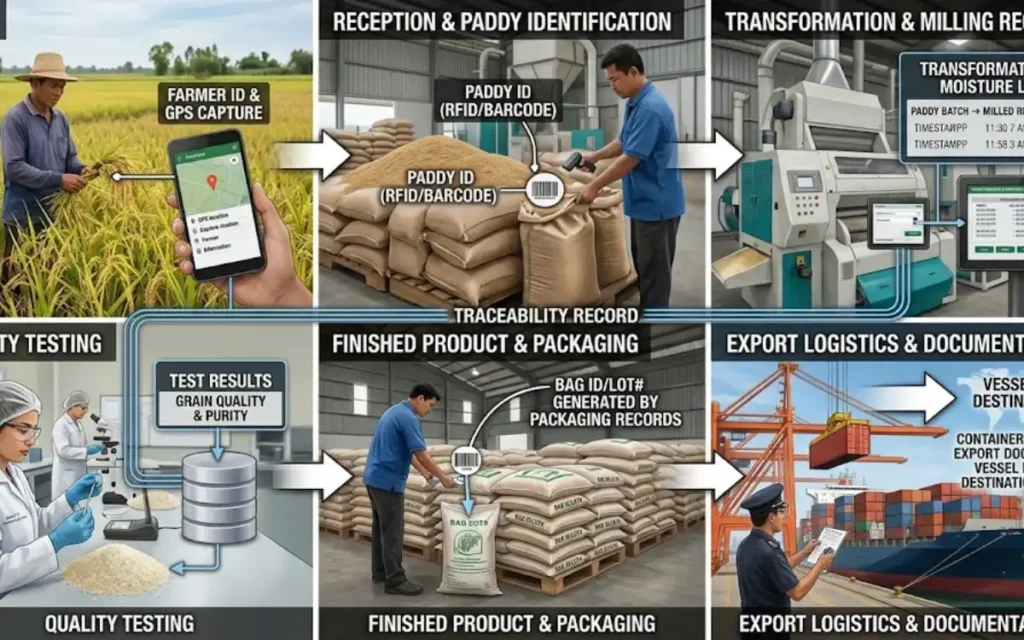
A complete rice traceability chain assigns an identity to the incoming paddy, records every transformation, links quality results to the production batch, connects finished bags to packaging records, and finally links the batch to container, seal, export documents, vessel, and destination.
Step 1: Identify the farm or supplier source
The process begins with the paddy source.
The exporter records the supplier, farm group, growing area, variety, procurement date, quantity, and crop information. Larger operations maintain individual farm identifiers or controlled supplier codes.
For Pakistani Basmati, geographical sourcing is commercially important because Punjab is the primary production region associated with the varieties supplied by AHK Rice.
Step 2: Assign a paddy lot number
A lot number creates the first traceability anchor.
For example, a paddy receipt can receive a code such as PK-PB-1121-2608-014. The exact coding structure depends on the exporter.
The important principle is uniqueness. One lot code must correspond to one defined quantity and documented source.
Step 3: Record intake quality
The exporter records moisture, impurities, damaged grains, foreign material, variety identification, and other agreed specifications.
These records establish the condition of the paddy before processing.
Step 4: Link processing events
The paddy lot enters cleaning and milling.
The exporter records processing dates, machinery or production line, milling batch, yield, grading results, and processing type.
For Sella rice, parboiling records become part of the traceability chain. For Steam rice, steam-processing records form part of the production history.
Step 5: Record grading and sorting
Grading determines whether the finished rice meets the commercial specification.
Relevant records include grain length, broken percentage, moisture, chalky grains, damaged kernels, colour-sorting results, and foreign matter.
This step is particularly important for premium Basmati because buyers frequently specify narrow tolerances.
Step 6: Connect laboratory testing to the batch
Laboratory reports must identify the exact sample and production lot.
A Certificate of Analysis without a batch connection provides weaker traceability.
The exporter therefore links the test report to the finished production batch and shipment.
Step 7: Connect packaging to the production batch
Packaging creates another physical identification point.
The exporter records packaging material, bag size, label version, packing date, quantity, and batch code.
AHK Rice provides customized packaging and private-label solutions as part of its Pakistan rice export service. Its stated process covers paddy procurement, cleaning, de-husking, grading, colour sorting, moisture control, quality inspection, packaging, export documentation, and container loading.
Step 8: Connect bags and pallets to the container
Container traceability begins during loading.
The exporter records:
- Container number
- Seal number
- Loading date
- Finished batch numbers
- Number of bags
- Net weight
- Gross weight
- Packing configuration
- Fumigation details
This creates the link between the finished product and the physical shipment.
Step 9: Link shipment records
The final record connects the container with commercial and logistics documentation.
Typical documents include the commercial invoice, packing list, certificate of origin, phytosanitary certificate, fumigation certificate, inspection certificate, and bill of lading.
The result is a traceability chain from origin to destination.
How do GCC and North American rice markets differ in grade preferences and procurement economics?
GCC buyers generally prioritize 1121, 1509, and Super Kernel according to retail, catering, and hospitality requirements, while North American buyers place stronger emphasis on premium grain appearance, aroma, consistency, packaging, and documented compliance. Price comparisons require FOB or landed-cost normalization.
| Market Region | Common Grade Preference | Indicative 2026 Price Position | Shelf-Life Target | Main Procurement Priority |
| GCC, especially UAE and Saudi Arabia | 1121 Steam, 1121 Sella, 1509 Steam, Super Kernel | About $900–$1,450/MT depending on grade and specification | 18–24 months for suitable parboiled grades | Value, cooking yield, aroma, HORECA performance |
| North America, especially USA | 1121 Steam, 1121 White, Super Kernel | About $1,150–$1,450/MT for premium specifications | Up to 24 months when specification and storage conditions support it | Premium quality, documentation, packaging, consistency |
These are indicative 2026 procurement ranges, not fixed quotations. AHK Rice‘s current market material places GCC 1121, 1509, and Super Kernel grades across different price positions, with 1509 positioned as a value-oriented option. Its U.S.-focused material identifies 1121 Steam, 1121 White, and Super Kernel as relevant premium grades.
Shelf life is a specification rather than a universal characteristic. Commercial Basmati products commonly target approximately 12–24 months under controlled packaging and cool, dry storage. Some Pakistani export products state a two-year shelf life. Golden Sella and other parboiled grades often provide stronger storage stability than standard white or steam grades.
For the U.S., buyers also need to distinguish current regulatory enforcement from future preparation. FDA states that the 2026 congressional directive prevents enforcement of the Food Traceability Rule before July 20, 2028, while FDA continues implementation support and traceability-readiness work.
Which method works best for different rice export cases?
The best traceability method depends on operational complexity. Small exporters can operate effectively with controlled digital records, while high-volume exporters benefit from ERP and machine-readable batch identification. Multi-party supply chains require stronger interoperability and standardized data structures.
| Export Case | Best Method | Why |
| Small exporter with few suppliers | Structured digital records | Low cost and simple administration |
| Growing exporter with multiple batches | Spreadsheet plus coded lots | Better batch organization |
| Integrated mill and export operation | ERP plus barcode/QR | Connects production, quality, inventory, and shipment |
| Private-label retail program | QR/barcode plus batch database | Links packaging to production and buyer records |
| Multi-party international supply chain | Standardized digital events and shared records | Improves interoperability across organizations |
An exporter handling 10 shipments per month does not require the same infrastructure as an operation handling hundreds of production batches.
The correct evaluation starts with the number of suppliers, production lines, destinations, packaging formats, and documents involved.
What are the pros and cons of each rice traceability approach?
Manual systems provide simplicity but slow retrieval. Spreadsheets improve organization but depend heavily on staff discipline. ERP systems deliver stronger integration but require investment. QR and barcode systems improve physical identification, while blockchain strengthens shared records without replacing source-data verification.
Paper records
The main advantage is simplicity. Staff can operate the system without specialized software.
The disadvantage is slow retrieval and greater exposure to missing, duplicated, or damaged records.
For example, a small exporter processing one variety for one buyer can manage paper records more easily than a company operating several varieties and packaging formats.
Spreadsheets
Spreadsheets provide inexpensive digital organization.
They also support filters, batch searches, calculations, and document references.
Their weakness is governance. Multiple versions of the same workbook create conflicting records.
ERP systems
ERP systems provide the strongest operational integration.
A production batch can connect with inventory, sales orders, quality tests, and shipment records.
The disadvantages are implementation cost, training requirements, and dependence on accurate data entry.
QR and barcode systems
Machine-readable codes reduce manual identification during packing, warehousing, and dispatch.
They work particularly well for private-label products and retail supply chains.
Their limitation is that the code only becomes valuable when the database behind it contains accurate information.
Blockchain
Blockchain supports shared records across organizations.
Its main disadvantage is complexity. It also does not prove that the physical rice matches the information entered into the system.
For most exporters, strong lot control and reliable digital records create more practical value than blockchain alone.
What factors should buyers consider when evaluating a rice exporter’s traceability system?
Buyers should evaluate traceability by asking whether every shipment can be reconstructed from supplier source through processing, testing, packaging, container loading, export documentation, and destination. Record retrieval speed, batch uniqueness, data accuracy, regulatory fit, and audit evidence determine practical traceability quality.
| Decision Factor | What to Verify | Why It Matters |
| Lot identity | Unique source and production codes | Prevents batch confusion |
| Process linkage | Milling and processing records | Shows how the rice was transformed |
| Quality evidence | Batch-linked COA and inspection records | Connects specifications to physical product |
| Shipment linkage | Container, seal, packing, and B/L records | Connects product to export movement |
| Retrieval capability | Complete records available quickly | Supports audits, investigations, and buyer verification |
The strongest exporter can answer a simple question: “Which farm or supplier lots, processing batches, laboratory results, packaging records, and shipment documents are connected to this container?”
That question separates traceability from ordinary recordkeeping.
European food law already places strong emphasis on identifying immediate suppliers and recipients through the food chain. The EU also requires traceability for imported food and operates official-control systems for relevant consignments.
For Basmati rice, traceability also supports authenticity. EU rules governing Basmati imports from India and Pakistan include authenticity certificates, and the current regulatory framework specifies a 90-day validity period for the certificate.
How should an importer evaluate a traceable Pakistani Basmati supplier?
An importer should request a sample traceability file for one real or representative shipment and verify that the supplier can connect origin, lot, processing, laboratory testing, packaging, container, seal, and export documents without unexplained gaps.
This evaluation is more useful than asking whether an exporter simply “has traceability.”
A buyer can request:
- A sample lot identifier.
- Source or supplier information.
- Production and milling records.
- Grade and specification sheet.
- Batch-linked laboratory report.
- Packaging batch information.
- Container and seal records.
- Commercial export documents.
- Inspection evidence.
- Shipment identification.
The buyer should then test whether the identifiers remain consistent across documents.
For example, the batch number on a Certificate of Analysis should connect logically with the production record and packing batch. The packing batch should connect with the container loaded for shipment. The container number should then appear consistently in the logistics documentation.
This creates an auditable chain rather than a collection of unrelated certificates.
What is the practical for rice importers comparing traceability systems?
The strongest practical model is a layered traceability system: controlled supplier records at origin, unique lot identification, digital production records, batch-linked testing, coded packaging, container-level shipment records, and organized export documentation. Technology strengthens traceability only when physical controls and data discipline are already reliable.
For a small exporter, a structured digital register can provide sufficient control.
For a growing exporter, coded lots and centralized spreadsheets improve consistency.
For an integrated operation such as AHK Rice, the strongest model connects paddy procurement, processing, grading, quality inspection, packaging, documentation, and container loading within one controlled workflow. AHK Rice states that its Punjab operation manages the process from paddy procurement through container loading and supplies 1121, Super Kernel, and 1509 Basmati to international markets.
The commercial value is clear. A buyer does not only receive rice. The buyer receives evidence of what the rice is, where the production lot originated, how it was processed, how it was tested, how it was packed, and which shipment carried it.
For decision-stage readers evaluating a supplier for Wisconsin, USA, the next step is the:
AHK Rice Provides Traceable Basmati Rice Supply for Wisconsin, USA
Frequently Asked Questions
How do rice exporters track products from farm to shipment?
Rice exporters track products using supplier records, unique lot numbers, processing records, quality tests, packaging codes, container numbers, and export documents.
What is a rice traceability system?
A rice traceability system records the movement and transformation of rice from its source through milling, testing, packaging, storage, loading, and shipment.
Why is lot identification important in rice exports?
Lot identification connects a specific quantity of rice with its supplier, variety, processing batch, quality results, packaging records, and shipment information.
What information do rice exporters record during processing?
Exporters record processing dates, rice variety, milling batch, grain specifications, moisture, broken percentage, grading results, sorting details, and production quantities.
How do exporters connect rice quality tests with shipments?
Exporters link laboratory reports and Certificates of Analysis to specific production or packing batch numbers, allowing buyers to connect test results with the rice loaded into a container.
What technologies are used for rice traceability?
Common technologies include spreadsheets, ERP systems, barcodes, QR codes, centralized databases, and standardized digital supply-chain records.
Is a QR code enough for rice traceability?
No. A QR code only provides an identification method. Effective traceability requires accurate underlying records connecting the code with the production batch, quality data, packaging, and shipment.
How does ERP improve rice traceability?
An ERP system connects procurement, inventory, production, quality control, packaging, sales, and logistics records, creating a centralized view of each rice batch.
How long should Basmati rice remain traceable?
Traceability records should remain available for the period required by applicable regulations, buyer contracts, food-safety procedures, and company record-retention policies. This differs from the product’s physical shelf life.
What is the difference between traceability and quality control?
Quality control determines whether rice meets defined specifications. Traceability records where the rice came from, how it was processed, tested, packed, and shipped.
How can an importer verify a rice exporter’s traceability?
An importer can request a representative traceability file and verify that supplier lots, processing batches, laboratory reports, packaging records, container numbers, seals, and export documents connect consistently.
Which rice traceability method is best for exporters?
The best method depends on operational complexity. Small exporters can use structured digital records, while larger operations benefit from ERP systems combined with barcode or QR-based batch identification.