Why Is Product Traceability Important in International Rice Trade?
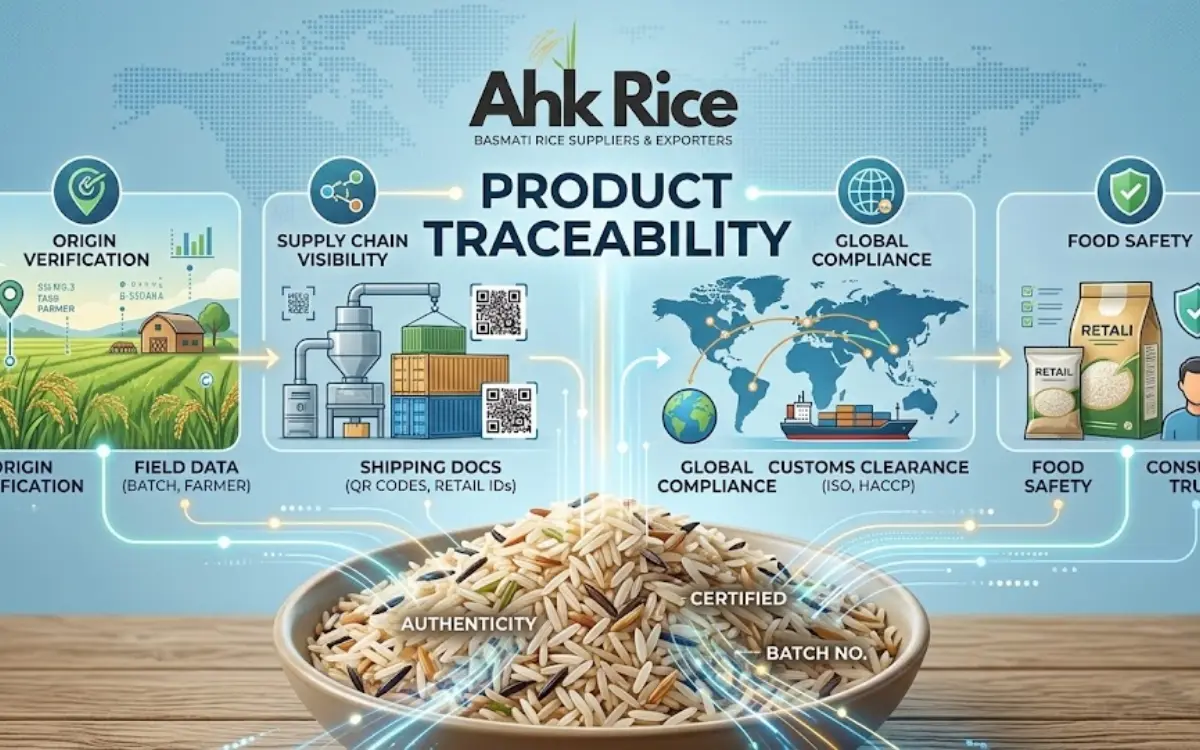
Product traceability is the documented ability to follow rice from its production source through harvesting, milling, packing, storage, transport, export clearance, and delivery. It connects each lot with records that support food safety, authenticity, quality control, and regulatory compliance requirements.
International rice trade involves multiple entities. Farmers produce paddy. Collectors and suppliers move it to mills. Processors clean, grade, mill, polish, sort, pack, and store rice. Exporters coordinate testing, documentation, customs clearance, containers, and international shipment. Importers then receive and distribute the product.
Traceability connects these stages into one documented chain.
The concept is especially important for Pakistani Basmati rice because commercial shipments are identified by variety, grade, processing method, crop information, packaging format, lot, and destination. Products such as 1121 Basmati, Super Kernel, and 1509 Basmati require controlled identification throughout processing and export.
In 2026, traceability also operates alongside digital certification and trade systems. Pakistan’s Department of Plant Protection uses electronic phytosanitary certification through the Pakistan Single Window, while importing markets maintain their own food-safety and traceability requirements.
What Is Product Traceability in International Rice Trade?
Product traceability is the documented ability to follow rice from its production source through harvesting, milling, packing, storage, transport, export clearance, and delivery. It connects each lot with records that support food safety, authenticity, quality control, and regulatory compliance requirements.
Codex defines traceability or product tracing as the ability to follow food through specified stages of production, processing, and distribution. The system provides information needed to identify where food came from and where it moved.
For rice, traceability starts before the container reaches a port.
A traceable rice supply chain records the origin of incoming paddy or milled rice, the supplier responsible for the material, the processing facility, the production lot, quality tests, packaging, warehouse movement, and final shipment.
What Does Traceability Mean for Pakistani Basmati Rice?
Pakistani Basmati rice is grown primarily in Punjab’s rice-producing areas. Commercial varieties include traditional Basmati types and long-grain varieties such as 1121 and 1509. Super Kernel is another major Pakistani Basmati category used in export trade.
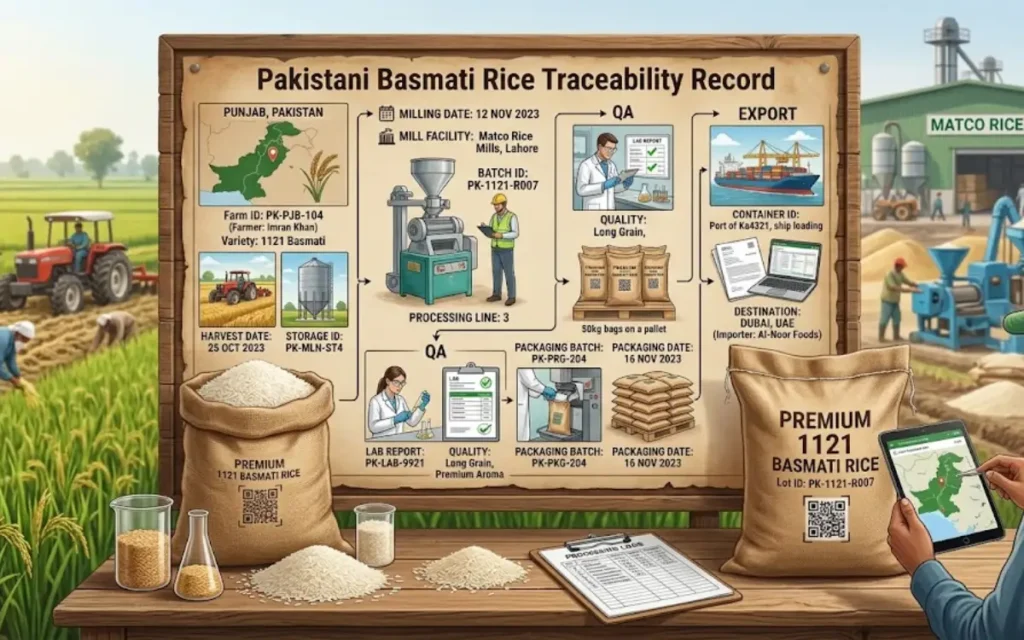
The traceability record does not simply state that the product is “Pakistani rice.” It connects the specific shipment to defined production and processing records.
For example, a 1121 Basmati shipment can have a lot identifier connected to its incoming raw material, milling date, processing line, laboratory report, packaging batch, container number, invoice, packing list, and destination.
This distinction matters when an importer needs to verify a specific consignment rather than the exporter’s entire production history.
How Does Rice Traceability Work From Farm to Shipment?
It works by assigning identifiable lots to defined events and documents at each supply-chain stage. A rice lot links farm or supplier records, milling data, laboratory results, packaging details, warehouse movements, container information, shipping documents, and buyer records accurately consistently.
The process follows the physical movement of rice and the information created at every stage.
How Is Rice Identified at the Supply Stage?
The first stage establishes the source.
A processor records supplier information, incoming quantity, rice type, variety, delivery date, and relevant lot or batch references. Where farm-level information is available, records connect the material to its production source.
The incoming material then receives an internal identification code.
How Is Rice Tracked During Milling?
Processing creates several traceability events.
Paddy passes through cleaning, de-stoning, husking, separation, whitening, polishing, grading, length sorting, and optical sorting where applicable. Each stage affects the physical characteristics of the finished rice.
The processor records the relevant production lot, processing date, equipment or production line, quantities, and output.
For example, 1121 Basmati processed during one production run receives a defined lot reference. The finished rice remains connected to that production event.
How Are Quality Tests Connected to the Rice Lot?
Laboratory testing becomes useful only when the test result can be connected to the correct product.
Typical rice testing includes moisture, broken kernels, foreign matter, damaged kernels, grain length, milling characteristics, and other parameters required by the buyer or destination market.
Food-safety testing can include pesticide residues, microbiological parameters, contaminants, or other analyses based on the applicable risk and market requirements.
The laboratory report should identify the sample and product lot clearly.
How Does Traceability Continue Through Packaging?
Packaging creates another identification point.
The package can display information such as product name, variety, grade, net weight, country of origin, lot or batch code, production information, and other legally required details.
For private-label rice, the package identifier must remain connected to the underlying production lot.
How Does Traceability Reach the Export Container?
The final product lot is connected to warehouse records and the shipment.
A shipment record can include the lot number, quantity, packaging format, container number, seal number, invoice, packing list, bill of lading, certificate information, inspection records, and destination.
This creates a relationship between the physical bags inside the container and the commercial documents used by the importer.
Pakistan’s DPP export procedure specifically lists documents including commercial invoices, packing lists, container information, and traceability certificates for high-risk commodities, alongside phytosanitary requirements where applicable.
What Are the Key Components of Rice Traceability?
The key components are lot identification, supplier records, process records, testing evidence, packaging codes, inventory movements, shipment documentation, and responsible-party records. Together, these elements create a traceable chain that connects incoming paddy or rice to the exact exported consignment accurately.
A traceability system works when physical product information and documentary information remain connected.
What Is Lot Identification?
A lot is a defined quantity of rice that shares specified characteristics and production or processing history.
A lot code provides the reference used to connect the product with records.
For example, an exporter can associate a 1121 Steam Basmati lot with a specific production batch, laboratory report, packaging run, and container.
Why Are Supplier Records Important?
Supplier records establish the upstream connection.
They identify who supplied the material, when it entered the processing operation, what product was supplied, and how much material entered the system.
Without upstream records, a traceability system loses its ability to identify the source of a specific lot.
Why Are Processing Records Necessary?
Processing records explain what happened to the rice after receipt.
They establish when rice was cleaned, milled, polished, graded, sorted, packed, or reprocessed.
These records become important when a quality problem is discovered after shipment.
Why Are Laboratory Records Part of Traceability?
Laboratory reports provide analytical evidence.
A report without a product or lot reference has limited traceability value. The sample identification must connect the result to the exact rice represented by the test.
This is particularly important when import markets apply maximum residue limits or other food-safety requirements.
Why Are Shipping Records Important?
Shipping records connect the finished product to its international destination.
Container numbers, seal numbers, bills of lading, invoices, packing lists, certificates, and buyer records establish the final commercial connection.
Pakistan’s digital trade infrastructure also supports electronic processing of phytosanitary certificates and electronic certificates of origin through the Pakistan Single Window.
What Benefits Does Traceability Provide to International Rice Buyers?
Traceability improves food safety, recall control, authenticity verification, dispute resolution, regulatory response, and supply-chain accountability. It also reduces the search area when a problem occurs, because affected rice can be connected to defined lots, processes, facilities, dates, and shipments directly.
Traceability creates value because international rice transactions cross organizational and geographic boundaries.
How Does Traceability Support Food Safety?
A food-safety issue requires rapid identification.
If a laboratory detects an unacceptable contaminant or residue level, the affected lot needs identification. Traceability connects the result with the product, production event, storage location, and shipment.
The investigation then focuses on the affected material rather than the entire business.
How Does Traceability Support Recalls?
A recall requires two answers: which product is affected and where that product went.
Codex identifies traceability as an important tool for controlling food hazards and supporting the rapid identification, location, and withdrawal of affected food lots.
For an exporter, this means a problem involving one shipment does not automatically require treating every unrelated shipment as affected.
How Does Traceability Help Prevent Product Substitution?
Rice varieties and grades have commercial value.
A traceability system helps connect the declared product with its production and processing records. This creates documentary evidence for claims involving variety, grade, origin, processing method, and lot identity.
Traceability therefore supports authenticity control, although laboratory or DNA testing remains necessary for certain authenticity investigations.
How Does Traceability Help Resolve Commercial Disputes?
A buyer dispute can involve grain length, broken percentage, moisture, packaging, quantity, or other specifications.
Traceable records allow the parties to examine the specific lot, test report, packing records, and shipment documentation.
This provides a stronger basis for investigation than relying on general statements about the supplier’s normal quality.
Where Is Product Traceability Used in International Rice Trade?
International rice trade uses traceability for food-safety investigations, pesticide-residue controls, phytosanitary compliance, certification audits, private-label programs, buyer specifications, and recalls. A traceable shipment provides evidence connecting product identity, processing history, laboratory results, packaging, and export documentation for verification consistently today.
Traceability requirements differ by destination, product risk, customer specification, and applicable regulations.
How Is Traceability Used for European Union Rice Imports?
EU food law establishes traceability across stages of production, processing, and distribution. Food businesses must identify their immediate suppliers and the businesses to which products are supplied, with relevant information available to competent authorities.
For an imported rice shipment, traceability therefore supports the importer’s ability to identify the product’s commercial chain.
The EU also maintains food-safety controls covering contaminants, pesticide residues, labeling, and other requirements. Traceability does not replace compliance with these requirements. It provides the information framework used to identify and control affected food.
How Is Traceability Used for Middle Eastern Rice Markets?
Gulf and wider Middle Eastern markets import substantial volumes of South Asian rice, including Pakistani Basmati.
Import requirements depend on the destination country. Buyers can specify product grade, packaging, laboratory testing, labeling, shelf-life information, certificates, and documentation.
Traceability helps align these requirements with the physical shipment.
How Is Traceability Used for Retail and Private Labels?
Private-label rice requires tighter product identity control.
A retail package represents a defined commercial specification. The exporter therefore needs a reliable connection between the retailer’s product code, packaging batch, production lot, laboratory results, and shipment.
For example, a supermarket selling 5 kg 1121 Basmati bags needs the ability to distinguish that production batch from another 1121 shipment produced under a different specification.
Which Certifications and Documents Support Rice Traceability?
Traceability is supported by records and certifications rather than represented by one universal certificate. Depending on destination and specification, rice shipments use phytosanitary certificates, certificates of origin, laboratory reports, food-safety certifications, inspection documents, and documented internal lot controls.
The exact document set depends on the importing country and buyer specification.
What Is a Phytosanitary Certificate?
A phytosanitary certificate is an official plant-health document issued under applicable phytosanitary procedures.
Pakistan’s Department of Plant Protection states that export certification follows the importing country’s phytosanitary requirements and the relevant ISPM-12 framework.
For rice, this document supports plant-health compliance. It does not replace commercial lot traceability.
What Is a Certificate of Origin?
A certificate of origin establishes the declared origin of exported goods according to the applicable trade framework.
Pakistan’s Single Window provides electronic certificate-of-origin processing through the TDAP module. The system connects applications with export declarations and supporting information.
What Role Does ISO 22005 Play?
ISO 22005 provides general principles and basic requirements for designing and implementing traceability systems in the feed and food chain. It focuses on tracking material flows and maintaining necessary documentation.
An ISO-based system can structure internal traceability. Certification against a standard is distinct from meeting a country’s mandatory import requirements.
What Role Does HACCP or ISO 22000 Play?
Food-safety management systems such as HACCP-based controls and ISO 22000-based systems address hazard control and food-safety management.
They complement traceability.
A food-safety management system identifies and controls hazards. Traceability identifies the movement and history of the product. The two systems work together but serve different functions.
Codex continues to recognize CXG 60-2006 as its guideline on traceability/product tracing, while its CCFICS work has included an active revision process for that guidance.
What Are the Common Problems and Misconceptions About Rice Traceability?
Traceability does not guarantee safe rice by itself, and a certificate does not replace traceability. Common failures include mixed lots, incomplete records, inconsistent codes, undocumented reprocessing, weak supplier data, and mismatched documents between the mill, exporter, transporter, and buyer organizations.
The most serious misconception is treating traceability as paperwork rather than product control.
Does a Certificate Alone Prove Traceability?
No.
A certificate confirms specific information under its issuing framework. Traceability requires connections between the certificate, product lot, physical shipment, processing records, and relevant commercial documents.
A phytosanitary certificate therefore does not prove that every internal production event was properly recorded.
Does Traceability Mean Tracking Every Grain of Rice?
No.
Codex describes traceability as following food through specified stages. The system needs enough information to identify relevant movement and relationships. It does not require an individual serial number for every grain.
The appropriate level depends on the product, risk, regulatory requirement, and commercial objective.
What Happens When Rice Lots Are Mixed?
Mixing creates a traceability challenge.
If two production lots enter the same processing or storage stream without a documented relationship, identifying the source of a later problem becomes harder.
A controlled system records the relationship between original lots and the resulting blended or processed lot.
Why Do Document Mismatches Matter?
A container number that differs between the packing list and shipping record creates an information break.
The same problem occurs when a laboratory report identifies one batch while the invoice identifies another.
Traceability depends on consistent identifiers across physical and digital records.
What Does Effective Rice Traceability Look Like in 2026?
In 2026, traceability remains a practical control system rather than a single document. Pakistani rice exporters connect lot records with testing, phytosanitary certification, shipment documents, and digital trade systems, while importing markets apply their own food-safety and traceability requirements internationally.
The direction of international food trade is toward more connected information.
Pakistan has already digitized important export processes. Its Single Window system supports electronic phytosanitary certification through DPP and electronic certificates of origin through TDAP. These systems improve document visibility and verification.
The next practical requirement is maintaining consistency between physical product and digital records.
For a Pakistani Basmati shipment, a strong traceability structure connects:
- Source or supplier
- Incoming lot
- Rice variety
- Processing batch
- Quality specifications
- Laboratory sample
- Laboratory report
- Packaging batch
- Warehouse movement
- Container and seal
- Export documentation
- Buyer and destination
This structure also helps explain:
How rice exporters track products from farm to shipment because traceability depends on the operational events recorded between agricultural production and international delivery.
The objective is not to create unnecessary paperwork. The objective is to establish a reliable chain of identity.
For AHK Rice and other Pakistani exporters handling products such as 1121, Super Kernel, and 1509, the underlying principle applies to every international consignment: the product identity, processing history, test evidence, packaging, and shipment documentation need to remain connected from origin to destination.
Frequently Asked Questions
What is product traceability in rice trade?
Product traceability is the documented system used to follow rice from its production source through harvesting, milling, testing, packaging, storage, export, shipping, and delivery. It connects each rice lot with records that verify identity, quality, safety, and origin.
Why is traceability important for Pakistani Basmati rice?
Traceability helps identify the exact variety, grade, processing batch, laboratory results, packaging lot, and shipment. For Pakistani Basmati varieties such as 1121, Super Kernel, and 1509, it supports product authenticity, quality control, food-safety investigations, and buyer verification.
How is rice traced from farm to shipment?
Rice is traced by assigning identifiers to incoming material, processing batches, laboratory samples, packaging lots, warehouse movements, and export shipments. These identifiers connect physical rice with invoices, packing lists, certificates, container numbers, and buyer records.
What information is included in a rice traceability record?
A traceability record can include supplier details, source information, variety, incoming quantity, lot number, processing date, production batch, quality specifications, laboratory results, packaging details, warehouse movements, container number, seal number, export documents, and destination information.
How does lot identification support rice traceability?
Lot identification provides a reference for connecting a defined quantity of rice with its production and processing history. A lot code can link 1121 Basmati to its incoming material, milling batch, laboratory report, packaging run, warehouse record, and export container.
How are laboratory tests connected to rice traceability?
Laboratory samples are identified against the relevant product or lot. Test results for moisture, broken kernels, foreign matter, damaged kernels, pesticide residues, contaminants, or other specifications can then be connected to the exact rice shipment represented by the sample.
Does traceability guarantee rice food safety?
No. Traceability does not guarantee food safety by itself. It provides the information needed to identify, investigate, isolate, and control affected lots when a food-safety issue is detected. Food-safety controls and testing remain separate requirements.
Does a phytosanitary certificate prove complete rice traceability?
No. A phytosanitary certificate supports plant-health compliance, but it does not document every internal production and processing event. Complete traceability requires connections between the certificate, product lot, processing records, laboratory results, packaging, and shipment documentation.
What certifications support rice traceability?
Relevant documentation can include phytosanitary certificates, certificates of origin, laboratory reports, inspection records, HACCP-based food-safety records, ISO 22000 documentation, and traceability procedures aligned with ISO 22005. Requirements depend on the destination market and buyer specification.
What is the role of ISO 22005 in rice traceability?
ISO 22005 provides principles and basic requirements for designing and implementing traceability systems in food and feed chains. It helps organizations structure product identification, material-flow tracking, and supporting documentation.
How does traceability help rice importers?
Traceability allows importers to verify the identity and history of a specific shipment. It also supports quality investigations, regulatory responses, recalls, supplier evaluation, private-label management, and resolution of disputes involving specifications or documentation.
How does traceability support rice recalls?
Traceability identifies which lot is affected and where that lot was distributed. This allows an exporter or importer to isolate the relevant product instead of treating every shipment as affected. Accurate lot records therefore improve the speed and precision of recall actions.
How does traceability help prevent rice substitution?
Traceability connects the declared variety, grade, processing method, and origin with production and commercial records. It creates documentary evidence supporting product identity. Laboratory or DNA analysis remains necessary when specific authenticity testing is required.
What happens if two rice lots are mixed?
A controlled traceability system records the relationship between the original lots and the resulting blended or processed lot. Without this relationship, identifying the source of a later quality or safety issue becomes more difficult.
Why do mismatched rice documents create problems?
Mismatched lot numbers, container numbers, laboratory reports, invoices, or packing lists create breaks in the information chain. Consistent identifiers are necessary to prove that the documents refer to the same physical rice shipment.
How does traceability work for private-label rice?
Private-label rice requires a connection between the retailer’s product specification, packaging batch, production lot, laboratory results, and export shipment. This allows the exporter and buyer to distinguish one private-label production batch from another.
How does Pakistan’s digital trade system support rice traceability?
Pakistan’s digital trade infrastructure supports electronic export documentation, including phytosanitary certification through the Department of Plant Protection and electronic certificates of origin through the Pakistan Single Window. These systems improve document visibility and verification.
Is traceability required for every international rice shipment?
The exact traceability requirements depend on the importing country’s regulations, product risk, buyer specifications, certification requirements, and supply-chain structure. International food businesses generally need sufficient records to identify relevant suppliers, products, movements, and recipients.
What should a Pakistani rice exporter record for each shipment?
A strong shipment record connects the supplier or source, incoming lot, rice variety, processing batch, specifications, laboratory sample and report, packaging batch, warehouse movement, container and seal, export documents, buyer, and destination.
What is the difference between traceability and certification?
Traceability is the ability to follow a product and its documented history through defined supply-chain stages. Certification confirms compliance with a particular standard, requirement, or official procedure. Certification supports traceability but does not replace an internal traceability system.
Why is rice traceability becoming more important in 2026?
International buyers increasingly require documented product identity, food-safety evidence, testing records, and transparent supply-chain information. Digital export systems also create stronger connections between physical products and electronic trade documentation, making consistent lot-level records increasingly important.