How Does Crop Year Affect the Quality of Pakistan Basmati Rice in the UAE?
Crop year directly affects the aroma, moisture level, cooking performance, grain stability, and commercial value of Pakistan Basmati rice in the UAE. Here is why: freshly harvested rice contains higher moisture, while properly aged rice develops stronger fragrance, cooks more uniformly, and produces longer separated grains after cooking.
Pakistan supplies millions of tonnes of rice to international markets every year, including the UAE, Saudi Arabia, Oman, Qatar, Europe, and North America (Source: Pakistan Bureau of Statistics FY2024–25). Among all quality specifications, crop year remains one of the most important purchasing factors because it determines how the rice performs after milling, shipping, storage, and cooking.
Understanding crop year also helps wholesale buyers compare rice beyond price. Buyers who evaluate harvest year alongside grain length, moisture content, broken percentage, and milling quality receive more consistent shipments. Readers who want to understand how storage changes rice performance can continue with our guide comparing freshly harvested and naturally aged Pakistan 1121 rice for wholesale purchasing .
What Is Crop Year in Pakistan Basmati Rice?
Crop year identifies the harvest season of the rice. It determines freshness, moisture content, aging period, and cooking characteristics before export.
Crop year refers to the agricultural season during which paddy rice is harvested. Pakistan cultivates Basmati rice mainly in Punjab. Farmers harvest the crop between October and November after approximately 120 to 150 growing days.
The harvested paddy enters rice mills where processors clean, dry, de-husk, polish, grade, inspect, and package the rice before export. The crop year remains associated with every production lot because buyers require traceability throughout international trade.
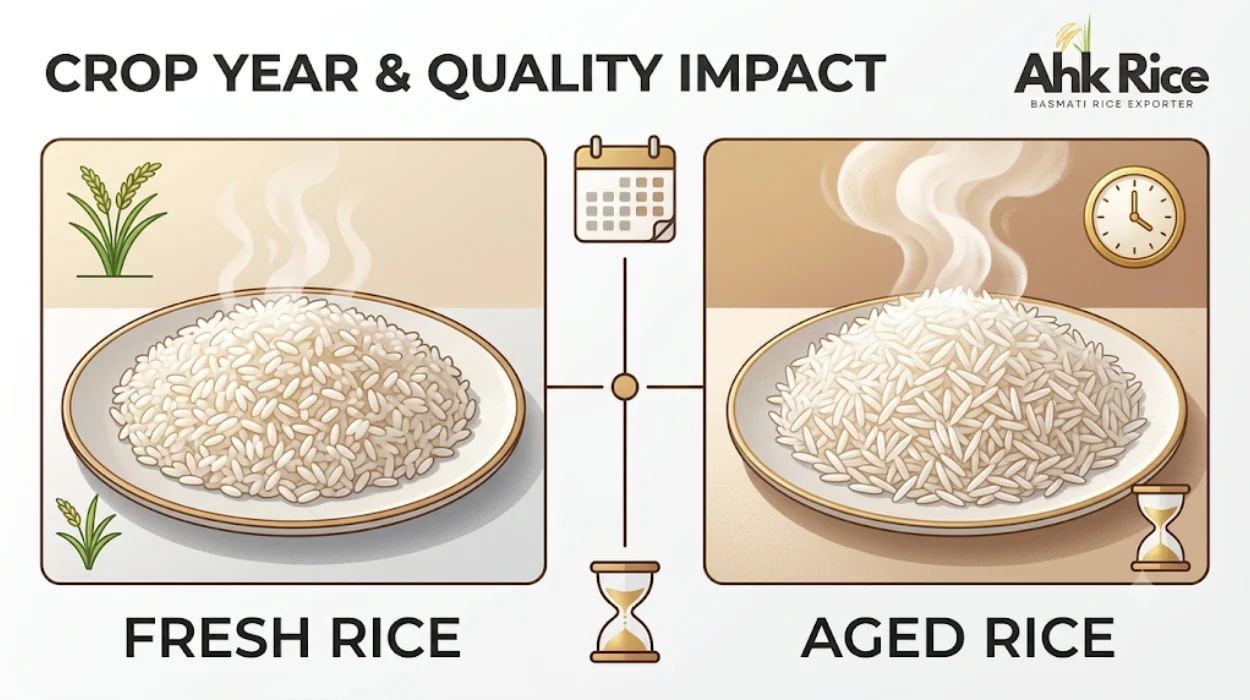
Different crop years create measurable differences in physical and cooking properties. Freshly harvested rice contains more internal moisture than naturally aged rice. Aging gradually reduces moisture while strengthening the characteristic Basmati aroma.
How Is Crop Year Recorded?
Exporters identify crop year using harvest records and production documentation.
Typical records include:
- Harvest date
- Paddy receiving date
- Milling date
- Batch identification
- Warehouse storage period
- Export inspection reports
These records improve traceability throughout the export process.
With the crop year clearly defined, the next question becomes how harvest age changes rice quality.
How Does Crop Year Change the Quality of Pakistan Basmati Rice?
Natural aging improves aroma, grain firmness, cooking expansion, and grain separation while reducing internal moisture to stable export levels.
Rice quality continues developing after harvest. Natural biochemical changes occur during storage under controlled warehouse conditions.
Fresh crop rice generally contains higher moisture. During aging, moisture gradually stabilizes. This process strengthens the natural fragrance associated with premium Pakistan Basmati rice.
Several quality characteristics improve during aging.
Aroma Development
Natural aromatic compounds become more concentrated over time.
Export buyers usually notice:
- stronger fragrance
- cleaner cooked aroma
- improved sensory quality
Cooking Performance
Aged rice cooks more consistently because internal moisture reaches equilibrium.
Wholesale catering companies prefer aged rice because cooked grains remain longer and separate more easily after steaming.
Grain Stability
Grain hardness increases during controlled storage.
Harder grains resist breakage during milling and transportation. Reduced breakage improves export grading and commercial value.
The relationship between crop year and quality leads directly to processing, because every milling stage preserves these natural characteristics.
How Is Pakistan Basmati Rice Processed After Harvest?
Proper processing preserves the benefits created by cultivation and aging through controlled cleaning, drying, milling, grading, testing, and packaging.
Rice processing begins immediately after farmers deliver harvested paddy to the mill.
Every processing stage protects grain quality before export.
Step-by-Step Processing
- Clean the harvested paddy.
- Dry the paddy to target moisture.
- De-husk the grain.
- Separate immature kernels.
- Polish the rice.
- Grade by grain length.
- Sort using optical colour sorters.
- Inspect every production batch.
- Package according to export specifications.
Each stage influences the final export quality.
Modern processing plants also inspect moisture percentage, damaged kernels, chalky grains, foreign matter, and broken rice before dispatching shipments.
Quality inspection remains essential because UAE importers require consistent specifications across every container.
With processing complete, buyers evaluate rice according to commercial grades rather than processing stages.
What Grades of Pakistan Basmati Rice Are Available for UAE Buyers?
Pakistan exports several premium Basmati grades, including 1121, Super Kernel, and 1509, each serving different commercial applications.
Different varieties satisfy different market requirements. Grain dimensions, aroma intensity, cooking length, and pricing vary between grades.
1121 Basmati Rice
1121 Basmati produces exceptionally long cooked grains.
Typical buyers include:
- supermarkets
- hospitality groups
- premium restaurants
- retail brands
Super Kernel Basmati Rice
Super Kernel offers traditional aroma and strong consumer recognition across Gulf markets.
Many retail brands continue selecting this variety because consumers associate it with authentic Pakistani Basmati.
1509 Basmati Rice
1509 matures earlier than traditional varieties.
It offers competitive pricing while maintaining attractive cooking characteristics for wholesale distribution.
Each grade responds differently to crop age, making harvest year an important comparison factor before procurement.
What Are the Benefits of Verifying Crop Year Before Importing Pakistan Basmati Rice?
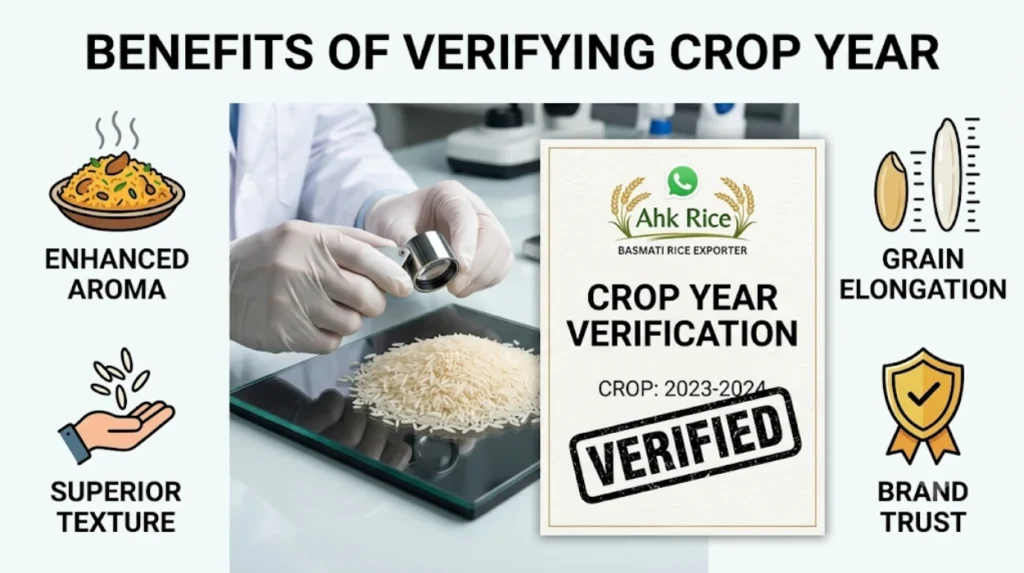
Buyers who verify crop year receive more consistent aroma, predictable cooking performance, longer shelf life, stronger grain integrity, and fewer commercial disputes.
Crop year verification reduces uncertainty during procurement. Every shipment carries measurable quality characteristics that develop after harvest. Buyers who understand these differences compare rice using objective specifications instead of relying only on price.
Better Aroma Retention
Naturally aged Pakistan Basmati rice develops a richer fragrance because aromatic compounds stabilize during storage. UAE consumers often associate this distinctive aroma with premium-quality Basmati. Retail brands benefit from stronger customer satisfaction when every shipment delivers the expected fragrance.
Improved Cooking Results
Aged rice absorbs water more evenly during cooking. Uniform moisture distribution allows grains to expand without sticking together. Hotels, restaurants, and catering companies prefer rice that delivers consistent plate presentation across thousands of daily servings.
Lower Breakage During Processing
Properly matured grains become firmer after controlled storage. Stronger kernels resist breakage during milling, grading, loading, and shipping. Lower broken percentages improve export grades and increase commercial value.
Longer Storage Stability
Wholesale importers often store inventory for several months before distribution. Rice harvested in an earlier crop year and stored correctly maintains quality longer than freshly harvested rice with elevated moisture levels.
Better Purchasing Decisions
Crop year allows buyers to compare suppliers using measurable specifications instead of marketing descriptions. Combined with grain length, moisture percentage, broken percentage, and purity standards, harvest year creates a complete quality profile.
Understanding these advantages naturally leads to identifying which export markets pay the closest attention to crop year.
Which Markets Pay the Most Attention to Crop Year?
The UAE, Saudi Arabia, Qatar, Kuwait, Oman, Europe, Canada, and North America regularly evaluate crop year because premium buyers demand consistent cooking quality and traceability.
Different importing regions purchase Pakistan Basmati rice for different commercial purposes. Crop year influences purchasing decisions according to customer expectations.
UAE
The UAE imports premium Basmati for supermarkets, hospitality groups, restaurants, and food distributors. Buyers prioritize aroma, grain length, cooking consistency, and shelf life because products often remain in warehouses before retail distribution.
Gulf Cooperation Council Markets
Saudi Arabia, Qatar, Oman, Bahrain, and Kuwait also import significant volumes of Pakistan Basmati rice. Premium food service businesses frequently request aged rice because it produces better grain separation after cooking.
European Markets
European importers focus heavily on documentation and traceability. Crop year forms part of broader quality verification alongside laboratory testing, food safety compliance, and export certification.
North American Markets
Retail brands serving South Asian communities evaluate crop year together with grain dimensions, packaging standards, and cooking performance.
These international requirements explain why certifications accompany every export shipment.
Which Certifications Support Crop Year Verification?
Export certifications verify quality, food safety, traceability, and compliance with importing country requirements before rice leaves Pakistan.
Certification does not replace crop year information. Instead, it confirms that the exported rice satisfies recognized quality standards.
Common export certifications include:
- ISO 22000 Food Safety Management
- HACCP Certification
- Phytosanitary Certificate
- Certificate of Origin
- Fumigation Certificate
- Quality Inspection Certificate
- Packing List
- Commercial Invoice
- Bill of Lading
Laboratories also inspect:
- Moisture percentage
- Broken kernels
- Chalky grains
- Foreign matter
- Damaged kernels
- Grain dimensions
These documents provide confidence throughout international trade.
With certification complete, buyers should also understand common misconceptions surrounding crop year.
What Misconceptions Exist About Crop Year?
Fresh crop rice is not automatically better, and older rice is not automatically superior. Proper storage determines whether aging improves quality.
Several misunderstandings create confusion during procurement.
Misconception 1: Fresh Rice Always Has Better Quality
Fresh harvest rice contains higher moisture. Higher moisture reduces storage stability and changes cooking performance. Fresh rice serves certain regional markets but does not automatically represent premium quality.
Misconception 2: Older Rice Always Delivers Better Results
Storage conditions determine aging quality. Rice stored in controlled warehouses maintains aroma and grain integrity. Poor storage introduces moisture fluctuations that reduce commercial quality.
Misconception 3: Crop Year Alone Determines Value
Crop year represents only one specification. Buyers should also inspect:
- Grain length
- Moisture percentage
- Broken percentage
- Purity
- Milling quality
- Variety
- Packaging
- Laboratory reports
Evaluating every specification together creates reliable purchasing decisions.
With these misconceptions resolved, the topic returns to the importance of informed sourcing.
Crop year directly influences the commercial quality of Pakistan Basmati rice imported into the UAE because harvest age changes aroma, moisture balance, cooking performance, grain strength, and storage stability. Buyers who evaluate crop year together with processing quality, export grading, laboratory inspection, and certification receive more predictable shipments and stronger long-term value.
Pakistan continues supplying premium Basmati rice to international markets because its cultivation environment, modern milling facilities, and established export standards support consistent quality (Source: REAP Export Data, December 2025). Understanding crop year helps wholesalers, distributors, retailers, and food service companies compare suppliers using measurable quality indicators instead of price alone.
Frequently Asked Questions
What is the crop year of Pakistan Basmati rice?
Crop year identifies the agricultural season in which the rice was harvested. It helps buyers evaluate freshness, aging period, and expected cooking performance.
Why is aged Pakistan Basmati rice preferred in the UAE?
Aged rice develops stronger aroma, cooks more evenly, produces better grain separation, and remains stable during long-term storage.
Which Pakistan Basmati varieties are commonly exported?
The most common premium export varieties include 1121 Basmati, Super Kernel Basmati, and 1509 Basmati.
Does crop year affect export quality?
Yes. Crop year influences moisture content, grain hardness, aroma development, milling performance, and shelf life.
How do exporters verify crop year?
Exporters maintain harvest records, batch numbers, milling records, warehouse documentation, quality inspection reports, and shipment traceability documents.