Why Does Crop Year Matter When the UAE Imports Pakistan Basmati Rice?
Importing Pakistan Basmati rice without confirming its crop year creates unnecessary commercial risk. Buyers who verify harvest year receive better aroma, predictable cooking performance, consistent grain quality, and fewer shipment disputes. Before comparing suppliers, learn how quality inspections work in our guide on foreign matter specifications for premium Pakistan rice exporters serving UAE buyers. If you are evaluating exporters, our comparison guide on choosing a Pakistan Basmati rice supplier that meets UAE foreign matter requirements explains supplier selection criteria in greater detail.
Crop year directly influences fragrance, moisture, grain stability, shelf life, and export value. UAE importers regularly request crop-year confirmation before signing purchase agreements because it affects retail quality and customer satisfaction. AHK Rice supplies verified crop-year Pakistan Basmati rice with complete export documentation, laboratory inspection, and shipment transparency.
What Is the Best Solution for Choosing the Right Crop Year?
The best solution is to purchase Pakistan Basmati rice with a verified crop year, laboratory inspection reports, moisture certification, and complete export documentation. Verified harvest information reduces quality uncertainty, protects import investments, improves customer satisfaction, and minimizes claims after shipment reaches UAE ports.
Many buyers focus only on price. Professional importers evaluate harvest year before negotiating.
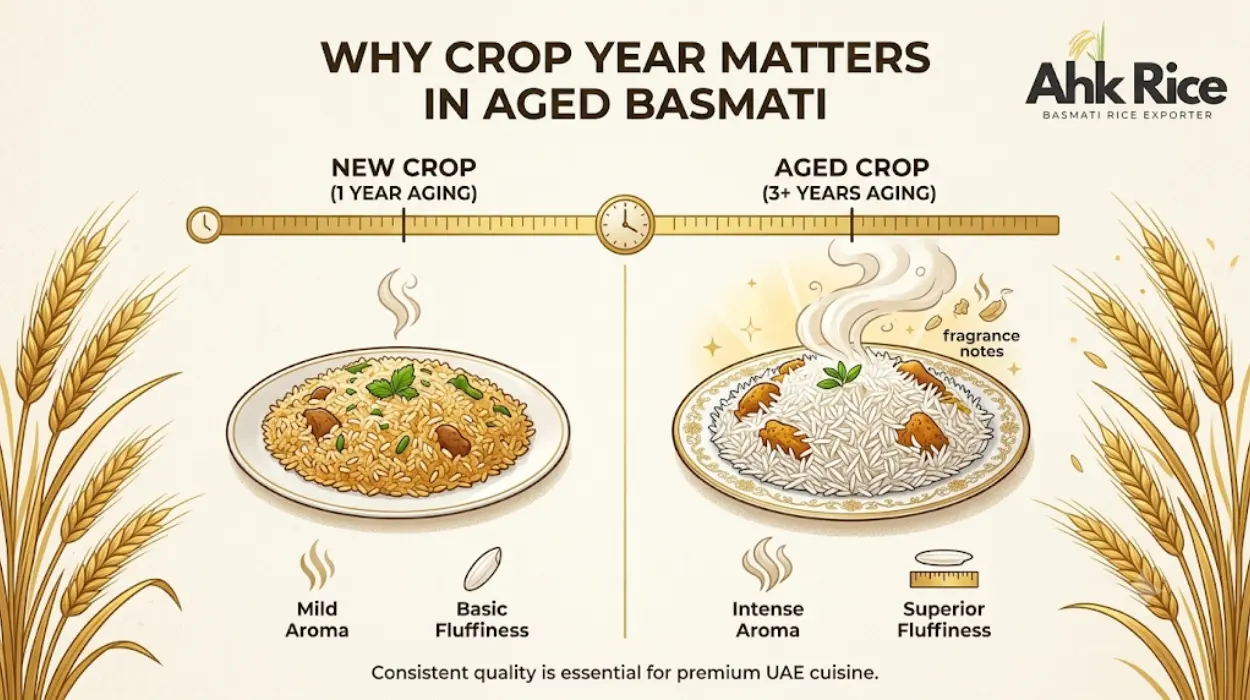
Freshly harvested rice usually contains higher moisture. This affects cooking consistency and storage stability. Properly matured rice develops stronger aroma and improved grain elongation.
AHK Rice identifies crop year in commercial invoices, packing lists, quality certificates, and buyer specifications. This creates transparency throughout the export process.
Importers purchasing aged Basmati generally experience:
- Better aroma
- Longer grain elongation
- Improved cooking texture
- Lower moisture variation
- Better retail acceptance
These quality improvements help UAE distributors build stronger customer loyalty.
Why Does Crop Year Affect Pakistan Basmati Rice Quality?
Crop year determines natural aging, moisture reduction, aroma development, cooking behavior, and storage performance. Even identical rice varieties perform differently when harvested in separate seasons because maturation continues after harvesting under controlled storage conditions.
Basmati rice improves after controlled aging.
Fresh crop rice often contains higher moisture percentages. During storage, moisture gradually stabilizes while aroma compounds become more concentrated.
This natural process produces:
- Better fragrance
- Reduced stickiness
- Improved grain separation
- Higher cooking volume
- Longer grain expansion
AHK Rice stores export-quality rice under controlled warehouse conditions before processing and shipment.
For premium UAE retailers, these differences directly influence customer satisfaction.
Why Choose AHK Rice?
Choosing AHK Rice provides verified crop-year documentation, export-quality processing, strict laboratory testing, professional logistics, and transparent communication from inquiry until shipment arrival. These services reduce purchasing risk while ensuring buyers receive consistent Pakistan Basmati rice that meets commercial expectations.
The first priority for commercial buyers is consistency.
AHK Rice offers complete export support through its Pakistan Basmati rice export services for wholesalers, supermarket chains, food distributors, and private-label brands.
Every shipment passes multiple quality inspections before loading.
Services include:
- Crop year verification
- Moisture testing
- Foreign matter inspection
- Broken percentage verification
- Color sorting
- Metal detection
- Packaging customization
- Export documentation
AHK Rice also assists buyers with packaging designs, labeling requirements, and UAE import documentation.
This complete approach reduces delays during customs clearance.
What Results Can UAE Importers Expect?
Importers selecting verified crop-year Pakistan Basmati rice usually experience fewer quality complaints, stronger consumer confidence, better repeat orders, improved shelf stability, and lower financial losses resulting from inconsistent product quality or rejected shipments after arrival.
Restaurants require consistency.
Retailers require attractive appearance.
Distributors require reliable supply.
A verified crop year helps satisfy all three requirements.
With AHK Rice, importers receive quality reports before shipment.
Each production batch is matched against buyer specifications.
Typical outcomes include:
- Improved customer satisfaction
- Better cooking consistency
- Reduced return rates
- Stronger distributor relationships
- Higher product reputation
These benefits create long-term commercial value.
What Factors Affect Pricing?
Pakistan Basmati rice pricing depends on crop year, rice variety, aging period, processing quality, packaging specifications, order quantity, freight costs, destination port, and current international market conditions rather than only harvest volume or supplier pricing strategies.
Older crop rice generally costs more.
The additional storage period increases warehouse expenses while improving quality.
Major pricing factors include:
| Pricing Factor | Impact |
|---|---|
| Crop Year | Older crops command premium prices |
| Rice Variety | 1121 generally costs more |
| Aging Period | Longer aging increases value |
| Packaging | Customized bags increase cost |
| Order Volume | Larger orders reduce unit cost |
| Freight Rates | Shipping market fluctuations |
| Destination Port | Different logistics expenses |
| Currency Exchange | Influences export quotations |
AHK Rice prepares customized quotations according to buyer specifications instead of offering one standard price.
How Does the Sample Approval Process Work?
Professional sample approval protects both exporter and importer by confirming product specifications before production begins. This process minimizes misunderstandings and ensures the delivered shipment matches the approved quality standard agreed upon in commercial negotiations.
A standard export sample process follows these steps:
Step 1: Requirement Discussion
The buyer shares:
- Rice variety
- Crop year preference
- Packaging
- Quantity
- Destination
Step 2: Sample Preparation
AHK Rice prepares representative rice samples from available stock.
Step 3: Laboratory Verification
Samples undergo testing for:
- Moisture
- Broken grains
- Foreign matter
- Chalkiness
- Grain length
Step 4: Sample Dispatch
Courier companies deliver samples worldwide.
Typical courier cost:
- UAE: USD 35–60
- GCC Countries: USD 40–70
- Europe: USD 50–90
Sample preparation itself is generally free for qualified commercial buyers.
Step 5: Buyer Evaluation
The importer checks:
- Aroma
- Appearance
- Cooking quality
- Grain elongation
- Packaging
Step 6: Production Approval
Commercial production begins only after written approval.
This process significantly reduces shipment disputes.
How Long Does Shipping Take to Different Markets?
Shipping schedules depend on destination ports, vessel availability, customs procedures, and seasonal logistics. Buyers should plan procurement according to realistic transit times rather than estimated averages to maintain inventory without interruption.
Typical sea freight transit:
| Market | Estimated Shipping Days |
|---|---|
| Jebel Ali (UAE) | 12–18 Days |
| Abu Dhabi | 13–19 Days |
| Oman | 10–16 Days |
| Qatar | 14–20 Days |
| Bahrain | 15–22 Days |
| Kuwait | 16–22 Days |
| Saudi Arabia | 16–24 Days |
Production usually requires approximately 10–20 days, depending on order quantity and packaging requirements.
AHK Rice coordinates production and shipping schedules to reduce unnecessary waiting time.
How Can Buyers Verify Crop Year Before Ordering?
Verification should include commercial documents, laboratory reports, production records, warehouse information, and supplier declarations. Multiple verification methods provide stronger confidence than relying only on verbal confirmation during sales discussions.
Ask suppliers for:
- Crop year declaration
- Certificate of origin
- Laboratory report
- Moisture analysis
- Product specifications
- Production date
- Packing date
Professional exporters willingly provide these documents.
AHK Rice supplies complete documentation before shipment confirmation.
Transparency creates trust.
Trust supports long-term business relationships.
How Do You Get Started?
The purchasing process begins with defining your rice specifications, approving samples, confirming commercial terms, and selecting a verified exporter capable of supplying consistent crop-year Pakistan Basmati rice for UAE market requirements without compromising quality standards.
Start by identifying:
- Required rice variety
- Crop year
- Packaging size
- Quantity
- Destination port
- Delivery schedule
Next, request a commercial quotation.
Review laboratory reports.
Approve samples.
Confirm payment terms.
Production begins after approval.
Finally, request your personalized quotation through Request a Quote and let AHK Rice prepare a shipment tailored to your exact UAE import requirements.
Frequently Asked Questions
Why is crop year important when importing Pakistan Basmati rice into the UAE?
Crop year affects aroma, moisture content, grain maturity, cooking quality, and shelf life. Older, properly aged rice generally delivers better elongation and fragrance than fresh crop rice. UAE importers prefer verified crop years because they help maintain consistent retail quality and reduce customer complaints. Confirming the crop year also minimizes the risk of receiving rice that does not meet commercial expectations.
How can buyers verify the crop year before placing an order?
Buyers should request a crop year declaration, laboratory reports, production records, moisture analysis, and export documentation. Reliable exporters provide these documents before shipment confirmation. Sample approval and quality inspection reports further validate the supplied information. Multiple verification methods create confidence and reduce purchasing risks.
Does older Basmati rice always cost more?
In most cases, yes. Properly aged Basmati rice requires additional warehouse storage, quality monitoring, and inventory management, increasing overall costs. However, the higher price is usually justified by improved aroma, cooking performance, and customer satisfaction. Buyers should compare value instead of focusing only on the lowest quotation.
How long does it take to ship Pakistan Basmati rice to the UAE?
Sea freight from Pakistan to UAE ports generally takes between 12 and 18 days, depending on vessel schedules and customs procedures. Production may require an additional 10 to 20 days based on packaging, order size, and processing requirements. Buyers should always confirm shipping schedules before finalizing purchase contracts.
Why should UAE importers choose AHK Rice?
AHK Rice provides verified crop-year documentation, laboratory-tested quality, transparent communication, export compliance, and customized packaging solutions. Every shipment undergoes strict quality inspection before dispatch. This professional approach helps buyers receive consistent Pakistan Basmati rice while reducing commercial risk and improving long-term business performance.