How Does Export History Reflect Supplier Reliability and Consistency?
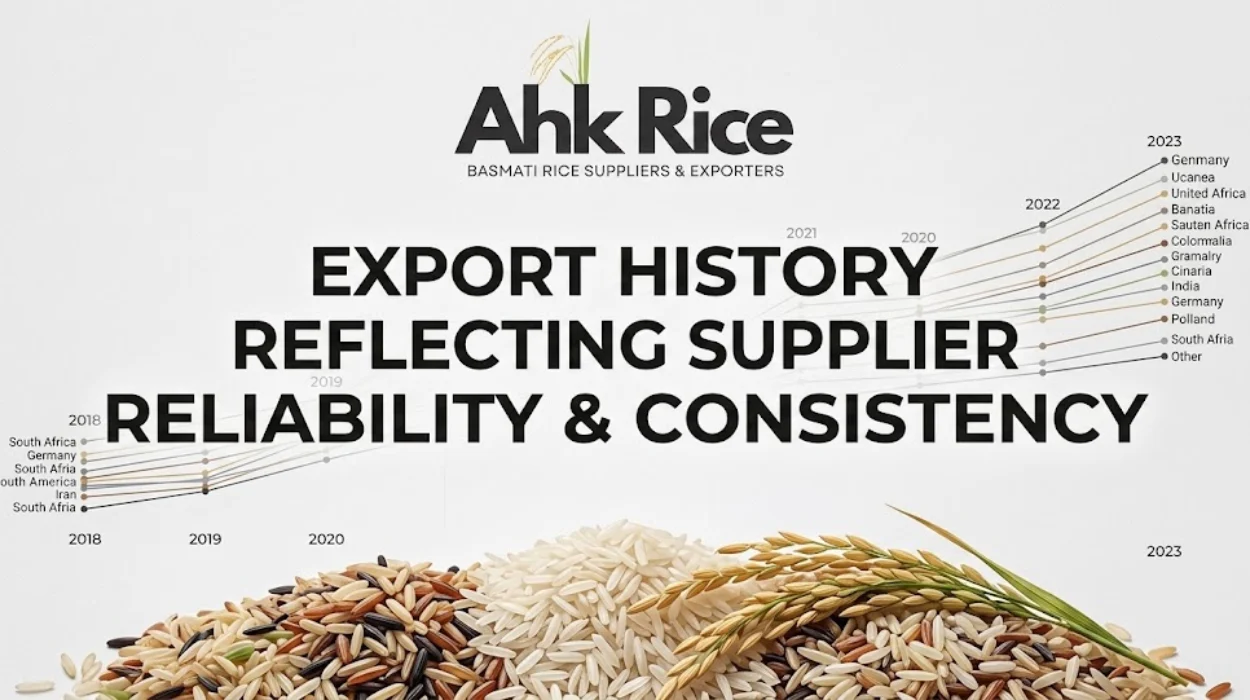
A supplier’s export history is one of the clearest indicators of whether it can repeat the same commercial performance after the first order. For Massachusetts importers, this matters because Pakistani Basmati rice must move through production, milling, inspection, documentation, ocean freight, customs clearance, and domestic distribution before it reaches restaurants, wholesalers, retailers, or foodservice buyers.
For buyers assessing supplier reliability,
Why Massachusetts importers prefer experienced rice exporters provides the educational foundation. Export history then becomes the evaluation layer: buyers can examine whether a supplier’s previous international shipments demonstrate repeatability rather than treating years in business as proof by itself.
Pakistan remains a major rice-exporting origin. USDA’s July 2026 Pakistan Grain and Feed Update forecasts 2026/27 rice production at 9.1 million metric tons and rice exports at 4.9 million metric tons, while 2025/26 exports are projected at 4.7 million metric tons. The same report identifies logistical challenges affecting Pakistan’s rice trade, making supplier execution even more important in 2026.
What are the available solutions for evaluating export reliability?
Massachusetts importers can choose an experienced exporter, a newer direct mill, a trading intermediary, or a broker-led sourcing model. Each option differs in traceability, documentation control, specification consistency, production visibility, communication speed, and ability to manage repeat container programs securely.
An experienced exporter has a documented history of selling and shipping rice internationally. The useful evidence is not simply the company’s founding year. It includes shipment destinations, product grades, repeat customers, container volumes, export documents, inspection records, and responses to quality issues.
A direct mill gives buyers closer visibility into processing. This model can work well when the mill controls paddy procurement, milling, sorting, grading, packaging, laboratory testing, and container loading. Its limitation appears when the mill has limited experience managing different destination requirements.
A trading intermediary sources rice from one or more mills. This can provide access to several grades and production sources. However, the importer must identify who actually controls processing, testing, packaging, and corrective actions.
A broker-led model focuses heavily on commercial matching. It can simplify supplier discovery but provides less direct evidence when the importer needs detailed production records or consistent private-label specifications.
For Massachusetts buyers, the key distinction is therefore evidence of repeat execution, not the supplier category alone.
How does export history compare across supplier types?
An experienced exporter provides strong evidence for recurring commercial programs because export records connect production, documentation, logistics, and customer requirements. A direct mill can excel on production control, while an intermediary can add sourcing reach but may reduce traceability directly.
The following comparison shows how the main approaches differ across seven procurement attributes.
| Attribute | Experienced Exporter | Direct Rice Mill | Trading Intermediary | Broker-Led Sourcing |
|---|---|---|---|---|
| Export history | Strong, shipment-based evidence | May be limited internationally | Depends on partner mills | Usually indirect |
| Specification control | High when standardized | High at factory level | Varies by mill | Depends on supplier |
| Documentation control | Strong | Moderate to strong | Varies | Often shared |
| Production visibility | High when exporter owns/controls processing | Very high | Medium | Low to medium |
| Multi-market experience | Usually high | Can be limited | Often high | Variable |
| Repeat-order management | Strong | Strong if capacity is available | Moderate to strong | Variable |
| Traceability | High | Very high | Medium | Lower |
Export history becomes especially valuable when the buyer is importing the same specification repeatedly. A supplier that shipped 1121 Basmati successfully to several markets has more useful commercial evidence than a supplier that only provides a current product catalogue.
For example, an importer ordering 20 containers annually needs confidence that the supplier can reproduce the agreed grain length, broken percentage, moisture level, foreign matter limits, packaging format, and labeling requirements. A single successful shipment does not prove that capability.
The history should also reveal whether the exporter has maintained customers across multiple seasons. Repeat purchasing is a practical indicator of commercial satisfaction, although buyers should still verify specifications independently.
Which market regions require different grade and pricing strategies?
Northeast U.S. buyers generally prioritize consistent long-grain Basmati specifications and regulatory documentation, while broader East Coast distribution programs require scalable volume and competitive landed cost. Grade choice changes procurement economics, shelf-life planning, and inventory strategy.
Massachusetts sits within the U.S. Northeast market, where Basmati rice demand comes from restaurants, ethnic grocery retailers, foodservice distributors, wholesalers, and private-label programs. Buyers typically prioritize long-grain appearance, cooking performance, packaging consistency, and documentation.
A second useful comparison is the broader U.S. East Coast distribution market, where larger distributors can consolidate demand across several states. These programs place greater emphasis on container availability, production capacity, shipping schedules, and price stability.
| Market region | Common grade preference | Indicative product price comparison | Shelf-life planning | Primary procurement priority |
| Massachusetts / Northeast | 1121 Steam, 1121 White, Super Kernel | 1121 Steam: ~$1,225/MT; 1121 White/Sella: ~$1,175/MT FOB reference | Commonly planned around 12–24 months, subject to pack and storage conditions | Consistency and compliance |
| Wider U.S. East Coast | 1121 Steam, Super Kernel, 1509 Steam | Premium grades generally command a higher FOB value than standard grades | Commonly planned around 12–24 months, subject to pack and storage conditions | Volume and landed cost |
The price figures above should be treated as FOB Pakistan procurement references rather than Massachusetts landed prices. Ocean freight, insurance, port charges, customs brokerage, inland transportation, duties where applicable, packaging, financing, and currency movements can materially change the final cost per metric ton.
Grade selection also changes the value equation. 1121 Steam Basmati is positioned toward premium long-grain applications where appearance and cooking performance support a higher selling price. Super Kernel can serve buyers seeking a premium Basmati profile with a different specification structure. 1509 varieties can provide another sourcing option when buyers balance grain characteristics and commercial pricing.
Shelf life should not be treated as a fixed number independent of packaging and storage. Rice quality depends on moisture control, packaging integrity, warehouse temperature, humidity, pest management, and stock rotation. An importer should therefore request the supplier’s stated shelf life and storage conditions for the exact SKU rather than applying a generic figure.
Export history helps here because established suppliers can demonstrate how the same product was packed, shipped, stored, and received in previous markets.
What are the pros and cons of using export history as a supplier metric?
Export history reduces procurement uncertainty because it provides evidence from completed transactions, but it cannot replace current specification testing, regulatory verification, or shipment inspection. Its value increases when historical records are detailed, destination-specific, recent, and connected to repeat commercial performance.
The main advantage is evidence. A supplier can claim reliability, but a shipment record can show whether containers actually moved repeatedly to international customers.
The second advantage is destination experience. Exporting to different countries requires exporters to manage different documentation, labeling, packaging, inspection, and logistical requirements. A supplier with U.S. experience is therefore better positioned to understand the operational requirements of Massachusetts buyers.
The third advantage is continuity. Historical shipments can reveal whether a supplier maintained supply during periods of price changes, harvest fluctuations, freight disruption, or production pressure.
The main disadvantage is that historical success can become outdated. A supplier may have strong export records but changes in ownership, factory arrangements, management, production capacity, or logistics partners can affect current performance.
Another limitation is that shipment volume does not automatically equal quality. An exporter can ship thousands of tons while producing specifications that do not match a particular importer’s requirements.
For example, a supplier may have exported large quantities of non-Basmati rice but have limited experience with premium 1121 Basmati specifications. Massachusetts buyers purchasing premium Basmati should therefore evaluate product-specific history.
The strongest evaluation combines export history with current samples, laboratory analysis, factory documentation, packaging specifications, and pre-shipment controls.
U.S. compliance also remains separate from commercial history. FDA states that imported food must meet the same legal requirements as domestically produced food. Covered facilities must meet applicable registration requirements, and importers must follow Prior Notice requirements.
FDA also requires food facilities subject to registration to renew registration every two years, while the agency can suspend registration in certain circumstances.
Therefore, an exporter’s history is valuable evidence, but it does not transfer regulatory responsibility away from the U.S. importer.
Which method works best for different Massachusetts buying cases?
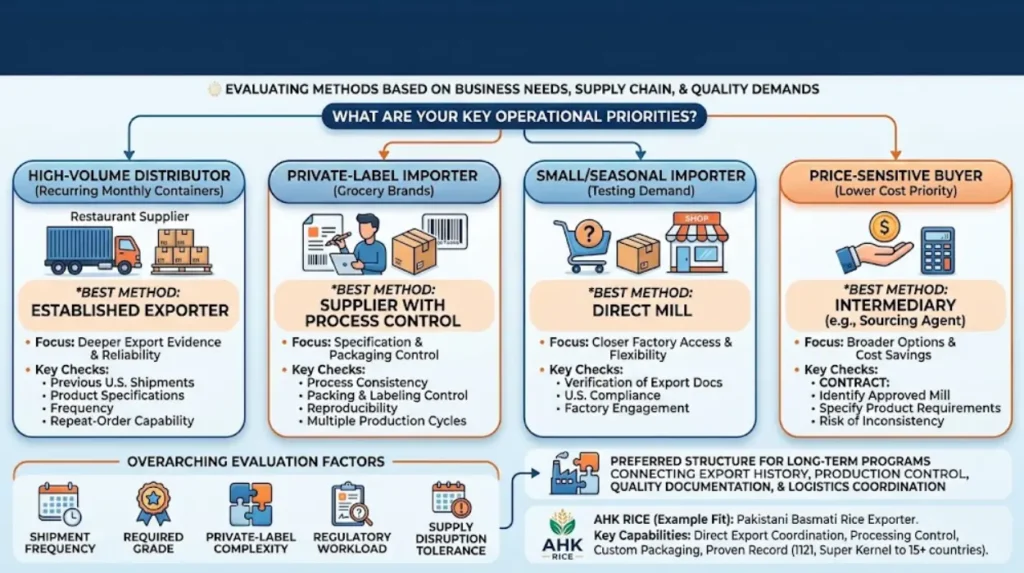
The best method depends on shipment frequency, required grade, private-label complexity, regulatory workload, and tolerance for supply disruption. A restaurant distributor ordering monthly containers needs deeper export evidence than a small importer testing one seasonal shipment or limited retail demand.
For a Massachusetts restaurant distributor with recurring container demand, an experienced exporter is usually the strongest starting point. The buyer should request evidence of previous U.S. shipments, product specifications, shipment frequency, and repeat-order capability.
For a private-label grocery importer, the priority shifts toward specification and packaging control. The supplier must demonstrate that the same rice grade can be processed, packed, labeled, and reproduced across multiple production cycles.
For a smaller importer testing demand, a direct mill can be attractive when the buyer wants closer factory access and does not require a large international distribution network. The buyer should still verify export documentation and U.S. compliance.
For a price-sensitive distributor, an intermediary may offer broader sourcing options. The risk is specification inconsistency when the intermediary changes mills between orders. The contract should identify the approved production facility and product specification.
For a long-term program, the preferred structure is one where export history, production control, quality documentation, and logistics coordination are connected.
AHK Rice fits this evaluation model as a Pakistani Basmati rice exporter based in Punjab, supplying 1121, Super Kernel, and 1509 varieties to 15+ countries. Its operating model includes processing, custom packaging, and export coordination, which are relevant capabilities when buyers evaluate consistency across repeat international shipments.
What decision factors should Massachusetts importers use?
Importers should evaluate export history as a measurable supplier-performance record rather than a marketing claim. The decision should combine shipment count, destination history, repeat-order evidence, specification stability, documentation accuracy, corrective-action records, production capacity, and communication before selecting a rice supplier.
A practical five-factor framework can help Massachusetts buyers compare suppliers objectively.
| Decision factor | What to verify | Why it matters |
| Export continuity | Shipment history for the last 3–5 years | Shows whether international supply is established |
| U.S. market experience | Previous U.S. shipments and documentation | Reduces destination-specific execution risk |
| Product consistency | COAs, samples, specifications, inspection records | Confirms that historical performance matches current product |
| Production capacity | Processing, storage, packing, and loading capability | Protects repeat container programs |
| Corrective-action performance | Evidence of how quality or logistics issues were resolved | Shows operational discipline under pressure |
The three-to-five-year review period is useful because it captures multiple procurement cycles rather than a single successful season. Buyers should request shipment evidence that is relevant to the actual product being purchased.
A Massachusetts importer buying 1121 Steam Basmati should examine 1121 Steam history rather than accepting general rice-export figures. Product-specific history provides a stronger connection between past performance and future procurement requirements.
Buyers should also compare shipment records against current capacity. Pakistan’s 2026 rice outlook demonstrates why this matters. USDA reduced the 2026/27 production forecast to 9.1 million metric tons in July 2026 and forecast exports at 4.9 million metric tons. The report also noted logistical challenges affecting exports.
This means export history should be interpreted together with current production conditions. A supplier that handled previous seasons successfully still needs sufficient present capacity, raw-material access, processing throughput, packaging availability, and shipping coordination.
Documentation should also be checked before contracting. FDA requires Prior Notice for covered food imports, and Prior Notice can be submitted through U.S. Customs and Border Protection’s electronic interface or FDA’s Prior Notice System Interface.
The final evaluation should therefore answer one commercial question: Can this supplier repeatedly deliver the same specification, in the required quantity, with correct documentation and predictable execution?
Export history provides the evidence base for that decision. Current testing, production verification, regulatory checks, and logistics planning complete the evaluation.
For Massachusetts buyers ready to move from supplier evaluation to a defined sourcing program, the next decision stage is:
Importing Pakistani Basmati rice into Massachusetts with AHK Rice, where the buyer can assess the practical requirements for product selection, packaging, documentation, and shipment execution.
Frequently Asked Questions
How does export history indicate rice supplier reliability?
Export history shows whether a supplier has repeatedly completed international shipments according to agreed product specifications, documentation requirements, quantities, and delivery schedules.
What should Massachusetts importers check in a rice exporter’s history?
Importers should check shipment frequency, destination markets, product-specific export records, repeat orders, documentation accuracy, quality reports, production capacity, and corrective-action history.
Why is product-specific export history important?
Product-specific history shows whether an exporter has consistently supplied the exact grade being purchased. A supplier experienced with 1121 Basmati, for example, provides stronger evidence than one with only general rice-export experience.
How many years of export history should a Massachusetts importer review?
A three-to-five-year period provides a useful view of repeated procurement cycles, seasonal conditions, market changes, and the supplier’s ability to maintain international operations over time.
Does a large export volume guarantee consistent rice quality?
No. Export volume demonstrates commercial activity but does not guarantee specification consistency. Buyers should also review samples, certificates of analysis, inspection reports, packaging specifications, and quality-control procedures.
How does U.S. export experience benefit Massachusetts rice importers?
U.S. export experience indicates familiarity with destination-specific documentation, food-import procedures, labeling requirements, Prior Notice, facility requirements, and logistics needed for shipments entering the American market.
What Pakistani Basmati rice grades can Massachusetts importers evaluate?
Massachusetts importers can evaluate grades such as 1121 Steam Basmati, 1121 White Basmati, Super Kernel, 1509 Steam Basmati, and other specifications according to their customer requirements and target market positioning.
How does export history help evaluate long-term supply capacity?
Previous shipment records can show whether a supplier has repeatedly handled commercial volumes. Buyers should combine this evidence with current production capacity, raw-material availability, processing throughput, storage, packaging, and container-loading capability.
Is export history more important than rice price?
Export history should be evaluated alongside price. A lower FOB price has limited value if inconsistent specifications, documentation problems, shipment delays, or quality claims increase the importer’s total landed cost.