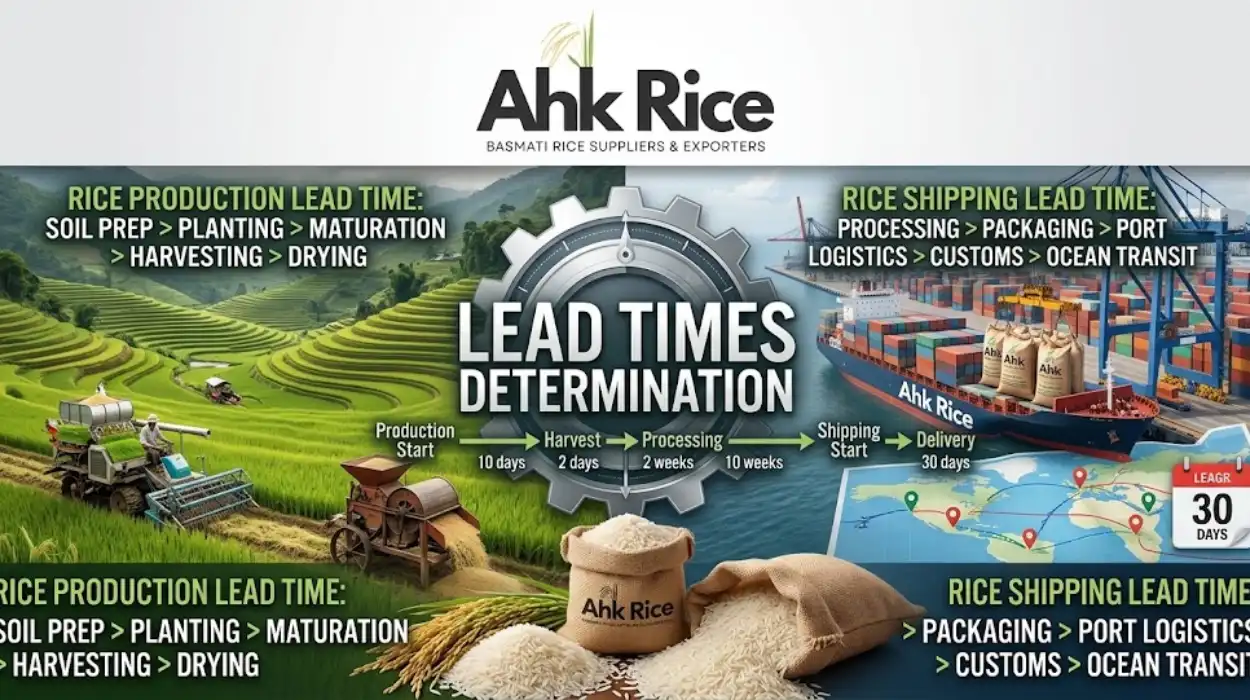
How Are Rice Production and Shipping Lead Times Determined?
Rice production and shipping lead times are determined by the product specification, production readiness, order volume, export documentation, vessel schedule, port handling, ocean transit, customs clearance, and final inland delivery, so Alabama importers should calculate the complete order-to-arrival cycle rather than only ocean transit.
For Alabama buyers, accurate planning starts with understanding how supplier production and shipping variables interact.
Why Alabama importers should calculate rice lead times accurately explains why production timing, vessel availability, and arrival planning affect inventory decisions. The next step is comparing the available ways to build a reliable lead-time estimate.
What are the available solutions for calculating rice production and shipping lead times?
The main solutions are fixed supplier schedules, order-specific production planning, vessel-based transit estimates, and integrated end-to-end lead-time models; integrated models provide the strongest planning accuracy because they connect production, documentation, loading, ocean transit, customs, and inland delivery.
A fixed supplier schedule uses standard production and dispatch periods. For example, an exporter may quote 7–10 days for processing and 25–35 days for shipment to major U.S. ports. This method is simple, but it does not fully reflect order volume, packaging requirements, or vessel availability.
An order-specific production plan calculates time after the buyer confirms variety, grade, quantity, packaging, and destination. This method is more precise because a 20 MT order requiring standard bulk bags does not create the same production workload as a large private-label program requiring custom packaging.
A vessel-based model starts with the confirmed sailing date. It adds factory readiness, container positioning, port cut-off, vessel transit, discharge, customs, and inland transport. This model works well when the shipping booking is already available.
An integrated end-to-end model combines all four stages. It measures production lead time, export preparation, port handling, ocean transit, U.S. import processing, and inland transportation as separate components. This is the most useful method for Alabama inventory planning.
AHK Rice provides Pakistani Basmati varieties including 1121, Super Kernel, and 1509 through its Pakistan rice export service. Its export workflow covers processing, grading, packaging, documentation, container loading, and shipment coordination, allowing production and logistics stages to be evaluated together.
How are rice production lead times determined before shipment?
Production lead time begins when specifications and commercial terms are confirmed and ends when export-ready containers reach the port; the main variables are paddy availability, milling capacity, grade requirements, packaging, inspection, documentation, and container loading readiness before vessel cut-off.
The first variable is rice availability. A supplier holding export-ready stock can begin packing faster than a supplier that must procure paddy, age or condition the rice, mill it, grade it, and prepare the finished product.
The second variable is rice grade. 1121 Basmati, Super Kernel, and 1509 Basmati have different commercial specifications. Processing may involve cleaning, husking, polishing, length grading, color sorting, moisture testing, and quality inspection. Steam and Sella products add controlled processing stages.
The third variable is quantity. A small order can fit into an existing production run. A larger order may require dedicated production scheduling. Container quantity also affects loading preparation and documentation.
The fourth variable is packaging. Standard 25 kg or 50 kg export bags generally require less preparation than custom retail packaging. Private-label orders require artwork approval, packaging production, filling, labeling, and final inspection.
The fifth variable is quality verification. Buyers may require laboratory testing or third-party inspection before loading. A supplier must therefore complete production early enough to allow inspection and corrective action if specifications are not met.
A practical production calculation is:
Production lead time = specification confirmation + procurement/stock preparation + processing + grading + packaging + inspection + documentation + container loading.
For example, an order requiring standard export-grade 1121 Basmati from available stock may move faster than a new private-label 1509 program requiring custom packaging and a fresh production run.
How do different rice shipping approaches compare for Alabama importers?
Alabama importers can choose direct port delivery, multi-port routing, or integrated logistics planning; direct and predictable routing normally provides the clearest inventory forecast, while alternative ports can improve flexibility when vessel schedules, congestion, or inland capacity change.
Alabama does not have a major ocean container gateway comparable to Savannah, New York, or Los Angeles. Importers therefore evaluate the destination port and inland route together.
For many Alabama buyers, Savannah can be commercially relevant because it provides access to the U.S. Southeast and established container infrastructure. Other buyers may route through New York/New Jersey, Houston, or West Coast ports depending on supplier contracts, distribution networks, and freight rates.
Current 2026 lane data illustrates why transit time should be treated as a range rather than one fixed number. A current Port Qasim-to-Savannah FCL quotation shows an estimated 29–39 days for a 40-foot high-cube container.
AHK Rice’s U.S. export information gives a broader 25–35-day door-to-door expectation from Karachi to major U.S. ports such as New York and Los Angeles, demonstrating that destination and routing materially affect the overall calculation.
The calculation should therefore separate:
| Lead-time stage | Planning variable |
|---|---|
| Production | Rice availability and processing capacity |
| Export preparation | Inspection and documentation |
| Port preparation | Container positioning and vessel cut-off |
| Ocean transit | Sailing schedule and transshipment |
| U.S. arrival | Discharge and customs processing |
| Inland delivery | Port-to-Alabama trucking or rail |
A shipment with 30 days of ocean transit is not a 30-day delivery. Production and pre-shipment preparation occur before sailing, while discharge, customs, and inland transportation occur afterward.
How do two U.S. market regions compare on rice grade, price, and shelf life?
Alabama and the wider Southeast generally favor value-balanced long-grain Basmati for ethnic retail, foodservice, and wholesale distribution, while Northeast premium channels place greater emphasis on 1121; price and shelf life depend on grade, processing, packaging, and destination logistics.
For comparison, two useful U.S. market regions are the Southeastern U.S. and the Northeastern U.S. Alabama belongs to the Southeast and shares distribution characteristics with nearby states where foodservice, wholesale, and South Asian retail demand influence purchasing decisions.
The Northeast has dense metropolitan markets and a large ethnic retail base. Premium retail and private-label buyers can place greater value on long grain appearance, making 1121 particularly suitable for premium positioning.
Current Pakistan export pricing provides a useful benchmark. Pakistan Customs’ 2026 valuation framework lists $1,175/MT for 1121 White/Sella and $1,225/MT for 1121 Steam, while 1509 White/Sella is listed at $1,100/MT and 1509 Steam at $1,150/MT.
These are customs valuation references, not delivered Alabama prices. Freight, insurance, packaging, inspection, port charges, customs costs, inland transportation, and commercial terms must be added to calculate landed cost.
| Attribute | Southeastern U.S. / Alabama | Northeastern U.S. |
| Primary demand | Wholesale, foodservice, ethnic retail | Premium retail, ethnic retail, foodservice |
| Preferred grade | 1509 and Super Kernel for value balance; 1121 for premium | 1121 for premium presentation; Super Kernel for traditional demand |
| Indicative Pakistan FOB benchmark | 1509: about $1,100–$1,150/MT; 1121: about $1,175–$1,225/MT depending on processing | 1121 commonly fits premium positioning at the higher end of the range |
| Landed-cost priority | Freight and inland delivery efficiency | Product premium and distribution economics |
| Shelf-life planning | Controlled moisture and sealed packaging are critical | Same technical requirements |
| Lead-time priority | Port-to-warehouse predictability | Vessel and port scheduling plus dense inland distribution |
Shelf life should not be treated as a major difference between these varieties when the rice is correctly processed, dried, packed, and stored. Moisture control, packaging integrity, warehouse temperature, humidity, pest control, and stock rotation have greater influence on storage performance.
The commercial difference is therefore more visible in price and market positioning than in basic shelf-life potential.
Which rice production and shipping method works best for different cases?
The best method depends on purchasing volume, stock position, packaging complexity, delivery urgency, and destination port; stock-based production suits urgent replenishment, planned production suits large contracts, and integrated scheduling suits recurring Alabama import programs.
For an urgent replenishment order, available finished stock is usually the strongest solution. The buyer avoids unnecessary production time and focuses on export documentation, container availability, and vessel booking.
For a large recurring contract, scheduled production is stronger. The supplier can reserve raw material, allocate processing capacity, prepare packaging, and coordinate multiple shipment windows.
For a private-label retail program, production planning must begin earlier. Packaging approval becomes a separate lead-time component. Artwork delays can become shipment delays even when rice is already available.
For a premium 1121 program, quality specifications deserve greater attention. Grain length, broken percentage, moisture, color, aroma, and cooking performance should be confirmed before bulk production.
For a value-focused 1509 program, cost and production efficiency become more important. The buyer can compare the lower product valuation against expected retail or foodservice movement.
For recurring Alabama imports, the strongest approach is a rolling schedule. Instead of calculating one shipment at a time, the buyer establishes expected monthly demand, safety stock, reorder point, production window, vessel window, and inland delivery buffer.
What are the pros and cons of each rice lead-time strategy?
Fixed schedules are simple but less responsive, order-specific planning improves accuracy but requires more coordination, vessel-based planning improves shipment visibility, and integrated planning gives the best control but requires reliable data from both the supplier and logistics providers.
A fixed schedule has one major advantage: simplicity. A buyer can quickly estimate when cargo should be available. Its weakness is that it can hide production and logistics dependencies.
Order-specific planning provides stronger accuracy. A buyer knows exactly which product, quantity, packaging, and inspection requirements drive the timeline. Its disadvantage is the need for more detailed communication before the order begins.
Vessel-based planning is valuable after booking. It provides a clear departure and estimated arrival window. Its limitation is that it begins too late if the buyer uses the sailing date as the entire lead-time calculation.
Integrated planning provides the strongest commercial picture. It connects production capacity with logistics capacity. Its limitation is complexity. The buyer must maintain accurate information about inventory, production, documentation, vessel schedules, port handling, and inland delivery.
For example, a buyer who needs 100 MT every month should not simply ask, “How many days is shipping?” The more useful question is, “How many days are required from order confirmation to warehouse receipt, and when must the next order enter production to protect safety stock?”
What decision factors should Alabama rice importers use?
Alabama importers should evaluate production readiness, grade, quantity, packaging, vessel schedule, destination port, customs requirements, inland freight, safety stock, and supplier coordination together because each factor can change the final warehouse arrival date and landed cost.
A practical five-factor decision framework is:
| Decision factor | What to evaluate | Why it matters |
| 1. Product readiness | Finished stock versus fresh production | Determines the first available loading date |
| 2. Specification complexity | Grade, processing, moisture, broken percentage, packaging | Determines production and inspection time |
| 3. Shipping route | Port, vessel schedule, transshipment, transit range | Determines ocean arrival |
| 4. Import readiness | FDA requirements, Prior Notice, customs documents | Reduces clearance-related delays |
| 5. Inventory position | Demand, safety stock, reorder point | Determines how much lead-time buffer is required |
U.S. food imports also require regulatory planning. FDA states that food imported into the United States must meet U.S. requirements, and importers are responsible for ensuring food is safe, sanitary, and properly labeled. FDA also requires Prior Notice before imported food arrives.
For waterborne food shipments, FDA’s Prior Notice guidance requires confirmation at least eight hours before arrival, subject to the applicable filing system and requirements.
This means compliance should be included in the shipment schedule rather than treated as an administrative task after the vessel arrives.
How should Alabama importers build a reliable rice lead-time calculation?
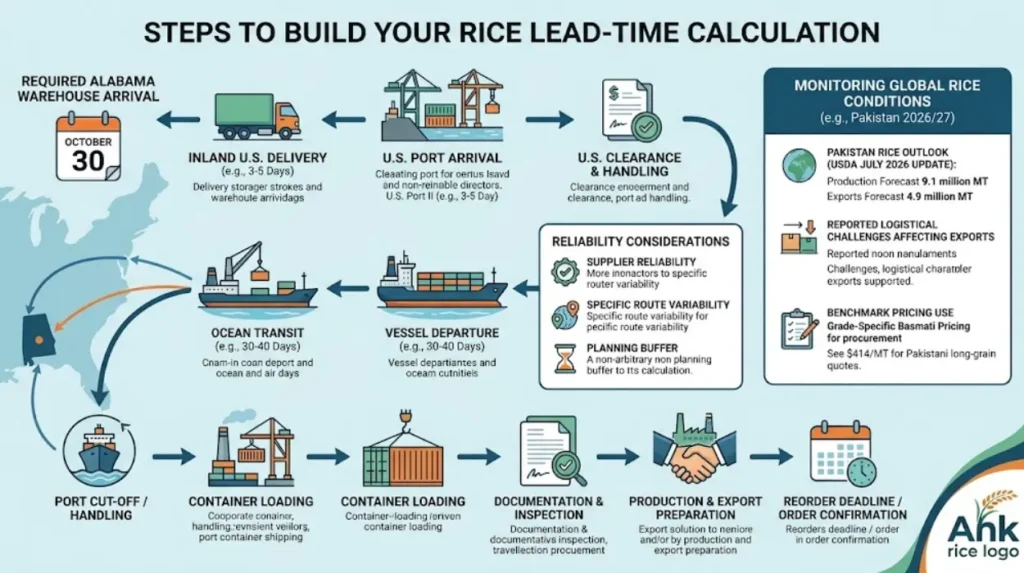
A reliable Alabama rice lead-time calculation should start with the required warehouse arrival date and work backward through inland delivery, port arrival, ocean transit, vessel cut-off, container loading, documentation, inspection, production, and order confirmation to establish the true reorder deadline.
Suppose an importer requires rice in an Alabama warehouse on October 30. The calculation should move backward from that date.
If inland delivery requires 3–5 days, the container should arrive at the U.S. port before that window. If ocean transit is approximately 30–40 days, the vessel must depart substantially earlier. Production, inspection, documentation, container loading, and port cut-off must then be scheduled before sailing.
A practical formula is:
Total lead time = production + export preparation + port handling + ocean transit + U.S. clearance + inland delivery + planning buffer.
The planning buffer should reflect the reliability of the specific route and supplier. It should not be an arbitrary number.
Pakistan’s 2026 rice outlook also reinforces why buyers should monitor supply conditions. USDA’s July 2026 Pakistan Grain and Feed Update forecasts 2026/27 rice production at 9.1 million metric tons and rice exports at 4.9 million metric tons. The report also notes logistical challenges affecting Pakistan’s rice exports.
USDA’s July 2026 global rice data also reported Pakistani long-grain export quotes at approximately $414/MT for its benchmark category, while noting higher Asian export quotes during the reporting period. This benchmark is not a Basmati quotation, so Alabama buyers should use grade-specific Basmati pricing for procurement decisions.
The commercial conclusion is straightforward. Rice lead time is not one shipping number. It is a chain of production, documentation, loading, ocean transportation, import clearance, and inland delivery events.
For Alabama importers, the strongest planning method is to calculate every stage separately, assign dates to each milestone, and maintain enough inventory to absorb normal schedule variation. That approach makes purchasing decisions more predictable and connects rice procurement with actual warehouse demand. For more information explore:
Plan Alabama Rice Imports with AHK Rice Delivery Schedules
Frequently Asked Questions
How is rice production lead time determined?
Rice production lead time is calculated from order confirmation through paddy availability, processing, grading, packaging, inspection, documentation, and container loading. Product grade, quantity, packaging, and stock availability determine the actual timeframe.
What factors affect rice shipping lead times?
Rice shipping lead times depend on container availability, port cut-off dates, vessel schedules, transshipment, ocean transit, customs clearance, and inland transportation. The destination port and Alabama delivery location also affect the final warehouse arrival date.
How long does Pakistani Basmati rice take to reach the USA?
Pakistani Basmati rice can require several weeks for ocean transportation, with the exact duration depending on the Pakistani departure port, U.S. destination port, vessel routing, and transshipment. Total lead time is longer because production, export preparation, clearance, and inland delivery must also be included.
Which Pakistani Basmati rice grades are suitable for Alabama importers?
Alabama importers can evaluate 1121 Basmati, Super Kernel, and 1509 Basmati based on their target customers. 1121 generally suits premium positioning, while Super Kernel and 1509 can provide different balances of grain appearance, cooking characteristics, and procurement cost.
How does rice quantity affect production lead time?
Larger rice orders usually require more production capacity, packaging preparation, quality inspection, and container loading coordination. A supplier with sufficient processing capacity can schedule larger orders more efficiently and maintain consistent shipment intervals.
Does custom packaging increase rice lead time?
Yes. Custom packaging can add artwork approval, packaging production, printing, filling, labeling, and inspection stages. Importers should approve packaging specifications early so private-label requirements do not delay the planned production or vessel schedule.
How does the destination port affect rice delivery time to Alabama?
The destination port affects ocean transit, discharge timing, customs processing, container availability, and inland transportation. Alabama importers can compare Southeast and other U.S. gateway options based on vessel schedules, freight costs, and the final warehouse location.