How Is 1121 Sella Basmati Cooked? Texture Aroma and Grain Separation Guide
1121 Sella Basmati is cooked as a parboiled, long‑grain rice that requires controlled soaking, boiling, and steaming to preserve aroma, texture, and clean grain separation. It is the same 1121 basmati variety that has been parboiled before milling, which changes how it absorbs water and how it behaves on the plate. The 1121 Sella cooking process is not the same as raw 1121, and small changes in water ratio, heat, and resting time noticeably shift the final outcome.
What is 1121 Sella Basmati, and where is it grown?
1121 Sella Basmati is parboiled long‑grain basmati that is soaked, steam‑treated, dried, milled, and graded to create a stable, export‑grade rice with strong grain separation and aroma. The “1121” refers to the basmati variety. The “Sella” label indicates that the grain has undergone the parboiling sequence before milling. The product is popular in export markets because it combines the extra‑length of 1121 with the texture and stability of parboiling.
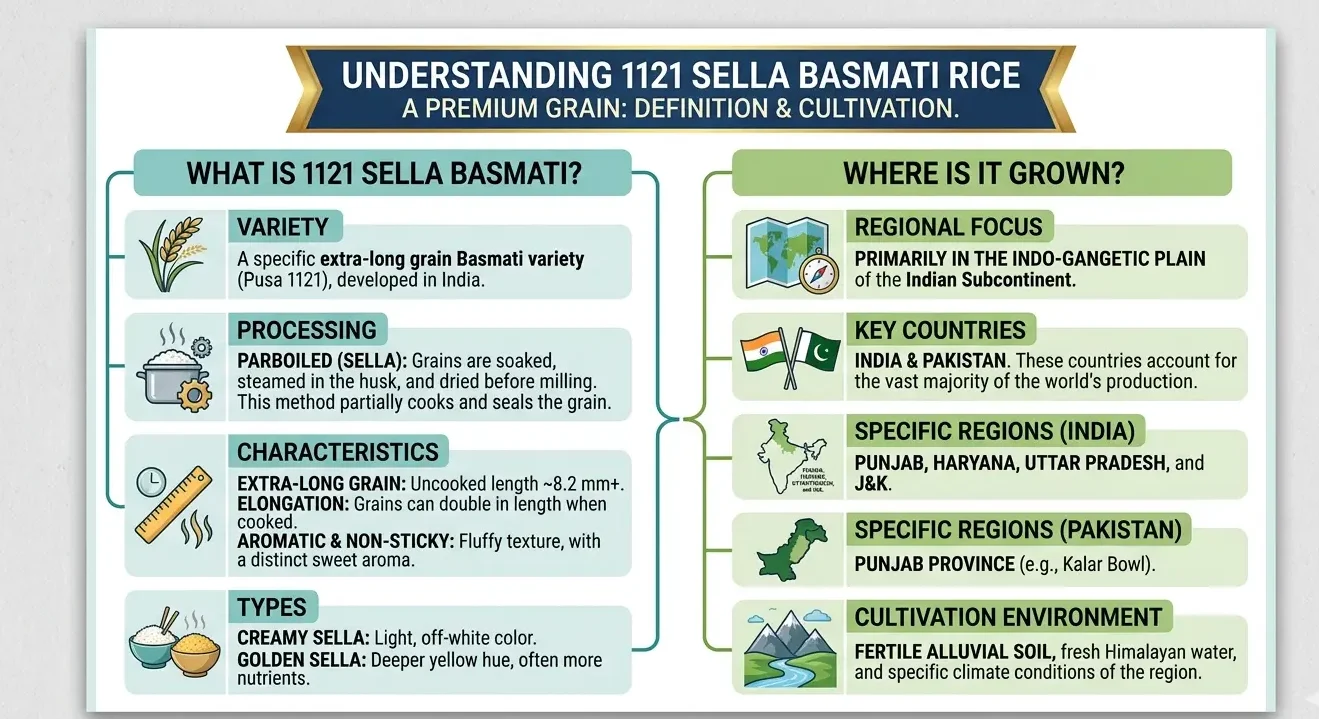
The 1121 variety is grown in Pakistan’s Punjab rice belt, where irrigation, soil conditions, and seasonal temperatures support long‑grain aromatic basmati production. The crop is sown in paddy fields, flooded during the growth phase, and harvested once the grains reach maturity. The rice is then dried, cleaned, and prepared for parboiling. The parboiling step usually happens at the mill before the further processing into Sella, Golden Sella, or Creamy Sella formats.
In the marketplace, 1121 Sella competes with raw 1121 and steam‑grain 1121 rather than with other basmati varieties. The parboiling process hardens the grain, reduces breakage, and improves storage and shelf life. The 1121 Sella base is the same across grades. The difference lies in how far the parboiling colour and texture are taken. The original 1121 Sella sits in the middle, Golden Sella pushes colour and gloss, and Creamy Sella reduces colour for a more functional‑graded product.
How does 1121 Sella behave when cooked: texture, aroma, separation?
Cooked 1121 Sella Basmati usually produces long, separate grains with a firm texture, moderate gloss, and clear aromatic lift that is stable even after cooling. The parboiling increases internal starch gelatinisation, which lowers the risk of mushiness, so the grains stay distinct even in mixed‑rice dishes. The aroma is less volatile than raw 1121, which is one reason the 1121 Sella cooking guide is important for repeatable results.
Texture is the first noticeable difference. Parboiled 1121 Sella feels firmer than raw 1121, closer to 70:30 rice in firmness but still with a long‑grain finish. The grain does not collapse easily under pressure, which makes it suitable for boiling, stewing, and reheating. Aroma comes from the basmati distillate, but the parboiling tightens the grain structure, so the perfume is released more slowly. This is why the 1121 Sella aroma profile is strong but not as “shock‑intense” as fresh‑raw basmati.
Grain separation is the third key attribute. Because the parboiled grain resists breaking, the cooked product tends to show fewer broken tips and a cleaner grain‑separation profile. When prepared correctly, 1121 Sella grains line up in the pot, separate from each other, and retain a light oil‑like sheen. The result is visually neat, which is why 1121 Sella is common in restaurants, catering, and institutional‑kitchen environments where the rice must look consistent on every plate.
What are the key components of the 1121 Sella cooking process?
The key components of 1121 Sella cooking are soaking, water‑to‑rice ratio, boiling time, and resting, all of which affect texture, aroma intensity, and grain separation. Each step can be adjusted, but the 1121 Sella parboiled grain responds differently than raw 1121, so the method must respect the structure created during milling.
Soaking is the first component. The 1121 Sella grain is less porous than raw 1121, so it usually needs 15–20 minutes of soaking in cold water, not 30–40 minutes. The soak lets the grain expand slightly before boiling, which reduces the risk of a hard core. Over‑soaking can soften the grain too much and weaken the separation. The soak time matters more for 1121 Sella than many steam‑grade parboiled products because the treatment level is moderate.
Water‑to‑rice ratio is the second component. Most 1121 Sella products perform best at 1:1.6 to 1:1.8 (rice:water) by volume, depending on the moisture content and cooking method. That is slightly less water than many raw 1121 recipes, which often sit at 1:2. The lower ratio helps preserve firmness and prevents the grains from clumping. The boil‑and‑rest method is usually preferred over long‑simmer‑covered methods because it better controls starch release.
Boiling and steaming are the third and fourth components. The rice is brought to a full boil, then simmered until the grains are just cooked and the water is absorbed. The grains are then covered off‑heat for a 5–10‑minute rest, and briefly fluffed. The 1121 Sella texture is at its best when the boil time is not extended beyond the required point, because the parboiled grain is already partially gelatinised. Over‑boiling turns the grain soft and reduces the separation profile.
How does 1121 Sella differ from raw 1121 in cooking practice?
1121 Sella differs from raw 1121 in that it needs a shorter soak, a slightly lower water ratio, and a more controlled boil to avoid over‑softening, even though the cook‑time is similar. The parboiling step changes the grain’s internal structure, so treating 1121 Sella exactly like raw 1121 usually leads to slightly softer grains and less sharp separation. The 1121 Sella cooking guide must therefore adjust for the extra firmness of the parboiled grain.
Soak time is shorter. Raw 1121 often benefits from a 30–40‑minute soak, depending on the brand, while 1121 Sella usually reaches its optimal expansion in 15–20 minutes. The parboiled layer surrounding the endosperm already holds moisture, so extra soaking is unnecessary. The 1121 Sella profile is strongest when the grain is still slightly resistant at the centre after boiling, then softened by resting.
Water ratio is usually lower. Many raw 1121 recipes use 1:2 rice‑to‑water, while 1121 Sella often performs better at 1:1.6–1:1.8. The lower ratio reduces the risk of clumping and a gummy surface. The 1121 Sella cooking guide recommends using a ratio that keeps the grains distinct at the end of the cook‑cycle, with very little excess water.
Heat profile is tighter. The 1121 Sella grain reaches full‑doneness faster than raw 1121, so the cook‑window is narrower. The boil should start at high heat, then drop to medium once the water reaches a steady simmer. The pot is covered and the rice is boiled until the water is absorbed, then removed from the heat to rest. The 1121 Sella method is less forgiving of extended simmer‑on‑low because the extra starch release can soften the grain too much.
What are the main benefits of using 1121 Sella Basmati in cooking?
The main benefits of 1121 Sella Basmati include consistent grain separation, stable texture after reheating, and strong aroma that survives bulk‑cooking cycles. These advantages suit both home cooks who want clean‑looking rice and professional kitchens that need repeatable plating. The 1121 Sella cooking profile is more robust than many raw 1121 formats, especially in environments where time, temperature, and technique vary.
The first benefit is clear grain separation. 1121 Sella’s parboiled structure resists breakage, so the grains stay long and separate even when cooked in large pots. The 1121 Sella grains lie in neat lines on the plate, which is visually important in restaurants, cafeterias, and catering. The benefit is especially visible in dishes where the rice is mixed with gravies or sauces, because the grain still keeps its outline.
The second benefit is reheating stability. Because the grain is already hardened by parboiling, 1121 Sella rice holds its texture better than raw 1121 when it is boiled, then reheated later. The cooked grains do not turn mushy as quickly, which supports buffet‑style serving, airline‑meal preparation, and food‑service reheating. The 1121 Sella texture is strong enough to survive steam‑holding or microwave‑reheat without losing its structure completely.
The third benefit is aroma retention. The 1121 Sella parboiled grain releases its aroma more slowly than raw 1121, but the result is a steadier‑lift that lasts longer on the plate and in storage. The 1121 Sella cooking guide shows that this is particularly useful in large‑scale operations, where rice is cooked in bulk and held for service later. The aroma stays present without the sharp‑peaking‑then‑fading cycle common in raw‑grain basmati.
In which use‑cases does 1121 Sella perform best?
1121 Sella Basmati performs best in biryani, pulao, mixed‑rice dishes, and institutional‑kitchen use where the grain must stay long, firm, and separate despite long cook‑times or reheating. The rice is less ideal for dishes that demand very soft, fluffy, short‑grain‑like texture, but it is strong where separation and stability matter. The 1121 Sella cooking profile suits environments where failure modes include mushiness, breakage, and inconsistent plating.
In biryani and pulao, 1121 Sella stands out because the grains resist soaking up too much moisture from the masala or ghee. The 1121 Sella grains remain distinct, even when the dish is simmered for 20–30 minutes. The colour is warm amber, which supports the premium visual of restaurant‑style biryani. The 1121 Sella aroma is strong but not overpowering, which keeps the dish balanced.
In institutional use, 1121 Sella is common in cafeterias, canteens, and catering operations. The rice is often pre‑boiled in bulk, then cooled and reheated when needed. The 1121 Sella structure tolerates this sequence better than raw 1121, which tends to over‑soften with repeated heating. The 1121 Sella texture is firm enough to hold its shape in serving trays, plates, and portion‑ware.
In home‑cook use, 1121 Sella suits households that buy in bulk, store rice for weeks, and value consistent results. The 1121 Sella grain separation is visible even when the cook has limited time or precision. The 1121 Sella cooking guide helps these users match the ratio and time to the specific product, which reduces the risk of a starchy or gummy outcome. The 1121 Sella format is less forgiving of very high water ratios, but it is more forgiving of over‑simmering than raw 1121.
What are common 1121 Sella cooking problems and misconceptions?
Common 1121 Sella cooking problems include mushy grains, clumping, and weak aroma, usually caused by too much water, over‑boiling, or incorrect soaking. Misconceptions usually claim that 1121 Sella should behave exactly like raw 1121, when in fact the parboiled grain needs a slightly different method. The 1122 Sella cooking guide helps users avoid treating parboiled 1121 like a raw alternative.
The first misconception is that 1121 Sella needs the same long soak as raw 1121. The 1121 Sella grain is already partially hydrated by the parboiling process, so a 15–20‑minute soak is usually enough. Soaking 1121 Sella for 30–40 minutes can soften the grain too much, which leads to mush and clumping when cooked. The 1121 Sella cooking profile is at its best with a short soak and a controlled water‑to‑rice ratio.
The second misconception is that 1121 Sella can use the same water ratio as raw 1121. The 1121 Sella grain is firmer, so it needs less water to reach full‑doneness. Using 1:2 water ratio on 1121 Sella often leads to a soft, gummy surface while the core stays hard, which ruins the grain‑separation effect. The 1121 Sella cooking method usually works best at 1:1.6–1:1.8, depending on the brand and moisture level.
The third misconception is that 1121 Sella should be boiled until the water is completely gone, like some steam‑grade parboiled rice. The 1121 Sella grain is moderately treated, so over‑boiling can exhaust the internal structure, which weakens separation. The 1121 Sella cooking guide recommends boiling until most of the water is absorbed, then covering and resting off‑heat. The resting period lets the remaining moisture finish the cook‑cycle without over‑simmering.
How should large‑scale or catering users adjust the 1121 Sella method?
Large‑scale or catering users should adjust the 1121 Sella method by standardising ratios, batch‑times, and resting steps, while keeping the water‑to‑rice ratio tight and the boil‑time controlled. The 1121 Sella grain behaves predictably when the same parameters are used across shifts, which is why a 1121 Sella large‑scale cooking protocol is important for consistency. The 1121 Sella cooking guide for catering reduces the risk of over‑boiling, uneven salt, or clumping across large pots.
First, standardise the ratio. For example, set 1:1.7 rice‑to‑water as the base rule for 1121 Sella in all batches, then adjust incrementally for different kettles or heat‑sources. The 1121 Sella grain will react the same way if the ratio and salt level are fixed. This is simpler for kitchen staff than letting them “eyeball” the water, which can vary widely.
Second, standardise boil‑time. Time the 1121 Sella boil from when the water reaches a full boil. For example, bring 1121 Sella to a full boil, then cook 12–16 minutes until the water is absorbed and the grains are just cooked. The 1121 Sella profile is firm enough to tolerate this range, but the texture drops if the boil is pushed beyond 18–20 minutes. The 1121 Sella cooking guide for catering sets a fixed time window and a consistency check (very little water, grains separate when stirred).
Third, standardise resting. The 1121 Sella pot is covered off‑heat for 5–10 minutes, then fluffed. The 1121 Sella grains finish absorbing the last moisture during this phase, which keeps them firm and separate. The 1121 Sella cooking method is especially useful in large‑scale environments where rice is cooked in bulk and held for later service. The 1121 Sella texture survives holding better than raw 1121, as long as the pot is not reheated too many times.