How New Trade Policies Affect Rice Exporters in Pakistan
What is the new rice export framework in Pakistan?
The new rice export framework in Pakistan regulates commercial agricultural shipments through revised pricing structures, financial incentives, and standardized quality rules. This regulatory framework eliminates older price ceilings and introduces targeted fiscal support to maintain global trade competitiveness.
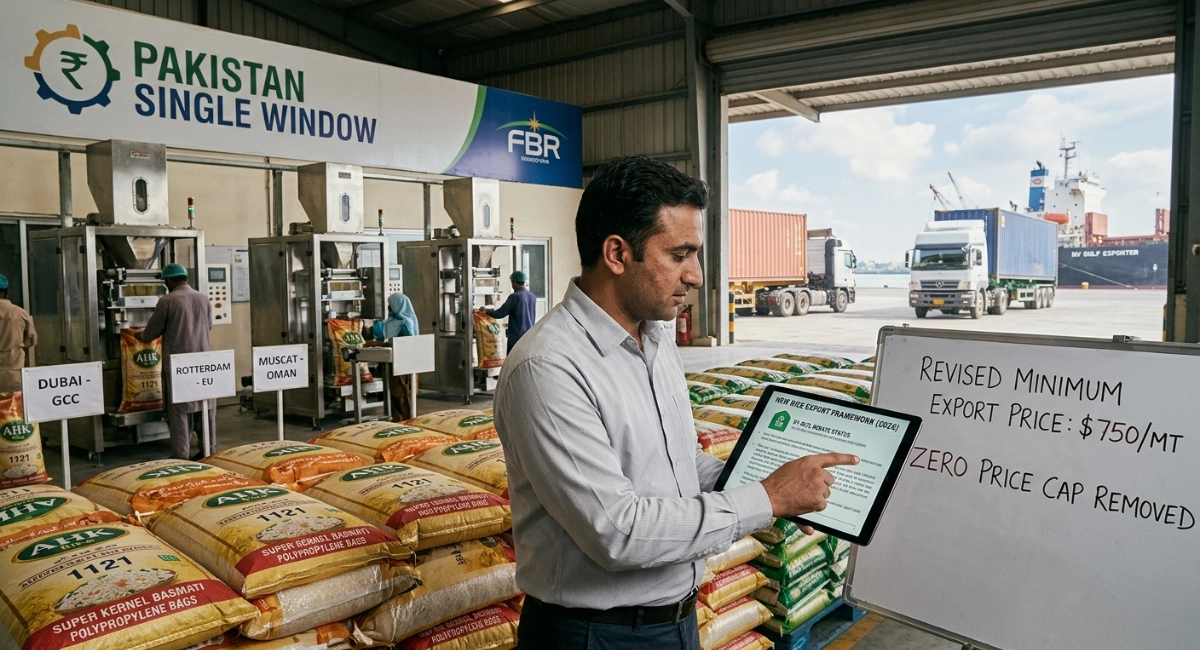
The Ministry of Commerce updated the Drawback of Local Taxes and Levies (DLTL) for Rice Order in early 2026. This legislative change allocates approximately 15 billion rupees to subsidize local tax refunds for registered processors. The policy specifically removes the historical ceiling cap of $1,275 per metric ton Free On Board (FOB). Exporters now receive a flat 9% cash drawback on shipments that meet or exceed a baseline value of $750 per ton.
This change operates in tandem with a transition from the Final Tax Regime (FTR) to the Normal Tax Regime (NTR) managed by the Federal Board of Revenue. The shift means corporate net income determines final tax liabilities rather than a flat percentage on gross export turnover. These combined adjustments modify the operating environment for milling houses handling fragrant long-grain varieties like Basmati.
How does the updated trade policy work?
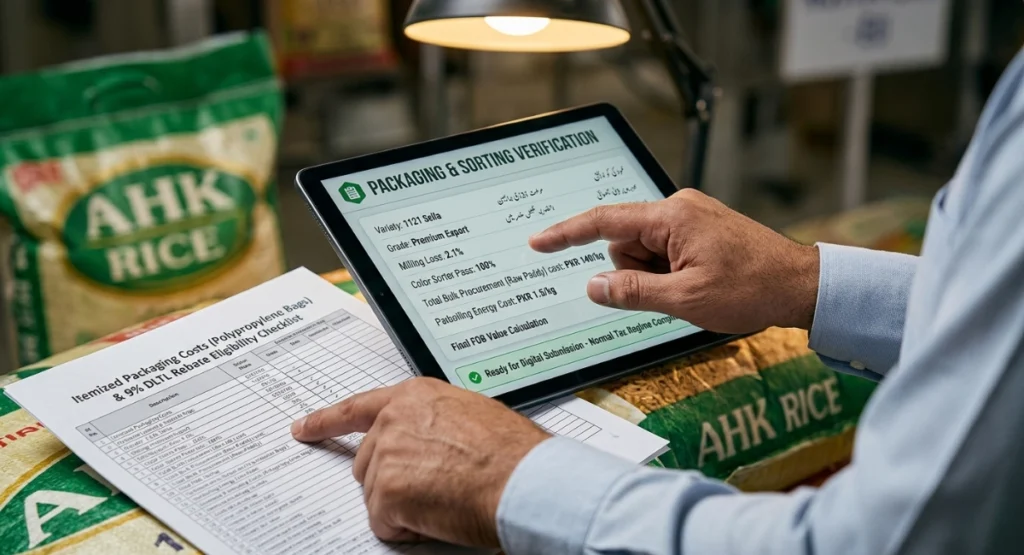
The updated trade policy works by linking financial support to minimum invoice values while enforcing specific customs clearances through the Pakistan Single Window network. Processing units must validate their production metrics and compliance paperwork digitally before receiving export authorization.
Exporters enter shipment parameters into the automated Pakistan Single Window system. The software automatically evaluates the declared Free On Board values against real-time global pricing baselines set by the Ministry of Commerce. If a shipment of premium 1121 Basmati or Super Kernel rice meets the minimum price floor, the customs clearance protocol activates.
The financial processing occurs retrospectively. Once the container clears the Port of Karachi or Port Qasim and the foreign buyer settles the invoice via an active Letter of Credit, the State Bank of Pakistan processes the 9% DLTL rebate. The government distributes these funds directly to the exporter’s verified commercial bank account. This mechanical workflow forces processing mills to maintain fully transparent transaction histories to unlock state subsidies.
What are the key components of the current trade rules?
The key components of the current trade rules include the revised DLTL incentive mechanism, the Normal Tax Regime transition, and mandatory regional trade treaties. These three pillars dictate the pricing, tax calculations, and market destination routes for all local grain suppliers.
The Drawback of Local Taxes and Levies (DLTL) Scheme
The current structure provides a 9% financial rebate based on the net FOB invoice value. It operates without an upper-tier price limitation, which changes the monetization model for premium aged 1121 and 1509 Basmati varieties.
The Normal Tax Regime (NTR) Shift
Corporate tax obligations are calculated using net profits rather than gross turnover rates. This means processing facilities must account for operational overheads, milling losses, and logistics fuel costs to optimize their domestic tax positions.
Preferential and Free Trade Agreements
The State coordinates market entry via specific trade pacts. Examples include the Pakistan–Türkiye Preferential Trade Agreement and the Look Africa Policy Initiative. These protocols establish specific Tariff-Rate Quotas (TRQs) that lower import duties in specific foreign jurisdictions.
What are the benefits of these trade policy updates?
The benefits of these trade policy updates are enhanced capital liquidity for large-scale milling facilities and improved price competitiveness in international wholesale markets. The removal of rigid regulatory limits helps local operators match aggressive pricing strategies from competing origins.
The 15 billion rupee financial pool injects liquid capital into the agricultural processing ecosystem. This influx allows exporters to purchase large volumes of raw paddy during the harvest season. For instance, milling houses can secure fresh crops of 1121, Super Kernel, and 1509 varieties from farmers in the Punjab region.
The policy adjustments also help close the price gap with regional competitors like India and Vietnam. Eliminating the upper price cap allows exporters to adjust their FOB offers downward when global spot market prices fall. This pricing flexibility helps maintain active export volumes to high-volume distribution hubs without sacrificing operating margins.
What are the use cases of the new policy structures?
The use cases of the new policy structures appear in bulk supply operations to the Gulf Cooperation Council markets, European retail distribution, and new African trade channels. Each destination utilizes specific sub-clauses of the trade rules to optimize shipping costs and customs clearings.
Regional market integration directly alters how bulk rice shipments are routed and priced under current bilateral trade mechanisms.
- Gulf Cooperation Council (GCC) Shipments: Mills use the zero-duty structures in Saudi Arabia and the United Arab Emirates to supply premium parboiled 1121 rice for large-scale catering chains.
- European Union Retail Supply: Processors apply strict phytosanitary testing protocols to clear European customs and capture higher per-ton values without hitting historical price caps.
- African Market Expansion: Exporters utilize revised benchmark values—such as Kenya lowering its customs valuation from $615 to $460 per ton—to send non-basmati and 1509 white rice varieties to East African ports.
What are the common problems and misconceptions regarding these policies?
The common problems and misconceptions regarding these policies include the belief that subsidies guarantee market access and that changing tax structures uniformly penalizes smaller operations. Misunderstanding these variables can lead to financial losses or customs rejections at destination ports.
A major misconception is that the 9% DLTL rebate automatically ensures a profitable transaction. The subsidy only applies when the global transaction value remains above $750 per metric ton. If an exporter lowers their price too much to compete with cheap regional options, they may drop below the baseline requirement and lose the entire financial rebate.
Another problem involves the transition to the Normal Tax Regime. Many suppliers assume that moving away from the old Final Tax Regime increases their overall tax liabilities. In reality, processing plants that invest in modern color sorters, multi-stage polishers, and energy-efficient parboiling equipment can write off these capital investments. This documentation reduces their net taxable income, resulting in lower net tax payments than under the old system.
Where are export-grade rice varieties grown and processed?
Export-grade rice varieties are grown in the fertile, canal-irrigated plains of Punjab and processed in advanced industrial milling facilities using sequential mechanical refinement steps. The geographic region provides the exact soil chemistry and climate needed to produce long-grain Basmati.
The core production zone spans traditional agricultural tracts like Gujranwala, Sheikhupura, and Sialkot. This region features heavy, clay-rich soil and high water tables fed by the Indus River system. These natural conditions allow varieties like 1121 Basmati, Super Kernel, and 1509 to develop their characteristic elongation properties and aroma profiles.
Processing follows a rigid mechanical timeline to transform raw field paddy into clean, export-ready grain:
1.Pre-Cleaning and De-Husking:Stage 1 – Initial Prep.
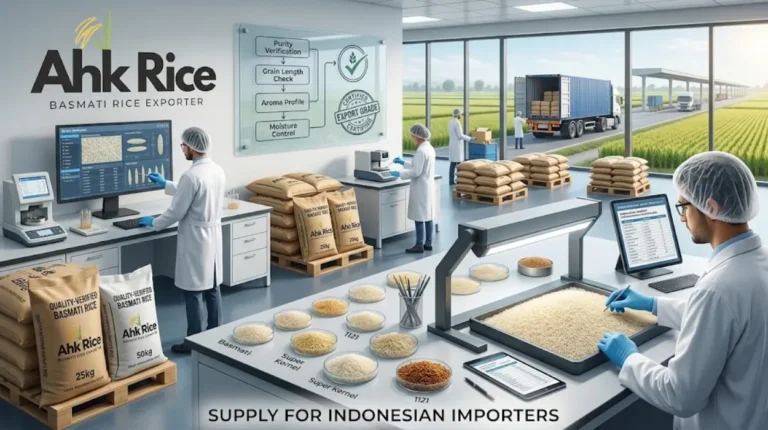
Raw paddy passes through high-capacity scalpers to remove straw, stones, and dust. The clean paddy then enters rubber-roll hullers that gently strip away the outer husk layer without fracturing the kernel.
2.Milling and Whitening:Stage 2 – Friction Polishing.
The brown rice moves into abrasive whitening machines where vertical abrasive stones remove the nutrient-rich bran layer. Abrasive friction transforms the brown grain into white rice.
3.Grading and Length Separation:Stage 3 – Sizing.
Plan-shifters and rotating indented cylinders separate the broken pieces from the whole grains. This step ensures the final shipment contains uniform grain lengths that match strict export specifications.
4.Color Sorting and Optical Inspection:Stage 4 – Purity Tuning.
High-speed optical color sorters scan the moving grain stream using CCD cameras. Computer-controlled air jets shoot out discolored, yellow, or immature grains to guarantee uniform visual purity.
What are the available commercial grades and global destination markets?
The available commercial grades include raw white, steamed, and parboiled sella options that cross international borders into Middle Eastern, Asian, and European import markets. Each variant meets distinct cooking demands and shelf-life requirements across different consumer regions.
Commercial grades are defined by the grain’s processing style and physical dimensions. The 1121 Basmati variant features an average pre-cooked grain length of 8.35 millimeters, while Super Kernel delivers a traditional aroma profile with a length of 7.20 millimeters. The 1509 variety provides an early-harvest option with an average length of 8.20 millimeters. These varieties are finished into specific commercial types:
- White Rice: Polished grains with the bran entirely removed, preferred for its clean appearance.
- Steamed Rice: Grains treated with wet steam before drying, which locks in the starch structure to keep the rice from sticking during large-scale cooking.
- Parboiled (Sella) Rice: Paddy that is soaked, pressurized with steam, and dried before milling. This process drives vitamins into the core, turning the grain a golden color and making it highly resistant to overcooking.
Global destinations import these grades based on local culinary habits and economic policies. Middle Eastern nations like Saudi Arabia, Oman, and the United Arab Emirates focus on premium 1121 Parboiled shipments for the commercial hospitality sector.
China imports large quantities of 1509 and non-basmati variants for industrial food manufacturing and bulk distribution. European markets buy aged Super Kernel and raw 1121 white rice, which must clear strict pesticide residue screens.
To secure authorization for these global destinations, shipments must carry verified compliance documents. Mandatory certifications include phytosanitary clearances from the Department of Plant Protection, non-GMO declarations, and ISO 22000 food safety certifications. Halal certificates are required for all Middle Eastern entry ports.