What German Importers Look for When Partnering with Pakistani Rice Exporters
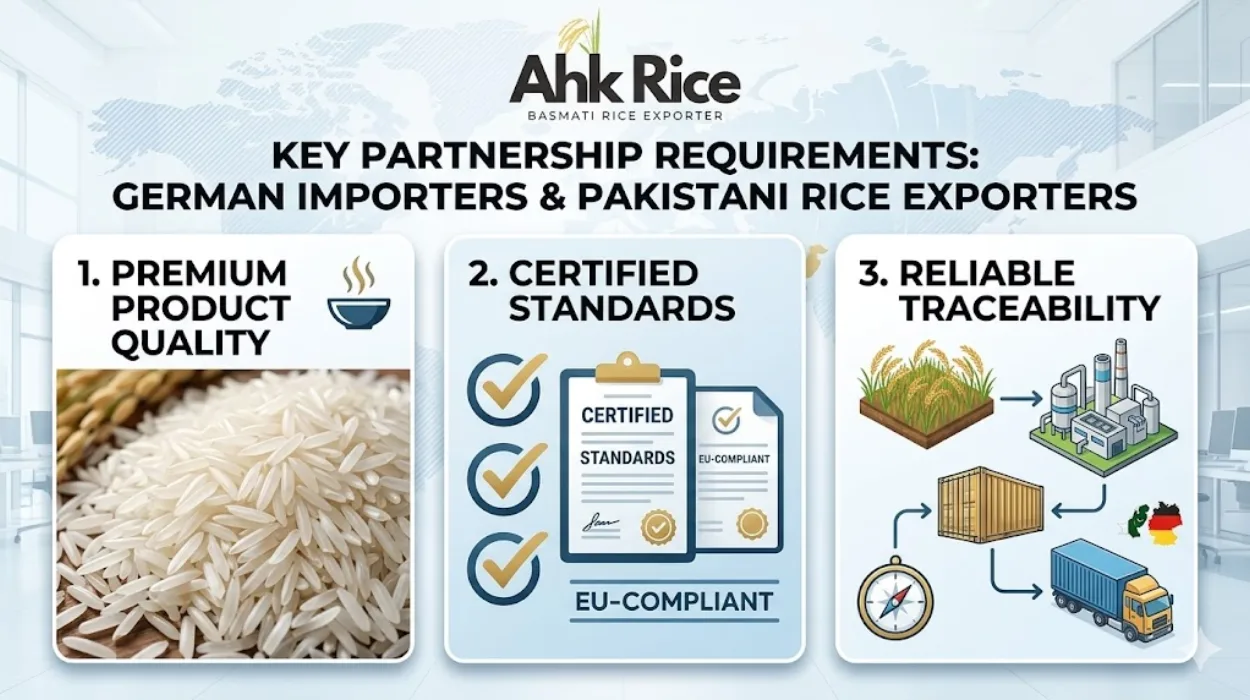
German importers choose Pakistani rice exporters based on quality consistency, food safety compliance, traceability, reliable logistics, and transparent documentation. Here is why: Germany operates under strict European Union food regulations, making supplier reliability as important as product quality.
German buyers import Pakistani Basmati rice because Pakistan produces internationally recognized long-grain aromatic varieties such as 1121 Basmati, Super Kernel Basmati, and 1509 Basmati. However, product quality alone does not secure long-term business relationships. Importers evaluate processing standards, certifications, supply chain transparency, and shipment performance before selecting suppliers.
AHK Rice operates within this export environment by processing, grading, packaging, and supplying Pakistani Basmati rice to international markets through end-to-end export management.
What do German importers evaluate before selecting a Pakistani rice exporter?
German importers prioritize certified food safety systems, documented traceability, stable grain specifications, compliant packaging, dependable shipment schedules, and transparent communication. These requirements reduce commercial risk and ensure imported rice complies with European food regulations while maintaining consistent retail and wholesale performance.
Germany represents one of Europe’s most quality-focused food markets. Importers face strict obligations under European food safety legislation. As a result, every supplier becomes part of their compliance system.
German buyers typically evaluate six core areas:
| Evaluation Factor | Importer Objective | Business Impact |
|---|---|---|
| Product Quality | Consistent grain performance | Lower customer complaints |
| Food Safety | Regulatory compliance | Reduced legal risk |
| Traceability | Product origin verification | Faster recalls if required |
| Documentation | Customs clearance efficiency | Reduced delays |
| Logistics Reliability | Predictable inventory planning | Better stock management |
| Communication | Faster issue resolution | Stronger partnerships |
Food safety receives the highest scrutiny. German importers routinely request laboratory reports, pesticide residue testing, heavy metal analysis, and microbiological testing.
Traceability has become increasingly important. Importers want evidence showing where rice was cultivated, how it was processed, and which batch entered each shipment.
Documentation quality directly influences customs performance. Missing certificates can delay container clearance and increase storage costs.
Quality compliance forms the foundation of supplier selection. The next consideration involves understanding which exporter solutions are available in the Pakistani market.
What supplier solutions are available for German rice importers?
German buyers can source through traders, commission agents, processors, integrated exporters, or private-label suppliers. Integrated exporters generally provide the highest control over quality, traceability, documentation, packaging, and shipment execution across the entire supply chain.
The Pakistani rice export sector contains multiple supplier categories.
Traders
Traders purchase rice from mills and resell it internationally.
Advantages:
- Lower minimum order quantities
- Flexible sourcing
- Broad product access
Disadvantages:
- Limited production control
- Variable quality consistency
- Reduced traceability visibility
Commission Agents
Agents connect buyers with mills and exporters.
Advantages:
- Market knowledge
- Supplier access
- Negotiation support
Disadvantages:
- Additional communication layer
- Limited operational control
- Dependency on third parties
Processing Mills
Processing mills focus primarily on manufacturing.
Advantages:
- Production expertise
- Direct factory access
- Better process visibility
Disadvantages:
- Limited export support
- Restricted logistics services
- Fewer packaging options
Integrated Exporters
Integrated exporters manage processing, quality control, packaging, documentation, and shipping.
Advantages:
- End-to-end control
- Better traceability
- Faster issue resolution
- Consistent specifications
Disadvantages:
- Higher operational requirements
- Larger compliance responsibilities
AHK Rice falls into this category by combining processing, grading, packaging, quality control, and export management within one operational structure.
Supplier models differ significantly. Understanding their performance differences helps German buyers identify the most suitable sourcing approach.
How do different Pakistani exporter approaches compare?
Integrated exporters outperform fragmented supply chains in traceability, consistency, documentation control, and logistics reliability. Traders may offer pricing flexibility, while processors provide manufacturing expertise, but integrated exporters generally reduce operational risk for European importers.
Specification Comparison Table
| Attribute | Traders | Agents | Processing Mills | Integrated Exporters |
|---|---|---|---|---|
| Quality Control | Medium | Low | High | High |
| Traceability | Low | Low | Medium | High |
| Documentation Accuracy | Medium | Medium | Medium | High |
| Packaging Flexibility | Medium | Low | Medium | High |
| Shipment Coordination | Medium | Low | Medium | High |
| Private Label Capability | Limited | Limited | Moderate | Extensive |
| Regulatory Support | Limited | Limited | Moderate | High |
German importers increasingly prefer exporters with internal quality systems because compliance obligations continue expanding across European food supply chains.
For example, a supermarket distributor importing private-label Basmati rice requires packaging consistency, barcode compliance, batch coding, and traceability records. Integrated exporters can manage these requirements within one workflow.
A restaurant wholesaler may prioritize shipment speed and pricing flexibility. Processing mills or specialized exporters can often satisfy those requirements efficiently.
Different sourcing models suit different business objectives. Market-specific preferences further influence supplier selection decisions.
Which rice grades do German and European markets prefer?
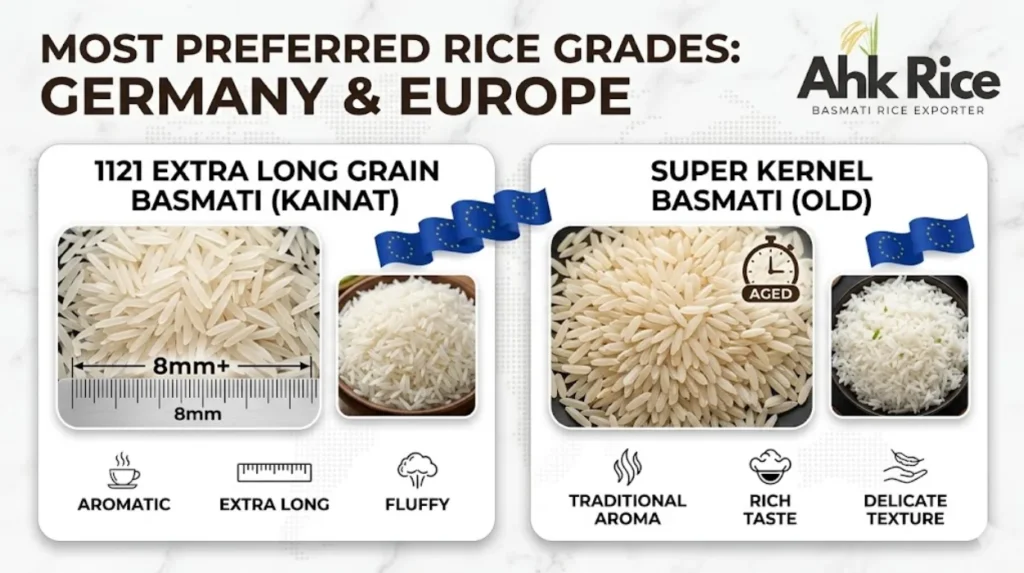
German retail buyers prefer premium Basmati grades with high purity and consistent grain length, while broader European foodservice buyers often balance quality and cost through multiple grade selections. Market positioning determines the preferred specification.
Germany Retail Market Preferences
German retail channels typically favor:
- 1121 Steam Basmati
- 1121 White Basmati
- Super Kernel Basmati
Key purchasing criteria include:
- Long grain appearance
- Aroma retention
- Uniform cooking performance
- Premium packaging presentation
European Foodservice Market Preferences
Foodservice distributors often purchase:
- 1121 Steam Basmati
- 1121 Sella Basmati
- 1509 Basmati
Key purchasing criteria include:
- Cost efficiency
- Bulk packaging
- Shelf stability
- Cooking consistency
Price Comparison per Metric Ton
| Grade | Typical Export Value Range |
|---|---|
| 1121 White Basmati | Premium |
| 1121 Steam Basmati | Premium-Mid |
| 1121 Golden Sella | Mid |
| Super Kernel Basmati | Premium |
| 1509 Basmati | Cost Competitive |
Export prices fluctuate according to harvest conditions, currency movements, freight rates, and global demand patterns.
Market preferences determine product selection. Product performance over time also influences importer decisions.
How important are shelf life and storage performance?
Shelf life directly impacts inventory planning, retail distribution, and product quality preservation. German importers evaluate rice grades according to storage stability, packaging integrity, and transportation performance throughout extended supply chains.
Shelf stability varies by processing method.
| Rice Type | Typical Shelf Life |
|---|---|
| White Basmati | Up to 18 months |
| Steam Basmati | Up to 24 months |
| Golden Sella Basmati | Up to 24 months |
| Super Kernel Basmati | Up to 18 months |
Golden Sella lasts longer than White rice under demanding storage conditions. In warm warehouse environments, Golden Sella maintains grain structure more effectively. Steam rice offers a balance between premium appearance and storage durability.
German distributors importing container volumes often prioritize grades with predictable storage performance because inventory may move through multiple warehouses before reaching consumers.
Storage performance influences operational efficiency. Importers also evaluate supplier strengths and weaknesses before finalizing partnerships.
What are the advantages and disadvantages of partnering with Pakistani rice exporters?
Pakistani exporters offer competitive pricing, premium Basmati varieties, and strong production capacity. Challenges typically involve supplier inconsistency, documentation quality differences, and varying levels of export experience among market participants.
Pros
| Advantage | Example |
|---|---|
| Premium Basmati Availability | 1121 and Super Kernel varieties |
| Competitive Pricing | Lower production costs than many competitors |
| Large Export Capacity | Ability to supply container programs |
| Product Diversity | White, Steam, Sella, Brown rice |
| Private Label Options | Retail-ready packaging solutions |
Cons
| Limitation | Example |
|---|---|
| Variable Quality Standards | Different mills use different controls |
| Documentation Gaps | Inexperienced exporters create delays |
| Traceability Differences | Some suppliers lack batch systems |
| Packaging Variation | Inconsistent presentation quality |
| Communication Delays | Slower issue resolution |
German importers reduce these risks by conducting supplier audits, reviewing certifications, and evaluating shipment records before entering long-term agreements.
Supplier strengths and weaknesses lead directly to the final decision framework.
Which exporter selection method works best for different German importers?
Retail chains require compliance-focused integrated exporters, foodservice distributors benefit from flexible processors, and specialty importers often succeed with premium-focused suppliers. The best choice depends on product strategy, risk tolerance, and operational requirements.
Decision Framework Table
| Buyer Type | Priority | Recommended Supplier Type | Reason |
|---|---|---|---|
| Supermarket Chain | Compliance | Integrated Exporter | Strong traceability |
| Private Label Brand | Packaging | Integrated Exporter | End-to-end control |
| Foodservice Distributor | Cost Efficiency | Processor/Exporter | Volume flexibility |
| Specialty Food Importer | Premium Quality | Premium Exporter | Product differentiation |
| Wholesale Trader | Price Optimization | Trader/Exporter | Market flexibility |
Retail buyers generally prioritize certifications and traceability.
Foodservice buyers often prioritize operational efficiency and supply continuity.
Specialty importers prioritize grain quality, aroma, and brand differentiation.
German importers evaluating long-term sourcing opportunities should also examine emerging export markets and global demand trends. Insights from growing Asian import opportunities for Pakistani rice suppliers provide useful perspective on how export demand influences supplier capacity and pricing strategies.
Frequently Asked Questions
Why do German importers prefer certified Pakistani rice exporters?
German importers prefer certified exporters because certifications verify food safety systems, quality controls, traceability procedures, and regulatory compliance required within European food markets.
Which Pakistani rice variety is most popular in Germany?
1121 Basmati rice remains the most requested variety because of its extra-long grain length, aroma, cooking performance, and premium retail positioning.
What certifications do German rice importers usually request?
Importers commonly request ISO certifications, HACCP compliance records, laboratory testing reports, phytosanitary certificates, and food safety documentation.
How important is traceability in German rice imports?
Traceability is critical because European food regulations require importers to identify product origins, production batches, and supply chain movements.
What packaging formats are commonly imported into Germany?
German importers commonly source 1 kg, 5 kg, 10 kg, 20 kg, and private-label retail packaging formats, depending on their distribution model.