How Pakistani Basmati Exporters Test for MRLs and Aflatoxin Before UAE Shipment
Pakistani Basmati exporters serving the UAE need a risk-based testing plan that combines accredited laboratory analysis, pesticide residue screening, aflatoxin testing, and documented batch traceability; the appropriate method depends on the rice grade, destination requirements, buyer specifications, and intended retail or wholesale use.
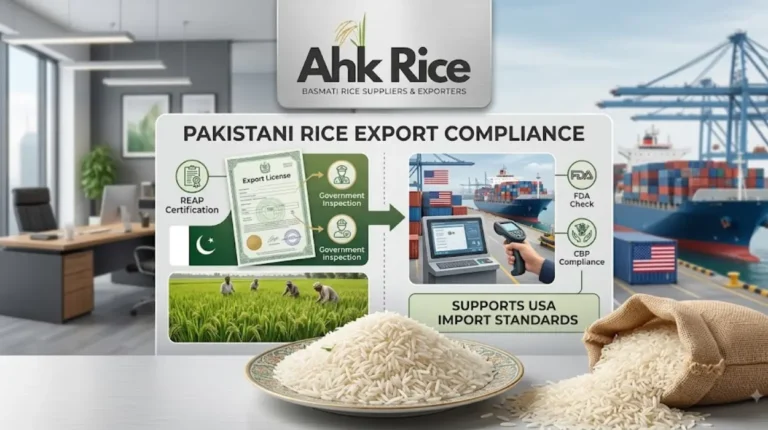
Before comparing testing methods, importers should understand how Pakistani rice exporters prepare food safety and export documentation. This foundation connects laboratory results with product specifications, shipment records, and the documentation required for commercial clearance. A laboratory report supports compliance, but it does not replace UAE import approvals, applicable food regulations, or any required inspection.
What do MRLs and aflatoxin testing mean for Pakistani Basmati exports?
Maximum residue limits (MRLs) define the legally permitted concentration of a pesticide residue in food, expressed in milligrams per kilogram. Aflatoxin testing measures toxic compounds produced by certain moulds. Both checks address different food safety risks.
An MRL is not a general pesticide safety certificate. Each limit relates to a specific pesticide and food commodity. Aflatoxins are mycotoxins, meaning toxic substances produced by certain fungi. Their occurrence relates to contamination risks during crop production, drying, storage, and handling.
The UAE’s Cabinet Resolution No. 116 of 2024 established a technical regulation for pesticide MRLs, effective from 1 November 2024. Exporters must check the applicable UAE requirements rather than relying solely on international reference values. Codex Alimentarius provides an additional international reference for pesticide-residue limits, but the applicable destination requirements govern the shipment.
For Pakistani Basmati rice, these checks should connect to the specific production lot, processing batch, packaging records, and final shipment. A report for one lot does not automatically establish compliance for another lot, even when both contain the same variety.
What testing solutions are available before a UAE shipment?
Exporters generally use accredited laboratory testing, rapid screening, supplier-level risk assessment, and pre-shipment inspection. These approaches serve different purposes. Laboratory analysis measures specified contaminants, screening identifies potential concerns, and inspection connects results with the physical consignment.
Four practical approaches form a pre-shipment testing programme:
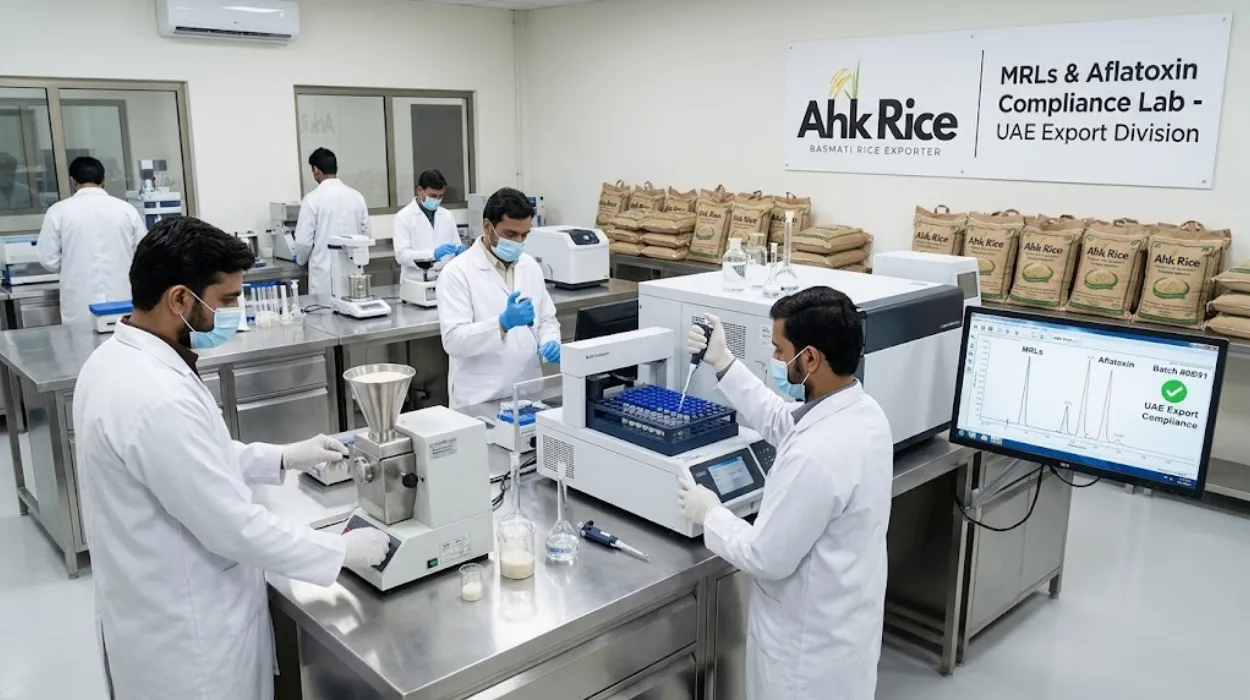
- Accredited laboratory analysis: A competent laboratory uses validated methods to quantify pesticide residues or detect and measure aflatoxins. The buyer receives results against specified analytes and reporting limits.
- Rapid screening: Screening methods provide an initial indication of possible contamination. A result requiring confirmation should be referred to a suitable laboratory method.
- Supplier and farm records: Pesticide application records, approved chemical-use practices, harvest details, drying controls, and storage records help identify risks before laboratory testing.
- Pre-shipment inspection: Inspectors check product identity, packaging, lot codes, container condition, and documentation. Physical inspection complements laboratory evidence rather than replacing it.
A practical programme combines these approaches according to the risk profile and contractual requirements. For example, a buyer ordering premium 1121 Basmati for retail distribution can request pesticide-residue analysis, aflatoxin results, a lot-specific certificate of analysis (COA), and a documented inspection before shipment.
How do different laboratory testing methods compare?
Multi-residue pesticide analysis offers broad coverage across selected pesticide compounds, while targeted testing concentrates on specified substances. Aflatoxin analysis requires a separate suitable method. Rapid screening supports initial decisions, but method selection must match the required detection limits and regulatory criteria.
| Attribute | Multi-residue analysis | Targeted pesticide analysis | Aflatoxin analysis |
|---|---|---|---|
| Primary purpose | Screens a broad panel of pesticides | Measures selected pesticide compounds | Detects or quantifies specified aflatoxins |
| Typical techniques | LC-MS/MS or GC-MS/MS | LC-MS/MS, GC-MS/MS, or another validated method | HPLC or LC-MS/MS; validated immunoassays may support screening |
| Coverage | Multiple compounds within method scope | Defined compounds requested by buyer | Individual aflatoxins or total aflatoxins, as specified |
| Main advantage | Broad screening in one analytical programme | Focus on known agricultural or storage risks | Direct assessment of a distinct mycotoxin hazard |
| Main limitation | Not every pesticide is covered by every method | Misses substances outside the selected panel | Does not establish pesticide-residue compliance |
| Reporting | Individual results, units, and reporting limits | Results for the requested compounds | Individual or total results according to the method |
| Best application | General export risk assessment | Known or buyer-specified pesticide risks | Rice lots requiring mycotoxin control |
The laboratory should state the method, analytes, units, limits of quantification, and relevant quality-control information. The limit of quantification (LOQ) is the lowest concentration the method can quantify with defined performance. A result reported as below the LOQ does not mean that absolutely no residue exists.
A multi-residue report also does not prove that every pesticide has been tested. The exporter must compare the laboratory’s analyte list with the relevant UAE requirements and the buyer’s specification before approving the shipment.
How should exporters test for pesticide residues and aflatoxins?
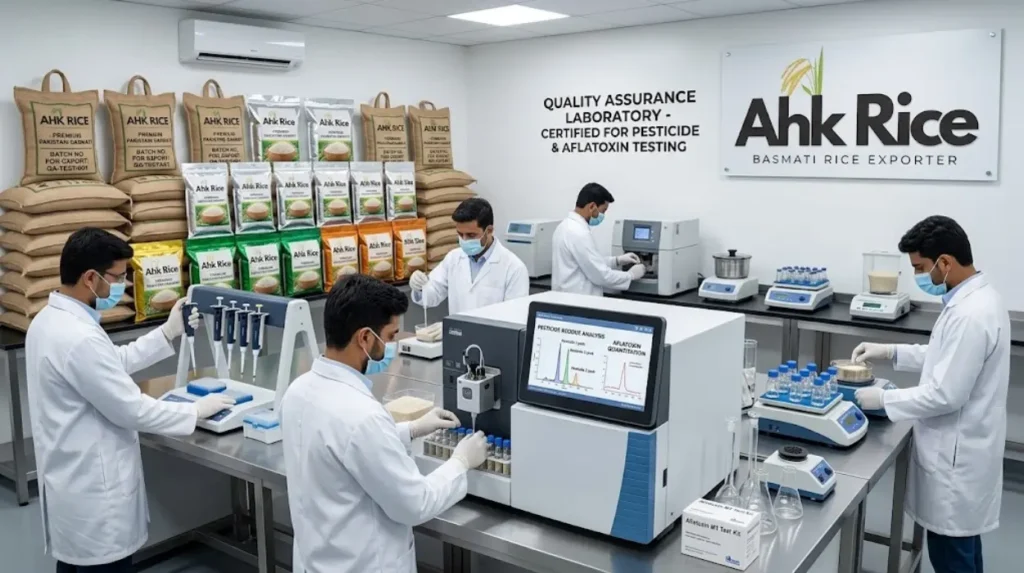
Exporters should define the destination limits, identify the shipment lot, collect a representative sample, select an appropriately accredited laboratory, review the analytical report, and release the batch only after the agreed criteria are met. Every stage requires traceable records.
- Confirm the applicable limits. Identify the rice commodity, intended market, relevant pesticide MRLs, applicable contaminant requirements, and buyer-specific limits. Use the current UAE regulatory framework and confirm interpretation with the UAE importer or competent authority where needed.
- Identify and segregate the lot. Record the variety, milling batch, production date, storage location, quantity, and lot code. Keep the sampled stock identifiable throughout testing.
- Collect a representative sample. Follow a documented sampling procedure suitable for the lot size and contaminant. Aflatoxins can be unevenly distributed, so sampling quality directly affects how well the result represents the consignment.
- Send the sample to a suitable laboratory. Verify that the laboratory’s accreditation scope covers the relevant food matrix, analytes, and methods. Specify whether the request covers multi-residue pesticides, selected compounds, aflatoxins, or all three.
- Review results before release. Compare each result with the applicable limit and agreed specification. Investigate exceedances, unexpected findings, and ambiguous reporting. Link the approved report to the correct shipment and retain the records.
For commercial shipments, buyers should agree on sampling responsibility, testing costs, report format, retesting rules, and who authorises release. These details prevent disputes when a laboratory result arrives close to the loading date.
Which testing approach works best for different cases?
A broad pesticide panel plus aflatoxin analysis suits buyers seeking comprehensive routine screening. Targeted analysis suits known risks or specific contractual requirements. Rapid screening supports preliminary checks, while additional confirmation is appropriate when a screening result or risk assessment requires it.
The choice depends on the buyer’s exposure, product use, and procurement controls.
- Premium retail orders: Request a broad pesticide-residue panel, aflatoxin testing, lot traceability, and a COA before final approval. Retailers need evidence that matches the product and the batch they receive.
- Large wholesale orders: Set testing requirements in the purchase specification and define the lot-sampling plan before processing. Use risk-based testing where the supplier’s records and history support it.
- New supplier onboarding: Begin with a documented supplier assessment and representative laboratory testing. Establish acceptable results, report requirements, and corrective-action procedures before repeat orders.
- Repeat shipments from an established supplier: Maintain routine testing and traceability, then adjust frequency according to changes in origin, season, storage, processing, or risk.
- A suspected contamination event: Hold the affected lot, investigate the source, and arrange appropriate confirmatory analysis. Do not use a clean result from an unrelated batch to release the held stock.
No single test replaces the others. Pesticide analysis and aflatoxin analysis address separate hazards, while supplier records and inspections help explain how the product was produced and handled.
How do UAE market regions affect grade selection and testing?
Dubai’s wholesale, retail, foodservice, and re-export channels require specifications aligned with each buyer’s end use. Abu Dhabi and other emirates follow their applicable food-control requirements, while importers should confirm any additional local procedures before shipment.
The two market segments below illustrate how procurement priorities influence grade selection and testing. They are commercial planning examples, not fixed rules for every buyer.
Market comparison: Dubai and Abu Dhabi
| Decision factor | Dubai market | Abu Dhabi market |
|---|---|---|
| Common buyer segments | Importers, distributors, retailers, foodservice, re-exporters | Distributors, retailers, foodservice, institutional buyers |
| Relevant grades | 1121, Super Kernel, 1509 according to price and end use | 1121, Super Kernel, 1509 according to menu and customer requirements |
| Testing priorities | Contract-specific pesticide panel, aflatoxin results, traceable COA | Contract-specific pesticide panel, aflatoxin results, traceable COA |
| Commercial emphasis | Packaging variety, distribution speed, re-export documentation | Consistent supply, product specifications, local food-control procedures |
| Price comparison | Depends on grade, order size, packaging, Incoterm, and delivery terms | Depends on the same factors, plus inland logistics and distribution costs |
The export price per metric tonne (MT) is not the same as the UAE buyer’s landed cost. A useful comparison separates the supplier’s FOB quotation from freight, insurance, port charges, clearance, testing, and local delivery.
For example, a 2026 planning benchmark for Super Kernel Basmati is approximately US$1,165–US$1,205 per MT FOB Karachi. This is an indicative grade-specific benchmark, not a live quotation or a UAE wholesale price. A comparable 1121 or 1509 quotation requires the exact grade, processing style, broken percentage, moisture specification, packaging, volume, and shipment terms.
Buyers should compare equivalent specifications rather than choosing the lowest headline price. A lower quotation that excludes agreed laboratory testing or uses a different grade does not represent a like-for-like offer.
How do shelf life and storage affect testing decisions?
Shelf life depends on moisture, processing, packaging, storage conditions, and product integrity. Laboratory testing documents the condition of the sampled lot at the time of analysis, while proper storage and traceability help maintain quality throughout distribution.
Basmati rice does not have one universal shelf-life period for every shipment. The exporter and importer should establish a validated shelf-life claim based on the product, packaging, storage conditions, and applicable labelling rules. The following comparison describes storage priorities rather than guaranteeing a fixed expiry period.
| Factor | Dubai distribution | Abu Dhabi and other emirates |
|---|---|---|
| Storage environment | Protect stock from heat, humidity, pests, and direct sunlight | Apply the same moisture, temperature, and pest controls |
| Packaging | Use intact, food-grade packaging suited to transport and retail | Match packaging to distribution, handling, and intended use |
| Shelf-life evidence | Confirm the declared period and storage instructions with the supplier | Apply the same documented shelf-life basis |
| Aflatoxin control | Control moisture exposure and investigate damaged or damp stock | Maintain dry storage and inspect stock for damage |
| Traceability | Retain lot codes and incoming inspection records | Retain lot codes and distribution records |
Aflatoxin prevention starts before the laboratory test. Rice exposed to moisture during storage or transport can face mould-related risks, especially where handling conditions are poor. Dry, clean storage and suitable container preparation reduce avoidable exposure, but they do not replace analytical verification.
A pre-shipment report also cannot guarantee that the rice will remain compliant if the consignment is later exposed to water, damaged packaging, or unsuitable storage. Buyers should preserve the relationship between the original COA, lot number, receiving inspection, and stock rotation records.
What are the pros and cons of each testing strategy?
Broad laboratory testing provides wider evidence but adds cost and lead time. Targeted testing reduces unnecessary analysis when the risk is well defined. Rapid screening speeds preliminary decisions, while documented supplier controls reduce preventable contamination risks without replacing laboratory verification.
| Strategy | Advantages | Limitations | Example |
|---|---|---|---|
| Broad pesticide panel plus aflatoxin analysis | Covers multiple specified hazards in one planned programme | Higher cost and potentially longer turnaround | A new retail supplier entering Dubai |
| Targeted pesticide analysis | Focuses spending on known risks and contractual requirements | Does not detect untested compounds | A repeat buyer specifies particular pesticide residues |
| Rapid screening | Supports quick preliminary decisions | Positive or unclear results may require confirmation | Initial checks during supplier qualification |
| Supplier-level prevention | Improves traceability and reduces avoidable handling risks | Records alone cannot prove the absence of residues | Monitoring farm practices and warehouse conditions |
| Independent pre-shipment inspection | Connects documents with the actual consignment | Cannot establish chemical compliance by visual examination alone | Verifying lot identity, packaging, and container condition |
The strongest programme is not necessarily the one with the largest test panel. It is the programme that covers applicable regulatory limits, buyer requirements, credible risks, and the exact product lot. Laboratory scope and sampling quality matter as much as the number of tests requested.
What decision factors should UAE importers use when choosing a testing plan?
Importers should decide testing requirements before placing the order, using five factors: destination compliance, product and supplier risk, analytical coverage, traceability, and total commercial cost. Written acceptance criteria prevent disagreements after the rice has been processed or loaded.
| Decision factor | Question to ask | Required evidence |
|---|---|---|
| Regulatory compliance | Which UAE limits and import procedures apply? | Current requirements and buyer-approved specifications |
| Product and supplier risk | What are the crop, processing, and storage risks? | Supplier records, lot details, risk assessment |
| Analytical coverage | Are the relevant pesticides and aflatoxins included? | Laboratory scope, method, analyte list, LOQ |
| Traceability | Does the report match the shipment? | Lot code, sampling record, COA, packing records |
| Total cost and timing | Can testing finish before the loading deadline? | Laboratory quotation, turnaround estimate, release procedure |
Importers should also agree on the response to a non-compliant result. The contract can define a hold on loading, confirmatory testing, investigation, rejection, or other corrective action, subject to the applicable law and purchase terms. A second test should follow a documented sampling and investigation plan rather than being used simply to obtain a preferred result.
For a new supplier, the buyer can make report approval a condition of shipment release. For repeat suppliers, the contract can specify routine test frequency and additional testing when the source, crop season, processing line, or storage conditions change.
How should AHK Rice prepare a tested shipment for UAE buyers?
AHK Rice should connect the agreed rice specification, representative sampling, laboratory reports, batch traceability, packaging checks, and export documents before shipment release. Buyers should approve the evidence against their purchase specifications and applicable UAE requirements.
AHK Rice is a Pakistani Basmati exporter based in Punjab, supplying 1121, Super Kernel, and 1509 varieties to more than 15 countries. Its end-to-end processing and custom packaging workflow provides a framework for linking quality checks to commercial shipment records.
For a UAE order, the buyer and exporter should confirm the grade, processing style, grain length, broken percentage, moisture, packaging, destination requirements, and testing scope. The laboratory request should identify the pesticide panel and aflatoxin parameters, while the resulting COA should identify the tested sample and corresponding lot.
Before loading, the exporter should reconcile the report with the packing list, invoice, lot identification, and other documents required for the transaction. The importer should separately confirm applicable food registration, labelling, customs, and inspection procedures with the relevant UAE authority. Official UAE guidance identifies local authorities as responsible for food-safety oversight and inspections.
FAQs about MRL and aflatoxin testing for UAE rice shipments
What does MRL mean in Pakistani Basmati rice exports?
MRL means maximum residue limit. It specifies the legally permitted concentration of a particular pesticide residue in a food commodity. Exporters must check the applicable UAE limit for each relevant pesticide and commodity.
Is pesticide residue testing enough for UAE rice imports?
No. Pesticide residue testing addresses specified chemical residues. Aflatoxin analysis addresses a separate mycotoxin risk. Buyers should determine which additional food-safety tests and documents apply to their product and import route.
Which laboratory should test Pakistani Basmati rice?
Choose a competent laboratory with accreditation covering the relevant rice matrix, analytes, and analytical methods. Confirm the accreditation scope, reporting limits, units, and expected turnaround before submitting the sample.
Does a COA guarantee UAE customs clearance?
No. A certificate of analysis records the results for the tested sample. Customs clearance and food release also depend on applicable import procedures, documentation, inspections, product registration where required, and compliance with UAE regulations.
When should exporters conduct MRL and aflatoxin testing?
Exporters should schedule testing early enough to receive and review results before shipment release. The timing depends on laboratory turnaround, sample preparation, the test panel, and the buyer’s approval process.