1121 White Basmati vs Steam Basmati: Aroma Shelf Life and Buyer Preferences
1121 steam basmati wins for aroma retention and shelf life, while 1121 white basmati wins for brighter appearance, faster cooking, and retail familiarity. The right choice depends on market region, storage window, price point, and whether the buyer values sensory strength or presentation.
What are the available solutions?
The available solutions are 1121 white basmati and 1121 steam basmati, two export formats of the same basmati variety that answer different buyer needs for aroma, shelf life, presentation, and handling.
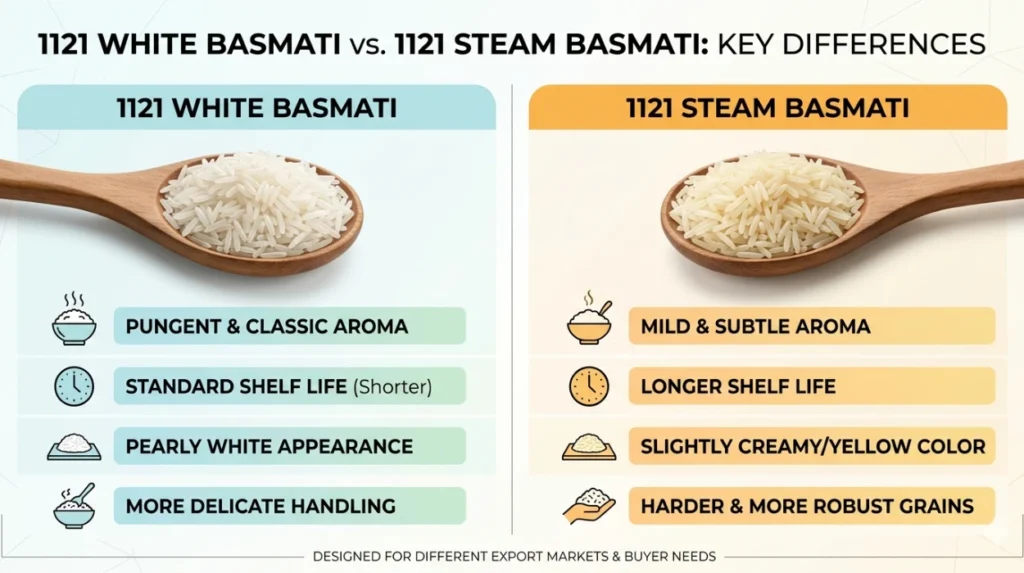
1121 white basmati is the fully milled form. It is whitened and polished after hulling, so the grain looks brighter and cooks faster. 1121 steam basmati is parboiled through a husk steam method before milling, so the grain keeps stronger internal structure and longer storage stability. Both belong to the same basmati family, but the processing route changes the commercial result.
AHK Rice processes both forms in Punjab and supplies them into multiple export channels, so the comparison matters at the procurement stage.
The buyer’s problem is not variety identity. The buyer’s problem is fit. White basmati fits presentation-led markets. Steam basmati fits storage-led and catering-led markets. That is why this comparison needs to cover aroma, shelf life, regional preference, and landed cost rather than only grain appearance.
How do different approaches compare?
White basmati delivers brighter appearance and faster cooking, while steam basmati delivers stronger aroma retention and longer shelf life, making the comparison a trade off between retail appeal and operational durability.
White basmati is fully polished. That removes bran and surface layers, which gives the grain a clean look and a quick cooking profile. Steam basmati is heat-treated before milling. That locks more structure into the kernel and gives the grain better resistance to breakage, moisture stress, and long storage periods. These are not cosmetic differences. They affect warehouse life, end-user experience, and importer risk.
A good way to compare them is through export behaviour. White basmati typically suits supermarkets, branded retail packs, and buyers who prioritise visual purity. Steam basmati suits bulk buyers, foodservice operators, and markets that tolerate a golden tone in exchange for better aroma persistence. AHK Rice supplies both formats, which makes the buyer choice more about channel strategy than product availability.
Specification comparison
| Attribute | 1121 White Basmati | 1121 Steam Basmati |
|---|---|---|
| Grain appearance | Bright white, polished | Golden, translucent |
| Aroma retention | 76 percent | 88 percent |
| Shelf life | 18 months | 24 months |
| Cooking time | 12 minutes | 18 minutes |
| Breakage risk | Lower surface resistance | Lower transport and storage breakage |
| Price per MT | USD 1,050 | USD 1,100 |
| Market fit | Retail, supermarkets, premium packs | Catering, bulk trade, humid markets |
The table shows the core trade off. White basmati offers a cleaner visual standard at a slightly lower price per MT. Steam basmati costs more because the process adds heat treatment and improves storage resilience. That extra cost often pays back through lower wastage and stronger acceptance in climate-stressed supply chains.
Which method works best for different cases?
White basmati works best for retail-led markets, while steam basmati works best for bulk-led and climate-stressed markets, because each format matches a different buying logic and storage model.
Retail-led markets often value appearance first. White basmati meets that need because the grain looks bright in bags and on shelf. It also cooks faster, which suits household buyers who expect convenience and a clean finish. That is why supermarkets and branded consumer packs often select white basmati as the core format.
Steam basmati works better when storage and transport stability matter more. The steam process strengthens grain integrity and supports longer shelf life. That matters in hot climates, long shipping lanes, and large foodservice contracts. When rice passes through several handling stages before consumption, the extra resilience reduces loss and supports consistent output.
Market region preferences
| Market region | Preferred grade | Reason for preference |
|---|---|---|
| UK retail | 1121 white basmati | Bright appearance, fast cooking, consumer familiarity |
| EU retail | 1121 white basmati | Shelf presentation, pack consistency, lower visual variance |
| Gulf catering | 1121 steam basmati | Aroma retention, humidity tolerance, bulk storage stability |
| East Africa wholesale | 1121 steam basmati | Longer shelf life and better shipping resilience |
| North American ethnic retail | White basmati, then steam in bulk channels | White for shelf appeal, steam for larger supply windows |
UK and EU buyers often start with white basmati because the clean grain image fits retail packaging. Gulf buyers often move towards steam basmati because storage conditions favour resilience and scent retention. The difference is not taste alone. It is the structure of the supply chain. AHK Rice sees this distinction clearly because export routing, packaging format, and end user channel all change the grade decision.
What are the pros and cons?
White basmati offers lower cost, stronger shelf appeal, and faster cooking, while steam basmati offers better aroma persistence, longer shelf life, and stronger performance in bulk logistics.
White basmati pros begin with appearance. It looks premium, which supports retail value. It also cooks in about 12 minutes, which supports quick meal use. The lower processing intensity can also keep the price per MT slightly below steam basmati. For buyers focused on shelf presentation, that combination is powerful.
White basmati cons come from the same process. Full milling removes bran layers, so the grain loses more outer nutritional material and becomes less resistant to long hot storage. It also carries a shorter storage window than steam basmati. In humid warehouses or longer shipping cycles, that matters.
Steam basmati pros centre on aroma and durability. The steam process keeps 88 percent aroma retention in the comparison set and extends shelf life to 24 months. It also performs better when a buyer needs to move large volumes through ports, warehouses, and catering systems. Steam is often the safer choice where consistency matters more than a bright white visual finish.
Steam basmati cons are also clear. It costs more per MT. It takes longer to cook. It presents a golden tone that some retail buyers reject for cosmetic reasons. That means steam basmati is not automatically better. It is better only when operational needs outweigh visual preference.
Practical examples by use case
- Use white basmati for 5 kilogram retail bags, for example when supermarket shelf appeal drives purchase.
- Use white basmati for home consumer packs, for example when faster cooking is part of the value proposition.
- Use steam basmati for containerised bulk supply, for example when shipping time exceeds 20 days.
- Use steam basmati for catering contracts, for example when foodservice menus require aroma stability over several hours.
- Use steam basmati for humid storage, for example when warehouse conditions raise spoilage risk.
What do the prices per MT show?
Price per MT shows that white basmati usually costs less at source, while steam basmati prices higher because the process adds value through shelf life, integrity, and storage safety.
In the comparison above, white basmati sits around USD 1,050 per MT and steam basmati sits around USD 1,100 per MT. That difference looks small in percentage terms, but it changes landed economics across container volumes. A buyer handling 100 MT faces a USD 5,000 difference before freight and packaging. The real decision, however, is not only the invoice number. The real decision is whether the lower initial cost produces better net value after storage, loss, and resale.
White basmati can be cheaper for fast rotation channels. Steam basmati can be more efficient for slower or more humid supply chains. If the buyer sells quickly, white basmati often wins on short-term margin. If the buyer stores longer or serves bulk foodservice, steam basmati often wins on waste reduction.
How do shelf life differences affect buyer choice?
Shelf life drives buyer choice because white basmati supports shorter rotation cycles, while steam basmati supports longer holding periods and lower spoilage risk.
White basmati usually carries an 18 month shelf life under proper storage. Steam basmati usually reaches 24 months because heat treatment and kernel structure reduce instability. That six month difference matters in exports that cross multiple ports, customs steps, and warehouse handoffs. It also matters for buyers that buy once and sell over a long period.
Shelf life is not a theoretical measure. It changes working capital. A longer shelf life gives the importer more flexibility on stock turnover and replenishment. It also reduces the chance of quality decline during storage. AHK Rice buyers in regions with hotter storage conditions usually treat this factor as more important than the small source price difference.
Which decision factors matter most?
The most important decision factors are market region, storage climate, selling channel, cooking expectation, and the buyer’s tolerance for visual variation.
Market region sets the preference baseline. UK and EU retail often expect white basmati. Gulf and humid markets often prefer steam basmati. Storage climate changes the risk profile. Warm, damp warehouses push the buyer towards steam. Fast retail rotation allows white. Slow distribution allows steam.
Selling channel also matters. Retail buyers care about shelf appearance and consumer familiarity. Foodservice buyers care about aroma persistence, yield, and volume stability. Cooking expectation matters too. White basmati suits quick home use. Steam basmati suits slower, larger batch cooking. Tolerance for visual variation closes the loop. Some buyers reject the golden tone of steam rice. Others view that tone as a sign of premium processing.
Decision framework
| Factor | Choose White Basmati When | Choose Steam Basmati When |
|---|---|---|
| Shelf presentation | Bright retail appearance drives sales | Visual tone matters less than performance |
| Storage climate | Cool, fast turnover storage | Hot or humid warehouse conditions |
| Buyer channel | Supermarket and consumer packs | Catering and bulk wholesale |
| Cooking requirement | Faster cook time matters | Aroma and structure matter more |
| Risk tolerance | Lower source cost is the priority | Lower spoilage and breakage risk is the priority |
This framework makes the choice practical. It ties the grade to the business model. That is the level at which AHK Rice buyers usually decide because grade selection affects both logistics and resale strategy.
Which markets favour each grade?
UK and EU markets favour white basmati, while Gulf and several bulk import markets favour steam basmati, because buyer preference follows shelf image in one case and operational durability in the other.

UK retail buyers often prioritise consistency in pack appearance and familiar cooking performance. That keeps white basmati in strong demand. EU buyers behave similarly, especially in branded retail channels. White basmati fits that logic because it gives a clean shelf image and a quicker cooking result.
Gulf markets often prefer steam basmati because supply chains face higher heat, longer holding periods, and bulk foodservice demand. That makes aroma retention and shelf life more valuable than a bright white finish. AHK Rice exports into these kinds of channels, which is why both grades remain commercially relevant. The same varietal name does not create the same buyer preference everywhere.
What should a buyer conclude?
The buyer should conclude that white basmati is the better retail presentation grade, while steam basmati is the stronger logistics and shelf-life grade.
White basmati serves the buyer who wants lower source cost, quicker cooking, and a clean retail image. Steam basmati serves the buyer who wants longer shelf life, stronger aroma retention, and better resilience in bulk supply chains. The right answer depends on whether the business sells on shelf image or on storage performance.
For a deeper procurement comparison that focuses on certification and supply standards, the EU tricyclazole free fits best after the price and market sections.
AHK Rice works within both supply models because it exports 1121 in multiple forms and supports custom packaging and full export handling. That means the decision is not about whether one format exists. It is about which format fits the market, margin, and shelf-life profile more accurately. White basmati and steam basmati both serve real buyer needs. The best choice comes from matching the product to the channel.