How Punjab’s Soil, Climate and Water Shape Basmati Grain Length and Aroma
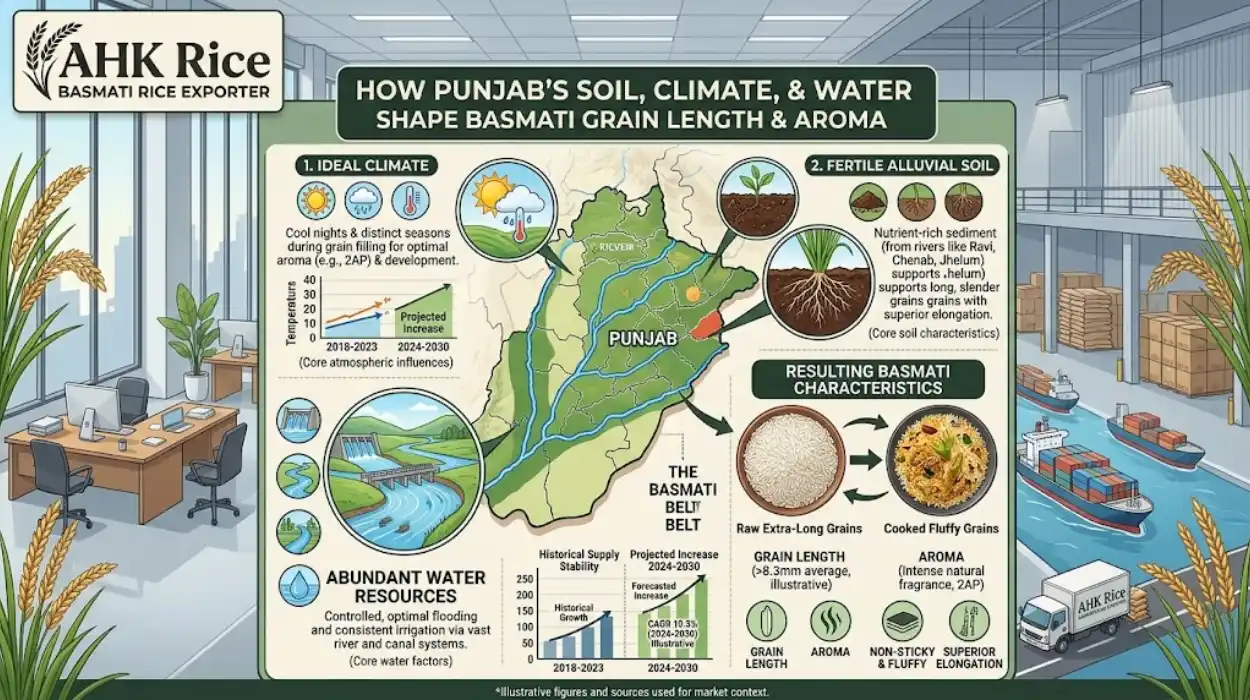
Punjab’s alluvial soil, seasonal temperature differences, controlled irrigation and traditional rice-growing environment give Pakistani Basmati its distinctive grain characteristics and aroma. However, soil fertility alone does not determine grain length or fragrance. Seed genetics, crop management, harvesting maturity and post-harvest processing work together to establish the final quality of export-grade Basmati rice.
Understanding these agricultural factors helps importers compare Pakistani Basmati varieties, evaluate origin claims and select suitable grades for different markets. This guide to understanding Pakistani Basmati rice varieties, cultivation and quality characteristics explains the agricultural foundations behind these differences. The following comparison examines how Punjab’s natural resources influence commercial rice quality and how buyers can evaluate origin, specifications and consistency.
What makes Punjab’s soil suitable for Basmati rice cultivation?
Punjab’s fertile alluvial soil supports Basmati cultivation through balanced nutrient availability, suitable soil structure and moisture retention. These conditions help rice plants establish healthy roots and develop grain-filling capacity. However, genetic variety and nutrient management determine whether plants achieve their expected grain length, aroma and cooking characteristics.
Punjab’s agricultural belt includes districts such as Hafizabad, Gujranwala, Sheikhupura, Narowal and Sialkot. These areas contain productive agricultural soils formed through river deposits. Their physical and chemical characteristics support paddy cultivation under managed irrigation.
How does soil composition influence grain length?
Alluvial soil contains varying proportions of sand, silt and clay. This combination influences drainage, nutrient retention and root development. A balanced soil structure maintains sufficient moisture without creating prolonged waterlogging around rice roots.
Nitrogen, phosphorus and potassium perform different functions during crop development. Nitrogen supports vegetative growth and leaf development. Phosphorus contributes to root establishment and energy transfer. Potassium regulates water balance and supports grain development.
Excessive nitrogen application increases vegetative growth and creates lodging risks. It also changes the balance between plant growth and grain production. Controlled fertiliser application helps maintain crop health and consistent grain filling.
Does soil determine Basmati aroma?
Soil influences crop nutrition and growing conditions, but it does not independently create Basmati’s characteristic fragrance. Genetic characteristics determine the plant’s capacity to produce aromatic compounds, particularly 2-acetyl-1-pyrroline (2AP).
Soil management influences plant health and the growing environment in which aroma develops. Variety selection, crop maturity, environmental stress and post-harvest storage also influence the aroma experienced by buyers.
How does Punjab’s climate influence Basmati grain length and aroma?
Punjab’s warm growing season, seasonal temperature variation and crop maturation conditions influence rice development. Temperature affects flowering, pollination and grain filling, while seasonal weather influences aroma development and harvest timing. Stable crop conditions support uniform maturity and help preserve the genetic grain characteristics of Basmati varieties.
What role does temperature play in grain development?
Rice grain development passes through flowering, fertilisation and grain-filling stages. Suitable temperatures during these stages support successful pollination and starch accumulation.
Extreme heat during flowering increases spikelet sterility and reduces grain formation. High temperatures during grain filling accelerate development and can reduce grain weight or increase chalkiness.
Cooler conditions during the later growing period support gradual maturation. This helps farmers harvest mature paddy with better physical consistency.
How does humidity influence aroma?
Humidity influences crop disease pressure, plant moisture conditions and grain drying requirements. High humidity during maturation and harvesting increases the risk of fungal development and post-harvest deterioration.
Basmati aroma also depends on the plant’s genetic capacity to accumulate 2AP. Environmental conditions influence its expression, but temperature and humidity do not replace the importance of authentic aromatic seed varieties.
Why does harvest maturity matter?
Harvesting too early produces immature grains with inconsistent moisture and physical development. Delayed harvesting increases exposure to weather damage, shattering and grain deterioration.
Farmers assess crop maturity before harvesting. Properly matured paddy provides a better starting point for milling, grading and export processing.
How does Punjab’s irrigation water affect Basmati quality?
Irrigation water influences root-zone moisture, nutrient availability and soil salinity. Consistent water management supports healthy crop development, while excessive salinity and poor drainage interfere with nutrient uptake. Water quality therefore affects crop uniformity, grain filling and the consistency of harvested paddy.
Punjab farmers use canal irrigation, groundwater and combinations of both. The Indus Basin irrigation system supplies agricultural water through an extensive canal network. Tube wells supplement canal supplies when rainfall and canal availability do not meet crop requirements.
Canal water versus groundwater
Canal water generally provides an important irrigation source for rice-growing districts. Its mineral composition and availability depend on the water source and distribution system. Groundwater provides farmers with additional control over irrigation schedules, but its suitability depends on salinity and dissolved mineral concentrations.
| Water management factor | Canal irrigation | Groundwater irrigation |
|---|---|---|
| Availability | Depends on canal schedules | Depends on aquifer and pumping |
| Salinity | Varies by source | Varies by location and depth |
| Control | Distribution schedule | Greater farm-level control |
| Cost | Often lower direct pumping cost | Includes pumping and energy |
| Main consideration | Timely supply | Water-quality testing |
Why does salinity matter?
Salinity increases the concentration of dissolved salts around plant roots. High salt concentrations make water absorption more difficult and create physiological stress. This affects plant development and can reduce crop productivity.
Farmers should evaluate irrigation water through electrical conductivity (EC), sodium adsorption ratio (SAR) and relevant laboratory tests. These measurements help identify unsuitable water and support better irrigation decisions.
What are the available solutions for achieving consistent Basmati grain quality?
Consistent Basmati quality requires a combination of suitable seed genetics, balanced soil nutrition, controlled irrigation, appropriate harvesting and professional milling. No single agricultural intervention guarantees long grains or strong aroma. Buyers achieve more reliable specifications by evaluating the complete production and processing system.
Three approaches provide practical options for farmers, millers and international importers.
1. Traditional Punjab cultivation
Traditional cultivation uses established local growing knowledge, regional seed varieties and familiar irrigation practices. Farmers manage planting, crop nutrition and harvesting according to local conditions.
Advantages:
- Maintains established agricultural practices.
- Supports traditional aromatic varieties.
- Uses existing regional farming knowledge.
- Provides access to recognised Punjab-origin production areas.
Disadvantages:
- Crop consistency varies between farms.
- Fertiliser and water management differ.
- Traceability requires additional documentation.
- Weather variations affect harvest quality.
For example, two farms in Hafizabad can produce different grain uniformity despite growing the same variety. Differences in seed purity, fertiliser application and harvest maturity explain much of this variation.
2. Precision agriculture and controlled cultivation
Precision agriculture uses soil testing, water analysis, planned fertiliser application and crop monitoring. Farmers use these measurements to adjust agricultural inputs according to field requirements.
Advantages:
- Improves nutrient management.
- Identifies irrigation-water problems.
- Supports consistent crop development.
- Reduces unnecessary fertiliser application.
- Creates measurable farm-level production records.
Disadvantages:
- Requires laboratory testing and technical knowledge.
- Increases monitoring costs.
- Needs reliable agricultural records.
- Requires investment in equipment and advisory services.
For commercial production, soil testing before planting and monitoring during crop development provide a stronger basis for managing grain quality than applying identical fertiliser quantities across every field.
3. Integrated farm-to-mill quality management
Integrated management connects cultivation records with harvesting, paddy procurement, milling, grading and export inspection. Each production stage follows documented quality requirements.
Advantages:
- Connects agricultural origin with finished rice.
- Improves batch identification.
- Supports consistent moisture and broken-grain control.
- Simplifies buyer inspections.
- Strengthens export documentation.
Disadvantages:
- Requires coordination between farmers and millers.
- Needs separate batch records.
- Increases administrative responsibilities.
- Depends on reliable quality-control procedures.
This approach provides the strongest commercial framework because it connects agricultural practices with measurable export specifications.
How do different Basmati varieties compare in grain length, aroma and processing?
1121 Basmati prioritises extra-long grain presentation, Super Kernel combines traditional fragrance with medium-long grain characteristics, and 1509 offers long grain with commercial yield efficiency. Their selection depends on raw grain specifications, cooked appearance, processing requirements and the buyer’s target market.
The following comparison presents practical export-oriented specifications. Actual contract specifications must be confirmed through laboratory testing and approved samples.
Seven-attribute Basmati specification comparison
| Attribute | 1121 Basmati | Super Kernel | 1509 Basmati |
|---|---|---|---|
| Raw grain length | 8.0–8.4 mm | 7.0–7.5 mm | 8.1–8.5 mm |
| Aroma | Distinctive | Traditional, aromatic | Distinctive |
| Grain appearance | Extra-long | Medium-long | Long |
| Cooked elongation | Excellent | Good | Up to 2.5× |
| Cooking texture | Elongated, separate grains | Fluffy, aromatic | Long, separate grains |
| Processing options | White, Steam, Sella | White, selected processing grades | White, Steam, Golden Sella |
| Main commercial use | Premium retail and catering | Traditional rice markets | Bulk retail and foodservice |
Grain length figures refer to indicative raw-grain ranges rather than guaranteed averages for every shipment. Variety purity, milling settings, moisture and grading determine the final specification.
How does processing change the final product?
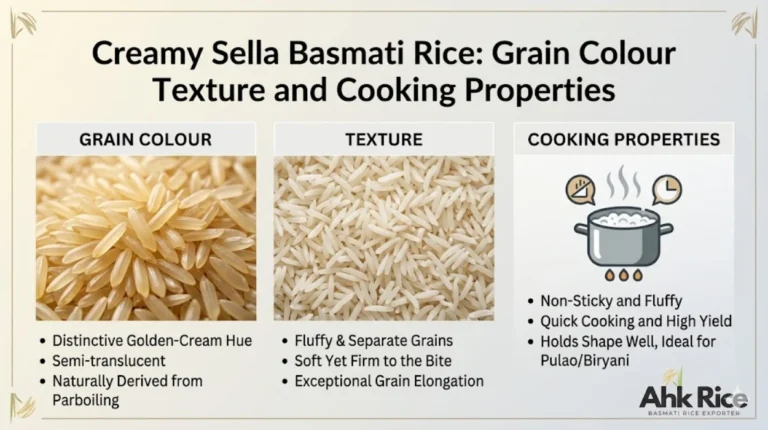
White rice retains its natural milled appearance and suits retail and household cooking requirements. Steam processing applies controlled heat before milling and produces a distinct cooking profile. Sella processing involves parboiling paddy before milling, changing starch characteristics and improving the grain’s resistance to breakage during cooking.
Golden Sella provides a yellowish appearance and firm cooked texture. It suits catering operations that require grains to retain their structure during preparation and serving.
These processing methods do not change the variety’s genetic identity. They change the physical and cooking characteristics of the finished product.
Which Basmati varieties suit Indonesia and Middle Eastern markets?
Indonesia and the Middle East require different commercial positioning, although both markets purchase aromatic rice for household consumption, retail distribution and foodservice. Indonesian buyers should assess local consumer preferences and landed cost, while Gulf buyers often evaluate extra-long grain appearance, aroma and catering performance when selecting export grades.
1. Indonesia: Value, cooking performance and distribution
Indonesia has a large domestic rice market and established rice-import regulations. Buyers sourcing Pakistani Basmati must consider consumer demand, import permissions, distribution costs and the product’s position within the local market.
Super Kernel suits buyers targeting traditional aromatic rice consumers who prioritise fragrance and cooking performance. 1121 offers a premium alternative for specialist retailers and foodservice businesses seeking longer grains. 1509 provides another option for importers balancing grain length and commercial purchasing costs.
2. Middle East: Premium grain presentation and foodservice
The UAE and Saudi Arabia provide established markets for imported Basmati rice. Their retail, wholesale and catering channels serve consumers who recognise Pakistani aromatic rice varieties.
1121 is suitable for premium retail shelves, restaurants and large-scale catering. Super Kernel serves buyers seeking traditional Pakistani Basmati aroma. Golden Sella 1121 and 1509 are suitable for catering and banquet operations that require firm, separate cooked grains.
Price comparison: Indonesia versus the Middle East
The following figures provide an indicative origin-price benchmark rather than confirmed destination-specific market prices. Export pricing varies according to grade, processing, packing, shipment quantity and contract terms.
| Grade | Indicative FOB Karachi price (USD/MT) | Indonesia | Middle East |
|---|---|---|---|
| 1121 White | $1,165–$1,205 | Premium segment | Premium segment |
| 1121 Sella | $1,135–$1,175 | Specialist demand | Catering and wholesale |
| Super Kernel | $1,165–$1,205 | Aromatic retail | Traditional retail |
| 1509 | Buyer-specific quotation | Value-oriented evaluation | Bulk and foodservice |
Price reference: September 2026 indicative Pakistani export-market listings. Prices are FOB Karachi, not confirmed CIF or landed prices. Direct Mill+1
Indonesia’s landed price includes ocean freight, insurance where applicable, port handling, customs duties and other destination charges. Middle Eastern landed prices also depend on the destination port and shipment terms. Buyers should compare quotations on the same Incoterm and packaging basis.
Shelf-life comparison across markets
White, Steam and Sella rice require appropriate moisture control, hygienic packaging and dry storage. Processing method alone does not establish a guaranteed shelf life.
| Product | Storage characteristics | Commercial consideration |
|---|---|---|
| White Basmati | Requires protection from moisture and pests | Suitable for standard retail distribution |
| Steam Basmati | Requires controlled moisture and sealed storage | Suitable for retail and foodservice |
| Golden Sella | Firm grains and good cooking stability | Suitable for catering and bulk storage |
| Aged Basmati | Develops different cooking characteristics during controlled storage | Requires documented ageing period |
For planning purposes, buyers commonly work with a 12–24-month commercial shelf-life target for properly packed milled rice. This is a planning range, not a universal guarantee. The exporter must validate the declared shelf life against packaging, moisture, storage conditions and applicable destination requirements.
Which method works best for different Basmati sourcing requirements?
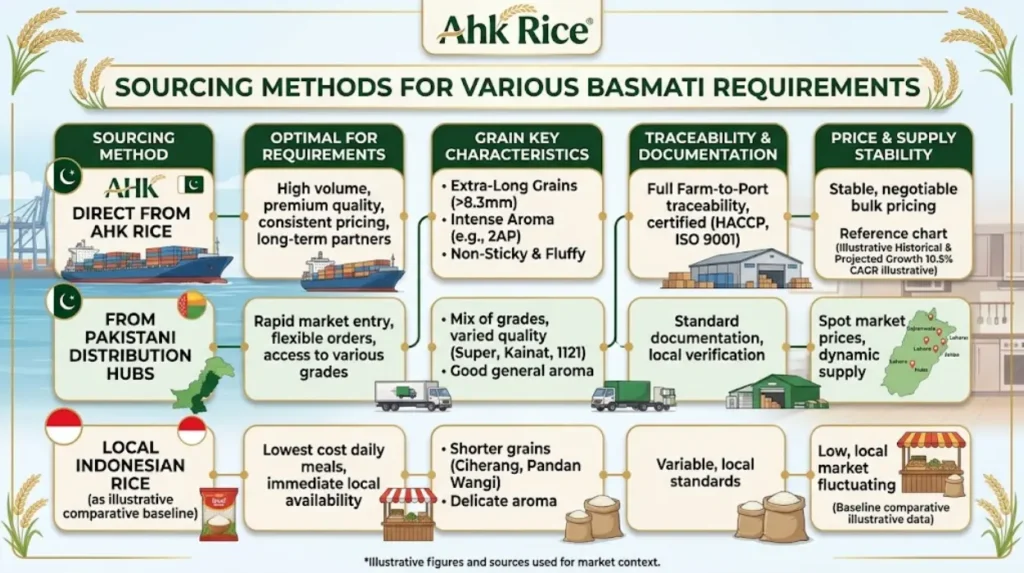
Integrated farm-to-port traceability works best for importers who need documented origin, consistent specifications and shipment-level quality control. Traditional cultivation remains suitable for maintaining regional characteristics, while precision agriculture improves production monitoring. Buyers should combine these approaches rather than treating them as competing solutions.
Five-row decision framework
| Buyer requirement | Recommended approach | Suitable variety |
|---|---|---|
| Premium extra-long grains | Select verified variety and strict length grading | 1121 |
| Traditional aroma | Prioritise authentic seed and origin verification | Super Kernel |
| Commercial bulk supply | Compare yield, specifications and FOB cost | 1509 |
| Catering and banquet operations | Select processing according to cooking requirements | 1121 or 1509 Sella |
| Consistent export shipments | Use farm-to-mill batch traceability and inspection | All three |
What are the advantages and disadvantages of Punjab-origin sourcing?
Punjab-origin sourcing offers access to recognised aromatic rice varieties, established agricultural production areas and specialised rice-processing facilities. However, geographical origin alone does not guarantee a uniform export product.
Advantages
- Regional agricultural identity supports origin-based product positioning.
- Established cultivation areas provide access to recognised Basmati varieties.
- Multiple varieties allow importers to target different consumer segments.
- Integrated milling and grading support export specifications.
- Farm and shipment records improve quality verification.
Disadvantages
- Soil and irrigation conditions vary between districts.
- Weather affects crop maturity and harvest quality.
- Different farmers produce varying levels of grain uniformity.
- Improper storage affects moisture and aroma retention.
- Inadequate traceability creates difficulties when verifying origin claims.
For example, an importer purchasing 1121 Basmati from two suppliers may receive different grain-length averages, broken percentages and moisture levels. Both suppliers can identify Punjab as the origin, but only documented specifications and batch inspections establish whether the shipments meet the same commercial standard.
How can importers verify Punjab-origin Basmati through farm-to-port traceability?
Farm-to-port traceability connects the agricultural source, paddy procurement, processing batch, laboratory results and export shipment through identifiable records. Importers use this information to verify origin claims, compare product specifications and establish accountability when the delivered shipment differs from the approved sample.
A reliable traceability system should cover five stages.
1. Agricultural origin verification
The supplier identifies the sourcing district, procurement area, variety and crop season. Farm or procurement records connect the paddy to its geographical source.
2. Paddy procurement and variety identification
Millers record incoming paddy quantities, variety identification and procurement batches. This stage helps prevent the mixing of different varieties without disclosure.
3. Processing and grading records
Processing records identify milling dates, Sortex grading, broken percentages, moisture levels and packaging specifications. These details help establish consistency between production batches.
4. Laboratory testing and sample approval
Importers review relevant quality reports, including moisture, broken percentage, grain length and applicable food-safety parameters. Buyers approve a commercial sample before authorising bulk production.
5. Export and shipping documentation
The exporter provides commercial invoices, packing lists, certificates of origin, phytosanitary documentation where required, fumigation documentation where applicable and shipping records.
AHK Rice’s Pakistani Basmati rice varieties and supply services provide the relevant product context for evaluating 1121, Super Kernel and 1509 sourcing requirements.
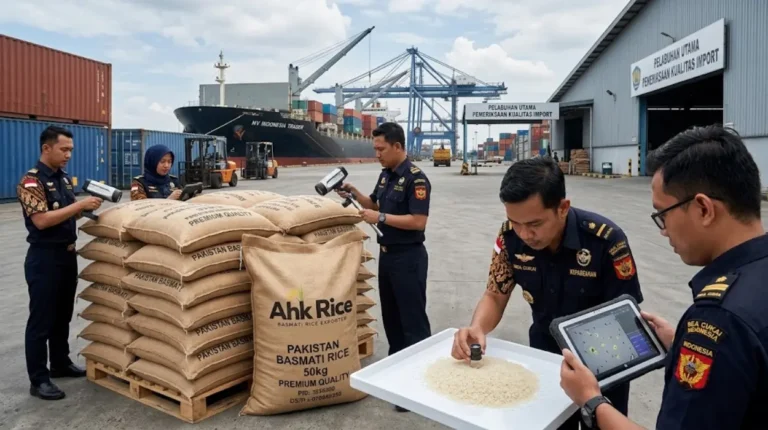
For Indonesian shipments, buyers must also verify current import permissions, applicable Indonesian food-safety requirements, labelling rules and documentation with their importer or customs representative. Pakistan-origin documentation does not replace Indonesian import compliance.
Punjab’s soil, climate and irrigation systems create the agricultural environment in which Pakistani Basmati develops its distinctive characteristics. However, grain length and aroma depend on the interaction between genetic variety, crop management, harvesting maturity and processing quality.
For international buyers, selecting the correct variety requires more than comparing geographical origin. They must evaluate raw grain length, aroma, moisture, broken percentage, cooking performance, shelf life and export pricing. Integrated farm-to-port traceability connects these specifications with the agricultural source and finished shipment.
AHK Rice is a trusted Pakistani Basmati rice exporter based in Punjab, supplying 1121, Super Kernel, and 1509 Basmati rice varieties to more than 15 countries. Its end-to-end processing, custom packaging and export services provide an established framework for buyers evaluating Pakistani Basmati sourcing.
Frequently asked questions
Does Punjab’s soil determine Basmati grain length?
No. Genetic variety primarily determines the potential grain length. Soil fertility, nutrient availability, irrigation and crop management influence plant development and the consistency of harvested grains.
Why does Pakistani Basmati have a distinctive aroma?
Authentic aromatic Basmati varieties produce 2-acetyl-1-pyrroline (2AP), a compound associated with their characteristic fragrance. Variety genetics, crop maturity and post-harvest handling influence aroma quality.
Which Punjab districts produce Basmati rice?
Hafizabad, Gujranwala, Sheikhupura, Narowal and Sialkot are recognised Basmati-growing areas in Punjab. Their agricultural conditions support established aromatic rice cultivation.
Is 1121 better than Super Kernel Basmati?
1121 is better suited to buyers prioritising extra-long grain presentation and premium positioning. Super Kernel suits buyers seeking traditional Pakistani Basmati aroma and medium-long grain characteristics. The better choice depends on customer expectations and budget.
Which Basmati variety is suitable for Indonesia?
Super Kernel suits aromatic rice buyers, while 1121 serves premium retail and specialist foodservice requirements. Importers should evaluate 1509 when commercial pricing and long-grain presentation are important.