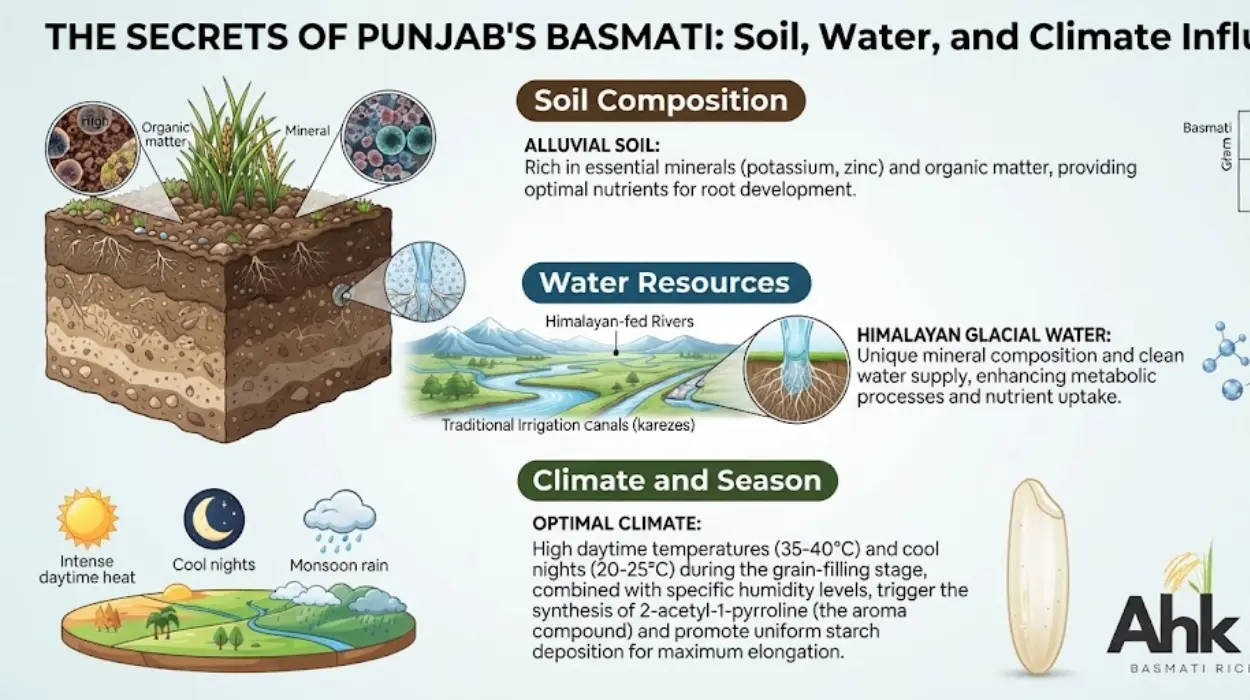
How Punjab’s Soil, Water and Climate Shape Basmati Grain Length and Aroma
Punjab’s soil, irrigation, temperature, and growing season directly influence Basmati grain development and aroma, while genetics determines the variety’s potential. Here is why: Punjab combines suitable soils, controlled irrigation, and cooler maturity conditions that support long grain formation and strong 2-acetyl-1-pyrroline expression.
For buyers studying Pakistani Basmati, origin alone does not explain quality. Cultivation conditions, harvest timing, milling, grading, and processing determine the commercial result. This makes agricultural origin an important part of the specification rather than a simple geographic label.
For broader product education, see this guide to what Pakistani Basmati rice is and how it is produced. The guide establishes the variety, cultivation region, processing chain, and major export grades before comparing the environmental factors behind grain length and aroma.
What makes Punjab suitable for Basmati rice production?
Punjab provides suitable clay-loam soils, established irrigation systems, warm crop growth, and cooler maturity conditions that support aromatic fine-grain rice. Here is why: these conditions interact with variety genetics, transplanting dates, water management, and crop maturity to shape grain development.
Punjab’s rice-growing areas include districts around the Rice Research Institute at Kala Shah Kaku and other production zones. Government research identifies Basmati as a fine aromatic rice category and records multiple varieties developed specifically for Punjab conditions. (source: Agriculture Department, Government of Punjab)
Soil provides the physical and chemical environment for root development. A recent Basmati irrigation study at Kala Shah Kaku recorded clay-loam soil with pH values of about 8.1–8.5 across tested depths. The study also measured organic matter, electrical conductivity, phosphorus, and potassium. (source: Sarhad Journal of Agriculture)
Water controls plant growth, nutrient movement, and grain filling. Punjab rice cultivation traditionally uses substantial irrigation, but research from Kala Shah Kaku shows that alternate wetting and drying can reduce irrigation inputs while maintaining important grain and milling characteristics. (source: Sarhad Journal of Agriculture)
Climate becomes especially important during grain maturation. Basmati develops stronger aroma under suitable cooler maturity conditions. Research on Basmati identifies environmental conditions, including temperature, as major contributors to aroma expression alongside genetic factors. (source: International Journal of Food Science and Technology)
The Punjab production environment therefore works as a system. Soil supports the crop, water manages growth, climate influences maturity, and genetics establishes the variety’s quality potential.
With Punjab’s production environment established, the next question is how each factor changes grain length and aroma.
How do soil, water, and climate affect grain length and aroma?
Grain length depends primarily on variety genetics, while soil, water, temperature, sunlight, and crop management influence how fully that genetic potential develops. Here is why: environmental stress changes plant growth, flowering, grain filling, and final kernel characteristics.
How does soil affect Basmati grain development?
Soil texture affects root-zone water movement and nutrient availability. Clay-loam soils retain water while providing a structured root environment. The Kala Shah Kaku study recorded clay-loam profiles at 0–45 cm depth. (source: Sarhad Journal of Agriculture)
Soil fertility affects vegetative growth and grain formation. Excessive nitrogen changes plant growth and can alter crop balance. Commercial cultivation therefore requires nutrient management based on soil conditions rather than applying one fertilizer program across every field.
Soil salinity also matters. Electrical conductivity affects root-zone conditions and water uptake. Maintaining suitable soil and irrigation conditions supports stable crop development through flowering and grain filling.
How does water affect Basmati quality?
Water management influences yield, milling quality, and grain characteristics. A two-year Kala Shah Kaku study compared conventional flood irrigation with alternate wetting and drying at 15, 20, and 25 cm thresholds. The research measured average grain length, cooked grain length, elongation ratio, head rice, and broken rice. (source: Sarhad Journal of Agriculture)
Punjab research also reports irrigation-saving practices that maintain standing water at 1–1.5 inches for 21 days after transplanting. The same research reports reduced puddling duration from 30–40 days to 3–4 days. (source: Agriculture Department, Government of Punjab)
How does climate affect Basmati aroma?
Climate affects aroma through temperature during crop maturity. Basmati aroma develops more strongly under cooler maturity conditions than under unsuitable high-temperature conditions. The characteristic aroma is associated with 2-acetyl-1-pyrroline, commonly called 2AP. (source: International Journal of Food Science and Technology)
A Pakistan study tested Super Basmati, Basmati-515, Basmati 2000, and Basmati 370. Gas chromatography confirmed 2AP in all four aromatic varieties, with Super Basmati recording the highest concentration among the tested samples. (source: Pakistan Journal of Analytical & Environmental Chemistry)
These relationships show why environmental quality cannot replace variety genetics. The field environment develops the crop, while the variety establishes its commercial identity.
With the environmental drivers defined, the next step is comparing the available Basmati production and processing approaches.
What are the available solutions for controlling Basmati quality?
The main quality-control solutions are variety selection, field management, water management, harvest control, milling, grading, sorting, and processing selection. Here is why: each stage controls a different quality attribute, from raw grain potential to final export specification.
Variety selection
Variety selection establishes the baseline for grain length and aroma. Punjab’s Agriculture Department lists PK 1121 Aromatic at 8.16 mm grain length, Super Basmati at 7.45 mm, and Basmati 515 at 7.56 mm. (source: Agriculture Department, Government of Punjab)
Recent Punjab breeding work has also produced longer-grain varieties. Sona Super Basmati records a grain length of 9.50 mm, while Sultan Super Basmati records 9.66 mm in the government variety database. (source: Agriculture Department, Government of Punjab)
Field management
Field management controls transplanting, plant density, nutrient availability, irrigation, and crop maturity. Research under Punjab conditions shows that transplanting dates and spacing influence crop growth and yield. (source: International Journal of Plant & Soil Science)
Processing management
Processing converts harvested paddy into a commercial rice specification. A controlled sequence includes:
- Clean the paddy to remove field debris.
- De-husk the grain to produce brown rice.
- Polish the grain to achieve the required appearance.
- Grade the rice according to length and quality.
- Sort the rice using mechanical and optical systems.
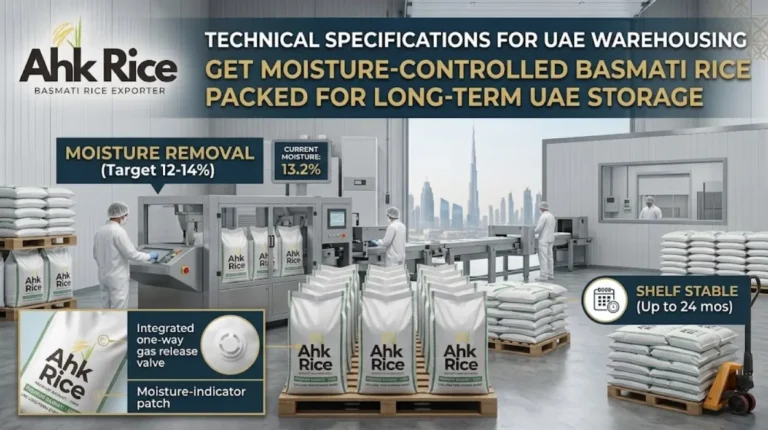
- Control moisture for stable storage and shipment.
- Pack the rice according to market and buyer requirements.
Processing cannot create genetic grain length that the variety does not possess. It can, however, protect grain appearance, reduce foreign material, control broken percentage, and maintain consistent commercial grading.
Processing selection
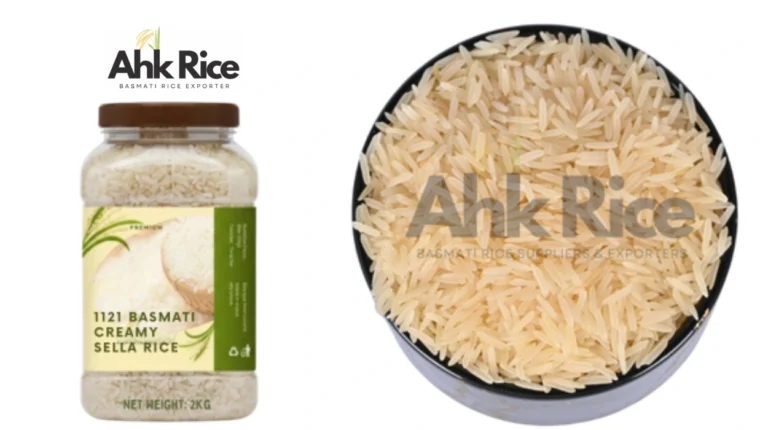
White, Steam, and Sella processing create different commercial specifications. White rice retains the conventional milled appearance. Steam processing uses controlled steaming before drying and milling. Sella refers to parboiled rice and provides a different texture, colour, and cooking profile.
With the available controls established, the next question is which combination works best for different export markets.
How do different Basmati approaches compare?
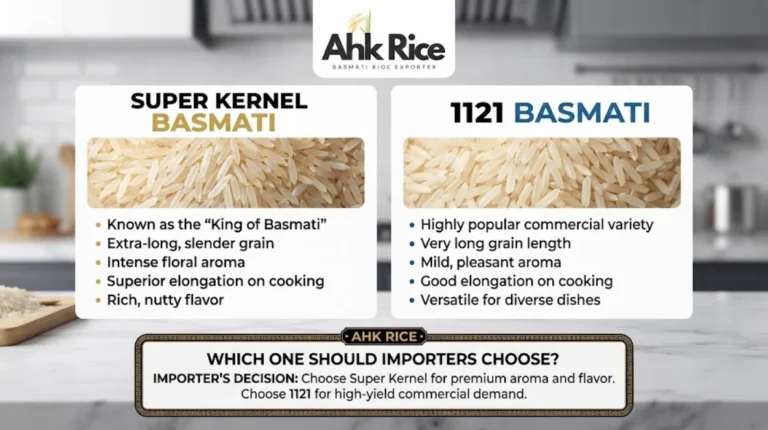
1121 prioritises extra-long visual grain, Super Kernel prioritises traditional aroma and balanced grain characteristics, while 1509 prioritises commercial efficiency and processing flexibility. Here is why: buyers select varieties according to retail positioning, foodservice use, price structure, and cooking expectations.
| Attribute | 1121 Basmati | Super Kernel | 1509 Basmati |
|---|---|---|---|
| Raw grain profile | About 8.3 mm | About 7.0–7.5 mm | About 8.1–8.4 mm |
| Main strength | Extra-long appearance | Traditional aroma | Yield and commercial efficiency |
| Aroma positioning | High | Strong traditional profile | Aromatic Basmati |
| Processing options | White, Steam, Sella | White, Steam, Sella | White, Steam, Sella |
| Typical buyer focus | Premium retail | Traditional Basmati markets | Volume distribution |
| Price position | Premium | Premium | Commercial |
| Best use | Retail and premium foodservice | Traditional retail and foodservice | Catering, wholesale and price-sensitive channels |
The 1121 specification is particularly important for buyers seeking visual length. Government Punjab data lists PK 1121 Aromatic at 8.16 mm, while commercial export specifications often distinguish 1121 through its extra-long grain profile. (source: Agriculture Department, Government of Punjab)
Super Kernel provides a different value proposition. Its grain is shorter than 1121, but its traditional aromatic identity supports premium Basmati positioning. AHK Rice’s current comparison places Super Kernel around 7.2 mm and 1121 around 8.3 mm.
1509 suits buyers focused on commercial distribution. Its shorter maturity cycle and high-yield positioning make it relevant for buyers balancing grain appearance with procurement economics.
With the variety comparison established, regional demand shows how these specifications translate into purchasing decisions.
Which method works best for UAE and UK markets?

UAE buyers generally prioritise 1121 and Super Kernel for premium channels, while UK buyers strongly value 1121 and Super Kernel for Asian retail and traditional Basmati demand. Here is why: both markets reward grain appearance and aroma, but distribution conditions and positioning differ.
UAE market
UAE buyers use Pakistani Basmati across retail, wholesale, catering, foodservice, and re-export channels. Current market references identify 1121 and Super Kernel as leading premium Pakistani Basmati choices for the UAE.
The UAE also demonstrates strong consumer price segmentation. The UAE Ministry of Economy’s retail platform listed 1121 Sella at AED 28.95 for 5 kg at Union Coop in October 2026. That equals AED 5.79 per kg before considering wholesale economics. (source: UAE Ministry of Economy and Tourism)
For export comparison, current indicative Pakistan FOB references place 1121 White and Super Kernel around US$1,165–US$1,205 per MT. Freight to Jebel Ali remains separate. (source: PakistanRice.com, September 2026)
Golden Sella suits UAE buyers requiring stronger holding performance for catering and bulk distribution. White and Steam suit buyers prioritising fresh appearance and premium retail presentation.
UK market
UK demand has a strong connection with South Asian grocery retail. Current market references identify 1121 White and Super Kernel as leading Pakistani Basmati products for the UK market.
Indicative FOB Karachi prices for September 2026 place 1121 White at US$1,165–US$1,205 per MT and Super Kernel at US$1,165–US$1,205 per MT. 1121 Sella is listed lower at US$1,135–US$1,175 per MT. Freight to Felixstowe is additional. (source: PakistanRice.com, August 2026)
Shelf life depends on processing, moisture, packaging, warehouse temperature, and storage conditions. Golden Sella provides a stronger choice for long holding and institutional distribution. White Basmati suits faster retail turnover under controlled warehouse conditions.
The UAE and UK therefore share premium-grade demand but apply different distribution priorities. The next section converts those differences into a practical decision framework.
What are the main decision factors for Basmati buyers?
Buyers should evaluate variety, grain length, aroma, processing type, moisture, broken percentage, storage conditions, and landed cost before selecting a Punjab-origin Basmati specification. Here is why: price alone cannot measure quality when the final product must meet a defined retail or foodservice position.
| Decision factor | Best evaluation approach |
|---|---|
| Grain length | Match raw and cooked grain specifications to the target market |
| Aroma | Test representative samples for characteristic Basmati fragrance |
| Processing | Select White, Steam, or Sella according to application |
| Storage | Match packaging and processing to warehouse conditions |
| Cost | Compare FOB, freight, duty, clearance, and local distribution |
| Consistency | Verify samples against the final commercial specification |
| Traceability | Connect cultivation, milling, inspection, packing, and shipment records |
Price per MT
Current indicative FOB references place premium Pakistani Basmati around US$1,135–US$1,205 per MT, depending on variety and processing. UAE and UK buyers should treat this as an origin-level comparison rather than a final landed price. (source: PakistanRice.com, September 2026)
Shelf life
Shelf-life performance depends on moisture, packaging, temperature, humidity, processing, and warehouse handling. Golden Sella generally fits longer storage programs better than fresh White rice. Buyers should approve the storage specification alongside the product sample rather than relying only on a printed shelf-life figure.
Traceability
Traceability connects field sourcing with the finished shipment. A robust system records sourcing, milling, grading, sorting, inspection, packing, loading, and dispatch. This creates a stronger commercial record for buyers evaluating consistency across repeated containers.
With these decision factors defined, the advantages and limitations of each approach become clearer.
What are the pros and cons of each Basmati approach?
Extra-long 1121 delivers stronger visual differentiation, Super Kernel delivers traditional aroma positioning, and 1509 delivers commercial efficiency; each choice has a specific trade-off. Here is why: grain length, aroma, processing, procurement cost, and market positioning do not peak in one variety simultaneously.
1121 Basmati
Pros: Extra-long grain creates strong retail shelf differentiation. The variety fits premium retail, private label, catering, and foodservice programs.
Cons: Premium specifications create higher procurement expectations. Buyers must control grain length, broken percentage, moisture, and processing consistency across shipments.
Super Kernel
Pros: Strong traditional aroma supports authentic Basmati positioning. Its balanced grain profile also suits buyers who value flavour alongside visual quality.
Cons: Its grain is shorter than 1121. Buyers targeting an extra-long visual specification should select 1121 instead.
1509 Basmati
Pros: Shorter maturity and commercial yield characteristics support volume distribution. Steam and Sella processing provide flexibility for catering and wholesale applications.
Cons: Buyers seeking the strongest premium visual positioning may prefer 1121. Product selection must match the intended retail or foodservice segment.
For AHK Rice, the relevant commercial framework connects Punjab cultivation with end-to-end processing, custom packaging, inspection, and export coordination. AHK Rice supplies 1121, Super Kernel, and 1509 from Punjab to international markets.
The final decision should therefore begin with the buyer’s market specification, then work backward to variety, processing, field sourcing, and shipment controls.
How should buyers connect Punjab origin with export quality?
The strongest sourcing method connects Punjab-origin cultivation with measurable grain specifications, controlled milling, sample approval, documented inspection, custom packaging, and container-ready shipment. Here is why: traceability allows buyers to evaluate both agricultural origin and commercial consistency.
Punjab origin provides the environmental foundation for Basmati quality. Variety selection determines genetic potential. Water and climate influence development. Harvest timing protects maturity. Milling and sorting protect the commercial specification.
A buyer should therefore compare samples using measurable criteria. Check raw grain length, cooked elongation, aroma, moisture, broken percentage, colour, milling quality, packaging, and laboratory documentation.
AHK Rice applies this end-to-end model across its Punjab-origin Basmati supply chain. The company supplies 1121, Super Kernel, and 1509 varieties with processing, grading, custom packaging, and export coordination.
For UAE distribution, the final commercial specification should connect farm-origin traceability with milling records, inspection results, packaging details, loading records, and shipping documentation. This provides a stronger basis for repeat procurement than evaluating price alone.
The environmental story of Punjab therefore becomes commercially useful only when buyers can connect it with measurable product specifications and documented shipment controls.
Frequently Asked Questions
Does Punjab soil affect Basmati grain length?
Punjab soil influences root development, water availability, nutrient movement, and crop growth. Variety genetics establishes grain-length potential, while soil and field management influence how effectively that potential develops.
What creates Basmati aroma?
The principal aroma compound is 2-acetyl-1-pyrroline (2AP). Punjab research confirms 2AP in tested aromatic Basmati varieties, with Super Basmati showing the highest concentration among four tested varieties. (source: Pakistan Journal of Analytical & Environmental Chemistry)
Does cooler weather improve Basmati aroma?
Cooler conditions during maturity support stronger Basmati aroma expression. Research identifies climate and genetics as major factors controlling aromatic quality. (source: International Journal of Food Science and Technology)
Which is longer, 1121 or Super Kernel?
1121 is longer. Commercial references place 1121 around 8.3 mm raw grain, while Super Kernel commonly measures around 7.0–7.5 mm. AHK Rice uses these differences when positioning the two varieties for different buyer requirements.
Which Basmati is better for UAE distribution?
1121 suits premium retail and visual-grain positioning. Super Kernel suits traditional aromatic Basmati demand. 1509 suits cost-sensitive wholesale, catering, and commercial distribution.
What is the current Basmati price per MT?
Current indicative FOB Karachi references place premium Basmati around US$1,135–US$1,205 per MT, depending on variety and processing. Freight, insurance, duties, clearance, and destination charges change the final landed cost. (source: PakistanRice.com, September 2026)
Why does Basmati processing matter after cultivation?
Processing protects the harvested grain’s commercial quality. Cleaning, dehusking, polishing, grading, sorting, moisture control, and packing determine the consistency delivered to the buyer.
How does traceability help a Basmati importer?
Traceability connects cultivation, harvesting, milling, grading, inspection, packaging, loading, and dispatch records. This allows importers to compare repeated shipments against an approved specification.