How UAE Buyers Evaluate 1509 Golden Sella Rice Suppliers
UAE buyers evaluate 1509 Golden Sella Rice suppliers through grain quality, processing standards, certifications, consistency, export capability, and compliance documentation. Here is why: UAE importers serve retail, wholesale, catering, and hospitality sectors that require stable quality, reliable shipments, and verified food safety standards.
1509 Golden Sella Rice remains one of the most imported Pakistani rice categories in Gulf markets. The variety combines long grain length, high cooking yield, golden appearance, and strong shelf stability. UAE buyers analyze every stage of the supply chain before selecting suppliers because product consistency directly affects restaurant operations, retail reputation, and distribution efficiency.
What Is 1509 Golden Sella Rice?
1509 Golden Sella Rice is a parboiled Basmati variety with grain lengths of approximately 8.10–8.40 mm, golden color, high cooking expansion, and strong grain strength during storage and transport.
1509 Basmati originated from agricultural research programs designed to produce higher yields than traditional Basmati varieties. Farmers cultivate this variety mainly in Punjab, Pakistan, where fertile soil and irrigation networks support large-scale production.
Golden Sella refers to the parboiling process. Paddy rice absorbs nutrients from the husk before milling. The process creates the characteristic golden color and improves grain durability.
UAE buyers prefer 1509 Golden Sella because the rice performs consistently in restaurants, catering kitchens, supermarkets, and food distribution networks. The variety maintains grain separation after cooking and delivers attractive plate presentation.
With the product defined, the next question is how suppliers produce export-quality 1509 Golden Sella Rice.
How Does 1509 Golden Sella Rice Processing Work?
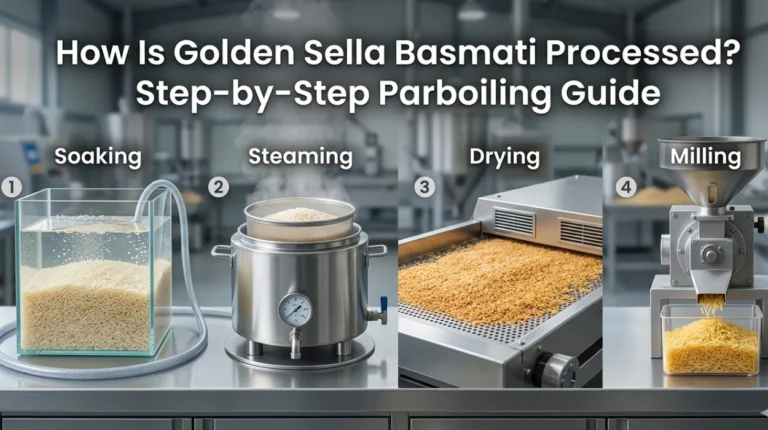
Export-quality 1509 Golden Sella Rice passes through 9 processing stages including cleaning, soaking, steaming, drying, milling, polishing, grading, sorting, and packaging.
Processing begins immediately after harvest. Every stage affects final grain appearance, cooking performance, and shelf life.
Processing Steps
- Clean the harvested paddy.
- Soak the paddy in controlled water tanks.
- Steam the grains under pressure.
- Dry the paddy to target moisture levels.
- Dehusk the grain.
- Mill the rice.
- Polish the kernels.
- Grade by size and quality.
- Sort using color sorters and pack.
Parboiling strengthens the grain structure. The process reduces breakage during milling and transportation. UAE buyers often review processing capabilities because processing quality influences the final product more than cultivation alone.
Modern exporters inspect moisture levels, broken percentages, and grain length at multiple checkpoints. Consistent processing creates uniform shipments throughout the year.
With the manufacturing process established, the next step is understanding which supplier components UAE buyers evaluate.
What Key Components Do UAE Buyers Assess In Suppliers?
UAE buyers focus on grain specifications, processing infrastructure, quality control, certifications, export documentation, packaging capability, and shipment consistency.
Rice procurement teams compare suppliers using measurable standards. Buyers require objective specifications rather than marketing claims.
Grain Specifications
Important specifications include:
- Grain length
- Moisture percentage
- Broken percentage
- Purity level
- Foreign matter level
- Cooking expansion
- Color consistency
Processing Infrastructure
Modern facilities improve consistency.
Key infrastructure includes:
- Color sorting machines
- Length grading systems
- Metal detectors
- Laboratory testing equipment
- Automated packaging lines
Export Documentation
Required export documents typically include:
- Phytosanitary Certificate
- Certificate of Origin
- Fumigation Certificate
- Packing List
- Commercial Invoice
- Bill of Lading
- Health Certificate
UAE buyers often audit suppliers before placing long-term contracts. Documentation verifies compliance with import regulations and food safety requirements.
Having examined supplier evaluation factors, the next question concerns the available grades of 1509 Golden Sella Rice.
What Grades Of 1509 Golden Sella Rice Are Available?
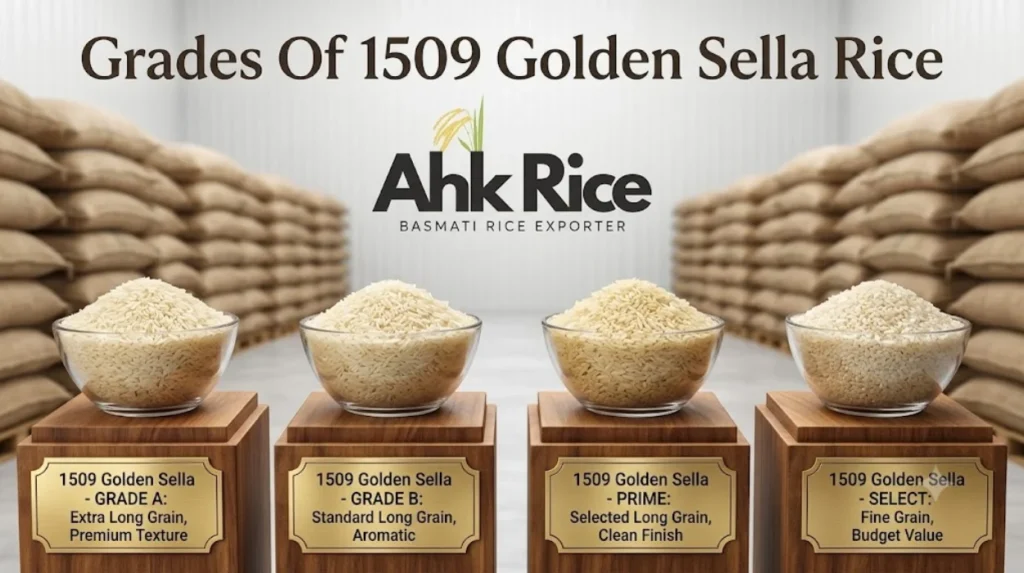
Export markets commonly purchase Premium, Super, Double Sortex, Single Sortex, and various broken-percentage grades depending on application requirements and budget targets.
Different buyers require different specifications. Retailers usually purchase premium grades. Catering businesses often purchase commercial grades.
Premium Grade
Premium grade contains longer grains and lower broken percentages. The grade targets supermarkets and branded retail packaging.
Super Grade
Super grade offers strong quality consistency and competitive pricing. Many UAE distributors prefer this specification.
Double Sortex Grade
Double Sortex rice passes through multiple sorting stages. The process improves visual appearance and purity.
Broken Percentage Grades
Common export grades include:
- 1% Broken
- 2% Broken
- 5% Broken
- 10% Broken
- 15% Broken
Lower broken percentages command higher prices. UAE buyers select grades according to end-user requirements.
With grades explained, the next question is why UAE importers continue sourcing this variety.
What Benefits Make 1509 Golden Sella Popular In The UAE?
High cooking yield, long grain length, attractive color, extended shelf life, and competitive pricing make 1509 Golden Sella a preferred import category.
1509 Golden Sella expands significantly after cooking. Food service operators benefit because higher expansion improves serving efficiency.
Golden Sella lasts longer than Steam rice. In hot warehouse conditions, Golden Sella maintains quality for approximately 18–24 months. Steam rice generally performs best within shorter storage periods.
Golden Sella resists grain breakage during transportation. The stronger grain structure helps maintain appearance after long-distance shipping.
The variety also offers price advantages compared with some premium traditional Basmati categories. This balance between quality and cost supports strong demand in Gulf markets.
Understanding benefits leads directly to examining practical applications across UAE industries.
Where Is 1509 Golden Sella Rice Commonly Used?
Restaurants, catering companies, supermarkets, wholesalers, food distributors, and institutional kitchens use 1509 Golden Sella Rice extensively across the UAE.
Food service businesses value consistency. Restaurants require rice that cooks uniformly across hundreds of servings daily.
Catering companies use Golden Sella for large events because the rice maintains grain separation after cooking and holding.
Retail chains stock packaged Golden Sella because consumers recognize the variety’s appearance and cooking performance.
Wholesale distributors procure container quantities for resale across Dubai, Abu Dhabi, Sharjah, and other Gulf markets.
Rice consumption remains significant across the GCC region. Pakistan continues among the leading suppliers of Basmati rice to Gulf markets (source: REAP export data, December 2025).
With use cases established, the final educational topic addresses common misconceptions buyers encounter.
What Common Misconceptions Affect Supplier Evaluation?
Price alone does not determine value, Golden Sella is not identical to Steam rice, and certifications alone do not guarantee product consistency.
Many buyers focus exclusively on price. Lower prices often reflect different specifications, higher broken percentages, or weaker processing controls.
Golden Sella differs from Steam rice. Golden Sella undergoes parboiling. Steam rice follows a different processing method. The products deliver different cooking characteristics.
Certifications remain important but do not replace inspection. Buyers still inspect grain quality, packaging standards, and laboratory reports.
Certifications Commonly Requested By UAE Buyers
Common certifications include:
- ISO 22000
- HACCP
- BRCGS
- Halal Certification
- SGS Inspection Reports
- Phytosanitary Compliance
Certifications verify system compliance. Product inspections verify shipment quality. Professional procurement teams evaluate both.
UAE buyers increasingly use supplier scorecards. These systems compare quality performance, documentation accuracy, delivery reliability, and complaint rates over time.
A complete supplier evaluation combines quality specifications, processing capability, certifications, and export performance.
UAE buyers evaluate 1509 Golden Sella Rice suppliers through measurable quality standards rather than promotional claims. Procurement teams examine cultivation regions, processing methods, grading systems, certifications, packaging options, documentation, and shipment consistency before selecting suppliers.
1509 Golden Sella Rice continues growing in demand because it combines long grain appearance, strong cooking performance, excellent shelf stability, and competitive pricing.
Buyers also compare delivery reliability and shipment assurance standards before finalizing annual procurement contracts.Suppliers that maintain consistent specifications, transparent documentation, and verified quality controls meet the requirements of modern UAE importers.
Frequently Asked Questions
How long is 1509 Golden Sella Rice grain?
1509 Golden Sella Rice typically measures 8.10–8.40 mm before cooking and expands significantly after cooking.
Why do UAE buyers prefer Golden Sella Rice?
UAE buyers prefer Golden Sella because of its long grain appearance, higher cooking yield, extended shelf life, and strong transport durability.
Which country exports the most 1509 Golden Sella Rice to the UAE?
Pakistan remains one of the leading exporters of 1509 Golden Sella Rice to UAE markets due to large-scale cultivation and processing capacity.
What certifications do UAE rice importers request?
Importers commonly request ISO 22000, HACCP, Halal certification, phytosanitary certificates, and third-party inspection reports.
What broken percentage is preferred in UAE retail markets?
Retail markets generally prefer 1% to 5% broken grades because of their premium appearance and stronger consumer acceptance.
What is the difference between Golden Sella and Steam Rice?
Golden Sella undergoes a parboiling process that creates a golden color and stronger grain structure. Steam Rice follows a different processing method and produces different cooking characteristics.