How UAE Importers Calculate Landed Cost of 1121 Creamy Sella Basmati Rice from Pakistan
UAE importers calculate landed cost by adding the Pakistan export price, freight charges, insurance, customs duties, port expenses, inland transport, and clearance costs. Here is why: every imported rice shipment accumulates costs between the Pakistani warehouse and the UAE buyer’s warehouse. Understanding each component helps importers estimate profitability and compare suppliers accurately.
1121 Creamy Sella Basmati Rice remains one of Pakistan’s most exported premium rice categories. The variety offers long grain length, strong elongation after cooking, and excellent shelf stability. UAE wholesalers, supermarkets, catering companies, and food distributors import significant volumes because the product matches Gulf consumer preferences for long-grain aromatic rice (source: REAP export data, December 2025).
Pakistan cultivates 1121 Basmati primarily in Punjab. Farmers harvest the paddy between October and November. Rice mills process the grain through parboiling, drying, milling, grading, sorting, and packaging before export. Understanding the product itself helps explain why landed cost calculations differ among grades and shipment specifications.
What Is 1121 Creamy Sella Basmati Rice?
1121 Creamy Sella Basmati Rice is a parboiled premium Basmati variety with grain length exceeding 8.30 mm, creamy color, high elongation, and strong cooking performance.
1121 Basmati originated from Pakistan’s Basmati-growing regions. Punjab contributes the largest production volume because the area’s soil composition, irrigation systems, and climate support long-grain cultivation.
Creamy Sella refers to a specific parboiling process. Paddy absorbs water before controlled steaming. Processors dry the grain and mill it afterward. This method strengthens kernels and improves breakage resistance.
1121 Creamy Sella serves multiple markets. Examples include UAE retail chains, Saudi Arabian distributors, Omani wholesalers, Qatari supermarkets, and Kuwaiti catering suppliers. The product maintains appearance during transport and storage.
Which Grades Are Available?
Rice exporters commonly supply:
- Sort 1
- Sort 2
- Sort 3
- Single Polished
- Double Polished
- Silky Polished
- Extra Long Grain
Each grade affects the final landed cost because quality specifications influence export pricing.
With the product definition established, the next question is how the rice reaches UAE buyers and generates import costs.
How Does 1121 Creamy Sella Basmati Rice Reach UAE Importers?
The supply chain includes cultivation, harvesting, processing, packaging, export clearance, ocean freight, UAE customs clearance, and local delivery.
1121 Basmati follows a structured export process. Every stage contributes to landed cost calculations.
How Is the Rice Processed?
Rice mills follow these steps:
- Clean the paddy.
- Soak the grain.
- Parboil the paddy.
- Dry the grain.
- De-husk the kernels.
- Mill the rice.
- Polish the grain.
- Sort by length.
- Grade by quality.
- Pack for export.
Each processing stage creates operational costs. Higher polishing standards require additional machinery time and labor.
How Is the Rice Exported?
Exporters prepare documentation before shipment.
Required documents include:
- Commercial Invoice
- Packing List
- Certificate of Origin
- Phytosanitary Certificate
- Fumigation Certificate
- Bill of Lading
- Health Certificate
Shipping companies load containers at Pakistani ports. Containers travel primarily from Karachi to Jebel Ali Port in Dubai.
With the logistics process explained, the next step is understanding the specific cost elements importers calculate.
What Components Form the Landed Cost Calculation?
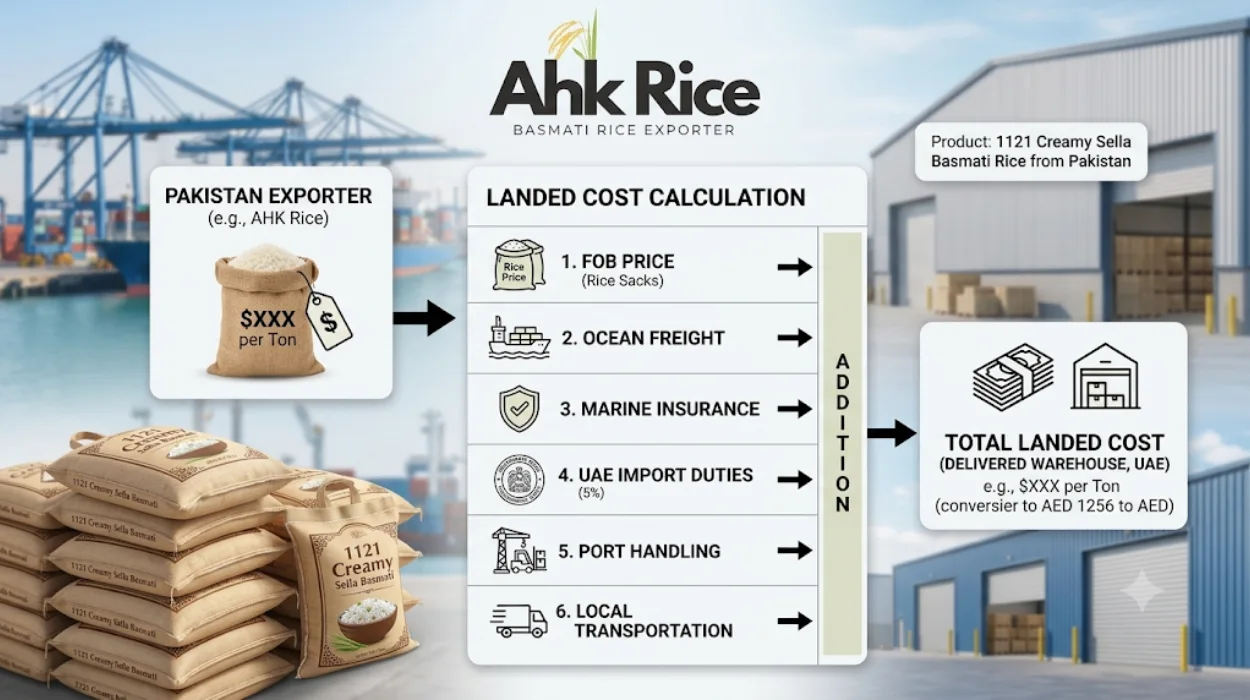
Landed cost consists of FOB value, freight, insurance, customs duty, port charges, clearance fees, and inland transportation.
Landed cost measures the complete expense incurred before rice reaches the buyer’s warehouse.
What Is FOB Cost?
FOB means Free on Board. The seller covers all costs until the cargo loads onto the vessel.
FOB cost includes:
- Paddy procurement
- Processing expenses
- Packaging costs
- Quality inspections
- Inland transport to port
- Export documentation
Many UAE buyers compare suppliers using FOB quotations because freight rates fluctuate frequently.
What Is Freight Cost?
Ocean freight represents transportation charges between Pakistan and the UAE.
Freight varies according to:
- Shipping season
- Container availability
- Fuel costs
- Shipping line pricing
A 20-foot container and a 40-foot container produce different freight structures.
What Is Insurance Cost?
Marine insurance protects cargo value during transport.
Insurance covers risks such as:
- Water damage
- Cargo loss
- Container accidents
- Transit incidents
Insurance usually represents a small percentage of cargo value but remains essential for import risk management.
What Are UAE Import Charges?
Importers calculate additional expenses after vessel arrival.
Typical charges include:
- Customs duty
- Port handling fees
- Documentation fees
- Inspection charges
- Delivery order fees
- Local transportation
These costs complete the landed cost formula.
Understanding cost components creates the foundation for examining a practical calculation model.
How Do UAE Importers Calculate Landed Cost Step by Step?
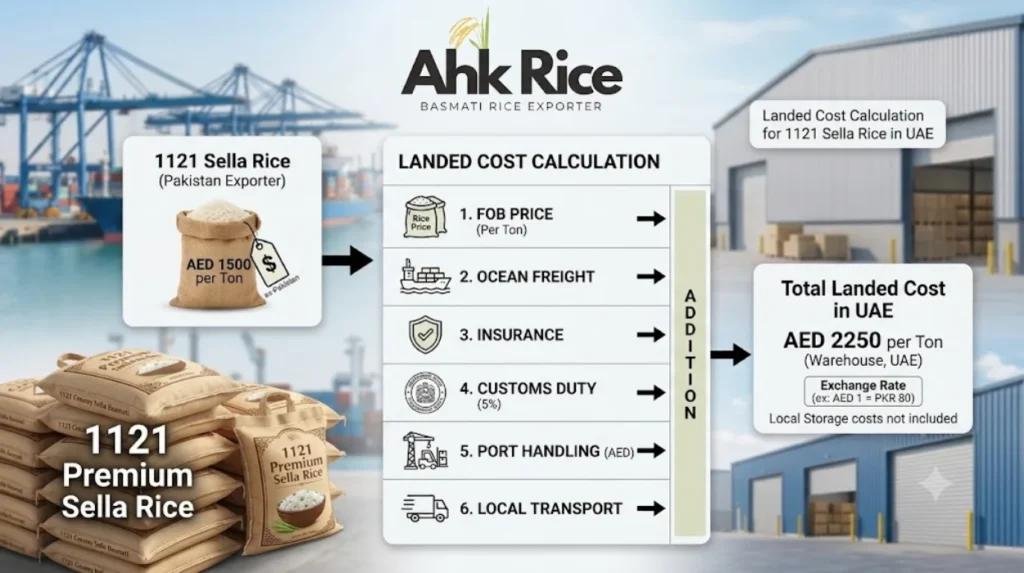
Importers add all expenses from supplier warehouse to final UAE warehouse delivery and divide the total by shipment quantity.
A simplified formula appears below:
Landed Cost = FOB Price + Freight + Insurance + Customs + Port Charges + Inland Transport
Example Calculation
Assume:
- FOB Pakistan: $1,150 per MT
- Freight: $60 per MT
- Insurance: $5 per MT
- UAE Duty: $60 per MT
- Port Charges: $15 per MT
- Local Transport: $10 per MT
Calculation:
$1,150 + $60 + $5 + $60 + $15 + $10
Total Landed Cost = $1,300 per MT
Importers use this figure to calculate wholesale margins and retail pricing.
Why Do Importers Use Landed Cost Instead of FOB?
FOB only reflects supplier-side expenses.
Landed cost reflects actual procurement expenses.
A supplier offering lower FOB prices can generate higher landed costs when freight, quality losses, or logistics expenses increase. Accurate comparisons require complete landed cost analysis.
With the calculation method explained, the next question concerns the advantages of using 1121 Creamy Sella for UAE markets.
Why Is 1121 Creamy Sella Popular in the UAE?
1121 Creamy Sella combines long grain appearance, high cooking yield, strong shelf life, and broad consumer acceptance.
UAE consumers prefer long-grain rice with visual appeal. 1121 Creamy Sella elongates significantly after cooking. This characteristic supports premium positioning.
1121 Creamy Sella offers strong storage stability. In Gulf warehouse environments, parboiled rice performs better than many raw rice categories. Extended shelf life reduces inventory losses.
1121 Creamy Sella provides high cooking recovery. Restaurants and catering businesses achieve greater serving volumes from the same quantity of rice. Foodservice operators value this efficiency.
1121 Creamy Sella supports multiple applications. Examples include biryani preparation, buffet service, institutional catering, retail packaging, and hotel procurement.
Understanding market demand helps clarify common misunderstandings surrounding import pricing.
What Common Misconceptions Affect Landed Cost Calculations?
The lowest FOB price does not create the lowest landed cost, and identical rice varieties do not carry identical import expenses.
Many buyers focus exclusively on supplier quotations. Freight fluctuations alter final costs significantly. Container shortages increase transportation expenses even when FOB prices remain unchanged.
Many importers assume all 1121 Creamy Sella grades are identical. Grain length, polishing level, sorting quality, and broken percentage vary substantially. These differences influence both pricing and market acceptance.
Many buyers ignore hidden charges. Port handling fees, inspection expenses, and local transportation costs affect profitability calculations. Comprehensive costing prevents inaccurate budgeting.
Many traders compare CIF and FOB prices incorrectly. Buyers seeking a deeper understanding of pricing structures can review a detailed analysis in the article discussing wholesale procurement economics and freight allocation between Pakistan and the UAE: 1121 Creamy Sella Basmati Rice FOB Pakistan vs CIF UAE Price Breakdown for Wholesale Buyers.
With common misconceptions clarified, the final consideration involves certification requirements that support international trade.
Which Certifications Apply to 1121 Creamy Sella Rice Exports?
Export shipments commonly require phytosanitary compliance, food safety verification, fumigation certification, and origin documentation.
Food safety standards influence international rice trade. Importers request documentation because regulatory authorities inspect food imports before market entry.
Common certifications include:
- Phytosanitary Certificate
- Certificate of Origin
- Fumigation Certificate
- ISO Certification
- HACCP Certification
- SGS Inspection Reports
- Laboratory Test Reports
Certification documents verify quality, safety, and compliance requirements. UAE authorities use these records during import clearance procedures.
Accurate certification supports smooth customs processing and completes the landed cost framework for international rice procurement.
Frequently Asked Questions
What is landed cost in rice imports?
Landed cost is the total expense incurred from supplier purchase to warehouse delivery, including freight, customs, insurance, and local charges.
Why is 1121 Creamy Sella Basmati Rice popular in the UAE?
1121 Creamy Sella offers long grain length, strong elongation, excellent appearance, and high cooking yield preferred by Gulf consumers.
Does freight significantly affect landed cost?
Yes. Freight can substantially change final procurement expenses, especially during container shortages or peak shipping seasons.
Which Pakistani region produces most 1121 Basmati Rice?
Punjab produces most 1121 Basmati Rice because its climate and irrigation systems support premium Basmati cultivation.
What documents are required for importing rice into the UAE?
Importers typically require a Commercial Invoice, Packing List, Certificate of Origin, Phytosanitary Certificate, Fumigation Certificate, and Bill of Lading.
What is the difference between FOB and landed cost?
FOB includes costs until cargo loading at the export port. Landed cost includes all expenses until delivery to the buyer’s warehouse.