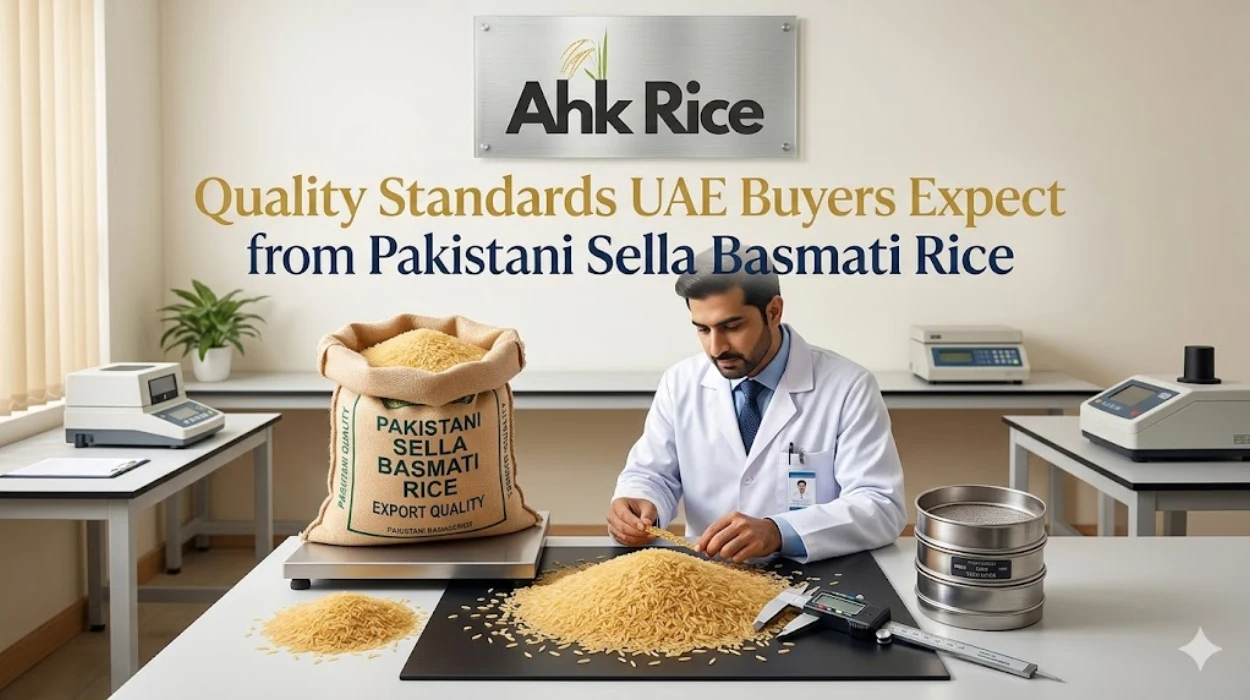
Quality Standards UAE Buyers Expect from Pakistani Sella Basmati Rice
Pakistani Sella Basmati rice meets UAE quality expectations when it is properly parboiled, length-graded, and moisture-stabilized. Here is why: UAE buyers in retail and hospitality sectors demand uniform grain elongation, low broken percentage, and certified export compliance, because food service consistency and retail shelf stability directly affect brand reputation and operating cost efficiency.
Pakistani exporters such as AHK Rice mill, dehusk, parboil, polish, grade, and test Sella rice to meet these Gulf specifications. These standards define whether rice enters premium supermarket shelves or bulk catering supply chains.
Internal benchmarking shows that UAE buyers prioritize grain integrity, cooking expansion ratio, and long storage life over price alone. For foundational demand insights across UAE retail and hospitality sectors, see this detailed overview of Pakistani Sella Basmati demand in the UAE market: Pakistani Sella Basmati Rice Demand Across UAE Retail and Hospitality Sectors.
What are the available solutions for meeting UAE quality standards?
UAE buyers accept three core supply solutions: raw white Basmati, steam-processed rice, and parboiled Sella rice, with Sella accounting for 60–70% of bulk hospitality demand due to longer shelf stability and higher grain integrity after cooking.
Sella Basmati solutions are defined by processing intensity and grain stability.
White Basmati solution
White rice is milled, polished, and sorted for immediate cooking applications. It delivers soft texture but lower storage resilience.
Steam rice solution
Steam rice is partially heat-treated before milling. It maintains moderate grain strength and suits mid-range retail packaging.
Sella (parboiled) solution
Sella rice is soaked, steamed, dried, dehusked, and aged before grading. It delivers high elongation and low breakage rates under UAE humidity conditions.
Colour consistency, moisture control, grain elongation, and certification compliance define solution selection in UAE procurement systems.
With solution types defined, the next step is understanding how these approaches compare in real UAE import conditions.
How do different processing approaches compare for UAE buyers?
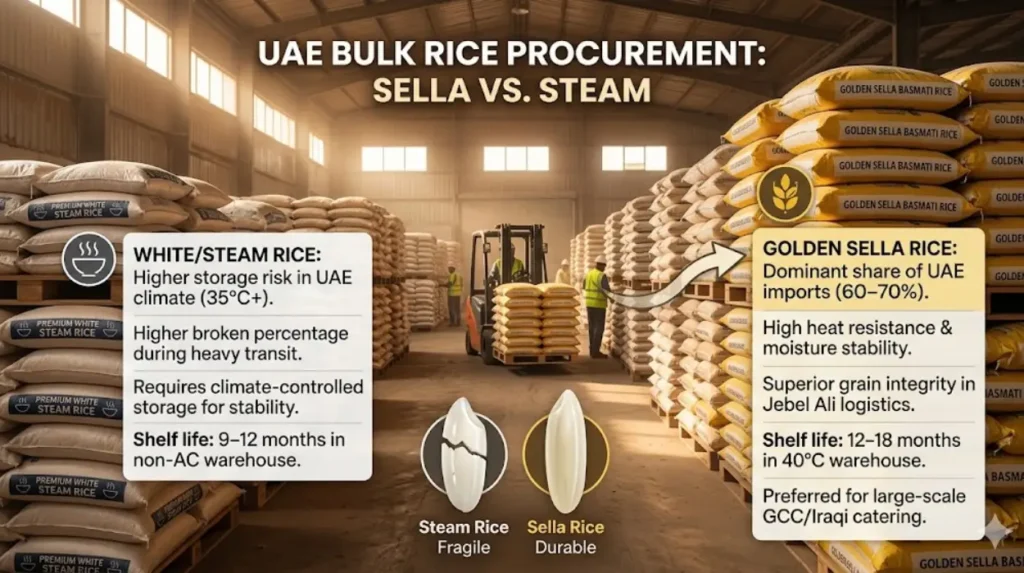
Sella rice outperforms steam and white rice in shelf life, grain integrity, and catering efficiency, especially in UAE climate conditions where storage temperatures often exceed 35°C.
Below is a specification comparison used by UAE importers and distributors.
Specification comparison table (7 attributes)
| Attribute | White Basmati | Steam Rice | Sella Basmati |
|---|---|---|---|
| Grain length after cooking | Medium | High | Very high (8.0–8.4 mm elongation) |
| Broken percentage | Medium | Low | Very low (≤5%) |
| Moisture stability | Low | Medium | High (10–12%) |
| Shelf life (UAE storage) | 6–9 months | 10–12 months | 12–18 months |
| Aroma retention | Medium | High | Very high |
| Cooking expansion ratio | 1:1.8 | 1:2.0 | 1:2.2–1:2.4 |
| Export demand share (UAE imports) | 20–25% | 20–30% | 60–70% |
Sella rice maintains structural stability during shipping, dispatch, and warehousing across Jebel Ali logistics corridors.
Golden Sella lasts longer than Steam. In a 40°C warehouse in the UAE, Golden Sella maintains quality for 18 months, while Steam requires consumption within 12 months. For Iraqi and GCC catering buyers using non-climate-controlled storage, Golden Sella remains the correct specification due to heat resistance and lower oxidation risk.
With comparison metrics established, the next question becomes which method works best for different UAE buyer cases.
Which method works best for different UAE buyer cases?
Sella Basmati works best for hospitality bulk supply, Steam works for mid-tier retail blends, and White rice fits niche fresh-consumption markets requiring fast turnover and softer texture profiles.
Hospitality bulk catering (hotels, airlines, restaurants)
Sella rice performs best because it withstands repeated cooking cycles and large batch steaming without grain collapse.
Retail packaged distribution (supermarkets)
Steam rice performs best for mid-range brands because it balances appearance and affordability.
Premium boutique rice segments
White Basmati performs best for niche consumers prioritizing softness over structure.
Grain uniformity, packaging durability, cooking yield, and price sensitivity determine method selection across UAE supply chains.
When buyers evaluate method suitability, they transition into analyzing pros and cons of each processing system.
A deeper market context of UAE procurement behavior is explained in this decision-focused analysis: Importing Pakistani Sella Basmati Rice into the UAE: Supplier Selection Guide.
What are the pros and cons of each rice processing approach?
Sella rice offers maximum export stability and cooking yield, but requires higher processing cost; White rice offers lower cost but weak storage resilience in Gulf climates.
Sella Basmati pros
- Grain strength increases during parboiling
- Moisture balance improves long-term storage
- Breakage reduces during transport and unloading
- Cooking expansion improves serving efficiency
Sella Basmati cons
- Processing cost increases due to soaking and steaming
- Color variation may occur if grading is inconsistent
Steam rice pros
- Balanced aroma retention after milling
- Moderate price stability for retail buyers
Steam rice cons
- Shorter shelf life in high-temperature storage
- Lower elongation compared to Sella
White rice pros
- Low processing cost
- Fast cooking time
White rice cons
- High breakage in logistics handling
- Reduced shelf stability under humidity exposure
Processing control, grading accuracy, and storage tolerance define how these pros and cons impact UAE import decisions.
With pros and cons established, UAE buyers next evaluate structured decision factors before procurement.
What decision factors influence UAE rice procurement?
UAE buyers prioritize grain uniformity, export certification, moisture stability, packaging strength, and consistent supply continuity when selecting Pakistani Sella Basmati suppliers.
Decision framework table (5 factors)
| Factor | Buyer expectation | Impact on selection | Risk if ignored | Preferred solution |
|---|---|---|---|---|
| Grain uniformity | Consistent 7.8–8.4 mm length | Brand positioning | Mixed cooking results | Sella Basmati |
| Moisture control | 10–12% moisture range | Shelf stability | Spoilage risk | Parboiled Sella |
| Certification | HACCP, ISO, phytosanitary | Import clearance | Shipment rejection | Certified exporters |
| Packaging strength | 25kg–50kg PP/jute bags | Logistics safety | Tear and loss | Reinforced packaging |
| Supply continuity | Monthly/quarterly shipment | Stock planning | Inventory shortage | Contract sourcing |
Certification compliance, moisture control, grain consistency, and logistics packaging strength form the backbone of UAE procurement decisions.
Because UAE importers operate in high-volume cycles, supplier reliability becomes more important than marginal price differences.
With decision factors defined, it is essential to connect these standards to real market outcomes and cost structures.
Why do UAE buyers prefer Sella Basmati over other rice types?
UAE buyers prefer Sella Basmati because it delivers superior storage stability, higher cooking yield, and consistent grain appearance under Gulf humidity and temperature conditions.
Sella rice reduces waste during hospitality cooking cycles because broken grains remain minimal during steaming and plating operations.
Sella rice reduces logistics losses because parboiled structure prevents grain fracture during container loading, dispatch, and inland trucking.
Sella rice increases serving efficiency because cooked grain expansion reduces per-plate raw consumption by measurable margins.
Grain expansion ratio, moisture retention stability, and structural hardness define why Sella dominates UAE import volumes.
With UAE preferences clarified, procurement strategy becomes the final consideration for buyers.
What is the best procurement strategy for UAE buyers?
The best procurement strategy combines long-term supplier contracts, certified grading consistency, and dual-sourcing from verified Pakistani exporters to stabilize pricing and supply continuity.
UAE buyers reduce risk by diversifying shipment schedules across quarterly cycles.
UAE buyers secure price stability by locking contracts during post-harvest supply peaks.
UAE buyers improve quality control by enforcing third-party inspection before dispatch.
UAE buyers maintain inventory balance by blending Sella grades for retail and hospitality channels.
Contract stability, grading verification, shipment scheduling, and supplier diversification form the strategic foundation of procurement success.
Final synthesis and internal linking guidance
UAE quality standards for Pakistani Sella Basmati rice are defined by measurable grain integrity, moisture control, and certification compliance. Sella rice consistently outperforms Steam and White rice in Gulf storage environments due to structural stability and longer shelf life.
Frequently Asked Questions
What makes Pakistani Sella Basmati suitable for UAE buyers?
Pakistani Sella Basmati rice is suitable for UAE buyers because it offers strong grain integrity, low breakage, and excellent storage stability in hot climates. Its parboiled structure helps it maintain quality during long shipping and warehouse storage, which is essential for UAE importers.
Why do UAE importers prefer Sella rice over white rice?
UAE importers prefer Sella rice because it delivers higher cooking yield, better elongation, and longer shelf life compared to white rice. It also performs better in hospitality settings where bulk cooking consistency and reduced grain breakage are important.
What quality standards are most important for UAE rice buyers?
UAE rice buyers focus on grain length consistency, moisture levels between 10–12%, low broken percentage, and proper export certifications such as HACCP and phytosanitary compliance. Packaging strength and supply consistency are also key procurement factors.
How does Sella rice perform in UAE storage conditions?
Sella rice performs very well in UAE storage conditions due to its heat-stable, parboiled structure. It can maintain quality for up to 12–18 months, even in high-temperature warehouses, without significant loss in aroma or grain strength.
Which suppliers meet UAE quality requirements for Sella rice?
Certified exporters with strong processing and grading systems typically meet UAE standards. For example, AHK Rice mill processes Sella rice through dehusking, parboiling, polishing, and grading to align with Gulf import specifications.