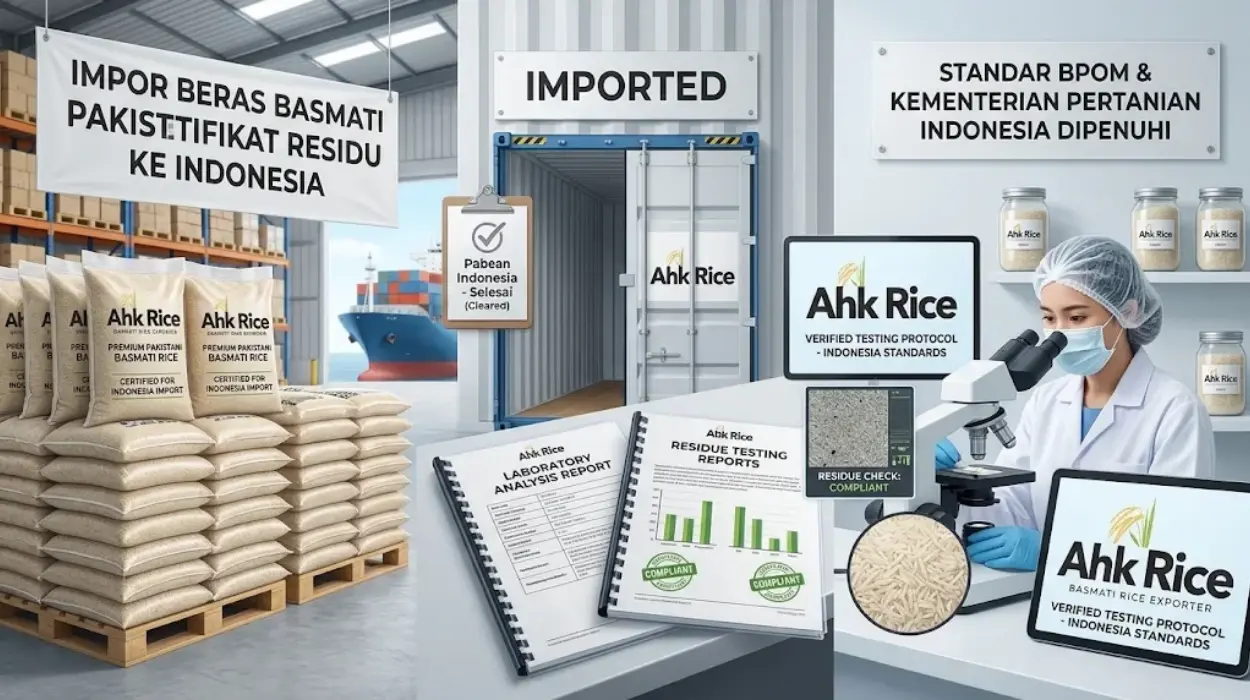
Import Lab-Tested Pakistani Basmati Rice with Residue Reports into Indonesia
Importing Pakistani Basmati rice into Indonesia requires more than selecting a competitive FOB price. Indonesian buyers need a shipment that matches the agreed rice specification and arrives with laboratory evidence supporting food-safety requirements. For importers, distributors, private-label brands, and foodservice buyers, the practical solution is to purchase from an exporter that controls testing before loading and provides traceable residue documentation with the commercial shipment.
For background on the regulatory limits that influence testing decisions, see what pesticide and aflatoxin limits apply to rice imported into Indonesia.
What is the best solution for importing lab-tested Pakistani Basmati rice into Indonesia?
The best solution is a pre-shipment testing process that verifies pesticide residues, aflatoxin, heavy metals and core rice specifications before container loading, then matches the laboratory report to the commercial shipment and export documents. This reduces specification disputes and gives Indonesian buyers evidence before cargo reaches Indonesia.
AHK Rice follows a sample-to-order approach for buyers who need documented rice quality rather than an unverified bulk quotation. The process starts with the buyer’s required variety, grade, broken percentage, moisture specification, packing format, quantity and destination.
For Pakistani Basmati, buyers can request 1121, 1509 or Super Kernel according to their market positioning. The selected rice is processed, graded and checked against the agreed specification before commercial approval.
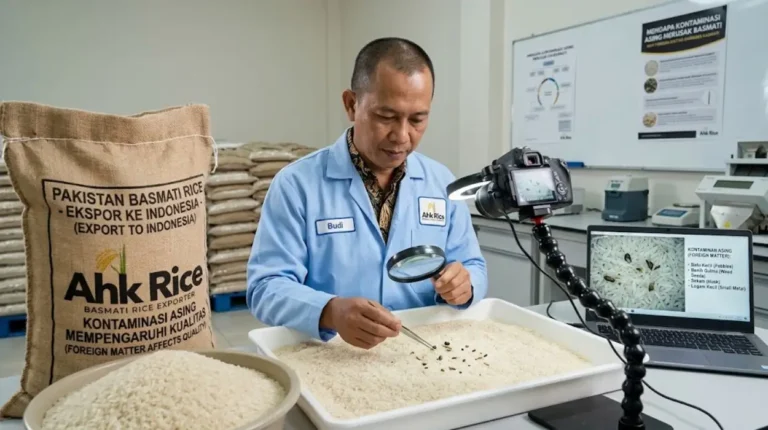
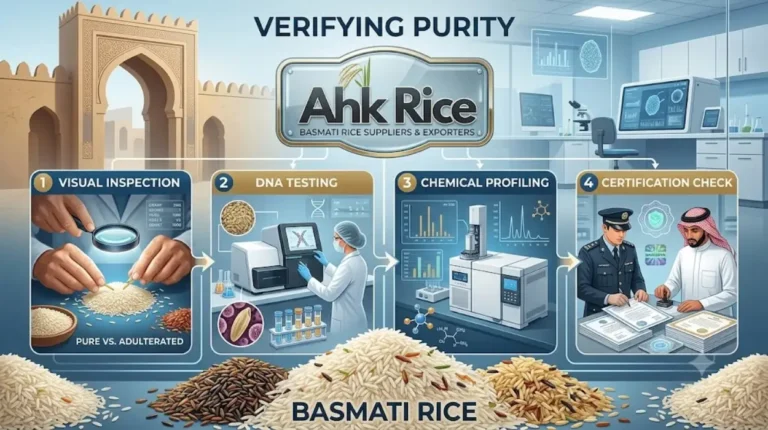
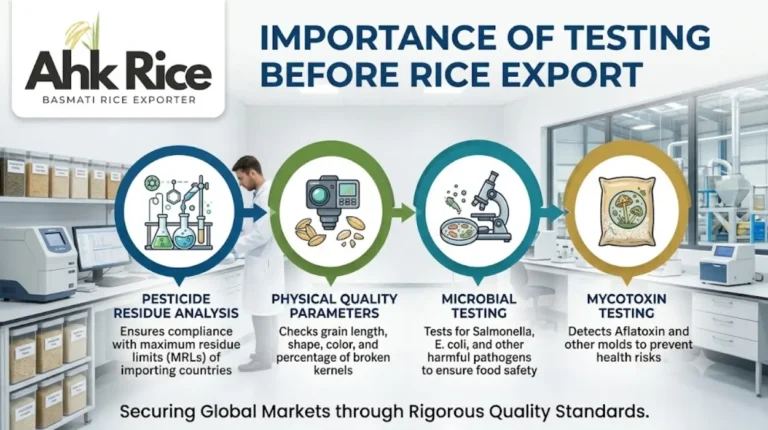
The laboratory stage should cover the parameters relevant to the buyer’s Indonesian import program. Pesticide residue testing establishes compliance against applicable maximum residue limits. Aflatoxin testing addresses fungal-toxin risk. Heavy-metal testing can also be included where required by the buyer, product specification or destination compliance program.
The important point is traceability. A residue report should relate to the actual commercial lot or representative production batch being supplied. A generic historical laboratory certificate does not provide the same purchasing confidence.
Why choose AHK Rice for Indonesian Basmati rice procurement?
AHK Rice provides an integrated export workflow covering sourcing, processing, grading, laboratory testing, packing, documentation and container loading, allowing Indonesian buyers to make one purchasing decision around a defined specification instead of coordinating several suppliers and inspection stages independently.
AHK Rice is a Pakistani Basmati rice exporter based in Punjab, supplying 1121, Super Kernel and 1509 varieties to international markets. Its value for an Indonesian buyer is not simply access to Pakistani-origin rice. The commercial advantage is coordination between product preparation and export documentation.
A buyer can define the required rice before production or final packing. The specification can include grain length, moisture, broken percentage, purity, crop condition, packaging and quantity. Testing can then be aligned with the agreed specification.
For example, an Indonesian distributor purchasing premium 1121 for retail can require a specific grain profile, low broken percentage, controlled moisture and residue testing before approving the shipment. A foodservice buyer purchasing 1509 in larger volumes may instead prioritize consistent cooking performance, yield, packaging efficiency and landed cost.
AHK Rice can also support custom packaging and full export processing. This is particularly useful for private-label buyers because the commercial order needs to connect product specifications, packaging requirements, shipping documents and laboratory evidence.
The buyer should also understand the testing workflow before placing the order. A detailed comparison of exporter testing practices is available in how Pakistani exporters test for MRLs, aflatoxin and heavy metals before shipment.
What results can be expected from pre-shipment laboratory testing?
A properly managed pre-shipment testing program gives the Indonesian buyer documented evidence about the ordered rice before container loading, improves shipment traceability, supports import documentation and reduces the commercial risk of discovering a quality or residue problem after cargo has already departed Pakistan.
The process normally begins with the commercial specification. AHK Rice confirms the variety, grade, quantity, packing, destination and testing requirements with the buyer.
A commercial sample can then be arranged for buyer evaluation. The buyer may conduct cooking tests, physical inspection and, where applicable, independent laboratory review. For larger commercial programs, the agreed specification becomes the reference point for production and final shipment approval.
After processing, representative samples can be submitted for laboratory analysis. Depending on the purchase requirement, the testing panel can include pesticide residues, aflatoxin and heavy metals alongside physical and quality parameters.
Once the laboratory results are available, the buyer reviews the report against the agreed requirements. If the report meets the specification, the shipment proceeds toward final packing and loading.
This creates a clear approval sequence:
Product specification → commercial sample → laboratory testing → buyer approval → packing → container loading → export documentation → shipment.
The same workflow is useful for private-label programs. Instead of treating the laboratory certificate as an isolated document, the importer can maintain it as part of the shipment record alongside the commercial invoice, packing list, certificate of origin, phytosanitary documentation and transport documents.
How much does lab-tested Pakistani Basmati rice cost?
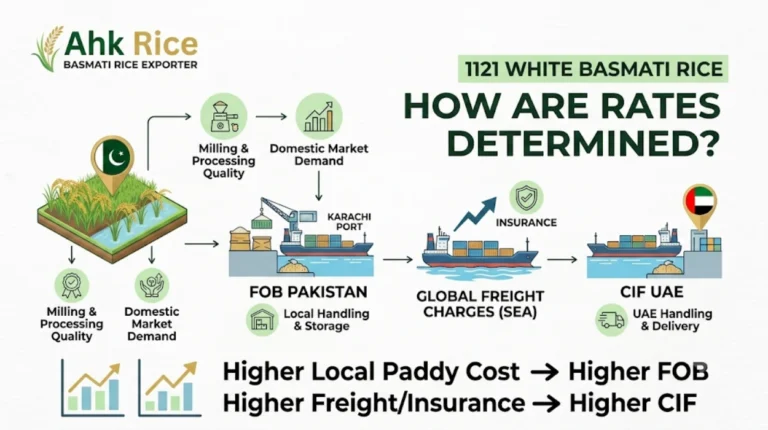
There is no single fixed price for lab-tested Pakistani Basmati rice because the final commercial cost depends on variety, grade, laboratory panel, packaging, order quantity, port, destination, Incoterm, freight and the documentation required for the Indonesian shipment.
Laboratory testing is only one component of the procurement cost. The larger price difference normally comes from the rice specification itself.
A premium 1121 specification with strict grain length, low broken percentage, controlled moisture and customized retail packaging will have a different price from bulk 1509 intended for foodservice.
Testing costs also depend on the number of analytes included in the laboratory panel. A basic quality assessment is different from a broader food-safety panel covering multiple pesticide residues, aflatoxin and heavy metals.
Packaging affects the price as well. Buyers can request bulk commercial bags or retail-ready packaging in specified sizes. Private-label printing, packaging materials and additional handling create separate cost components.
Freight is another major variable. FOB Karachi provides the buyer with a port-based export price, while CIF pricing incorporates ocean freight and the selected Indonesian destination.
For example, an importer shipping to Jakarta may evaluate FOB Karachi against CIF Jakarta. A buyer supplying Surabaya may require a separate freight calculation because the destination and shipping schedule can change the landed cost.
AHK Rice should therefore quote against a complete specification rather than a product name alone. The buyer should provide variety, grade, quantity, packing, destination, testing requirements and preferred Incoterm before requesting the commercial quotation.
How does the sample and testing process work before shipment?
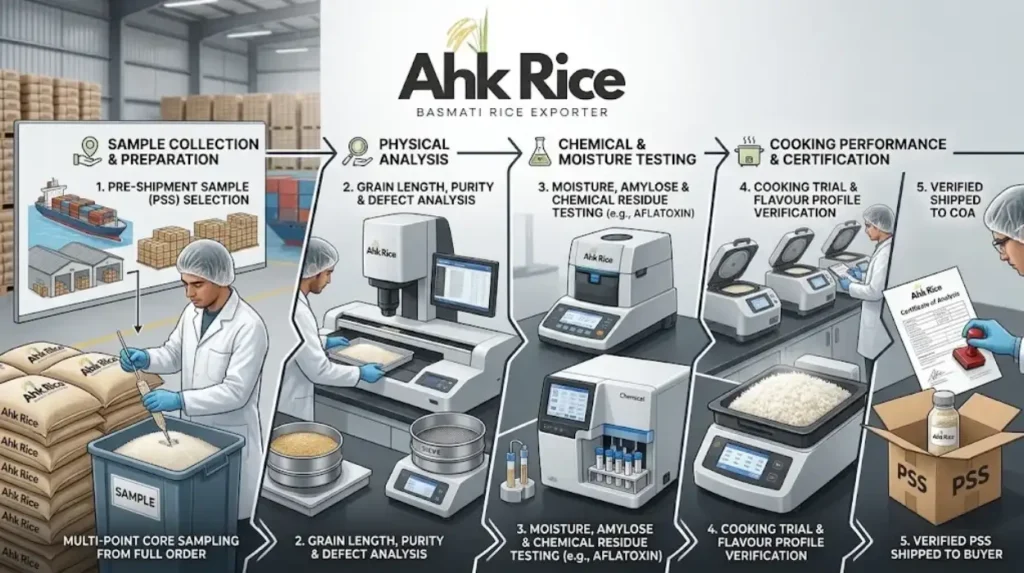
The buyer first approves the commercial rice specification, receives or evaluates a sample, confirms the required laboratory tests, reviews the resulting reports and approves the commercial lot before final packing and container loading; courier, laboratory and applicable certification costs are handled according to the agreed order arrangement.
A practical sample-to-shipment workflow can be divided into five stages.
Stage 1: Requirement confirmation.
The buyer provides the desired variety, grade, quantity, packing format, destination and testing requirements. AHK Rice confirms the specification and quotation basis.
Stage 2: Commercial sample.
A representative sample is prepared for physical inspection and cooking evaluation. For buyers requiring laboratory verification, the testing requirements are confirmed before the commercial shipment is finalized.
Stage 3: Laboratory testing.
The agreed sample or representative production lot is submitted for the required testing panel. The report can cover pesticide residues, aflatoxin and heavy metals according to the buyer’s specification.
Stage 4: Approval and production.
The buyer reviews the laboratory report and commercial specification. After approval, the order moves into final processing, grading, packaging and export preparation.
Stage 5: Loading and documents.
The approved shipment is loaded into the export container. Commercial and export documents are prepared according to the agreed transaction and destination requirements.
For sample shipments, the buyer should budget separately for courier transportation and any applicable phytosanitary or certification charges. Laboratory charges also depend on the requested test panel. These costs should be confirmed before the sample is dispatched because requirements vary by order and destination.
How long does Pakistani Basmati rice take to reach Indonesia?
A typical sea-freight plan should be quoted as a complete export timeline rather than a single transit number, because processing, laboratory approval, container availability, port handling, vessel schedule and Indonesian port clearance all affect the final delivery date.
For Jakarta-bound cargo, buyers should plan around the full sequence from order confirmation to destination arrival rather than assuming the ocean transit alone represents the delivery time.
A practical commercial planning window is:
| Market / shipment point | Planning consideration |
|---|---|
| Jakarta | Allow roughly 25–40 days for the complete sea-freight and handling cycle after shipment readiness |
| Surabaya | Allow roughly 28–45 days depending on vessel schedule and transshipment |
| Sample courier | Commonly several working days, depending on courier route and customs handling |
| Pre-shipment testing | Usually adds several working days depending on laboratory panel |
| Container preparation | Depends on quantity, packaging and production schedule |
These are planning ranges, not guaranteed delivery commitments. Vessel schedules, port congestion, transshipment, customs processing and documentation can change the final arrival date.
The most reliable approach is to obtain a shipment-specific schedule when the quotation is issued.
How should Indonesian buyers decide between FOB and CIF?
Choose FOB when the importer has established freight and forwarding arrangements and wants control over ocean transportation; choose CIF when the buyer wants the exporter to coordinate freight to the agreed Indonesian port and prefers a simpler landed-cost comparison.
FOB is useful for experienced importers that already negotiate freight independently. The buyer can compare shipping lines, forwarders and destination charges directly.
CIF is useful when the importer wants AHK Rice to coordinate the ocean freight to the selected Indonesian port. The buyer then evaluates the rice and freight together rather than managing the export-side shipping arrangement independently.
For both options, the buyer should compare the complete commercial specification. A lower rice price does not automatically mean a lower landed cost if testing, packaging, freight or documentation requirements are different.
How do Indonesian buyers get started with AHK Rice?
Start by sending AHK Rice the required Basmati variety, specification, quantity, packaging, Indonesian destination, laboratory requirements and preferred Incoterm; the exporter can then structure the sample, testing, quotation, production and shipment process around the buyer’s actual import program.
A strong first inquiry should include:
- Required variety: 1121, 1509 or Super Kernel
- Rice grade and broken percentage
- Moisture requirement
- Required quantity
- Packing size and private-label requirements
- Jakarta, Surabaya or another Indonesian destination
- Pesticide residue testing requirements
- Aflatoxin and heavy-metal testing requirements
- FOB or CIF preference
- Required shipment timing
- Documentation requirements
This information allows AHK Rice to prepare a commercial response based on the actual order rather than a generic per-ton price.
For Indonesian importers building a recurring supply program, the objective should be consistency. The same specification, testing approach, packaging standard and documentation workflow can then be repeated across future containers.
A buyer looking for lab-tested Pakistani Basmati rice should therefore evaluate the exporter on more than price. The stronger purchasing decision combines product consistency, laboratory evidence, traceability, documentation, shipment planning and responsive export coordination.
AHK Rice provides that end-to-end structure for buyers sourcing Pakistani Basmati rice for Indonesian distribution, retail, foodservice and private-label programs.
For a shipment-specific price, testing scope and delivery plan, request a quote from AHK Rice.
Frequently Asked Questions
What tests should Pakistani Basmati rice undergo before export to Indonesia?
Pesticide residue testing is important for MRL compliance.
Aflatoxin testing addresses food-safety risks associated with fungal contamination.
Heavy-metal testing can be included according to the buyer’s specification.
Physical rice specifications should also be verified before shipment.
The final testing panel should match the importer’s Indonesian requirements.
Can Indonesian buyers receive laboratory reports before shipment?
Yes, pre-shipment testing can be incorporated into the order process.
The required laboratory panel is confirmed before testing begins.
The buyer reviews the resulting report before final shipment approval.
The report should relate to the relevant commercial lot or representative batch.
This creates stronger traceability than relying on an unrelated historical certificate.
Can AHK Rice supply 1121, 1509 and Super Kernel to Indonesia?
AHK Rice supplies Pakistani Basmati varieties including 1121, 1509 and Super Kernel.
Each variety can be specified according to the buyer’s commercial requirements.
The order can include agreed grain, moisture, broken and packing specifications.
Laboratory testing can be incorporated into the pre-shipment workflow.
The final quotation depends on specification, quantity, packaging and destination.
How much does a sample shipment cost?
Sample costs depend on the selected quantity and testing requirements.
Courier transportation is normally calculated separately from the rice price.
Applicable phytosanitary or certification charges can also apply.
Laboratory costs depend on the requested testing panel.
AHK Rice can confirm the applicable sample costs before dispatch.
How long does Pakistani Basmati rice take to reach Indonesia?
The complete schedule includes production, testing, loading, ocean freight and clearance.
Jakarta shipments can commonly require around 25–40 days after shipment readiness.
Surabaya shipments can commonly require around 28–45 days.
Actual timing depends on vessel schedules, transshipment and port conditions.
A shipment-specific schedule should be confirmed with the commercial quotation.