Importing Pakistani Basmati Rice into Germany: EU Pesticide Rules Explained
Pakistani Basmati rice enters Germany only after passing strict European Union pesticide residue controls, traceability checks, and laboratory testing requirements. Germany imports premium aromatic rice for retail, foodservice, and ethnic distribution channels because Pakistani Basmati offers 6.8–8.4 mm grain length, strong elongation, and consistent cooking quality. Here is why: EU authorities enforce Maximum Residue Limits (MRLs), require tricyclazole-free compliance, and inspect every shipment through documented testing and customs clearance procedures.
What are the EU pesticide rules for importing Pakistani Basmati rice into Germany?
Germany applies EU Maximum Residue Limits, mandatory residue testing, and traceability verification for every imported Basmati shipment. Importers must verify pesticide levels before customs clearance.
The European Union regulates pesticide residues under Regulation (EC) No 396/2005. This framework defines Maximum Residue Limits for food imports entering Germany and other EU member states. Maximum Residue Limits define the highest legally permitted pesticide concentration in food products.
Pakistani Basmati rice exporters must test rice before dispatch because German customs authorities inspect shipments at ports such as Hamburg and Bremerhaven. Laboratories verify pesticide residues, heavy metals, aflatoxins, and microbiological contamination.
Tricyclazole receives special attention in EU rice imports. Tricyclazole is a fungicide used to control rice blast disease. Germany rejects rice shipments exceeding EU tolerance levels because residue compliance protects consumer safety and maintains food traceability standards.
EU authorities classify rice as a monitored agricultural import because rice cultivation uses fungicides, herbicides, and insecticides during farming. Importers therefore require detailed residue reports before procurement contracts.
Germany imports Basmati rice through supermarket chains, ethnic food distributors, restaurant suppliers, and private-label retail programs. German buyers prefer certified residue-controlled rice because supermarkets enforce internal food safety standards stricter than EU law.
Pakistan remains one of the world’s largest Basmati exporters alongside India (source: REAP export data, December 2025). Germany imports aromatic long-grain rice because South Asian cuisine consumption increased across Berlin, Frankfurt, Hamburg, and Munich.
With EU pesticide regulations defined, the next question is how Pakistani Basmati rice moves through the compliance process before reaching Germany.
How does Pakistani Basmati rice comply with German and EU import requirements?
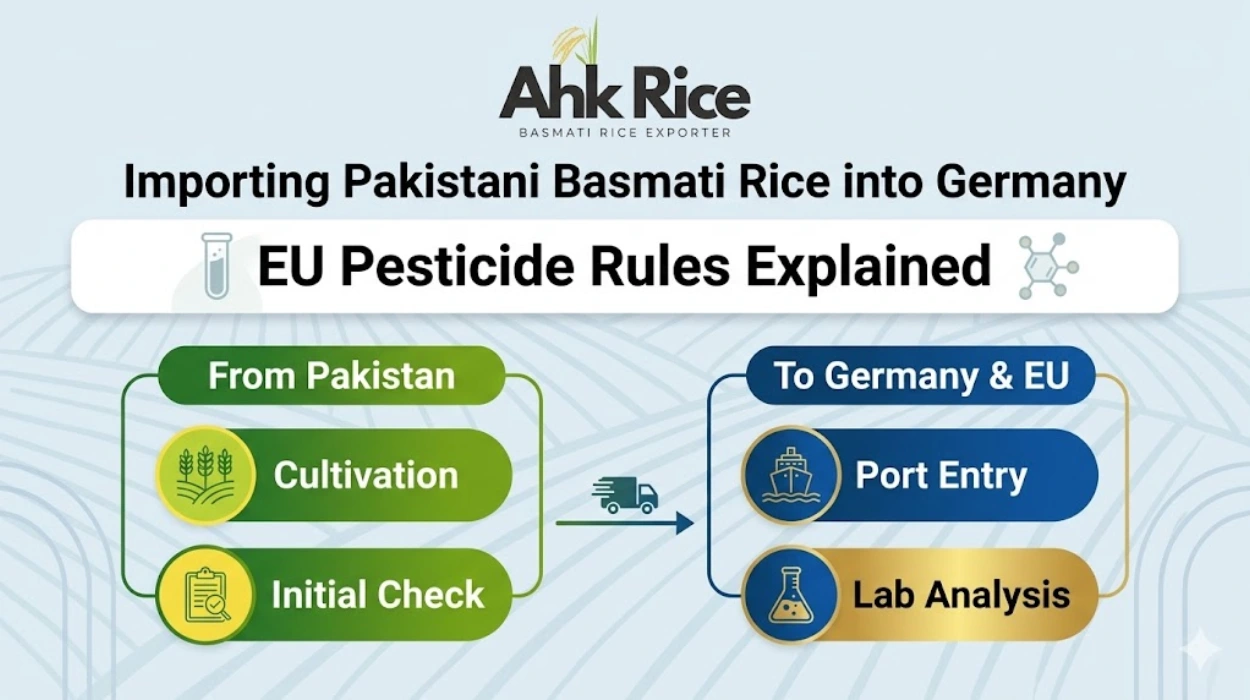
Pakistani exporters cultivate, mill, test, certify, load, and ship rice through documented compliance stages before German customs approval.
EU-compliant rice export begins at cultivation level. Farmers cultivate Basmati rice in Punjab because the region provides fertile alluvial soil, controlled irrigation, and temperature variation required for aroma development.
Exporters monitor pesticide application schedules during cultivation. Residue compliance starts before harvesting because prohibited pesticide use creates irreversible export rejection risks.
How is Pakistani Basmati cultivated for EU compliance?
Punjab farmers cultivate Basmati rice under monitored pesticide schedules, controlled irrigation systems, and harvest timing protocols.
Farmers irrigate Basmati fields using canal water systems from Punjab river networks. Controlled irrigation reduces fungal pressure and limits excessive agrochemical application.
Agronomists inspect crops during vegetative growth because EU residue compliance depends on pre-harvest chemical management. Farmers stop fungicide application within defined withdrawal periods before harvesting.
Harvesters collect paddy at moisture levels between 20% and 24%. Correct harvest timing preserves grain structure and reduces fungal contamination during storage.
How is Basmati rice processed before export to Germany?
Exporters complete cleaning, dehusking, polishing, grading, sorting, testing, packaging, and fumigation before shipment dispatch.
Rice mills process paddy through structured industrial stages. Each stage removes contaminants and standardizes export quality.
The export processing workflow includes:
- Clean the paddy to remove stones, dust, and straw
- Dry the grain to controlled moisture levels
- Dehusk the paddy using rubber roll shellers
- Polish the rice surface for appearance consistency
- Grade the kernels by size and break percentage
- Sort discolored grains using optical color sorters
- Test residue levels in certified laboratories
- Pack rice into retail or bulk export bags
- Fumigate containers before loading
European buyers require detailed documentation for each processing stage because traceability supports food safety enforcement.
Which documents support EU rice imports into Germany?
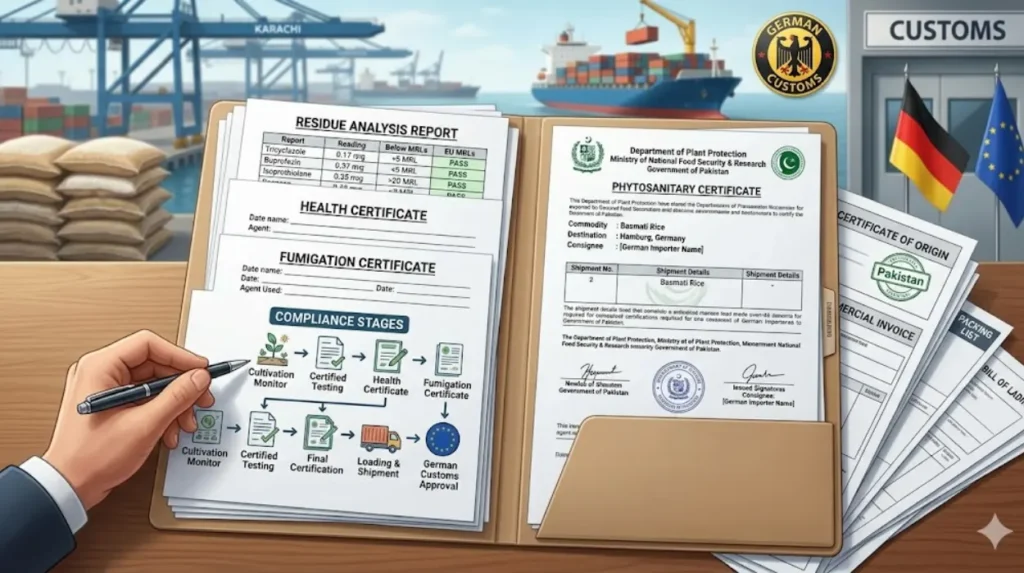
Importers require residue reports, phytosanitary certificates, health certificates, packing lists, and certificates of origin.
German customs authorities inspect documentation before release. Missing certificates delay clearance and increase demurrage costs at ports.
Required export documents include:
- Phytosanitary certificate
- Certificate of origin
- Commercial invoice
- Packing list
- Bill of lading
- Fumigation certificate
- Residue analysis report
- Health certificate
Residue reports contain laboratory measurements for pesticides such as tricyclazole, buprofezin, and isoprothiolane because EU monitoring programs track these substances closely.
With the compliance process established, the next question is which Pakistani Basmati grades Germany imports most frequently.
Which Pakistani Basmati rice grades enter the German market?
Germany imports 1121 Basmati, Super Kernel Basmati, and 1509 Basmati because these grades satisfy retail, catering, and ethnic food demand.
Pakistani exporters classify Basmati rice by grain length, processing type, and cooking characteristics. German importers select grades according to retail positioning and end-user applications.
What is 1121 Basmati rice?
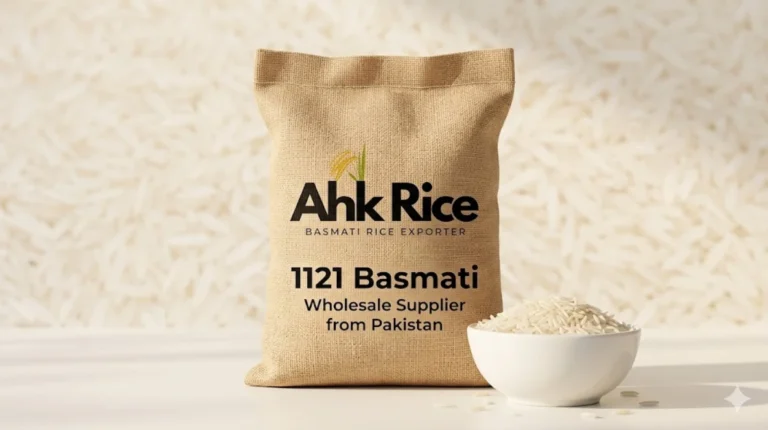
1121 Basmati delivers extra-long kernels measuring 8.2–8.4 mm before cooking and elongates significantly after boiling.
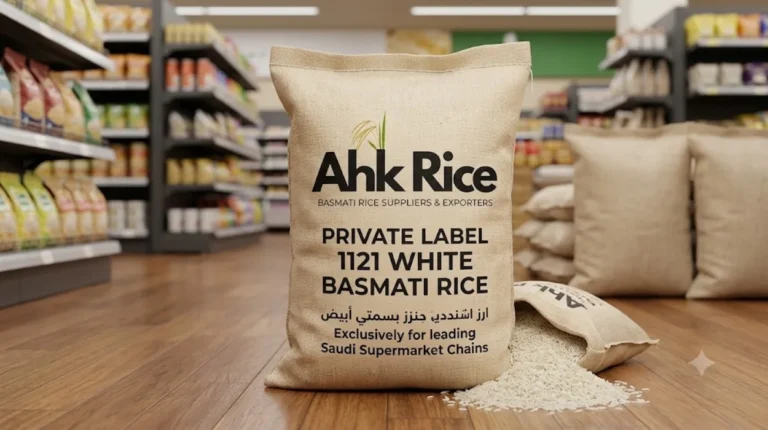
1121 Basmati dominates premium export markets because consumers prefer visual grain length and separate cooked texture. German supermarkets sell 1121 in branded retail packs and private-label packaging.
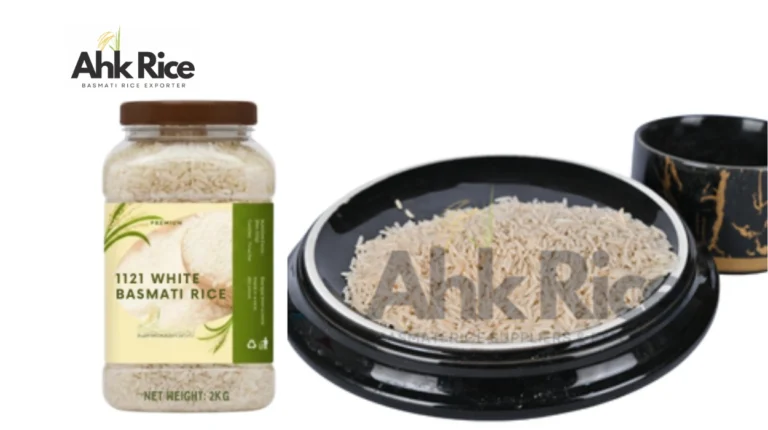
1121 White Basmati undergoes milling and polishing without parboiling. The rice cooks faster and produces a soft texture preferred for home cooking.
1121 Golden Sella undergoes parboiling before milling. Parboiling strengthens the grain structure and increases storage durability. In large-scale catering kitchens, Golden Sella maintains kernel separation during bulk cooking.
German retail buyers frequently compare texture and shelf positioning between premium Basmati grades. Buyers evaluating retail assortment strategies often examine differences between traditional aromatic profiles and extra-long grain presentation through detailed procurement comparisons such as super kernel vs 1121 white basmati German retail buyers.
What is Super Kernel Basmati rice?
Super Kernel Basmati provides traditional aroma, medium-long grain structure, and strong consumer recognition in European ethnic markets.
Super Kernel Basmati originates from traditional Pakistani Basmati breeding lines cultivated in Punjab. The variety produces a strong natural aroma because of higher 2-acetyl-1-pyrroline compound concentration.
German South Asian grocery chains stock Super Kernel because diaspora consumers recognize its traditional cooking characteristics. Restaurants preparing biryani and pulao select Super Kernel for fragrance consistency.
Super Kernel White cooks softer than Golden Sella variants. Super Kernel Steam maintains firmer texture because steam treatment stabilizes the kernel surface.
What is 1509 Basmati rice?
1509 Basmati offers shorter cultivation cycles, competitive pricing, and high-volume export availability for commercial foodservice supply.
1509 matures faster than traditional Basmati varieties. Faster harvest cycles increase supply consistency and support commercial procurement programs.
German foodservice distributors source 1509 for institutional catering because controlled procurement costs support large-scale meal preparation.
With German import grades clarified, the next question is why tricyclazole-free rice receives special attention in EU trade.
Why does tricyclazole-free rice matter in EU Basmati imports?
EU authorities enforce strict tricyclazole residue limits because the fungicide remains heavily monitored in imported rice shipments.
Tricyclazole controls rice blast disease during cultivation. EU food regulators restrict residue levels because imported food products must meet harmonized consumer safety standards.
German importers therefore request tricyclazole-free rice specifications during procurement negotiations. Laboratory verification protects distributors from customs seizure risks.
Residue compliance influences every stage of rice sourcing. Buyers verify cultivation practices before signing annual contracts because rejected shipments create financial losses across logistics chains.
Laboratories test rice samples using chromatographic analysis methods. These tests identify residue concentrations in parts per million. Importers release shipments only after confirmed compliance.
EU monitoring programs increased inspection frequency for rice imports during recent years because pesticide violations affected several global rice suppliers (source: European Commission food safety monitoring reports, 2025).
Tricyclazole-free positioning also affects retail marketing. German consumers increasingly purchase food products carrying safety certifications and residue-controlled sourcing claims.
With tricyclazole compliance explained, the next question concerns certifications required for EU market entry.
Which certifications support Basmati EU compliance?
German importers prioritize ISO, HACCP, BRCGS, phytosanitary, and laboratory residue certifications for compliant rice sourcing.
Food safety certifications standardize export procedures and reduce procurement risk. German retailers require documented quality systems because supermarkets remain legally responsible for imported food safety.
What does HACCP certification verify?
HACCP verifies hazard control procedures throughout cultivation, processing, storage, and shipment operations.
Hazard Analysis Critical Control Point systems identify contamination risks during production. Rice mills monitor moisture, contamination, and foreign material levels because controlled processing reduces food safety incidents.
HACCP systems require documented inspections. Processors therefore record cleaning schedules, fumigation procedures, and laboratory testing data.
What does BRCGS certification verify?
BRCGS verifies food safety management, factory hygiene, traceability systems, and export processing consistency.
British Retail Consortium Global Standards certification supports supermarket procurement across Europe. German retailers often request BRCGS-approved suppliers because certification simplifies compliance verification.
Factories undergo external audits covering sanitation, pest control, allergen management, and operational traceability.
Why do laboratory certifications matter?
Accredited laboratory reports verify pesticide residues, microbiological safety, and heavy metal compliance before shipment dispatch.
EU importers require independent testing because customs authorities recognize accredited analytical reports. Laboratories use internationally standardized testing methods to verify compliance thresholds.
Residue certificates also support customs inspections during random port sampling procedures.
With certification requirements clarified, the next question is which problems affect Pakistani Basmati imports into Germany.
What problems affect Pakistani Basmati imports under EU pesticide rules?
Residue violations, incorrect documentation, moisture imbalance, and traceability failures create the largest import disruptions.
Pesticide exceedance remains the primary import risk. Rice exceeding EU Maximum Residue Limits faces rejection, destruction, or re-export.
Documentation inconsistency creates secondary problems. Customs authorities delay shipments because mismatched packing lists and laboratory reports prevent traceability verification.
Moisture imbalance damages grain quality during shipping. Rice above 14% moisture develops fungal contamination risks during sea transit. Exporters therefore dry rice before container loading.
Traceability gaps weaken importer confidence. German buyers require farm-to-container documentation because EU food regulations enforce accountability across supply chains.
Some buyers incorrectly assume all Basmati rice satisfies EU standards automatically. Compliance depends on cultivation control, processing discipline, and laboratory verification. Country origin alone does not guarantee approval.
Another misconception concerns parboiled rice. Buyers sometimes assume Golden Sella contains higher pesticide residues because of processing color changes. Parboiling affects grain appearance and texture, not pesticide concentration.
Quality differences between rice grades also create procurement confusion. Buyers comparing traditional aromatic varieties with extra-long grain retail products often need detailed specification analysis before selecting supermarket assortments.
With common import problems clarified, the final question concerns why Germany continues increasing Basmati rice imports despite strict regulations.
Why does Germany continue importing Pakistani Basmati rice despite strict EU regulations?
Germany imports Pakistani Basmati because controlled cultivation, strong aroma, long grain structure, and growing ethnic food demand support stable market growth.
German consumers increasingly purchase international rice varieties because multicultural cuisine demand expanded across retail and restaurant sectors. Basmati supports Indian, Pakistani, Middle Eastern, and fusion food categories.
Pakistani Basmati maintains competitive export relevance because Punjab cultivation conditions support aroma development naturally. Cool nighttime temperatures and mineral-rich soils strengthen grain fragrance characteristics.
Export infrastructure also improved significantly during recent years. Modern rice mills now use optical sorting systems, automated grading equipment, and residue-controlled storage facilities.
Germany benefits from diversified sourcing because multiple Basmati origins strengthen supply chain resilience. Importers therefore maintain procurement relationships with certified Pakistani exporters alongside other Asian suppliers.
European food safety standards remain strict because consumer protection drives regulatory enforcement. Pakistani exporters meeting those standards secure access to one of the world’s highest-value packaged food markets.
German Basmati imports therefore depend on measurable compliance, documented traceability, and residue-controlled cultivation rather than low-cost commodity trade alone.
Frequently Asked Questions
What pesticide rules apply to basmati rice in Germany?
EU pesticide rules apply Maximum Residue Limits under Regulation 396/2005. German authorities test imported basmati rice for banned substances like tricyclazole before customs clearance and retail approval.
Is tricyclazole allowed in Pakistani basmati rice exports?
Tricyclazole is not allowed under EU import standards. Pakistani exporters must ensure zero detectable residue through certified laboratory testing before shipping basmati rice to Germany and other EU countries.
How is basmati rice tested for EU compliance?
Basmati rice is tested using accredited laboratories that apply gas chromatography and mass spectrometry. These tests detect pesticide residues at trace levels before export certification is issued.
Which basmati rice varieties are exported to Germany?
Pakistan exports 1121, Super Kernel, and 1509 basmati rice varieties to Germany. These varieties are processed, graded, and certified for EU compliance before shipment and retail distribution.
Why do German importers prefer EU certified basmati rice?
German importers prefer EU certified basmati rice because it ensures food safety compliance, faster customs clearance, consistent grain quality, and reduced regulatory risk in retail and food service supply chains.