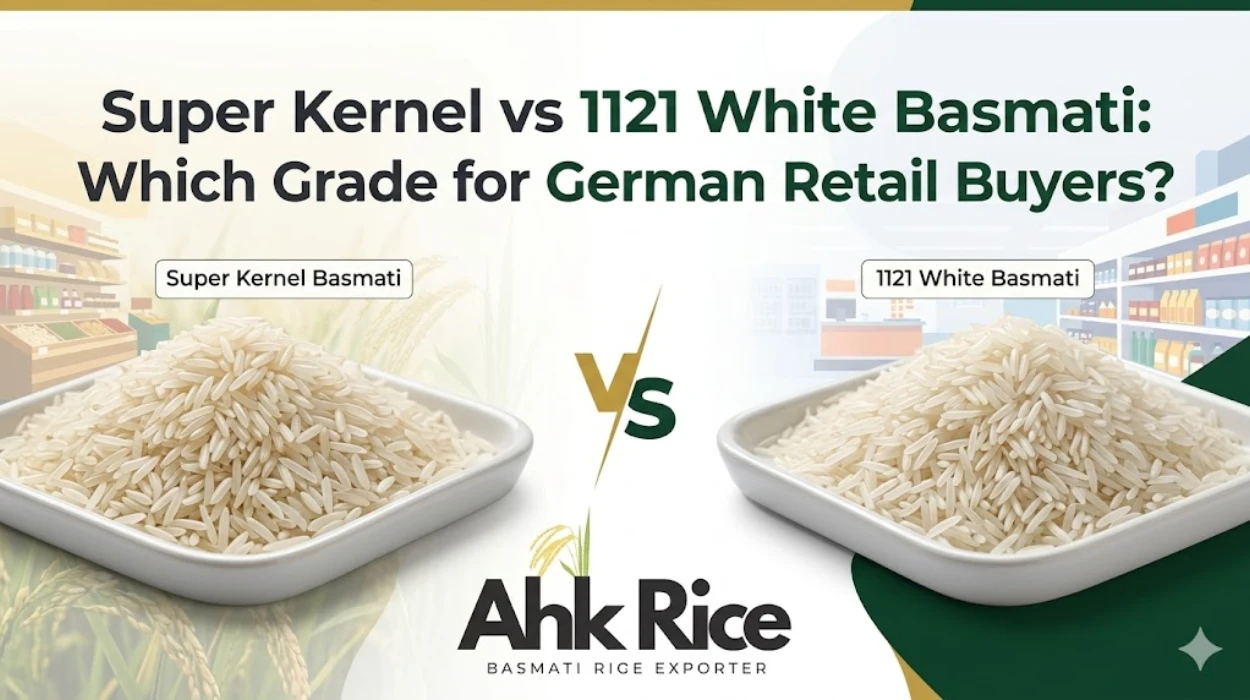
Super Kernel vs 1121 White Basmati: Which Grade for German Retail Buyers?
1121 White Basmati is the primary choice for German retail buyers in premium supermarket channels, while Super Kernel performs better in price-sensitive EU private label segments. Here is why: grain length consistency, aroma intensity, and export-grade polishing standards make 1121 a higher retail-grade SKU, whereas Super Kernel optimizes cost efficiency with stable cooking performance.
German retail basmati demand is shaped by strict EU retail compliance and consumer expectations for fragrance and elongation.
For foundational basmati grading concepts, see this contextual guide on basmati grading and export standards.
In structured export supply, AHK Rice processes and supplies both Super Kernel and 1121 White Basmati through end-to-end milling, polishing, grading, and export dispatch systems for EU retail programs.
For buyers evaluating compliance-ready sourcing, refer to the BOFU overview of AHK Rice EU wholesale basmati operations: AHK Rice Germany EU compliant basmati wholesale direct.
Specification Comparison Table (Core Technical Benchmark)
| Attribute | 1121 White Basmati | Super Kernel Basmati |
|---|---|---|
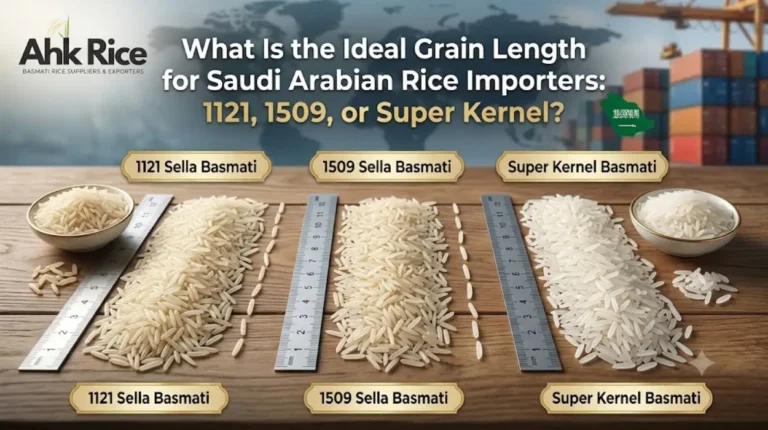
| Grain length (mm) | 8.30–8.40 | 7.60–7.90 |
| Aroma intensity | Very high natural fragrance | Medium fragrance profile |
| Elongation after cooking | 2.2x–2.5x expansion | 2.0x–2.2x expansion |
| Broken percentage | ≤2% premium sort | ≤5% commercial sort |
| Polish level | Extra silky double-polish | Standard polish finish |
| EU retail positioning | Premium supermarket SKUs | Private label/value SKUs |
| Price stability index | High export price volatility sensitivity | Stable cost optimization grade |
1121 White Basmati dominates premium retail shelf positioning because uniform grain structure improves visual appeal and cooking expansion consistency.
Super Kernel dominates high-volume retail programs because cost efficiency supports aggressive pricing strategies in competitive supermarket chains.
With technical differences established, the next step is understanding how these grades translate into market solutions for German buyers.
What are the available solutions for German retail basmati sourcing?
German retail buyers select between 1121 White Basmati, Super Kernel Basmati, and blended private-label formulations depending on price tier, shelf positioning, and consumer expectation. 1121 serves premium retail branding, Super Kernel serves value retail SKUs, and blends stabilize cost-performance balance for large supermarket contracts.
1121 White Basmati functions as a premium long-grain export rice cultivated, harvested, milled, polished, and graded under strict export protocols.
It delivers fragrance intensity and elongation performance aligned with German premium retail expectations.
Super Kernel Basmati functions as a commercial-grade long grain variety processed through standard polishing and grading systems.
It prioritizes yield efficiency and stable cooking performance for mass retail distribution.
Retail blending solutions combine 1121 and Super Kernel to balance aroma and cost per SKU.
Blending improves margin control in private label supermarket contracts across EU chains.
Market positioning table: Germany vs Western EU retail demand
| Region | Preferred Grade | Retail Strategy | Consumer Preference |
|---|---|---|---|
| Germany retail | 1121 White Basmati | Premium branding + clean labeling | High aroma + long grain visual |
| Western EU retail (France/Netherlands) | Super Kernel | Price-driven private label SKUs | Balanced aroma + affordability |
Germany retail buyers prioritize premium sensory differentiation, while Western EU buyers prioritize pricing efficiency and shelf turnover.
With available sourcing solutions defined, the next focus is how these approaches compare in performance and export economics.
How do different approaches compare in performance and export economics?
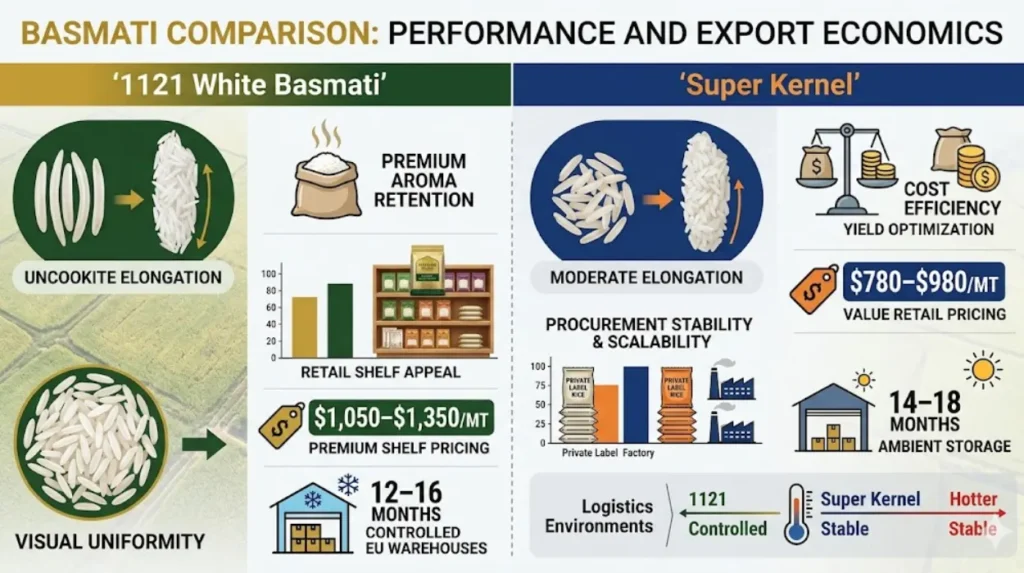
1121 White Basmati outperforms Super Kernel in aroma, grain elongation, and retail shelf appeal, while Super Kernel outperforms 1121 in cost efficiency, procurement stability, and private label scalability for EU supermarket contracts.
1121 White Basmati is milled, dehusked, polished, and graded to maximize visual uniformity and aroma retention.
This increases shelf attractiveness in German premium retail aisles.
Super Kernel is milled, dehusked, and sorted with emphasis on yield optimization and cost efficiency.
This improves margin control for high-volume importers.
Price per MT comparison (EU import benchmark)
| Grade | Price per MT (USD range) | Retail impact |
|---|---|---|
| 1121 White Basmati | $1,050–$1,350/MT | Premium shelf pricing |
| Super Kernel | $780–$980/MT | Value retail pricing |
1121 White Basmati maintains higher export pricing due to grain length consistency and aroma retention during storage and shipping.
Super Kernel maintains lower pricing due to reduced polishing intensity and higher throughput yield during milling operations.
Shelf life comparison under export storage conditions
1121 White Basmati maintains quality for 12–16 months in controlled EU warehouses, preserving aroma intensity longer in sealed retail packaging.
Super Kernel maintains quality for 14–18 months in ambient storage, performing better in non-climate-controlled retail distribution networks.
In hotter logistics environments, Super Kernel retains structural stability longer, while 1121 retains sensory superiority in controlled environments.
With performance differences clarified, the next section evaluates which method works best for different retail use cases.
Which method works best for different German retail cases?
1121 White Basmati works best for premium German supermarket branding, organic and gourmet retail segments, while Super Kernel works best for discount retail chains, private label contracts, and high-volume EU distribution programs requiring cost stability.
1121 White Basmati is cultivated for premium retail SKUs where aroma, elongation, and visual grain integrity drive purchase decisions.
German consumers associate it with authenticity and premium Asian cuisine positioning.
Super Kernel is cultivated and processed for commercial retail efficiency where pricing dominates shelf decision-making.
It performs strongly in supermarkets targeting value-conscious households.
Retail use-case alignment table (decision mapping)
| Use case | Recommended grade | Reason |
|---|---|---|
| Premium German supermarkets | 1121 White Basmati | Aroma + grain premiumization |
| Private label discount chains | Super Kernel | Cost optimization |
| Gourmet Asian specialty stores | 1121 White Basmati | Culinary authenticity |
| Large EU food distributors | Super Kernel | Supply stability |
| Mixed retail portfolios | Blended SK + 1121 | Balanced cost-performance |
1121 White Basmati dominates in culinary storytelling retail formats where packaging and sensory cues influence purchase intent.
Super Kernel dominates in logistics-heavy retail environments where price per kilogram determines shelf placement.
With use-case mapping established, the next section evaluates advantages and disadvantages of each grade.
What are the pros and cons of each basmati grade?
1121 White Basmati delivers superior aroma, elongation, and premium shelf appeal but requires higher procurement cost, while Super Kernel delivers strong cost efficiency and stable logistics performance but offers lower fragrance intensity and reduced premium positioning.
1121 White Basmati delivers export-grade sensory performance through extended polishing, grading, and sorting cycles.
It increases retail conversion in premium supermarket aisles.
Super Kernel delivers operational efficiency through optimized milling yield and reduced production cost per metric ton.
It improves profitability in high-volume procurement programs.
1121 White Basmati – pros and cons
Pros
- Aroma intensity supporting premium retail branding
- Grain elongation enhancing plated presentation
- Polishing consistency improving shelf uniformity
Cons
- Procurement cost higher per MT
- Storage sensitivity in high humidity logistics
- Premium packaging requirements increase total landed cost
Super Kernel – pros and cons
Pros
- Cost efficiency supporting private label scaling
- Storage stability in mixed climate logistics
- Supply consistency across bulk contracts
Cons
- Aroma intensity lower than 1121 baseline
- Grain visual premium lower for luxury retail
- Limited differentiation in gourmet segments
1121 White Basmati leads in sensory retail impact, while Super Kernel leads in commercial efficiency.
With advantages defined, the final section explains decision factors for German retail procurement teams.
What are the key decision factors for German retail buyers?
German retail buyers select basmati grades based on price per MT, consumer positioning strategy, shelf life requirements, packaging format, and EU compliance standards, with aroma intensity and grain integrity acting as secondary but critical differentiators in premium segments.
1121 White Basmati is selected when retail branding requires strong sensory differentiation and premium shelf storytelling.
It increases perceived value in German supermarket environments.
Super Kernel is selected when procurement teams prioritize cost control and stable long-term supply contracts.
It supports predictable retail pricing strategies.
Decision framework table (5-factor model)
| Factor | 1121 White Basmati | Super Kernel |
|---|---|---|
| Cost sensitivity | Medium impact | High advantage |
| Aroma requirement | Critical advantage | Moderate |
| Retail positioning | Premium shelves | Value/private label |
| Supply scalability | Medium | High advantage |
| Storage resilience | Moderate | High advantage |
1121 White Basmati dominates sensory-driven purchasing decisions in German retail environments focused on premiumization.
Super Kernel dominates operational procurement decisions where logistics, price stability, and scalability define success.
Conclusion: structured grade selection for German retail basmati strategy
1121 White Basmati defines premium German retail basmati positioning, while Super Kernel defines scalable EU value retail supply chains.
The correct selection depends on retail tier, pricing strategy, and consumer targeting model.
German retail buyers gain maximum efficiency when they align grade selection with shelf segmentation strategy rather than commodity pricing alone.
Frequently Asked Questions
What is the main difference between Super Kernel and 1121 White Basmati?
1121 White Basmati delivers higher aroma, longer grain, and stronger elongation after cooking, making it suitable for premium German retail shelves. Super Kernel focuses on cost efficiency and stable supply, making it suitable for private label and value retail segments in Germany and wider EU markets.
Which basmati rice is better for German premium supermarkets?
1121 White Basmati is better for German premium supermarkets because it offers strong fragrance, polished grain appearance, and consistent elongation. These features match consumer expectations in high-end retail environments where visual quality and aroma strongly influence purchase decisions.
Which grade is more cost-effective for EU importers?
Super Kernel is more cost-effective for EU importers because it has a lower price per metric ton and stable supply availability. It is widely used in private label programs where supermarkets prioritize competitive pricing over premium sensory characteristics.
How does shelf life differ between Super Kernel and 1121?
Super Kernel generally has a slightly longer shelf stability in non-climate-controlled storage conditions due to its standard polishing level. 1121 White Basmati performs best in controlled storage environments where aroma retention and grain integrity are preserved for premium retail packaging.
Can German retailers use both grades together?
Yes, German retailers often use both grades in a mixed portfolio strategy. 1121 White Basmati is used for premium SKUs, while Super Kernel is used for value or private label SKUs. This combination helps balance profitability, pricing flexibility, and consumer segmentation across retail channels.