Best 1509 Rice Grade for Catering Businesses
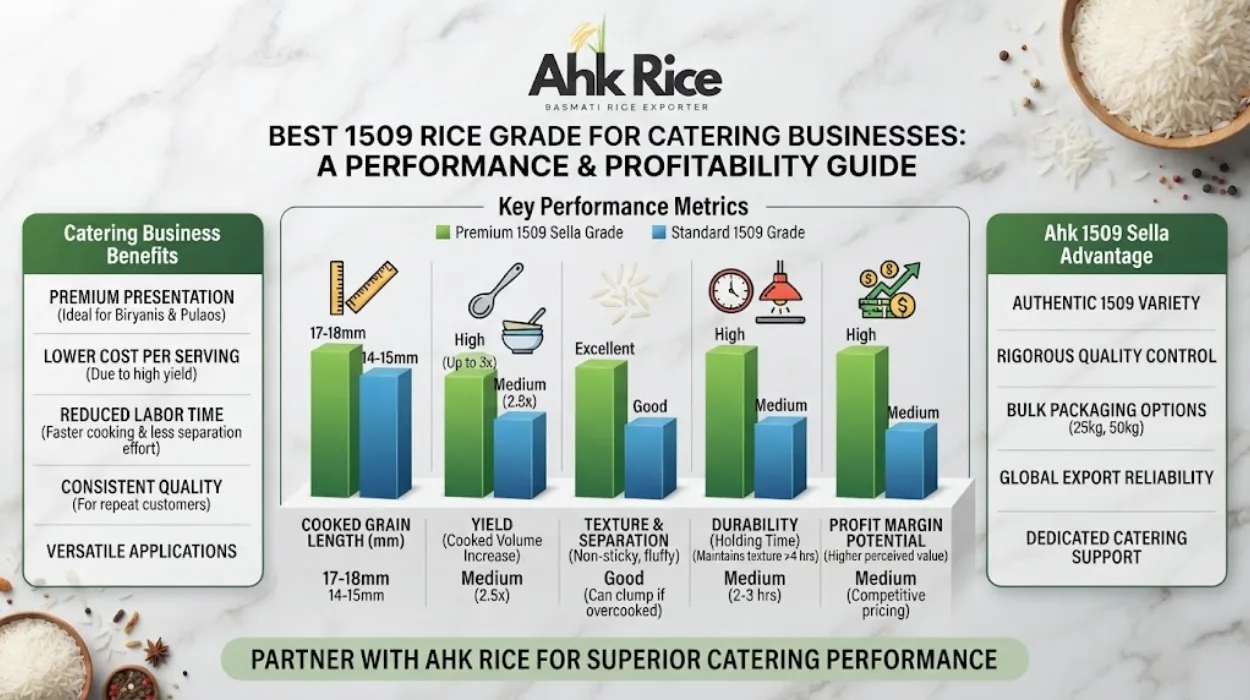
1509 Steam and 1509 Sella are the strongest catering grades, with Steam fitting fresh high-volume cooking and Golden Sella fitting extended holding and storage. Here is why: both grades strengthen cooking consistency, while parboiling gives Sella greater grain resilience during bulk preparation and service.
1509 Basmati suits catering businesses because its long grain, cooking elongation, commercial yield, and competitive procurement position support large-volume food production. The variety is cultivated mainly in Punjab and commonly measures around 8.10–8.50 mm before cooking. Read the complete guide to 1509 Basmati grain length and cooking performance before comparing processing grades.
1509 Basmati Rice reaches catering kitchens through different processing methods. AHK Rice supplies the variety through end-to-end processing, grading, sorting, custom packaging, and export coordination. The available commercial grades include White, Brown, Steam, Parboiled, Golden Sella, Creamy Sella, and Sella.
What are the available 1509 rice grades for catering businesses?
The main catering solutions are White, Steam, Parboiled, Golden Sella, Creamy Sella, Sella, and Brown, with Steam and Golden Sella providing the strongest balance of cooking performance and commercial efficiency.
White 1509 Basmati
White 1509 is milled and polished rice without parboiling. The grade provides a clean appearance and natural Basmati character. It fits restaurants that cook smaller batches and serve rice soon after preparation.
White rice requires tighter cooking control than parboiled grades. Large catering kitchens must control water ratios, cooking temperature, resting time, and handling. This grade works best for fresh service rather than prolonged holding.
Steam 1509 Basmati
Steam 1509 receives steam treatment before final milling. The process strengthens the grain while retaining a white or creamy-white appearance. The grade provides a strong combination of long grain presentation, aroma, cooking yield, and price efficiency.
Steam 1509 suits restaurants, banquet kitchens, catering companies, and foodservice distributors. Current commercial listings position steam 1509 around 8.40 mm and show its use across high-volume foodservice applications. (source: current 2026 rice supplier listings)
Golden Sella 1509
Golden Sella is a parboiled 1509 grade with a golden appearance. The process includes soaking, steaming, drying, dehusking, milling, polishing, grading, and sorting. Parboiling strengthens the grain structure.
Golden Sella suits catering operations that cook large batches and hold rice before service. The firmer grain reduces handling sensitivity during bulk cooking. It also provides stronger storage flexibility than ordinary Steam rice.
Creamy Sella 1509
Creamy Sella is a parboiled grade with a lighter creamy appearance than Golden Sella. The processing creates a firm grain while preserving a cleaner visual profile.
Creamy Sella fits catering buyers that need parboiled performance without the stronger golden appearance. It provides a practical middle position between visual presentation and grain resilience.
Sella 1509
Sella refers to parboiled rice. Processing strengthens the kernel before milling and grading. The grade supports bulk cooking where grain integrity matters more than raw-rice appearance.
Sella works well for institutional catering, banquet kitchens, and foodservice distributors. Buyers should specify broken percentage, moisture, grain length, and cooking performance before contracting.
Brown 1509 Basmati
Brown 1509 retains the bran layer after milling. The grade provides a darker appearance and a different cooking profile from polished rice.
Brown 1509 fits health-focused menus and specialty catering. It does not suit conventional biryani catering where white or parboiled presentation remains the primary requirement.
These grades create different operating outcomes. The next comparison shows how their specifications translate into catering performance.
How do 1509 rice grades compare for catering?
Steam provides the strongest balance for fresh bulk cooking, while Golden Sella provides stronger grain integrity and storage flexibility for extended catering operations.
| Attribute | 1509 White | 1509 Steam | 1509 Golden Sella | 1509 Creamy Sella |
|---|---|---|---|---|
| Processing | Milled and polished | Steam treated | Parboiled and dried | Parboiled and dried |
| Grain profile | Long and slender | Long and firm | Long and firm | Long and firm |
| Appearance | White | White/creamy | Golden | Creamy-white |
| Cooking use | Fresh service | Bulk cooking | Bulk cooking and holding | Bulk cooking |
| Grain resilience | Moderate | High | Very high | Very high |
| Storage flexibility | Moderate | High | Very high | Very high |
| Catering fit | Restaurants | Restaurants and caterers | Large catering operations | Catering and institutions |
Grain resilience separates raw White from Steam and Sella grades. Steam treatment strengthens the kernel without creating the darker appearance associated with Golden Sella. Parboiling creates greater structural strength, which helps large kitchens manage cooking, serving, and reheating.
Commercial specifications vary by supplier and contract. Current supplier listings show 1509 specifications around 8.2–8.5 mm, moisture near 13% maximum, and broken-grain limits ranging from 1–5% depending on grade and supplier. (source: current 2026 supplier specifications)
Price also changes with processing. A current Pakistan supplier listing places 1509 Basmati around US$900–US$1,100 per MT FOB, while a current 1509 Steam listing shows US$1,100–US$1,300 per MT FOB. (source: EximNext supplier listings, September 2026) These are reference offers rather than fixed market prices.
The specification table shows why grade selection cannot depend on grain length alone. The next section applies these differences to actual catering markets.
Which 1509 grade works best for Gulf catering businesses?
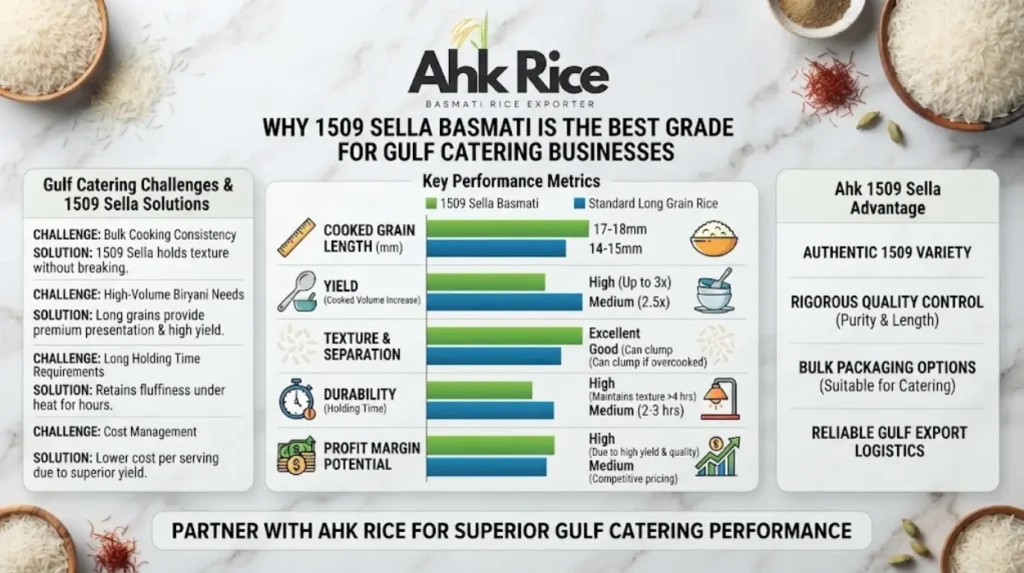
Golden Sella and Creamy Sella suit Gulf catering operations requiring strong grain integrity, extended storage, and reliable performance during large-volume preparation and service.
Gulf catering includes restaurants, hotels, banquet operators, wedding caterers, and institutional kitchens. Saudi Arabia, the UAE, Qatar, Kuwait, and Oman maintain strong foodservice demand for long-grain aromatic rice. Catering kitchens often prepare rice in large batches.
Golden Sella suits long holding periods. Its parboiled structure supports firm grains during bulk cooking and serving. The golden appearance also matches dishes such as biryani, mandi, and pulao.
Creamy Sella provides a lighter appearance. The grade fits catering menus that require parboiled cooking performance without a strong golden colour.
Steam 1509 remains useful for Gulf kitchens that prioritize a white appearance and fresh service. The grade provides long grains and firm cooking performance while avoiding the golden appearance of Sella.
Gulf price and shelf-life comparison
Current export references place 1509 Steam around US$900–US$1,300 per MT FOB, depending on supplier, specification, quantity, and contract terms. A current Pakistan listing places standard 1509 around US$900–US$1,100 per MT FOB. (source: EximNext supplier listings, September 2026)
Golden Sella generally carries a processing premium over basic White rice. The premium reflects parboiling, drying, handling, grading, and stronger commercial specifications.
Golden Sella also provides longer storage flexibility. AHK Rice’s Gulf-focused specification guidance gives Golden Sella approximately 18–24 months shelf life and Steam approximately 12–15 months under controlled storage conditions.
Gulf buyers should therefore compare total foodservice cost rather than purchase price alone. A lower FOB price can lose its advantage through higher breakage, shorter storage flexibility, or inconsistent cooking.
With Gulf requirements established, the next comparison moves to Southeast Asian catering operations.
Which 1509 grade works best for Southeast Asian catering?
Steam 1509 fits Southeast Asian catering businesses seeking white long grains, efficient cooking, moderate aroma, and competitive procurement for restaurants and foodservice distribution.
Indonesia provides a useful example because foodservice operators use Basmati for restaurants, hotels, catering companies, biryani kitchens, and foodservice distribution. Pakistan 1509 combines long grain appearance with commercial cooking performance.
Steam 1509 works well for fresh restaurant service. The white appearance supports plated rice dishes and biryani presentation. Steam processing also improves grain strength during commercial cooking.
Sella grades suit larger catering contracts. Parboiling creates stronger grain structure and supports repeated bulk preparation. Golden Sella fits buyers seeking stronger storage performance and a distinctive golden appearance.
Southeast Asian price and shelf-life comparison
Current 2026 FOB references place 1509 Steam around US$926–US$955 per MT in Indian export listings. Golden Sella references range around US$916–US$995 per MT, depending on supplier and market specification. (source: current 2026 Indian export price listings)
Pakistan-origin offers require separate comparison because origin, milling specification, packaging, freight, and destination costs change the final price. A buyer should compare the same grain length, broken percentage, moisture, packing, Incoterm, and quantity.
Steam provides approximately 12–15 months of shelf-life guidance under controlled storage. Golden Sella provides approximately 18–24 months under controlled storage. These figures make Sella more suitable for distributors holding larger inventories.
Southeast Asian catering buyers should therefore connect grade selection to inventory turnover. High-frequency kitchens can prioritize Steam. Distributors and large catering networks can prioritize Sella.
What are the pros and cons of each 1509 catering grade?
Steam offers white appearance and efficient bulk cooking, while Golden Sella offers stronger grain resilience and storage flexibility; White costs less processing but requires tighter kitchen control.
1509 White
White 1509 provides a clean appearance and natural rice profile. The main advantage is straightforward preparation without parboiling.
The limitation is lower structural resilience than Steam or Sella. Large kitchens must maintain consistent cooking conditions to reduce breakage and clumping.
1509 Steam
Steam 1509 combines long grain presentation, firm texture, and commercial efficiency. Its white appearance fits restaurants and catering menus.
The limitation is shorter storage flexibility than Sella. Steam also requires careful moisture control throughout procurement and storage.
1509 Golden Sella
Golden Sella provides strong grain integrity and extended storage flexibility. Its structure suits large pots, banquet preparation, and longer holding periods.
The limitation is its golden appearance. Some restaurant concepts require a white rice appearance, making Creamy Sella or Steam more suitable.
1509 Creamy Sella
Creamy Sella combines parboiled strength with a lighter appearance. It works well for catering menus requiring firm grains without a pronounced golden colour.
The limitation is processing cost. Buyers should compare its final cooking yield against Steam before selecting it for high-volume contracts.
Pros and cons become meaningful only against operating requirements. The next framework converts those requirements into a procurement decision.
What factors should catering businesses use to choose 1509 rice?
Catering businesses should evaluate cooking volume, holding time, appearance, storage duration, and delivered cost before selecting a 1509 processing grade.
| Decision factor | Steam 1509 | Golden Sella 1509 | Creamy Sella 1509 | White 1509 |
|---|---|---|---|---|
| Fresh daily cooking | Strong fit | Strong fit | Strong fit | Strong fit |
| Extended holding | Strong | Very strong | Very strong | Moderate |
| Long inventory cycles | Moderate | Very strong | Very strong | Moderate |
| White presentation | Very strong | Moderate | Strong | Very strong |
| Cost-focused catering | Strong | Strong | Moderate | Strong |
Cooking volume should come first. A catering company serving hundreds of portions needs predictable cooking behavior across every batch.
Holding time should come next. Banquet and event kitchens often cook before peak service. Sella grades provide stronger grain resilience during this operating cycle.
Appearance remains important for customer-facing dishes. Steam and White provide the cleanest white appearance. Creamy Sella provides a lighter parboiled appearance. Golden Sella provides the most distinctive colour.
Storage duration affects procurement strategy. Golden Sella provides greater storage flexibility than Steam under controlled conditions. This matters for importers, distributors, and catering groups maintaining larger stocks.
Delivered cost provides the final commercial comparison. Buyers should compare FOB or CIF prices against the same specifications. Packaging, freight, inspection, customs, and destination handling can materially change the final landed cost.
A specification-based procurement process therefore produces a better comparison than a grade name alone. With the decision factors established, the final recommendation can be matched to each catering model.
Which 1509 grade should different catering businesses choose?
Restaurants should generally consider Steam, high-volume caterers should consider Golden Sella, and institutional kitchens should compare Golden Sella with Creamy Sella against storage and appearance requirements.
Restaurants benefit from Steam 1509 when fresh cooking and white presentation dominate the menu. The grade supports biryani, pulao, rice bowls, and other long-grain dishes.
Wedding caterers benefit from Golden Sella when large batches require strong grain integrity. The grade supports bulk cooking, holding, transportation, and service.
Hotels can compare Steam and Creamy Sella. Steam supports white presentation. Creamy Sella supports parboiled performance with a lighter appearance.
Institutional kitchens can compare Golden Sella and Creamy Sella. These grades provide stronger structural performance for repeated large-volume preparation.
Foodservice distributors should prioritize specification consistency. A repeatable grain length, broken percentage, moisture level, packaging format, and processing method makes procurement easier across multiple customers.
The practical choice is therefore application-specific. Steam fits fresh high-volume cooking. Golden Sella fits extended holding and storage. Creamy Sella fits parboiled performance with lighter colour. White fits fresh service with tighter cooking control.
What should buyers check before ordering 1509 Basmati?
Buyers should approve grain length, broken percentage, moisture, cooking performance, packaging, inspection requirements, and commercial terms before confirming a bulk 1509 order.
Sample approval should use the same specification planned for the commercial shipment. The sample should be cooked using the buyer’s normal kitchen method. Grain separation, elongation, aroma, texture, breakage, and cooked yield should be recorded.
Specification approval should cover raw grain length and broken percentage. Moisture should also be documented through the supplier’s certificate of analysis.
Packaging should match storage and distribution requirements. Catering buyers can select bulk PP bags or customized formats according to their supply chain.
Inspection should verify the agreed specification before loading. Export documentation should include the required commercial, phytosanitary, fumigation, origin, and shipping documents.
AHK Rice supports sourcing, processing, grading, sorting, custom packaging, export documentation, and container loading from Pakistan. The export service also supports FOB shipping and destination-specific requirements.
For buyers moving from comparison to physical verification, the next step is a representative sample of the selected 1509 grade.
What is the final decision for catering businesses?
1509 Steam is the practical choice for fresh high-volume catering, while Golden Sella is stronger for long holding, larger inventories, and demanding bulk-service conditions.
Steam provides the strongest combination of white appearance, grain length, cooking performance, and commercial efficiency. It fits restaurants and catering businesses with rapid kitchen turnover.
Golden Sella provides stronger grain structure and storage flexibility. It fits wedding caterers, banquet kitchens, distributors, and institutional operations requiring longer holding periods.
Creamy Sella provides a middle position. It combines parboiled cooking performance with a lighter appearance.
White 1509 remains suitable for fresh-service restaurants that prioritize a natural white appearance and controlled cooking. Brown 1509 serves specialty menus rather than conventional high-volume catering.
The correct grade should therefore match the kitchen’s cooking cycle, holding period, visual requirement, storage duration, and landed cost. Buyers should approve a physical sample before committing to container volume.
FAQs About 1509 Rice for Catering Businesses
Which 1509 Basmati rice grade is best for catering?
1509 Steam is a strong choice for fresh high-volume catering, while Golden Sella suits operations requiring longer holding and storage. Steam provides a white appearance and firm cooking performance. Golden Sella provides greater grain resilience during bulk cooking and service.
Is 1509 Steam rice good for restaurants?
Yes, 1509 Steam suits restaurants that prioritize long white grains, fresh cooking, and consistent presentation. Steam treatment strengthens the grain before milling. The grade works well for biryani, pulao, steamed rice, and other restaurant dishes.
Is Golden Sella 1509 good for large catering orders?
Yes, Golden Sella 1509 suits large catering orders because parboiling strengthens the grain structure for bulk cooking and holding. The grade works particularly well for wedding catering, banquet kitchens, institutional foodservice, and large-volume meal preparation.
What is the difference between 1509 Steam and 1509 Golden Sella?
1509 Steam has a white or creamy appearance, while Golden Sella has a golden appearance and stronger parboiled grain structure. Steam suits fresh service. Golden Sella suits bulk preparation, extended holding, and longer inventory cycles.
What is the grain length of 1509 Basmati rice?
1509 Basmati commonly measures around 8.10–8.50 mm before cooking, depending on the agreed commercial specification. Grain length should be confirmed through the supplier’s specification sheet and approved physical sample before bulk procurement.
Which 1509 grade is best for biryani catering?
1509 Steam and Golden Sella both suit biryani catering, with the choice depending on appearance, holding time, and cooking requirements. Steam provides a white presentation. Golden Sella provides stronger grain integrity for large batches and extended service.
Does 1509 Basmati rice have good cooking yield?
Yes, 1509 Basmati provides commercial cooking yield and long-grain presentation, making it suitable for high-volume foodservice. Actual cooked yield depends on moisture, milling quality, soaking, water ratio, cooking method, and the approved grain specification.
How long can 1509 Basmati rice be stored?
Controlled storage can support approximately 12–15 months for Steam and 18–24 months for Golden Sella under the specifications used in this article. Buyers should maintain dry, clean, temperature-controlled storage and follow the supplier’s stated shelf-life requirements.
Is 1509 White suitable for catering?
1509 White suits fresh-service catering where clean white appearance and immediate consumption are priorities. The grade does not receive the same parboiling treatment as Sella. Large kitchens therefore need consistent water ratios, cooking temperatures, and handling.