Is Halal Certification Required for Rice Imported into the UAE?
Halal certification for rice imported into the UAE depends on the product, its processing, its labelling claims, and the applicable import requirements. Plain, unprocessed rice is plant-based, so it does not carry the same slaughter-certification requirements as meat. However, importers must verify whether halal certification applies to their specific product and commercial arrangement.
Rice importers must distinguish halal compliance from general food-import compliance. The UAE has a halal product control framework under Cabinet Resolution No. 10 of 2014, administered through the Ministry of Industry and Advanced Technology (MoIAT). The government also maintains requirements for food registration, safety, labelling, and import documentation.
What Is Halal Certification for Rice Imported into the UAE?
Halal certification confirms that a product and its relevant production processes meet applicable Islamic dietary requirements. For plain rice, the main checks concern ingredients, processing aids, handling, storage, and packaging, alongside any certification requirements arising from product claims or buyer specifications.
Halal means permissible under Islamic law. A halal certificate is a document issued by an authorised certification body after assessing a product against the relevant halal standards. In the UAE, MoIAT registers halal certification bodies and oversees the national halal framework.
Rice is a plant-based agricultural product. Natural rice grains do not involve animal slaughter. This makes their halal assessment different from the assessment of meat, poultry, gelatine, and other animal-derived ingredients.
The distinction becomes important when rice undergoes additional processing. Plain white rice, steamed Basmati rice, parboiled rice, and flavoured rice have different processing profiles. A flavoured rice product containing animal-derived flavourings or processing ingredients requires a different assessment from a bag of plain rice.
A halal certificate also differs from a food-safety certificate. Halal certification addresses religious permissibility, while food-safety controls address hygiene, contamination, and suitability for consumption.
Is Halal Certification Legally Mandatory for Every Rice Shipment Entering the UAE?
A halal certificate is not listed as a universal standard customs document for every plain rice shipment. UAE requirements depend on the product category and applicable controls, while halal claims, processing ingredients, and buyer contracts can create additional certification obligations.
The UAE government identifies commercial invoices, certificates of origin, packing lists, transport documents, and relevant food-health certificates among import documentation requirements. Its published general import guidance specifically identifies halal slaughter certificates for meat and poultry, rather than establishing a universal slaughter-certificate requirement for plain rice.
This distinction does not mean rice exporters can ignore halal regulations. MoIAT states that establishments must obtain halal certificates for covered final products and production raw materials from certification bodies registered with the ministry. The applicable product scope must therefore be checked before shipment.
UAE importers should confirm three points before placing an order:
- Whether the exact rice product falls within an applicable halal certification requirement.
- Whether the product label or marketing materials make a halal claim.
- Whether the importer, distributor, retailer, or foodservice customer requires a valid halal certificate.
The importer should also confirm documentation and registration requirements with the relevant emirate’s food-control authority or customs channel. This prevents a buyer from treating a general rule as sufficient proof for a specific consignment.
How Does Halal Compliance Work for Pakistani Basmati Rice Exports?
Halal compliance starts with identifying the rice product, reviewing ingredients and processing, checking handling controls, and confirming certification requirements. The exporter and UAE importer then align the product specification, supporting documents, packaging claims, and shipment records before dispatch.
Pakistani Basmati rice is grown mainly in Punjab, where suitable growing conditions support recognised aromatic varieties. Export products include 1121 Basmati, Super Kernel Basmati, and 1509 Basmati. These varieties differ in grain characteristics, cooking performance, processing options, and commercial positioning.
The export process generally follows these steps:
1. Identify the product and grade
The buyer defines the rice variety, processing type, grain length, broken-grain percentage, moisture limit, and required packaging. For example, a 1121 Steam order and a Super Kernel White order need separate specifications because their grain characteristics and processing methods differ.
2. Review ingredients and processing
The exporter identifies whether the product contains only rice or includes added ingredients. Plain rice undergoes cleaning and milling. Depending on the grade, processing also includes husking, polishing, colour sorting, and grading. Parboiled rice receives a hydrothermal treatment before drying and milling.
3. Check halal certification requirements
The exporter and importer establish whether the product needs a halal certificate under the applicable UAE framework or a buyer’s contract. When certification is required, they verify that the issuing body is registered and that the certificate covers the product and relevant facility.
4. Verify food safety and quality
The exporter arranges the required quality checks and supporting records. Depending on the contract and destination requirements, these include laboratory reports, inspection records, a certificate of analysis (COA), and a government-issued health or phytosanitary certificate where applicable.
5. Approve packaging and dispatch documents
The parties confirm the product label, net weight, lot identification, country of origin, and other applicable declarations. The exporter prepares the commercial invoice, packing list, certificate of origin, and transport documents before shipment.
Halal verification forms one part of this workflow. It does not replace product-quality checks, food registration, or customs documentation.
Which Components Determine Halal Compliance for Rice?
Rice halal compliance depends on ingredients, processing aids, equipment hygiene, storage, packaging, traceability, and valid certification where required. These components establish whether the finished product meets the relevant halal standard and whether its claims match the evidence supplied.
The main components are:
| Component | What the importer checks |
|---|---|
| Ingredients | Plain rice or additional flavourings and ingredients |
| Processing | Cleaning, milling, polishing, steaming, or parboiling |
| Equipment | Hygiene and controls against contamination |
| Storage | Separation from unsuitable materials and clean storage conditions |
| Packaging | Suitable materials and accurate product declarations |
| Traceability | Lot numbers, facility details, and supporting records |
| Certification | Issuer recognition, product scope, validity, and certificate details |
UAE halal standards include UAE.S 2055-1 for general halal food requirements and UAE.S 2055-2 for halal certification bodies. The relevant standard and certification route depend on the product and certification arrangement.
Importers should examine a certificate’s issuer, number, validity period, product description, and covered facility. A certificate for one product does not automatically establish coverage for every product manufactured at the same site.
What Are the Benefits of Halal Certification for Rice Importers?
Appropriate halal certification gives importers documented evidence for applicable halal claims and buyer requirements. It supports supplier verification, purchasing decisions, and traceability, while food-safety records and product specifications provide separate evidence of quality, hygiene, and shipment conformity.
The principal benefit is clearer documentation. Importers can evaluate whether the supplier has addressed the relevant halal requirements instead of relying on a verbal assurance.
Certification also helps buyers manage private-label and retail requirements. A supermarket chain, food distributor, or institutional caterer can include halal documentation in its supplier approval process. The buyer can then compare suppliers against a consistent checklist.
Another benefit is improved traceability. Product and facility details help connect the certificate with the relevant production and shipment records. This becomes particularly important when an importer handles several rice varieties or different processing categories.
Certification alone does not prove that rice meets every commercial specification. Buyers still need to assess grain length, broken percentage, moisture, purity, cooking performance, packaging integrity, and agreed delivery terms. A valid halal certificate cannot replace these checks.
Which Pakistani Rice Varieties and Processing Grades Need Different Checks?
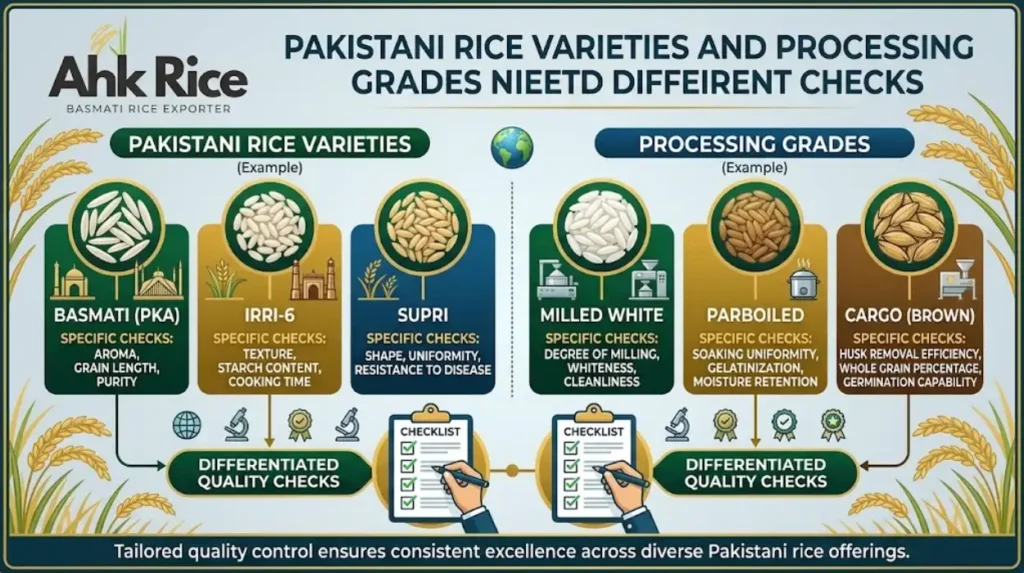
Pakistani rice varieties share the same basic plant origin, but their processing methods, ingredients, packaging, and buyer requirements determine the appropriate compliance checks. Plain 1121, Super Kernel, and 1509 rice need product-specific documentation rather than assumptions based on variety names.
1121 Basmati
1121 is known for its long grains and pronounced cooked elongation. Export grades include White, Steam, Golden Sella, Creamy Sella, Brown, and broken rice. The processing route and final product description should match the order documents.
Super Kernel Basmati
Super Kernel is a traditional aromatic Pakistani Basmati variety. Buyers commonly assess grain length, aroma, purity, moisture, and broken percentage. For plain Super Kernel rice, the central halal question concerns the applicable product and certification scope rather than the variety name alone.
1509 Basmati
1509 is valued for its grain length, cooking performance, and commercial efficiency. Export options include White, Steam, and other agreed processing grades. Buyers should check the exact grade, ingredients, handling, and label declarations.
A useful starting point is the product specification. The next step is understanding how halal certification works for Pakistani Basmati rice exports to the GCC, including the relationship between certification bodies, shipment records, and buyer requirements.
Which UAE Rice Import Documents Should Buyers Check?
UAE rice importers should verify the commercial invoice, packing list, certificate of origin, transport document, applicable health documentation, product registration, and any required halal certificate. The final checklist depends on the product, importing emirate, shipment route, and buyer contract.
The commercial invoice identifies the goods, quantity, and value. The packing list records package counts and weights. The certificate of origin identifies where the rice originates, while the bill of lading records sea transport.
Food consignments also require applicable health and safety documentation. Plant-health documents depend on the product and relevant import controls. The importer must confirm whether a phytosanitary certificate or other permit applies to the particular shipment.
The UAE’s National Food Accreditation and Registration System guidance states that imported food products must be registered in the relevant electronic system before being handled in the market. Importers should confirm current registration procedures and local authority requirements before dispatch.
For halal documentation, buyers should verify the certificate against the actual product and the registered status of the issuing body. They should not accept an unrelated certificate simply because it carries a halal logo.
What Common Misconceptions Cause Problems With UAE Rice Imports?
The main mistakes are assuming every rice shipment needs the same halal certificate, treating a halal logo as sufficient evidence, and confusing halal compliance with food safety. Importers avoid these problems by checking product scope, legal requirements, and documentation before shipment.
One misconception is that every food product requires identical halal documentation. Plain rice differs from meat and processed foods containing animal-derived ingredients. The applicable rules must be assessed against the product rather than generalised across all foods.
A second mistake is assuming that a halal claim automatically proves certification validity. Buyers must verify the issuer, scope, expiry date, and relevant product details.
A third mistake is treating a halal certificate as a substitute for a health certificate, food registration, or quality report. These documents serve different purposes and address different requirements.
The final problem is checking compliance only after cargo dispatch. Early verification allows the exporter and importer to correct labels, obtain missing documents, and align the order specification before shipment. The buyer should obtain written confirmation of any special certification requirements before approving the final documents.
Frequently Asked Questions
Is halal certification compulsory for plain Basmati rice imported into the UAE?
A halal certificate is not identified as a universal customs document for every plain rice shipment. Importers must verify the applicable product rules, labelling claims, and contractual requirements before shipping.
Does Pakistani Basmati rice qualify as halal?
Plain Pakistani Basmati rice is plant-based and contains no animal ingredients by nature. Any additional ingredients, processing aids, or handling practices require assessment when relevant to halal compliance.
Who issues halal certificates accepted in the UAE?
MoIAT registers halal certification bodies under the UAE halal framework. Importers should verify the issuing body’s current registration, certification scope, and validity before accepting its certificate.
Does a halal certificate replace a phytosanitary certificate?
No. A halal certificate addresses halal compliance, while a phytosanitary certificate addresses applicable plant-health requirements. Importers must establish which documents apply to their rice shipment.
Do 1121, Super Kernel, and 1509 rice require separate halal certificates?
Not automatically. Certification depends on the applicable requirements and the certificate’s scope. Buyers should confirm that the documentation covers the relevant variety, processing grade, product, and facility.