ISO 22000, HACCP, BRCGS and FSSC 22000 Explained for UAE Rice Importers
UAE rice importers should select suppliers by matching the certification system to their food safety risks, customer requirements and import compliance obligations: HACCP establishes hazard controls, ISO 22000 structures food safety management, BRCGS provides a detailed site standard, and FSSC 22000 offers a GFSI-recognised certification scheme.
For buyers evaluating Pakistani Basmati rice, certification is one part of supplier qualification. Understanding which certifications a Pakistani Basmati rice exporter should have helps importers assess factory controls, documentation, traceability and the suitability of each supplier before placing a commercial order.
What are ISO 22000, HACCP, BRCGS and FSSC 22000?
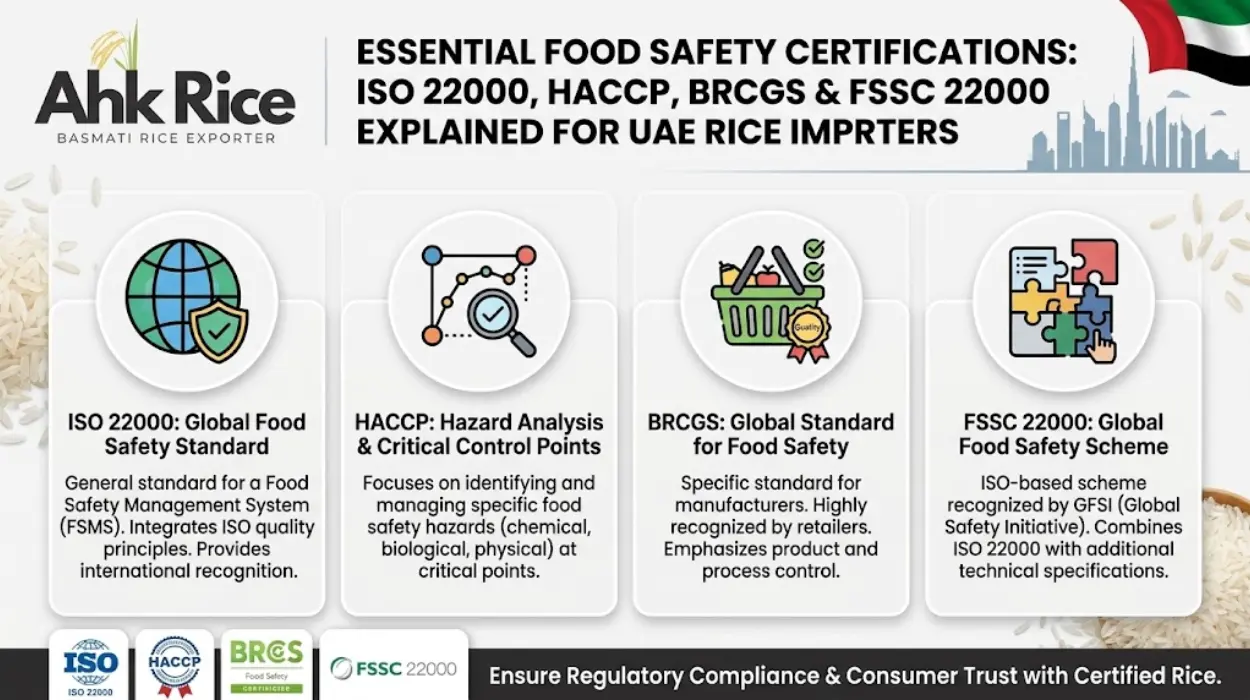
ISO 22000 is an international food safety management system standard, HACCP is a hazard-control methodology, BRCGS is a food safety and quality standard, and FSSC 22000 is a certification scheme built around ISO 22000 and additional requirements. Each addresses food safety differently, so importers must compare their purpose and scope.
ISO 22000 specifies requirements for a food safety management system. It combines communication, management responsibility, prerequisite programmes and hazard analysis to control food safety risks throughout the food chain.
HACCP, meaning Hazard Analysis and Critical Control Points, identifies biological, chemical and physical hazards. A facility evaluates where hazards arise, establishes control measures, monitors critical control points where applicable, and maintains corrective-action records. HACCP principles form part of ISO 22000, but a HACCP certificate and an ISO 22000 certificate are not interchangeable.
BRCGS, originally associated with the British Retail Consortium, provides standards used across food manufacturing and supply chains. Its Global Standard for Food Safety covers areas such as management commitment, hazard analysis, site standards, product control, process control and traceability. Retailers and food brands often specify BRCGS certification during supplier approval.
FSSC 22000, or Food Safety System Certification 22000, is a certification scheme that combines ISO 22000 with applicable sector-specific prerequisite programme requirements and additional scheme requirements. It is recognised by the Global Food Safety Initiative (GFSI), making it relevant to buyers whose procurement policies require GFSI-recognised certification.
What food safety risks must UAE rice importers evaluate?
UAE importers must assess hazards associated with rice cultivation, handling, milling, storage, packaging and transportation. Certification supports preventive controls, while laboratory testing, shipment documentation and destination-specific checks establish whether a particular consignment meets its requirements.
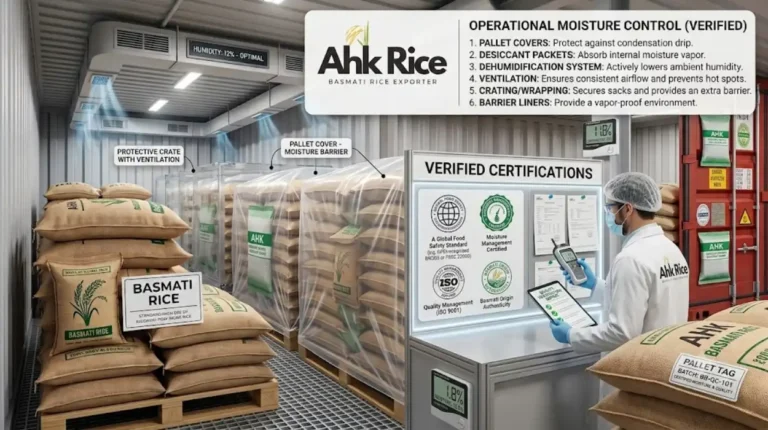
Rice is a dry agricultural product, but its supply chain still presents food safety risks. Potential hazards include pesticide residues, heavy metals, foreign materials, pest infestation, contamination during handling and mould growth associated with unsuitable moisture or storage conditions. Mycotoxins, including aflatoxins, require risk-based consideration where relevant to the product and applicable controls.
The milling process introduces additional control points. Paddy cleaning, dehusking, whitening, polishing, grading, sorting and packing require documented procedures. Equipment maintenance, sanitation, pest management and personnel hygiene help prevent contamination. Optical sorting and physical inspection support foreign-material control, but neither replaces a complete hazard-control programme.
Importers must also check the requirements applicable to their product, packaging, origin and intended use under UAE food control arrangements. Product registration, label information, import permits where applicable, health or phytosanitary documentation, certificates of origin and laboratory reports depend on the consignment and current rules. A factory certificate does not automatically satisfy every border or municipal requirement.
For example, a shipment of 1121 Basmati rice can originate from a certified facility and still require product-specific evidence covering its agreed specifications, residues or other applicable parameters. Buyers should review the certificate alongside the commercial specification, certificate of analysis (COA), lot identification and shipping documents.
How do the four food safety approaches compare?
HACCP focuses on identifying and controlling hazards, ISO 22000 provides a management system, BRCGS applies detailed site-level food safety and quality requirements, and FSSC 22000 adds scheme requirements to an ISO-based system. The correct comparison depends on buyer policies, audit expectations and supply-chain complexity.
| Comparison attribute | HACCP | ISO 22000 | BRCGS Food Safety | FSSC 22000 |
|---|---|---|---|---|
| Primary purpose | Identify and control food safety hazards | Establish a food safety management system | Apply detailed food safety and quality requirements at a site | Certify a food safety management system against scheme requirements |
| Main structure | Hazard analysis and control principles | Management system and HACCP-based controls | Prescriptive standard with site and operational requirements | ISO 22000, sector-specific prerequisite programmes and additional requirements |
| Scope | Hazard controls within the defined operation | Organisations across the food chain | Applicable food manufacturing and processing sites | Eligible food-chain organisations within scheme scope |
| Audit approach | Depends on the certification or verification programme | Audit against ISO 22000 requirements | Audit against the applicable BRCGS issue and grading rules | Audit against current FSSC scheme requirements |
| Buyer recognition | Depends on buyer policy and verification | Broad international management-system relevance | Strong relevance where retailers and food brands require BRCGS | GFSI-recognised scheme relevant to many international procurement programmes |
| Main advantage | Clear focus on food safety hazards | Integrates hazards with management and communication | Detailed operational expectations and site assessment | Combines ISO-based management with scheme-specific requirements |
| Main limitation | Does not automatically provide a complete certified management system | May not meet a buyer’s separate BRCGS or GFSI-recognition requirement | Requires substantial site-level implementation and audit readiness | Requires compliance with additional scheme and sector requirements |
Certification scope matters as much as the certificate name. Importers should confirm the legal entity, manufacturing site, product category, standard version, certification body, issue date and expiry date. They should also verify the certificate directly through the issuing body or the relevant official directory where available.
Which certification works best for different UAE rice importers?
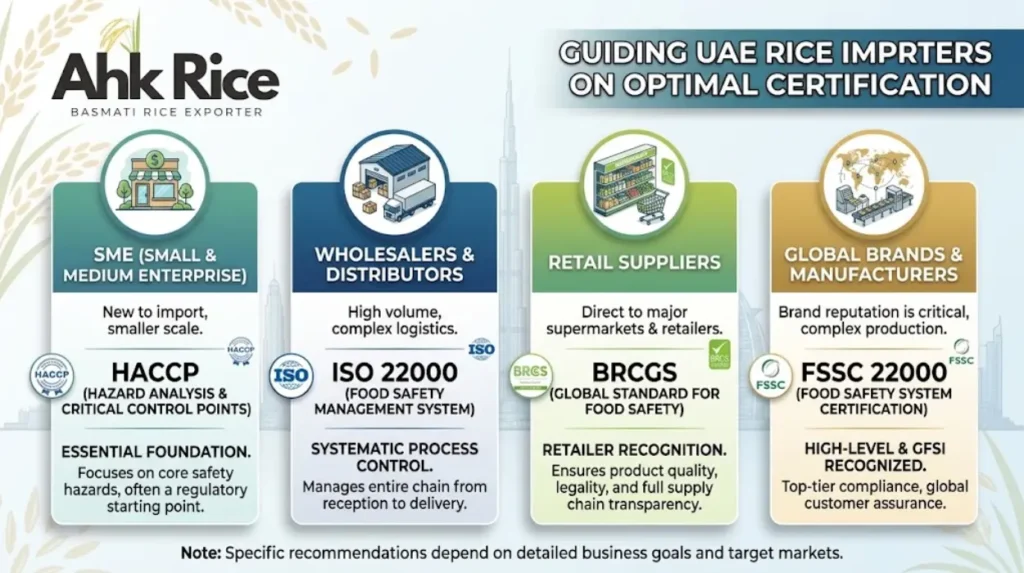
HACCP can suit buyers prioritising documented hazard controls, ISO 22000 suits organisations seeking a structured food safety management system, BRCGS suits supply chains that specify its site standard, and FSSC 22000 suits buyers requiring an eligible GFSI-recognised scheme. Procurement requirements determine the preferred option.
Small and medium-sized rice distributors often start by evaluating HACCP-based controls, hygiene practices and credible supplier documentation. This approach gives buyers a practical foundation for assessing milling, storage, pest prevention and packaging risks. However, a basic HACCP programme does not fulfil a contract that explicitly requires a certified ISO 22000, BRCGS or FSSC 22000 site.
Importers supplying supermarkets, large retailers or established private-label brands should prioritise the certification named in the customer’s supplier approval policy. A retailer may require BRCGS or accept another GFSI-recognised certification scheme. Buyers must obtain written confirmation instead of assuming that all certificates provide equivalent acceptance.
Foodservice distributors and wholesalers need a broader evaluation. Their priorities often include consistent cooking performance, reliable deliveries, suitable packaging and traceable lots alongside food safety. ISO 22000 or FSSC 22000 can support systematic controls, while the importer’s own quality assurance team verifies the commercial specifications and intended-use requirements.
For UAE importers serving multiple customer segments, a supplier holding a recognised certification that meets the strictest applicable customer requirement can simplify supplier approval. The buyer must still check the certificate’s scope and the requirements of each customer, product and shipment.
What are the advantages and disadvantages of each approach?
Each approach provides value when its controls match the buyer’s risks and procurement rules. HACCP offers focused hazard management, ISO 22000 integrates management processes, BRCGS provides detailed site requirements, and FSSC 22000 supports GFSI-oriented procurement. Their limitations concern scope, implementation effort and acceptance by individual customers.
HACCP’s main advantage is its practical focus on identifying hazards and establishing controls. A rice mill can use it to document risks during cleaning, milling, grading, storage and packing. Its limitation is that the term alone does not prove independent certification or satisfy a customer’s broader management-system requirements.
ISO 22000 integrates hazard controls with management responsibilities, documented processes and continual improvement. It helps a supplier maintain a consistent system across operations. However, a buyer that requires a specific GFSI-recognised certification or BRCGS audit cannot assume ISO 22000 alone meets that condition.
BRCGS offers detailed requirements and a site-focused audit model that can support retailer approval. It also requires strong implementation, records, staff training and audit preparation. A certificate remains limited to its defined site, scope and validity; it does not guarantee that every shipment is defect-free.
FSSC 22000 combines an ISO-based system with additional scheme requirements and has GFSI recognition. It suits procurement programmes that accept the scheme. Its implementation and audit demands require ongoing resources, and it does not automatically replace customer-specific requirements, product testing or UAE import documentation.
Consider a UAE wholesaler sourcing Super Kernel Basmati for ethnic grocery stores. A valid certification helps assess the exporter’s systems, while a pre-shipment COA, approved packaging artwork, agreed broken-grain percentage and lot traceability help evaluate the actual order. These controls answer different questions and should work together.
How should importers compare rice suppliers in different market regions?
UAE buyers should evaluate certification against the requirements of their sales channel, whether they supply domestic retail, foodservice, wholesale distribution or re-export customers. Price, shelf life and grade suitability must be assessed separately from certification because none is established by a food safety certificate alone.
In the UAE and wider GCC market, distributors serving supermarkets and established food brands should confirm whether customers require BRCGS, FSSC 22000 or another accepted certification. Foodservice and wholesale buyers should also assess bulk handling, cooking performance, packaging strength and traceability. Heat and humidity make moisture control, warehouse conditions and pest prevention important operational considerations.
For the UK and wider European retail market, importers often face demanding retailer specifications, supplier approval procedures and destination-specific food law requirements. BRCGS can be particularly relevant when a retailer specifies it, while FSSC 22000 may fit procurement policies accepting GFSI-recognised schemes. Acceptance must be confirmed with the individual buyer rather than inferred from geography.
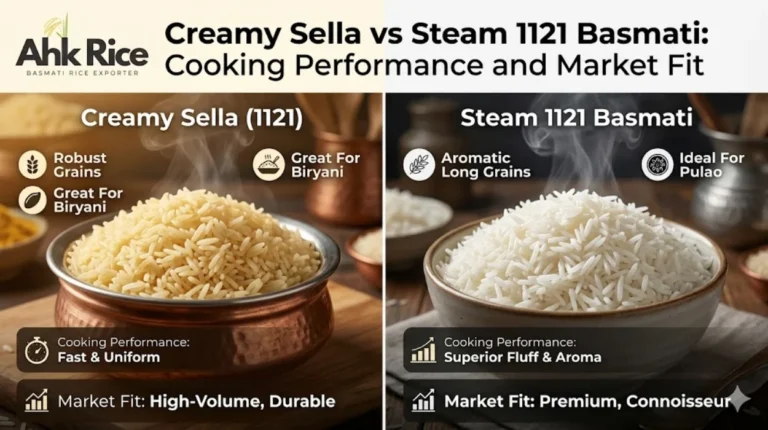
Price comparisons should use matching specifications and commercial terms. A quotation for 1121 Steam Basmati cannot be compared fairly with Super Kernel Raw or 1509 Golden Sella without accounting for processing, grain dimensions, broken percentage, packaging, order volume and Incoterms. Certification and testing costs can affect supplier overheads, but no universal certification-based price premium applies.
Shelf life also depends on product condition, moisture, packaging, storage temperature, humidity, pests and the manufacturer’s validated date marking. Importers should request the supplier’s declared shelf life and storage instructions, then confirm that the remaining shelf life meets the destination and customer requirements. Certification alone does not establish a specific number of months.
What decision factors should buyers use before approving a supplier?
Importers should assess certification validity, site scope, product specifications, testing evidence and shipment controls together. A five-factor evaluation framework helps purchasing teams compare suppliers consistently, identify missing documentation and approve only those arrangements that satisfy their commercial and regulatory requirements.
| Decision factor | What the importer should verify | Evidence to request |
|---|---|---|
| Certification validity | Standard, issuing body, site, scope and expiry date | Verifiable certificate and current audit status |
| Product specifications | Variety, grain length, broken percentage, moisture and purity | Signed specification sheet and representative sample |
| Food safety evidence | Applicable microbiological, chemical or contaminant requirements | Relevant laboratory reports and shipment COA |
| Traceability and corrective action | Lot identification, recall procedure, complaint handling and records | Traceability documentation and corrective-action procedure |
| Commercial and logistics readiness | Packing, quantity, lead time, Incoterms and destination documentation | Pro forma invoice, packing details and agreed shipping documents |
A useful approval process begins with a supplier questionnaire and certificate verification. The importer then reviews the specification sheet, requests a representative sample, evaluates cooking performance where relevant and confirms testing requirements. Before shipment, both parties agree on the final specification, packing, inspection arrangements, COA and documentary responsibilities.
Buyers should record unresolved issues before issuing a purchase order. A certificate with an expired date, an incorrect site scope or a product category outside its coverage requires clarification. The importer should also establish how specification deviations are handled, including notification, corrective action and agreed remedies.
How can AHK Rice support supplier evaluation for UAE imports?
AHK Rice is a Pakistani Basmati rice exporter based in Punjab, supplying 1121, Super Kernel and 1509 varieties to international markets. UAE buyers can evaluate its product specifications, processing arrangements, packaging options and export documentation against their own supplier approval criteria before confirming an order.
Supplier assessment should start with the required variety and grade. Buyers can specify raw or parboiled rice, grain dimensions, broken percentage, moisture limits, packing format and order quantity. The supplier and importer should then agree on sample approval, relevant food safety documentation, inspection requirements and the final COA before shipment.
AHK Rice’s end-to-end processing, custom packaging and export coordination provide a basis for discussing these requirements across the sourcing and shipment workflow. Buyers should request the current certificates applicable to the actual processing site and product, verify their scope and validity, and confirm the documents available for the destination market. Certification claims should be supported by verifiable records rather than assumptions.
The commercial decision should consider the complete order: product suitability, food safety evidence, approved specifications, packaging, price, lead time and shipping terms. This approach helps UAE importers distinguish between a supplier that has a certificate and a supplier whose documented controls and commercial capabilities meet the specific purchase requirements.
Frequently Asked Questions
Is HACCP the same as ISO 22000?
No. HACCP is a methodology for identifying and controlling food safety hazards. ISO 22000 is a food safety management system standard that incorporates HACCP-based principles alongside management responsibilities, communication and prerequisite programmes.
Is FSSC 22000 better than BRCGS for rice exporters?
Neither is universally better. FSSC 22000 suits buyers whose procurement policies accept that GFSI-recognised scheme. BRCGS suits buyers who specifically require its Food Safety Standard. The importer should confirm the applicable customer requirement before approving the supplier.
Do UAE rice importers need a certified supplier?
The applicable legal requirements and individual buyer policies determine the required certification. A certificate supports supplier qualification, but it does not replace mandatory import documentation, product testing or compliance with the rules applicable to the consignment.
Does ISO 22000 certification guarantee rice quality?
No. ISO 22000 concerns food safety management. Grain length, broken percentage, aroma, appearance, cooking performance and other commercial quality attributes require separate specifications, inspections and appropriate testing.
What documents should buyers request from a Pakistani rice exporter?
Buyers should request the applicable valid certificate, product specification sheet, sample details, relevant laboratory reports, COA, lot traceability information, packaging details and shipment documents. The exact list depends on the product, destination requirements and purchase contract.
How should importers verify a food safety certificate?
Check the certificate number, issuing certification body, certified legal entity, processing site, standard, scope, issue date and expiry date. Verify the record through the certification body or official directory where available, and resolve any mismatch before placing the order.