LC at Sight vs TT Advance vs CAD: Payment Options for UAE Rice Importers
UAE rice importers should choose LC at sight for structured transactions requiring bank-controlled document handling, TT advance for trusted suppliers and smaller orders, and CAD for buyers seeking document control without a full letter of credit. The best option depends on supplier history, order value, cash flow, banking costs, and shipment documentation.
Payment terms determine when an importer pays, which documents control cargo release, and how much risk each party accepts. Before purchasing Pakistani Basmati rice, buyers need to understand the differences between a letter of credit at sight, telegraphic transfer in advance, and cash against documents. This educational guide to Pakistani rice imports and sourcing provides additional context for evaluating suppliers, grades, and export procedures.
For UAE wholesalers, supermarket distributors, foodservice suppliers, and private-label brands, the payment decision must match the shipment specifications. A competitive price per metric tonne does not guarantee a profitable transaction when bank charges, delayed documents, or working-capital requirements are overlooked.
What are LC at sight, TT advance, and CAD payment terms?
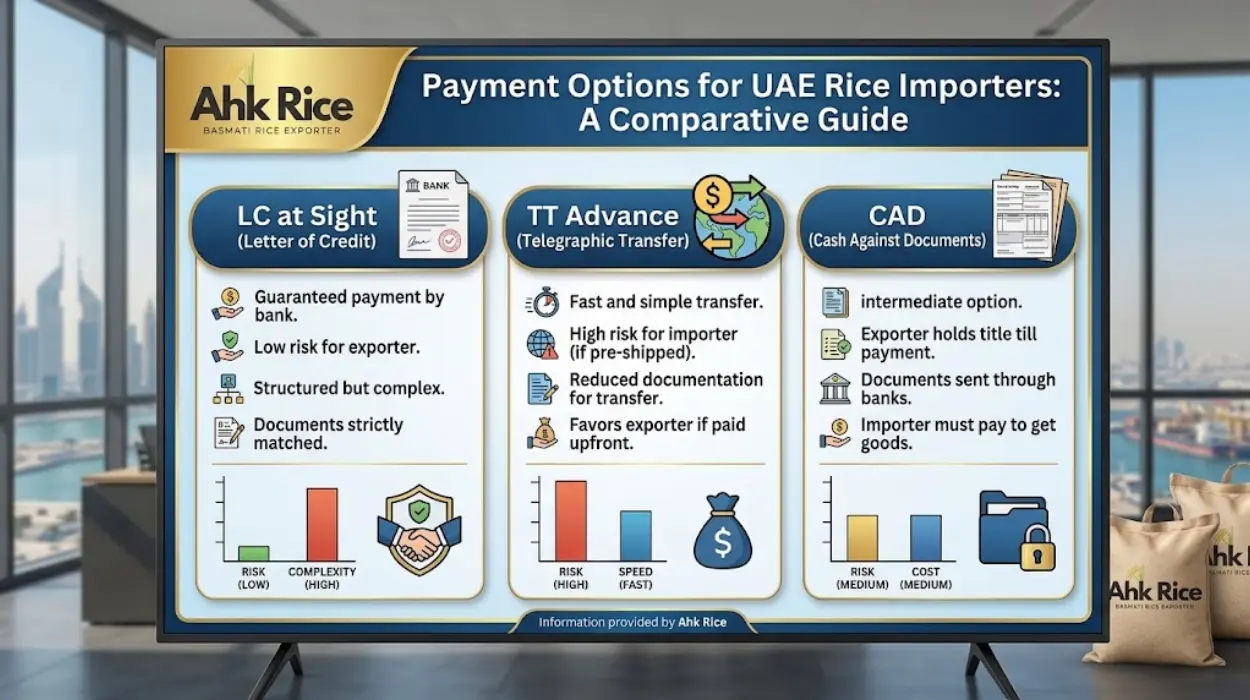
LC at sight is a bank-issued payment undertaking triggered by compliant documents, TT advance transfers money before shipment, and CAD releases shipping documents against payment through a banking channel. Each method distributes financial risk, administrative work, and cash-flow pressure differently.
A letter of credit (LC) is a bank’s undertaking to pay the exporter when the required documents comply with the credit terms. At sight means payment is due after the nominated bank determines that the presented documents meet the LC requirements and completes the applicable processing.
Telegraphic transfer (TT) is an electronic bank transfer between the buyer and seller. Under TT advance, the importer pays some or all of the invoice before shipment. The exporter then proceeds according to the agreed production, inspection, and dispatch schedule.
Cash against documents (CAD), commonly handled through documentary collection, requires the exporter to send shipping documents through banks. The buyer pays the collection amount before receiving documents under documents against payment (D/P) terms. Banks handle the collection but do not provide the same payment guarantee as an LC.
For example, a UAE importer purchasing 25 metric tonnes of Pakistani Basmati rice might prefer TT advance when dealing with an established exporter. A buyer placing a larger first order may favour an LC at sight if both banks approve the arrangement. CAD suits buyers and sellers who accept documentary collection and understand the risk that the buyer may refuse payment.
How do LC at sight, TT advance, and CAD compare?
LC at sight offers a documentary bank undertaking, TT advance offers straightforward payment with greater advance-payment exposure, and CAD provides payment against document release without a bank guarantee of the buyer’s payment. The right choice balances transaction protection, cost, speed, and liquidity.
| Comparison attribute | LC at sight | TT advance | CAD (D/P) |
|---|---|---|---|
| Payment timing | After compliant documents are presented and processed | Before shipment, as contractually agreed | Before shipping documents are released |
| Bank undertaking | Yes, subject to LC terms and issuing-bank obligations | No payment undertaking from the buyer’s bank | No guarantee that the buyer will pay |
| Importer cash flow | Funds committed or available according to bank arrangements | Cash leaves before dispatch | Cash leaves when documents are released |
| Exporter payment risk | Reduced when documents comply and the bank undertaking is effective | Lower after cleared advance payment | Higher if the buyer refuses collection |
| Banking costs | Generally higher due to issuance, advising, confirmation, and document fees where applicable | Usually simpler transfer fees | Collection and remittance fees apply |
| Documentation | Strict compliance with LC terms | Documents follow the sales contract and export requirements | Documents move through banks for collection |
| Best-fit transaction | Larger or structured orders requiring documentary controls | Trusted suppliers and agreed advance-payment deals | Established trading relationships accepting collection risk |
These methods protect different parts of a transaction. An LC addresses the exporter’s payment risk through a bank undertaking, provided its terms are satisfied. It does not guarantee rice quality or replace independent inspection. TT advance prioritises payment simplicity, while CAD makes document release conditional on payment but leaves the seller exposed if the buyer refuses to pay.
An importer should compare the total cost rather than the headline bank fee. LC costs can include issuance, advising, amendments, discrepancy handling, and confirmation if required. TT costs usually include transfer charges and any agreed intermediary-bank fees. CAD involves collection charges and possible storage, demurrage, or diversion costs if the buyer does not pay promptly.
Which payment method works best for different UAE rice importers?
Established UAE importers with trusted suppliers often benefit from TT advance or CAD, while first-time buyers handling larger orders may prefer an LC at sight. Importers should select terms based on supplier verification, order value, bank access, working capital, and document-control requirements.
The three methods serve different commercial situations. No payment term removes every risk, so importers should match the method to their purchasing strategy.
- First-time importers: An LC at sight can reduce payment risk when the exporter accepts the credit and the buyer can meet bank requirements. Supplier verification and pre-shipment inspection remain necessary.
- Established wholesale distributors: TT advance can simplify repeat orders when the supplier has a reliable delivery record, clear specifications, and an agreed refund or dispute process.
- Importers managing working capital: CAD can delay payment until shipping documents are available. However, payment is still required before document release, and the buyer must arrange sufficient funds.
- Private-label brands: An LC can provide structured documentary requirements for customised packaging, quantities, and shipment paperwork. Buyers must ensure every requirement is practical and verifiable.
- Small trial-order buyers: TT advance can be operationally simple for a modest shipment. The importer should verify the exporter, approve specifications, and agree on inspection and dispatch milestones before transferring funds.
Consider a UAE distributor purchasing 1121 Basmati for supermarket sales. The buyer needs consistent grain specifications, agreed packaging, and predictable documentation. An LC at sight may suit a larger first order where the parties require bank-controlled documentary payment. After successful shipments, the importer and exporter can reassess TT advance or CAD to reduce transaction administration.
A restaurant supplier purchasing Super Kernel or 1509 rice for regular wholesale distribution may prioritise speed and cash-flow efficiency. An established relationship with clear contracts can make TT advance practical. The decision should reflect the supplier’s actual performance, not simply a lower quoted price.
What are the advantages and disadvantages of each payment method?
LC at sight provides structured documentary payment but increases banking administration. TT advance simplifies settlement but exposes the buyer before shipment. CAD controls shipping-document release but exposes the seller to refusal of payment and potential cargo delays.
LC at sight: stronger documentary controls
Advantages
- The exporter receives a bank payment undertaking subject to compliant presentation and applicable terms.
- The buyer can specify required commercial and shipping documents in the credit.
- The structure suits transactions involving substantial invoice values or unfamiliar trading relationships.
Disadvantages
- Issuance, amendments, and document examination create additional costs and work.
- Documentary discrepancies can delay payment and cargo release.
- The buyer may need credit facilities, collateral, or sufficient bank capacity.
For example, an importer ordering US$50,000 of rice may request a commercial invoice, packing list, bill of lading, and specified inspection certificate under the LC. Every requirement must be achievable and consistent with the sales contract. A discrepancy can require a waiver, amendment, or other bank-approved resolution.
An LC is not an independent quality guarantee. Banks generally examine documents rather than the physical rice. Importers should arrange suitable inspection and agree on quality specifications separately.
TT advance: simpler settlement
Advantages
- The parties can transfer funds without establishing a documentary credit.
- Settlement arrangements are relatively straightforward.
- Repeat orders can proceed efficiently when production and dispatch schedules are agreed.
Disadvantages
- The buyer pays before receiving the shipment.
- Recovery of funds can be difficult if the exporter fails to perform.
- Currency conversion and intermediary-bank fees can affect the landed cost.
Suppose a buyer transfers a 30% advance for a rice order and agrees to pay the remaining 70% before dispatch. The contract should specify the production deadline, inspection arrangements, balance-payment trigger, and consequences of non-compliance. The importer should not release the advance solely because the supplier offers an attractive price.
CAD: payment against document release
Advantages
- The exporter routes agreed shipping documents through banks.
- The buyer pays before receiving the documents needed to claim the cargo.
- The arrangement avoids the full structure of an LC.
Disadvantages
- The bank does not guarantee that the buyer will pay.
- The importer must fund payment when documents are presented.
- If the buyer refuses payment, the exporter may face storage, demurrage, re-export, or resale costs.
For example, a UAE importer may agree to CAD for a repeat shipment after several successful orders. If the buyer experiences a sudden cash-flow shortage, it may refuse collection. The rice can then remain at the destination or require another commercial arrangement. Documentary control does not eliminate the physical and financial consequences of a rejected shipment.
What decision factors should UAE importers evaluate before choosing payment terms?
UAE importers should evaluate supplier reliability, order value, available working capital, document requirements, and the cost of payment delays. These five factors establish whether LC at sight, TT advance, or CAD provides the most practical balance of control and commercial efficiency.
| Decision factor | Choose LC at sight when… | Choose TT advance when… | Choose CAD when… |
|---|---|---|---|
| Supplier relationship | The buyer needs a bank undertaking for a new or structured transaction | The supplier has a verified performance record | Both parties trust the relationship but require payment-controlled document release |
| Order value | The transaction justifies bank fees and documentary administration | The advance exposure is acceptable to the buyer | The collection arrangement is proportionate to the shipment |
| Working capital | Bank facilities can support the credit terms | Cash is available before dispatch | Funds are available when collection documents arrive |
| Documentation | Both parties can satisfy precise LC conditions | The contract clearly defines documents and milestones | The required documents can be routed through the collection banks |
| Delay exposure | The parties can manage discrepancies and bank processing time | The parties can meet advance and dispatch deadlines | The seller has a plan if the buyer refuses collection |
These factors should be assessed together. An LC may improve documentary payment security but become uneconomical for a small order with high amendment costs. TT advance may be efficient for repeat business but unsuitable when the buyer cannot verify the exporter. CAD can preserve a degree of document control but does not solve the seller’s risk of buyer refusal.
Importers should also calculate the cost of delayed cargo release. Port storage, demurrage, container detention, and customs-related delays can erode the savings from a lower-cost payment method. Contractual responsibility for these charges should be explicit.
How should UAE buyers connect payment terms with rice specifications and shipment documents?
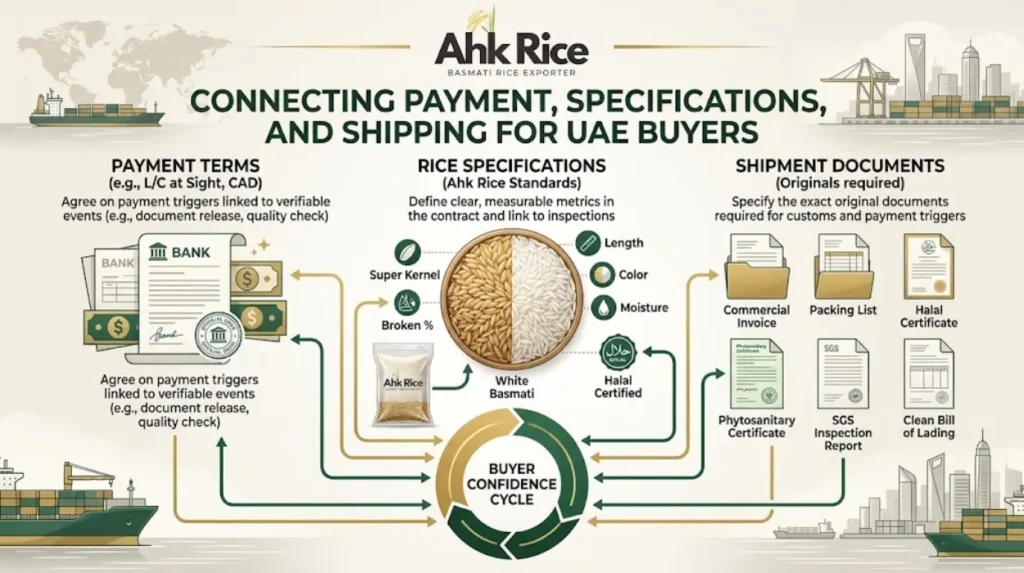
Buyers should finalise rice grade, quantity, packaging, inspection criteria, delivery terms, and required export documents before selecting payment terms. The contract and banking instructions must agree, because conflicting specifications or document deadlines can delay payment and cargo clearance.
A purchase contract for Pakistani Basmati rice should define the variety, crop or origin details where relevant, grain length or grade, broken percentage, moisture limits, packaging, quantity, price, and delivery terms. It should also establish inspection procedures, shipment deadlines, document responsibilities, and remedies for non-performance.
AHK Rice supplies 1121, Super Kernel, and 1509 varieties from Punjab, with end-to-end processing, custom packaging, and export support. Buyers considering Pakistani Basmati rice from AHK Rice should align the agreed grade and packaging specifications with their payment structure before confirming an order.
The required documents depend on the contract, destination rules, shipping arrangement, and payment method. Common export documents include:
- Commercial invoice showing the agreed goods and price.
- Packing list identifying bag count, net weight, and gross weight.
- Bill of lading or other agreed transport document.
- Certificate of origin, where required.
- Phytosanitary certificate and other regulatory documents where applicable.
- Inspection or laboratory certificates when specified by the contract, buyer, or destination authority.
Under an LC, the buyer and exporter must ensure the documents can meet the credit’s exact terms. Under TT advance, the sales contract must still establish which documents the exporter provides and when. Under CAD, the parties must agree which documents travel through the banks and which are delivered separately.
The UAE importer remains responsible for confirming current import requirements with its customs broker and relevant authorities. A payment arrangement does not replace food-safety compliance, product registration where applicable, or accurate Arabic labelling requirements.
How can importers reduce payment disputes before the first shipment?
Importers can reduce payment disputes by verifying the exporter, signing a complete sales contract, agreeing on inspection criteria, checking banking instructions independently, and matching payment milestones to shipment documents. These controls improve transaction transparency without depending on a payment method alone.
Before transferring funds or opening an LC, UAE buyers should complete five practical checks:
- Verify the exporter: Confirm the business identity, company details, banking information, export experience, and references through appropriate independent channels.
- Approve the specifications: Record the rice variety, grade, moisture, broken percentage, packaging, quantity, and inspection procedure in the contract.
- Agree on payment triggers: Define the advance percentage, balance-payment deadline, LC presentation requirements, or CAD collection procedure.
- Validate the documents: Confirm that the commercial invoice, packing list, transport documents, and required certificates are consistent with the contract and destination rules.
- Plan for exceptions: Agree on how the parties handle failed inspections, shipment delays, documentary discrepancies, payment refusal, and additional cargo charges.
Buyers should independently verify any change to the supplier’s bank account using previously established contact details. A last-minute change in payment instructions is a fraud warning sign that requires verification before funds are released.
The first transaction should also establish a clear communication process. The importer, exporter, freight forwarder, inspection provider, and banks should know their responsibilities and deadlines. This reduces confusion when the shipment moves from processing to loading, document preparation, payment, and customs clearance.
For buyers ready to move from evaluating payment methods to planning an order, the decision-focused guide Start Your First Basmati Rice Order with AHK Rice on Secure Payment Terms is the logical next step.
Which payment method offers the best balance of cost, control, and security?
LC at sight suits transactions requiring a bank payment undertaking, TT advance suits verified suppliers and manageable advance exposure, and CAD suits buyers and sellers accepting documentary collection risk. The best arrangement is the one that fits the contract, banking capacity, and shipment value.
There is no universally best payment method for UAE rice imports. An LC at sight offers stronger payment protection for the exporter when the credit terms are satisfied, while giving the importer structured documentary requirements. Its fees and administrative burden must justify the transaction value.
TT advance works when the buyer has verified the supplier and accepts the risk of paying before dispatch. CAD offers a middle-ground documentary process, but the exporter retains the risk of non-payment if the buyer refuses the collection. Neither method replaces a complete contract, supplier checks, or inspection.
UAE importers should compare total banking costs, cash-flow requirements, delivery schedules, and the consequences of document discrepancies before agreeing on terms. For the first shipment, clear responsibilities and verifiable milestones matter as much as the payment method itself.
Frequently asked questions
Is LC at sight safer than TT advance for a first rice import?
LC at sight provides a bank payment undertaking subject to compliant documents and applicable terms. TT advance requires the buyer to pay before shipment without that undertaking. Supplier verification, inspection, and a clear contract remain necessary under both methods.
Does CAD guarantee that the rice importer will pay?
No. CAD instructs banks to collect payment against the agreed documents, but the banks do not guarantee buyer payment. If the importer refuses the documents, the exporter may face storage, demurrage, resale, or re-export costs.
Which payment method has the lowest banking fees?
TT advance generally involves simpler transfer charges. CAD adds collection fees, while an LC can involve issuance, advising, amendment, and discrepancy charges. The total cost depends on the banks, transaction terms, and any additional services required.
Can a UAE importer negotiate a partial TT advance?
Yes. The buyer and exporter can agree on a deposit and subsequent payment milestones, such as an advance followed by a balance before dispatch. The contract should define each trigger, supporting documents, deadlines, and remedies for non-performance.
What documents should a UAE rice importer check before payment?
Common documents include the commercial invoice, packing list, bill of lading, and any required certificates of origin, phytosanitary documents, or inspection reports. The exact list depends on UAE import requirements, the sales contract, shipping terms, and payment method.