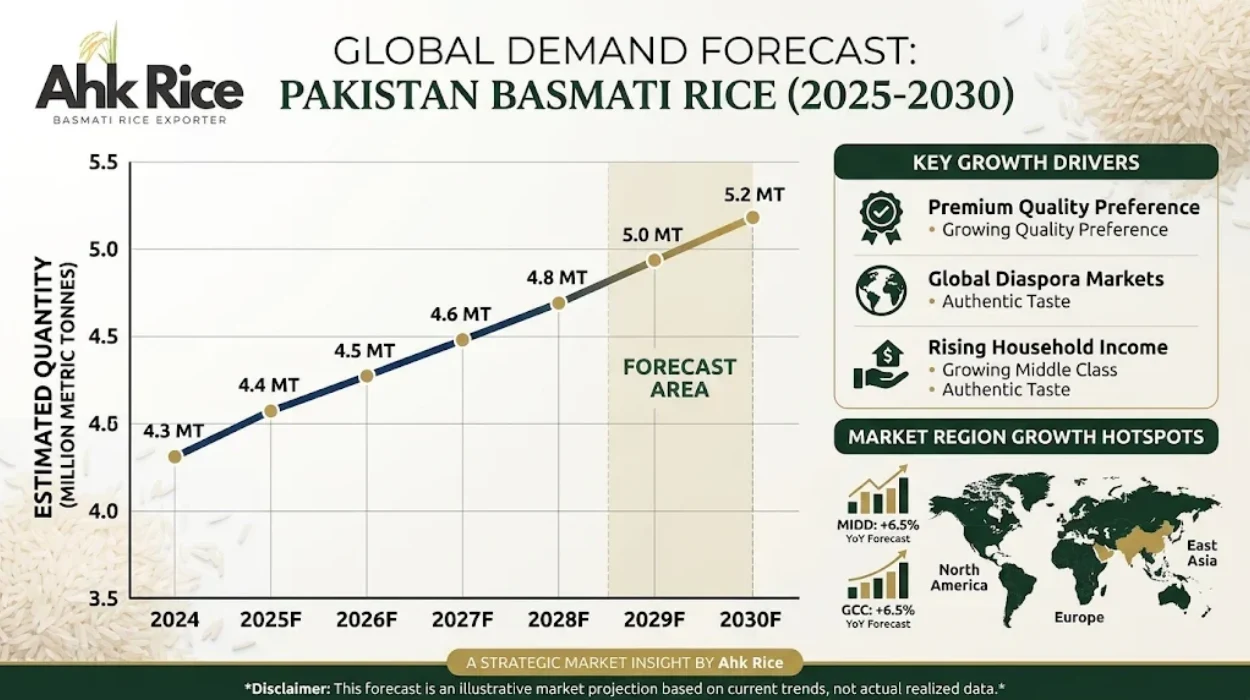
Pakistan Basmati Rice Demand Forecast for International Markets
International buyers sourcing Pakistani Basmati rice need more than a general market forecast. They need dependable supply, competitive export pricing, consistent grain specifications, predictable shipping schedules and documentation that meets destination-country requirements. The Pakistan Rice Export Decline: What Is Causing the Recent Slowdown? provides background on export challenges, while this guide focuses on purchasing decisions and future sourcing opportunities.
Pakistan’s Basmati export potential depends on international demand, harvest availability, competing origins, currency movements and buyer purchasing power. Importers must evaluate these factors before confirming annual contracts or container shipments. A reliable exporter should provide grade-specific quotations, pre-shipment samples, quality inspection and shipment coordination.
For international wholesalers, distributors, supermarket suppliers, foodservice companies and private-label brands, AHK Rice offers a structured sourcing approach covering Pakistani Basmati varieties, processing, packaging and export documentation.
What is the Pakistan Basmati rice demand forecast for 2026–2027?
Pakistan’s Basmati export outlook remains commercially promising, but exporters must compete through consistent quality, market-specific grades and reliable shipment execution. Demand opportunities are strongest in established Gulf markets and expanding Central Asian destinations, while international price competition remains significant.
The USDA Foreign Agricultural Service’s 2026 Pakistan grain outlook forecasts total rice exports of approximately 4.7 million tonnes for 2025/26 and 5 million tonnes for 2026/27. These figures cover all rice varieties, not Basmati alone. The report also identifies renewed Indian competition as a major pressure on Pakistan’s export performance. USDA Apps+1
Pakistan’s Basmati business nevertheless has important market opportunities. According to PACRA’s FY2026 sector analysis, the UAE accounts for approximately 20.4% of Pakistan’s Basmati export volume, followed by Saudi Arabia at 11.4% and Kazakhstan at 9.1%. PACRA
For importers, the practical purchasing decision is to select the correct variety for the destination market rather than buying exclusively on the lowest FOB price.
The main commercial varieties include:
- 1121 Basmati: Premium grain length, aroma and cooked elongation for premium retail and foodservice.
- Super Kernel Basmati: Aromatic Pakistani rice suitable for ethnic grocery distribution, wholesalers and private-label products.
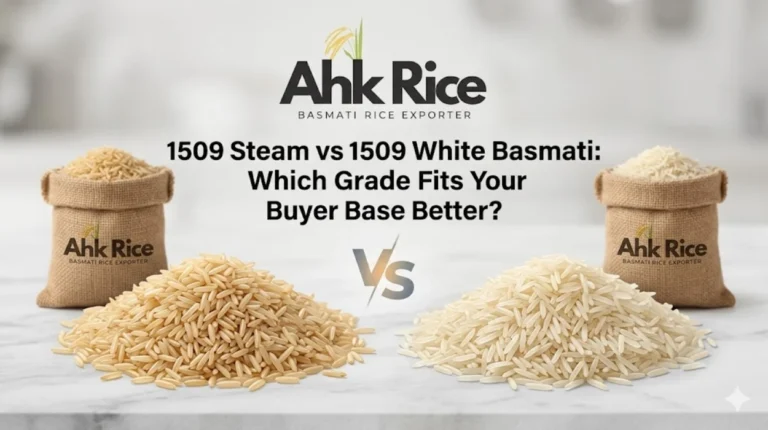
- 1509 Basmati: A commercially attractive option for buyers prioritising supply economics and bulk distribution.
These varieties serve different customer segments. AHK Rice helps buyers match grain specifications, processing requirements and packaging formats with their target markets.
Which international markets offer the strongest opportunities for Pakistani Basmati?
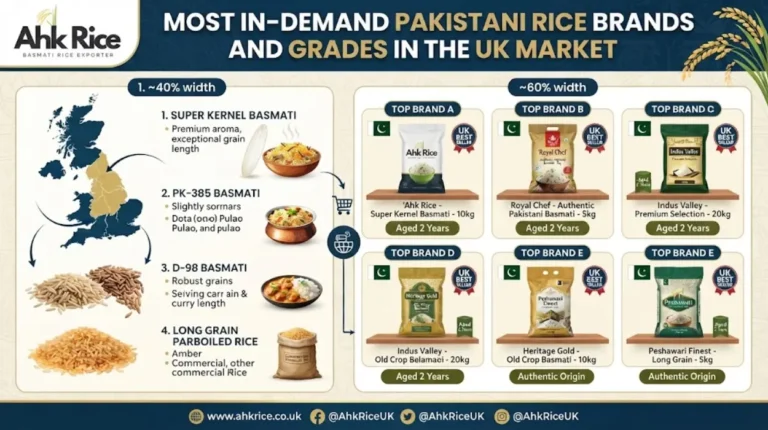
The UAE, Saudi Arabia, Oman, Kazakhstan, the UK and European markets offer established or developing opportunities for Pakistani Basmati. Importers should assess local consumer preferences, competition, regulatory requirements and landed costs before selecting a grade.
| Market | Commercial opportunity | Suitable Basmati |
|---|---|---|
| UAE | Wholesale, retail and re-export | 1121, Super Kernel |
| Saudi Arabia | Premium retail and foodservice | 1121 Sella, Super Kernel |
| Oman | Distributors and hospitality | 1121, Super Kernel |
| Kazakhstan | Growing Central Asian demand | 1121, 1509 |
| UK | Ethnic supermarkets and private label | 1121, Super Kernel |
| USA | Premium retail and foodservice | 1121, Super Kernel |
| Malaysia | Specialty rice distribution | 1121, Super Kernel |
| Italy | Ethnic retail and specialist distributors | 1121, Super Kernel |
Pakistan’s December 2025 export performance demonstrated the importance of international diversification. Dawn reported strong Basmati shipment growth during that month, with the UAE remaining a leading destination. Kazakhstan and Uzbekistan also demonstrated increasing importance in Central Asian trade. Basmati boom propels Pakistan past Vietnam+1
Importers should also consider the effect of Indian export policy changes on international prices, supply availability and competitive positioning. The comparison in How India’s Rice Policy Changes Are Affecting Global Markets provides useful context for evaluating competing origins and procurement timing.
What is the best solution for international buyers sourcing Pakistani Basmati?
The best solution is to work with an exporter that controls sourcing, processing, grading, quality verification, packaging and export documentation. This reduces specification mismatches, improves shipment coordination and creates a more predictable purchasing process.
International rice buyers often face four procurement problems:
- Inconsistent grain length and broken percentages between shipments.
- Differences between approved samples and commercial production.
- Delays caused by incomplete export documentation.
- Unclear pricing because processing, packaging and freight requirements are not defined.
A structured supply arrangement addresses these problems before the purchase order is confirmed.
AHK Rice provides an integrated sourcing and export service through its Pakistani Basmati rice export and supply operations.
The procurement process should include:
- Confirmation of rice variety and processing type.
- Agreed grain length and broken percentage.
- Moisture and foreign matter limits.
- Sortex and purity requirements.
- Packaging weight and material.
- Pre-shipment sample approval.
- Final Certificate of Analysis.
- Shipping and documentation coordination.
For example, a UAE distributor purchasing 1121 Golden Sella should confirm grain appearance, cooking performance, broken percentage and bag specifications before approving the commercial shipment.
AHK Rice can coordinate these requirements from sourcing through container-ready export preparation.
Why choose AHK Rice for international Basmati rice supply?
AHK Rice offers Pakistani Basmati sourcing, processing coordination, custom packaging and export support through one commercial supply process. Buyers can define product specifications before shipment and coordinate sampling, documentation and container preparation with their supplier.
AHK Rice operates from Punjab, Pakistan, a recognised Basmati-producing region. Its supply portfolio includes 1121, Super Kernel and 1509 Basmati rice for international wholesale and distribution requirements.
The main purchasing advantages include:
Variety selection: Buyers can select Steam, Golden Sella, Creamy Sella, White or other agreed processing specifications according to market requirements.
Quality control: Grain length, moisture, broken percentage, purity and appearance can be established in the purchase specification.
Custom packaging: Retail and wholesale packaging can be arranged according to the buyer’s approved artwork, bag material, weight and labelling requirements.
Export coordination: AHK Rice coordinates the commercial export process, including shipment preparation and relevant documentation.
Buyer-specific supply: Importers can request specifications suited to supermarket distribution, ethnic grocery networks, restaurants, catering companies and bulk trading operations.
The objective is to establish a repeatable supply arrangement rather than complete a single transaction without long-term quality consistency.
What shipping time should importers expect from Pakistan?
Shipping time depends on destination port, vessel schedule, transshipment, customs clearance and inland transportation. Buyers should use indicative sea-transit estimates for initial planning and obtain confirmed sailing schedules before signing delivery commitments.
The following figures are planning estimates, not guaranteed vessel schedules.
| Destination market | Indicative sea transit |
|---|---|
| UAE – Jebel Ali | 5–11 days |
| Saudi Arabia – Jeddah | 6–10 days |
| Oman – Salalah | 3–6 days |
| Malaysia – Port Klang | 10–16 days |
| Italy – Genoa | 18–22 days |
| UK – Felixstowe | 22–25 days |
| USA – New York | 28–40 days |
| USA – Los Angeles | 22–28 days |
Actual transit varies by shipping line and routing. Current regional disruptions can also change sailing schedules. PMT Group+2
Importers should distinguish ocean transit from total delivery time. Total lead time includes production, inspection, export clearance, vessel waiting, destination customs and inland delivery.
AHK Rice recommends confirming the loading port, destination port, Incoterm, vessel schedule and expected arrival window before finalising a shipment.
What factors affect Pakistani Basmati rice export prices?
Export prices depend on rice variety, grain length, processing method, broken percentage, moisture, packaging, order quantity, destination and delivery terms. Importers should compare complete specifications and landed costs rather than choosing suppliers on headline price alone.
The main pricing factors are:
| Pricing factor | Effect on quotation |
|---|---|
| Rice variety | 1121, Super Kernel and 1509 have different market values |
| Grain length | Longer premium specifications generally command higher prices |
| Processing | Steam, Golden Sella and Creamy Sella require different processing |
| Broken percentage | Lower broken content affects grading and cost |
| Moisture | Controlled moisture supports quality and storage requirements |
| Packaging | Printed retail bags cost differently from bulk packaging |
| Quantity | Container volume and repeat orders influence commercial pricing |
| Destination | Freight, insurance and destination charges affect landed cost |
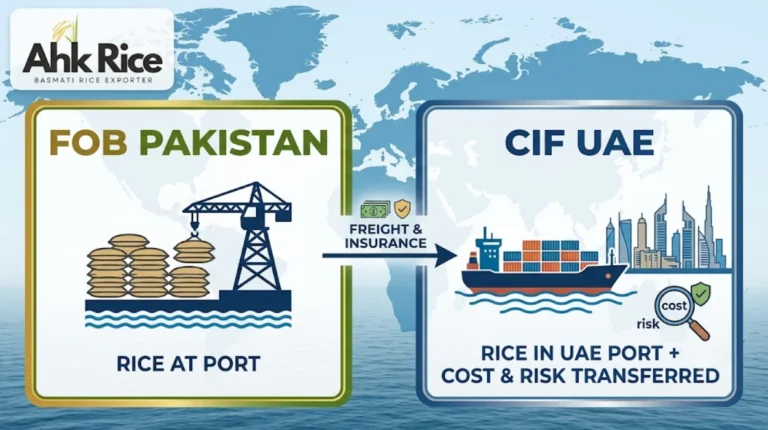
FOB pricing: The buyer arranges international freight and insurance after the goods are loaded according to the agreed FOB terms.
CIF pricing: The exporter arranges freight and insurance to the named destination port, subject to the agreed Incoterm.
An accurate quotation should identify the rice variety, crop year, grade, processing type, packaging, quantity, loading port, destination and payment terms.
AHK Rice prepares quotations around the buyer’s required specification rather than treating every Basmati order as an identical product.
How does the AHK Rice sample and approval process work?
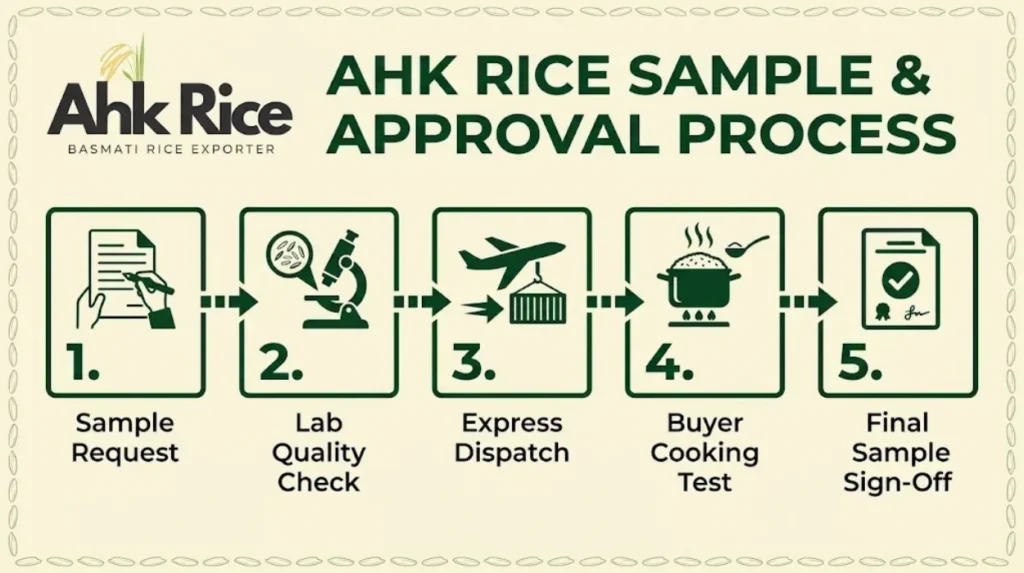
The sample process allows importers to evaluate grain appearance, aroma, cooking performance and product suitability before placing a bulk order. Buyers should approve the commercial specification and sample before production and container loading.
AHK Rice follows a practical sample-to-order approach.
Step 1: Share purchasing requirements.
The buyer provides the required variety, processing type, quantity, destination country, packaging preference and target specifications.
Step 2: Confirm sample availability.
AHK Rice confirms the available grade and sample arrangements. Eligible buyers can request up to 20 kg of Super Kernel Basmati for sampling without a rice charge. The buyer covers courier shipping and applicable phytosanitary charges.
Step 3: Arrange sample dispatch.
The exporter coordinates sample preparation and dispatch. Courier charges depend on destination, parcel weight and service availability. Phytosanitary charges depend on applicable requirements.
Step 4: Conduct cooking and quality tests.
The importer evaluates grain length, aroma, appearance, texture, cooking performance and suitability for the intended customer segment.
Step 5: Approve the commercial specification.
Both parties confirm the variety, moisture, broken percentage, packaging, quantity and other agreed quality parameters.
Step 6: Confirm the purchase order.
The buyer approves the proforma invoice, payment terms, Incoterm and shipment arrangements.
Step 7: Prepare and inspect the order.
AHK Rice coordinates processing, grading, packaging and relevant quality checks. The final agreed specifications are documented before dispatch.
Step 8: Complete export documentation and shipment.
The exporter coordinates the applicable commercial invoice, packing list, certificate of origin, phytosanitary certificate, bill of lading and other destination-specific documents.
This process helps reduce purchasing uncertainty. It also gives importers a clear record of the approved product before committing to recurring shipments.
What results can international buyers expect?
A properly managed export arrangement provides clearer product specifications, improved purchasing control, more predictable shipment planning and better alignment between the approved sample and commercial order. Results depend on agreed quality standards and execution at every stage.
For example, a supermarket distributor in the UAE may require 1121 Steam Basmati in branded 5 kg and 10 kg bags. A hotel supplier in Saudi Arabia may prefer 1121 Golden Sella in larger commercial packaging.
Both buyers need different processing, packaging and purchasing arrangements.
AHK Rice can coordinate these requirements through a defined export specification.
Expected commercial outcomes include:
- Better control over grain quality and grading.
- Packaging aligned with the intended sales channel.
- Reduced specification misunderstandings.
- Clearer cost calculations before ordering.
- Improved shipment and documentation coordination.
- A repeatable purchasing process for future orders.
The most important result is supply consistency. International buyers need products that meet their approved specifications across successive shipments.
How can importers get started with AHK Rice?
Importers can begin by sharing their required Basmati variety, quantity, destination, packaging and delivery terms. AHK Rice can then coordinate product specifications, sample arrangements and a commercial export quotation for evaluation.
To begin procurement, buyers should prepare:
- Destination country and delivery port.
- Required variety: 1121, Super Kernel or 1509.
- Processing preference: Steam, Golden Sella, Creamy Sella or White.
- Required quantity in metric tonnes.
- Packaging size and private-label requirements.
- Quality specifications and documentation requirements.
- Preferred Incoterm: FOB or CIF.
AHK Rice uses these details to establish the product specification and quotation requirements.
For buyers planning annual contracts, it is useful to discuss estimated monthly demand, preferred shipment frequency and expected stock requirements. This allows the exporter to plan sourcing and processing around the buyer’s purchasing schedule.
The commercial objective is to establish a dependable Pakistani Basmati supply relationship with transparent specifications and clearly defined shipment responsibilities.
Frequently Asked Questions
What is the demand forecast for Pakistani Basmati rice in 2026–2027?
Pakistan’s Basmati export sector has opportunities in established and emerging markets.
The UAE and Saudi Arabia remain important commercial destinations.
Kazakhstan and other Central Asian markets offer additional opportunities.
Competition from Indian rice continues to influence international pricing.
Buyers should monitor market prices, crop availability and import demand before contracting.
Which Pakistani Basmati variety is best for international markets?
1121 Basmati is suitable for premium retail and foodservice markets.
Super Kernel serves aromatic rice distributors and ethnic grocery retailers.
1509 offers an alternative for buyers prioritising commercial supply economics.
Steam and Golden Sella serve different cooking and foodservice requirements.
The best selection depends on customer preferences and destination-market demand.
How long does Pakistani Basmati rice shipping take?
UAE shipments can take approximately 5–11 days by sea.
Saudi Arabia shipments generally require around 6–10 days.
Malaysia shipments can require approximately 10–16 days.
European and American shipments generally take longer depending on routing.
Actual delivery depends on vessel schedules, customs and destination handling.
Does AHK Rice provide free Basmati rice samples?
Eligible buyers can request up to 20 kg of Super Kernel Basmati for sampling.
The rice sample is provided without a product charge.
Buyers cover courier shipping costs.
Applicable phytosanitary charges are also payable by the buyer.
Sample approval can help buyers evaluate quality before bulk procurement.
What determines the export price of Pakistani Basmati rice?
Variety and processing type influence the initial product price.
Grain length, moisture and broken percentage determine the agreed specification.
Packaging, quantity and crop year also affect the quotation.
Freight, insurance and destination charges influence the landed cost.
Importers should request a current FOB or CIF quotation for accurate purchasing calculations.