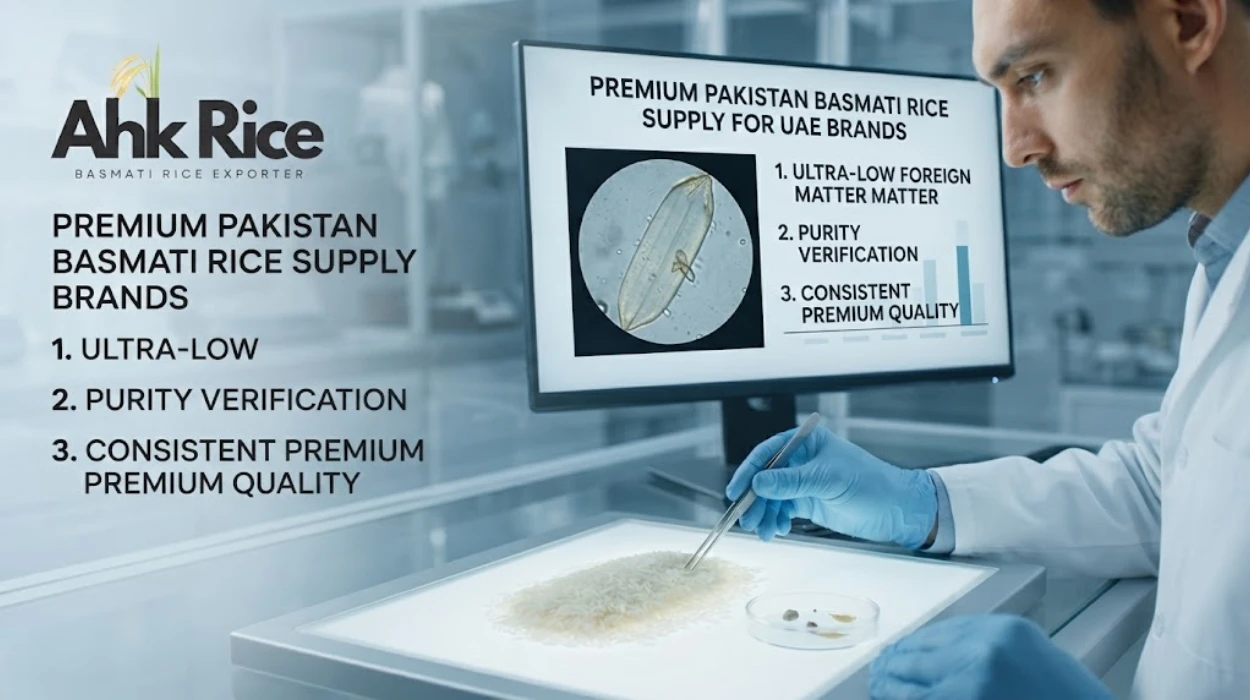
Premium Pakistan Basmati Rice Supply for UAE Brands with Strict Foreign Matter Control
Premium Pakistan Basmati rice with strict foreign matter control provides the most consistent product for UAE food brands. The correct supplier combines controlled cultivation, advanced milling, laboratory testing, and export-grade sorting. This process reduces contamination, improves cooking performance, and helps importers comply with UAE food regulations while protecting their brand reputation.
UAE buyers evaluate rice beyond appearance. They compare grain uniformity, broken percentage, moisture level, chalkiness, foreign matter limits, packaging standards, and shipment consistency. Understanding these specifications before choosing an exporter reduces commercial risk and improves long-term supply stability.
Businesses researching rice quality standards often begin by understanding how foreign matter affects export quality.
AHK Rice, a trusted Pakistani Basmati rice exporter based in Punjab, supplies premium 1121, Super Kernel, and 1509 Basmati varieties to buyers in more than fifteen countries. Through its Basmati rice export services, the company manages cultivation support, milling, grading, packaging, quality inspection, documentation, and international shipping under one export process.
What solutions are available for supplying premium Pakistan Basmati rice with strict foreign matter control?
The most effective solutions combine certified cultivation, multi-stage milling, optical sorting, laboratory inspection, controlled packaging, and documented export verification. Each stage removes specific contamination risks while improving consistency, food safety, and compliance with UAE import requirements across retail and food service markets.
Foreign matter refers to any material that is not edible rice. Examples include stones, husk particles, dust, straw fragments, immature grains, weed seeds, metal particles, insects, and damaged kernels. Every contaminant affects product quality differently. UAE importers therefore measure foreign matter separately instead of treating contamination as one category.
Premium Pakistan Basmati rice suppliers control contamination before harvesting begins. Farmers cultivate certified seed varieties, maintain irrigation schedules, and harvest mature paddy at the correct moisture level. Early quality control reduces contamination before milling starts.
Rice mills remove additional impurities through sequential processing. Every processing stage performs one measurable function instead of multiple uncontrolled operations.
Standard Export Processing Stages
- Harvest mature paddy.
- Dry harvested grain.
- De-husk rice.
- Polish kernels.
- Grade by size.
- Sort with optical colour sorters.
- Separate stones.
- Detect metal fragments.
- Inspect laboratory samples.
- Pack under hygienic conditions.
Each processing stage reduces a different contamination source. Combined processing creates significantly cleaner export rice than manual inspection alone.
AHK Rice follows end-to-end processing because every inspection stage verifies measurable specifications before shipment. Buyers receive documented quality parameters instead of visual assumptions.
Specification Comparison
| Specification | Premium Export Grade | Standard Commercial Grade |
|---|---|---|
| Grain Purity | 99.90%+ | 99.00–99.50% |
| Foreign Matter | ≤0.1% | 0.3–0.5% |
| Broken Rice | 1–2% | 5–10% |
| Moisture | 12–13% | 13–14% |
| Stone Removal | 100% machine separated | Partial mechanical removal |
| Colour Sorting | Multiple optical passes | Single sorting stage |
| Laboratory Inspection | Every production lot | Periodic sampling |
Premium specifications reduce complaints after arrival because contamination remains within predictable export tolerances.
With the available quality control solutions established, the next question is how different supply methods compare for commercial buyers.
How do different supply approaches compare for UAE rice brands?
Integrated processing delivers higher consistency than outsourced production because every processing stage remains under controlled inspection. Independent sourcing reduces purchase cost but creates variation in grain quality, contamination levels, packaging standards, and shipment consistency across multiple production batches.
Not every Pakistan rice exporter operates the same production model. Buyers generally compare three sourcing approaches before selecting a supplier.
Fully Integrated Export Processing
Integrated exporters supervise cultivation support, milling, grading, packaging, documentation, and logistics. Every production stage follows predefined specifications. Laboratory testing verifies each shipment before loading.
Advantages include consistent grain quality, traceable production records, stable packaging quality, and lower contamination risk.
Outsourced Milling
Some exporters purchase paddy and outsource milling to independent factories.
Quality depends on the contracted mill instead of one standardized processing system.
Batch variation becomes more common because different factories apply different sorting standards
Trading Companies
Trading companies purchase finished rice from multiple suppliers.
Product availability remains flexible.
Quality consistency often changes between shipments because production originates from different mills.
Comparison of Supply Models
| Evaluation Factor | Integrated Exporter | Outsourced Milling | Trading Company |
|---|---|---|---|
| Quality Consistency | Excellent | Moderate | Variable |
| Foreign Matter Control | Excellent | Moderate | Moderate |
| Traceability | Complete | Partial | Limited |
| Packaging Flexibility | High | Medium | Medium |
| Export Documentation | Complete | Varies | Varies |
| Batch Consistency | Excellent | Moderate | Variable |
| Long-Term Supply | Stable | Moderate | Depends on sourcing |
Integrated processing provides the highest consistency because quality control remains under one management system rather than several independent facilities.
For UAE supermarket brands, consistent retail packaging often matters more than the lowest purchase price. Consumers expect every bag to cook identically throughout the year.
Food service distributors evaluate consistency differently. Hotels and restaurants prioritize cooking yield, grain elongation, and batch stability because operational costs increase when rice quality varies between shipments.
Which premium Pakistan Basmati rice supply method works best for different UAE buyers?
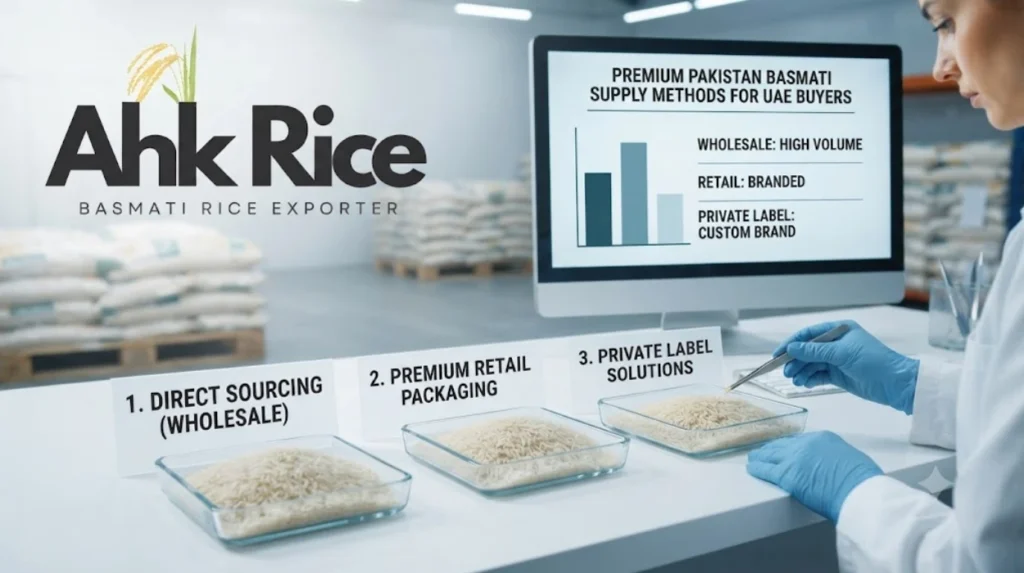
The best supply method depends on the buyer’s business model. Retail brands require premium sorted rice with consistent packaging. Food service distributors prioritize cooking performance. Private-label importers require flexible packaging, while wholesale traders focus on competitive pricing with reliable export specifications.
Different buyers evaluate Pakistan Basmati rice using different commercial priorities. One specification does not satisfy every market segment. The most effective supplier matches processing grades, packaging options, and quality standards with the buyer’s distribution channel.
Retail Supermarkets
Retail brands protect consumer confidence through consistent product quality. Customers expect every bag to deliver identical grain length, aroma, and cooking performance.
Premium 1121 Steam Basmati Rice and 1121 Golden Sella Basmati Rice remain the preferred retail choices because they provide excellent grain elongation and attractive shelf presentation.
Retail buyers generally require:
- 1–2% broken rice
- ≤0.1% foreign matter
- 12–13% moisture
- Multi-pass colour sorting
- Retail-ready packaging
These specifications reduce customer complaints and improve repeat purchases.
Hotels, Restaurants, and Catering (HoReCa)
Food service businesses evaluate rice differently. Large kitchens prepare hundreds of servings every day. Consistent cooking performance reduces food waste and improves operational efficiency.
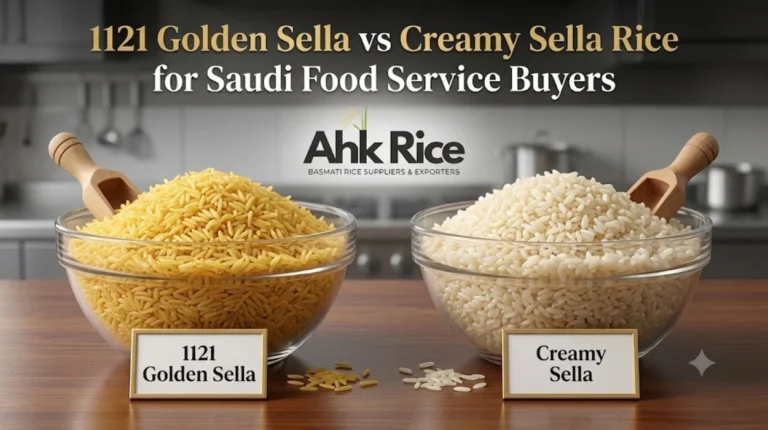
1121 Golden Sella Basmati Rice remains the preferred grade because parboiling strengthens the grain structure. The rice cooks longer without breaking and remains separate after serving.
Typical food service specifications include:
- High cooking yield
- Strong grain integrity
- Long holding time
- Uniform moisture
- Stable aroma
Restaurants gain value from consistent performance instead of decorative packaging.
Private Label Importers
Private-label companies build their own consumer brands. Packaging quality becomes as important as grain quality.
Premium exporters provide:
- Custom bag artwork
- Private-label printing
- Barcode integration
- Multilingual packaging
- UAE food labeling compliance
Integrated production simplifies private-label development because packaging and processing remain under one quality system.
Wholesale Traders
Wholesale traders usually purchase larger volumes with broader commercial specifications.
Typical priorities include:
- Stable monthly supply
- Competitive pricing
- Reliable shipment schedules
- Export documentation
- Consistent milling quality
These buyers often select specifications according to destination market demand rather than retail presentation.
With buyer requirements defined, comparing regional market preferences provides additional guidance for selecting the appropriate export grade.
How do UAE and Saudi Arabian markets compare when selecting Pakistan Basmati rice?
UAE buyers prioritize premium presentation, strict foreign matter limits, and branded retail packaging. Saudi Arabian buyers purchase larger catering volumes, making cooking yield, grain durability, and long-term storage performance equally important purchasing factors.
Although both markets import premium Pakistan Basmati rice, their purchasing behavior differs significantly.
UAE Market Preferences
The UAE imports premium packaged rice for supermarkets, premium grocery chains, hotels, restaurants, and private-label distributors.
Most preferred grades include:
- 1121 Steam Basmati
- 1121 Golden Sella
- Super Kernel Basmati
Preferred specifications include:
- Extra-long grains
- Very low foreign matter
- Premium appearance
- Consumer-ready packaging
Retail presentation directly influences purchasing decisions.
Saudi Arabian Market Preferences
Saudi Arabia imports substantial quantities for institutional catering, wholesalers, hotels, and food distributors.
Preferred grades include:
- 1121 Golden Sella
- Super Kernel Sella
- 1509 Sella
Buyers emphasize:
- Cooking stability
- Grain strength
- Long shelf life
- Competitive bulk pricing
Golden Sella remains highly preferred because the parboiling process strengthens each kernel during cooking.
Regional Grade Preference Comparison
| Market | Preferred Grades | Primary Buying Priority |
|---|---|---|
| UAE | 1121 Steam, 1121 Golden Sella, Super Kernel | Premium appearance, packaging, purity |
| Saudi Arabia | 1121 Golden Sella, Super Kernel Sella, 1509 Sella | Cooking yield, durability, storage |
| Oman | 1121 Steam, Super Kernel | Balanced quality and pricing |
| Qatar | 1121 Premium Steam | Luxury retail products |
Different regional preferences demonstrate why exporters maintain multiple processing grades instead of producing a single specification.
Price per MT comparison of premium Pakistan Basmati grades
Export prices vary according to grain length, processing method, sorting level, and packaging specification. Premium grades command higher prices because they require additional milling, inspection, colour sorting, and quality verification before shipment.
Indicative export pricing varies throughout the year according to harvest volume and international demand.
| Grade | Typical Export Price (USD/MT)* |
|---|---|
| 1121 Steam | $1,180–1,320 |
| 1121 Golden Sella | $1,150–1,280 |
| Super Kernel Steam | $980–1,120 |
| Super Kernel Sella | $960–1,100 |
| 1509 Steam | $900–1,020 |
Prices fluctuate based on harvest season, packaging, freight, and destination market.
Higher-priced grades generally offer:
- Better grain uniformity
- Lower foreign matter
- Improved elongation
- Premium retail appeal
Lower-priced grades remain suitable for cost-sensitive wholesale and catering markets.
How does shelf life differ between major Basmati rice grades?
Properly processed Basmati rice maintains quality for twelve to twenty-four months. Storage conditions, moisture content, processing method, and packaging determine the practical shelf life more than grain variety alone.
Correct moisture management prevents microbial growth and preserves grain quality throughout export and distribution.
Shelf Life Comparison
| Grade | Recommended Shelf Life |
|---|---|
| 1121 Steam | 12–18 months |
| 1121 Golden Sella | 18–24 months |
| Super Kernel Steam | 12–18 months |
| Super Kernel Sella | 18–24 months |
| 1509 Steam | 12–18 months |
Golden Sella generally offers longer storage because the parboiling process hardens the grain and reduces breakage during handling.
For UAE distributors maintaining warehouse inventory through seasonal demand, Golden Sella provides greater storage flexibility. Retail brands launching premium packaged products often prefer Steam rice because of its brighter appearance and softer cooking texture.
What are the advantages and disadvantages of premium Pakistan Basmati rice supply solutions?
Integrated processing provides the highest consistency, food safety, and export reliability. Independent sourcing reduces initial costs but increases variation in grain quality, packaging, and shipment consistency. Buyers should compare long-term commercial value instead of focusing only on the purchase price.
Every sourcing model offers commercial benefits. The correct choice depends on product positioning, target customers, and quality expectations.
Fully Integrated Export Processing
Integrated exporters manage cultivation support, milling, grading, laboratory testing, packaging, documentation, and shipping within one controlled system.
Advantages
- Consistent grain quality
- ≤0.1% foreign matter
- Complete production traceability
- Uniform packaging standards
- Reliable shipment scheduling
- Lower rejection risk
- Simplified communication
Example
A UAE supermarket chain importing premium 5 kg retail packs benefits from integrated processing because every shipment maintains identical grain appearance and cooking quality. Consistency strengthens consumer trust and reduces product returns.
Disadvantages
- Higher production costs
- Longer preparation for custom packaging
- Premium specifications increase purchase prices
Outsourced Milling
Outsourced production separates rice procurement from milling.
Advantages
- Lower procurement costs
- Flexible sourcing
- Competitive pricing
Disadvantages
- Variable grain quality
- Different milling standards
- Higher contamination risk
- Less traceability
Example
A wholesale trader purchasing mixed production batches may receive different grain appearances across consecutive shipments because separate mills apply different grading standards.
Trading Companies
Trading companies purchase finished rice from multiple suppliers.
Advantages
- Fast availability
- Flexible quantities
- Multiple grade options
Disadvantages
- Limited production control
- Inconsistent specifications
- Variable packaging quality
- Reduced batch consistency
What decision factors should UAE buyers evaluate before selecting a Pakistan Basmati rice supplier?
Successful buyers compare measurable specifications instead of marketing claims. Grain quality, foreign matter limits, processing technology, certifications, packaging, logistics capability, and export documentation determine long-term supply reliability more accurately than price alone.
Professional procurement teams evaluate objective specifications before requesting quotations.
Key Decision Factors
Grain Quality
Long, uniform kernels improve retail appearance and cooking performance.
Preferred specification:
- 8.30 mm average grain length
- Uniform grading
- Low broken percentage
Foreign Matter Control
Foreign matter directly affects food safety and regulatory compliance.
Premium export specifications maintain:
- ≤0.1% foreign matter
- Advanced colour sorting
- Stone separation
- Metal detection
Processing Technology
Modern processing produces cleaner and more consistent rice.
Essential technologies include:
- Optical colour sorters
- Gravity separators
- Destoners
- Metal detectors
- Laboratory moisture testing
Packaging Capability
Packaging protects rice throughout storage and international transport.
Buyers often require:
- PP woven bags
- BOPP laminated bags
- Vacuum packs
- Retail pouches
- Private-label packaging
Export Experience
Experienced exporters simplify customs clearance through accurate documentation.
Common export documents include:
- Commercial Invoice
- Packing List
- Certificate of Origin
- Phytosanitary Certificate
- Fumigation Certificate
- Bill of Lading
- Quality Inspection Report
Decision Framework
| Business Requirement | Recommended Solution | Suitable Grade | Packaging | Priority |
|---|---|---|---|---|
| Premium Retail Brand | Integrated exporter | 1121 Steam | Retail bags | Appearance |
| Hotel & Catering | Integrated exporter | 1121 Golden Sella | 20–40 kg | Cooking yield |
| Private Label | Integrated exporter | 1121 Steam | Custom printed | Branding |
| Wholesale Distribution | Integrated or Trader | Super Kernel | Bulk PP bags | Competitive price |
| Institutional Supply | Integrated exporter | 1509 Sella | Bulk bags | Stable supply |
Selecting the correct supplier becomes easier after evaluating measurable specifications. The remaining questions focus on practical concerns buyers frequently ask before placing an export order.
Premium Pakistan Basmati rice supply depends on controlled cultivation, advanced milling, strict foreign matter management, laboratory verification, and consistent export procedures. Buyers evaluating suppliers should compare measurable specifications instead of relying on general quality claims. Grain purity, processing technology, packaging capability, and documentation determine long-term supply performance more accurately than purchase price alone.
AHK Rice supports international buyers with premium 1121, Super Kernel, and 1509 Basmati varieties, combining end-to-end processing, custom packaging, strict quality inspection, and complete export documentation for customers in more than 15 countries.
For buyers who have completed the evaluation stage and are ready to assess supplier verification procedures, continue reading how UAE importers verify foreign matter inspection before purchasing Pakistan Basmati rice.
Frequently Asked Questions
What is foreign matter in Pakistan Basmati rice?
Foreign matter includes stones, husk, straw, dust, weed seeds, metal fragments, insects, and other materials that are not edible rice. Premium exporters reduce foreign matter to ≤0.1% through multiple cleaning, grading, and inspection stages.
Why is foreign matter control important for UAE brands?
Strict foreign matter control improves food safety, protects brand reputation, supports UAE import compliance, and reduces customer complaints. Cleaner rice also improves cooking consistency and consumer satisfaction.
Which Pakistan Basmati rice grade is most popular in the UAE?
1121 Steam Basmati Rice and 1121 Golden Sella Basmati Rice remain the most popular grades because they combine extra-long grains, excellent aroma, premium appearance, and reliable cooking performance.
How is premium Pakistan Basmati rice inspected before export?
Exporters inspect rice through optical colour sorting, gravity separation, stone removal, metal detection, moisture testing, laboratory sampling, and final packaging inspection before shipment.
How long does premium Basmati rice remain suitable for storage?
Steam Basmati generally maintains quality for 12–18 months, while Golden Sella remains suitable for 18–24 months when stored in cool, dry warehouse conditions.