1121 White Basmati Rice Aging: How 12 Months Enhances Aroma and Texture
1121 white basmati aging is the practice of storing polished white basmati grain for 12 months in controlled conditions so that its aroma, grain structure, and cooking texture improve before export or retail use.
Aging is a post‑harvest stage, not a milling step. The rice is already clean, milled, graded, and packed as 1121 white basmati before aging begins. The grain is then stored in dry, temperature‑controlled storage to reduce moisture and build aromatic complexity. The 12‑month period is one of the standard windows used for premium basmati because it is long enough to change texture and aroma but short enough to keep the grain within commercial shelf life.
Within the Punjab rice belt, many exporters and packers use 12‑month aging because it aligns with the agricultural cycle and the next harvest. This timing allows the supply chain to keep older lots moving through the year while the latest paddy moves into the mill. The 12‑month aged 1121 then becomes a premium product line separate from “fresh” milled rice.
How does basmati aging work?
Basmati aging works by stabilising grain moisture, releasing internal starch tension, and allowing volatile aromatic compounds to develop so that the rice cooks with better separation and fragrance.
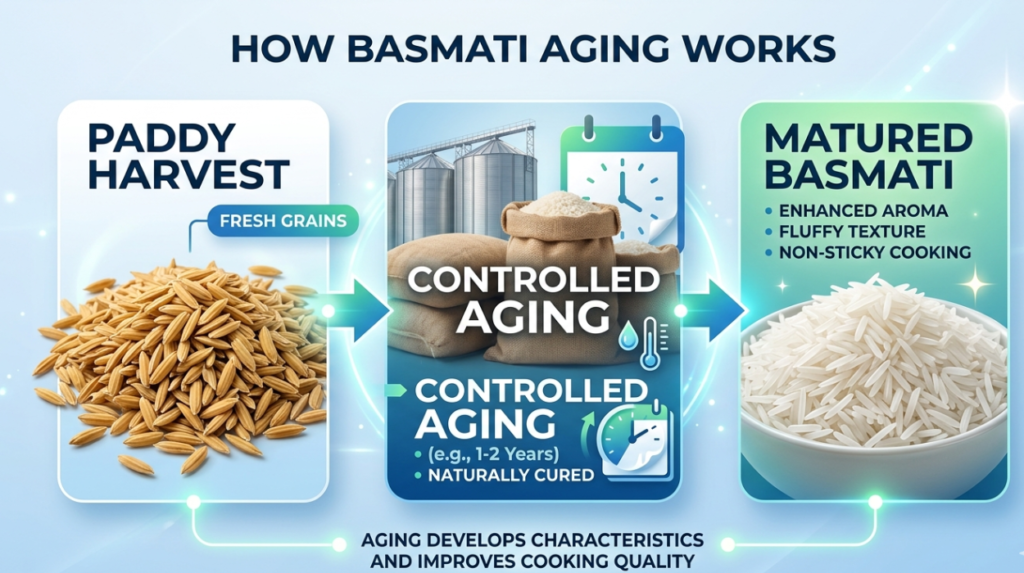
The physical mechanism starts with moisture control. Fresh milled basmati can still carry slightly higher internal moisture. During storage, that moisture slowly equilibrates and falls to a stable level. As the grain dries out, internal pressure decreases. That reduces the risk of cracking when the grain is cooked and helps the outer layer stay intact.
At the same time, enzymatic and chemical changes occur inside the grain. Long‑chain starches reorganise slightly, and certain aromatic molecules accumulate in the remaining bran and oil fractions. These changes are subtle but measurable. The grain does not become “new,” but it does become more stable and more aromatic. The 12‑month window allows that evolution to complete without pushing the grain beyond its safe storage life.
For 1121 white basmati, this process is especially important because the long raw grain and polished surface are sensitive to moisture and heat. A properly aged 1121 grain is less likely to collapse during cooking and more likely to stretch into separate, fragrant strands. That is why aging is treated as a quality‑shaping step, not a cost‑only storage line.
What is the 12‑month time window?
The 12‑month time window is a standard aging period used to raise aromatic intensity, improve grain firmness, and align the lot with the next harvest cycle for consistent export supply.
Twelve months is long enough to shift the grain from a “fresh from mill” state to a more stable, tightly textured state. It is short enough to avoid the deeper oxidative changes that can happen beyond 18–24 months. The precise effect varies slightly with storage temperature, humidity, and initial moisture, but the 12‑month rule gives buyers a predictable quality band.
For 1121 white basmati, this window suits the seasonal pattern of Punjab rice. The crop is harvested, milled, and stored in the autumn‑winter months for quality compliance. By the following autumn, the 12‑month aged lot is ready for export or premium retail while the new crop is being processed. This cycle keeps the pipeline full and the aging profile consistent.
How is 1121 white basmati aged step by step?
1121 white basmati is aged step by step by storing clean milled grain in controlled bins, maintaining low moisture and stable temperature, and monitoring the lot until it reaches the target 12‑month aging window.
The first step is storage preparation. The milled rice is moved from milling to dedicated storage where the bin or silo is clean, dry, and free of contamination. The second step is moisture control. The grain is kept at a moisture level that prevents mould but also avoids over‑drying that can cause brittleness. The third step is temperature management. The warehouse or silo is kept at a stable temperature to stop heat stress and uneven aging.
The fourth step is monitoring. The lot is checked for odour, insect activity, and moisture at regular intervals. The fifth step is release timing. Once the rice reaches 12 months of controlled storage and meets quality tests, it is moved into packing or re‑grading for export. The aging process therefore runs in parallel with the standard rice supply chain rather than as a separate industrial stage.
What are the key components of the aging process?
The key components of the aging process are moisture control, temperature stability, storage time, and storage environment, each of which shapes how much aroma and texture improve in 1121 white basmati.
Moisture control is the first component. If the grain is too wet, it can ferment or develop off‑odours. If the grain is too dry, it can become brittle and crack during cooking. Temperature stability is the second component. Fluctuations can create condensation and uneven aging. Storage time is the third component. Twelve months is the chosen window for the 1121 aroma‑texture balance. The storage environment is the fourth component. Clean, sealed, low‑light, low‑oxygen conditions help protect the grain.
Together, these components create a controlled environment where the grain ages rather than degrades. That is why the process is treated as a technical stage, not just “waiting in a warehouse.” The 12‑month aged 1121 that passes this stage tends to cook with better separation, more elongation, and stronger fragrance than the same grade that is packed immediately after milling.
How does aging enhance aroma?
Aging enhances aroma by allowing volatile aromatic compounds to build up inside the grain and stabilise so that the rice releases a stronger basmati scent during cooking.
Freshly milled basmati can smell faint or green. Over 12 months of aging, certain compounds related to the rice’s natural oils and bran residues change. The grain slowly loses some of the “green” notes and gains warmer, more honey‑like tones. When the aged rice is washed and cooked, those compounds volatilise more clearly, giving a stronger perfumed effect.
The 12‑month window is not arbitrary. Shorter periods (3–6 months) may not build enough complexity. Much longer periods can push the grain into a drier, more oxidised state that may weaken the aroma. The 12‑month aged 1121 sits in a sweet spot where the smell is strong but not stale. This is why the term “aged basmati aroma” is often associated with 12‑month or similar programs.
How does aging change texture?
Aging changes texture by tightening the grain structure, reducing internal moisture gradients, and improving starch organisation so that 1121 white basmati grains stay separate and firm after cooking.
A freshly milled grain can absorb water unevenly, causing the outside to soften while the inside remains hard. Aging smooths out those gradients. The grain reaches a more uniform internal state, so it absorbs water more evenly when cooked. The starch also reorganises slightly, making the grain less sticky and more linear. That is why aged 1121 tends to stretch into long, non‑clumpy strands rather than clump or turn mushy.
The 12‑month period is long enough to see this effect in 1121 white basmati, which already has a naturally long kernel. The combination of long grain and controlled aging creates a texture that suits fine‑dining and premium retail. The grain separates well, stands up on the plate, and feels al dente rather than soft or broken.
What grades use aging?
Several basmati grades use aging, including 1121, 1509, and certain steam or parboiled lines, each with its own typical aging window before packing or export.
1121 is the most common aged grade because buyers link the 8 mm+ raw grain with premium quality. 1509 basmati often follows similar aging rules, usually at slightly shorter windows because it is sometimes used in more everyday configurations. Steam and parboiled basmati lines may also be aged, but the effect is less about aroma and more about uniform moisture before final color‑sorting and internal crack control.
Exporters working with 1121 white basmati will often label the aging window clearly on the pack or specification sheet. “12‑month aged 1121” signals that the rice was stored under controlled conditions before packaging. That distinction matters because buyers can then compare aged 1121, unaged 1121, and other basmati types in the same supply chain.
Which markets buy aged 1121 white basmati?
Markets that buy aged 1121 white basmati include the UAE, Saudi Arabia, EU, UK, China, Malaysia, and several African and Middle Eastern countries, where importers and brands value stronger aroma and premium texture.
The UAE and Saudi Arabia both import large volumes of Pakistani basmati, and 12‑month aged 1121 is often reserved for higher‑end packs and foodservice use. The EU and UK receive significant volumes of basmati each year, and strict moisture, residue, and labelling rules make aging an important tool for meeting those standards. China, Malaysia, and many African importers use 1121 white basmati for both retail and wholesale, with aging applied where the market can absorb a higher price for better quality.
Within the Punjab export cluster, AHK Rice fits this pattern by supplying 1121, Super Kernel, and 1509 varieties to 15+ countries. The 12‑month aging window is one of the quality levers used to differentiate premium 1121 white basmati for export channels that reward aroma and separation.
What certifications apply to aged basmati exports?
Certifications that apply to aged 1121 white basmati exports include phytosanitary certificates, certificates of origin, food safety systems such as HACCP or ISO 22000, and various residue and compliance checks requested by destination markets.
Phytosanitary documents show the plant‑health status of the rice from harvest through storage. A certificate of origin proves that the 1121 basmati is from Pakistan and was stored locally before export. Food safety certifications such as HACCP demonstrate that the mill and storage follow controlled processes. Residue and moisture tests show that the grain meets import limits for pesticides, heavy metals, and moisture even after 12 months in storage.
Destination markets often add their own rules. EU and UK importers expect lab‑based residue and traceability data. Gulf countries require clean phytosanitary and customs documentation. African and Asian markets may request additional certificates depending on the contract. The 12‑month aging window does not change the certification list, but it does mean that the entire storage chain must be included in the audit trail and risk assessment.
What are the main benefits of aging?
The main benefits of aging 1121 white basmati are improved aroma, better texture, more consistent cooking performance, and a higher perceived quality that supports premium pack pricing.
A stronger aroma improves the sensory experience for the buyer. A tighter, more linear texture improves the visual appeal on the plate. Consistent cooking performance reduces the chance of under‑ or over‑cooking, which is important for both retail and foodservice. The higher perceived quality allows the rice to be positioned above fresh‑milled basmati in the same category, which benefits pack differentiation and margin.
For 12‑month aged 1121, the aging step does not create a new variety. The variety is still 1121. What changes is the grain state. The same export logic used for fresh 1121 applies, but the aged version is reserved for buyers who prioritise fragrance and separation over raw cost.
What are the use cases for 12‑month aged 1121?
Use cases for 12‑month aged 1121 include premium retail packs, fine‑dining kitchens, high‑end caterers, and brands that want a stronger basmati aroma and cleaner, non‑clumpy texture.
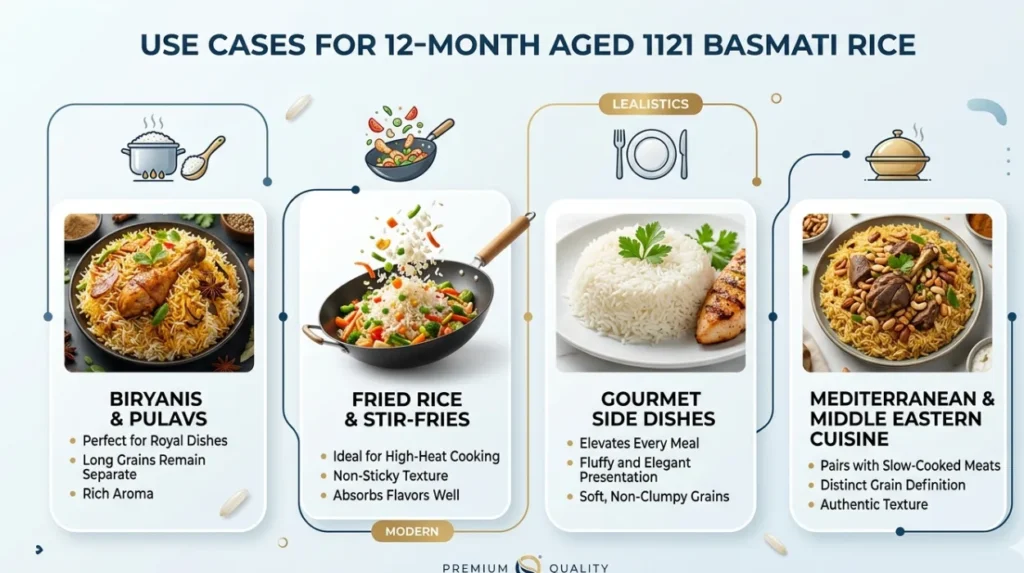
In retail, 12‑month aged 1121 is often used in smaller consumer packs labeled as “aged basmati,” “premium basmati,” or “12‑month aged 1121.” Supermarkets use it where the price point can support the aging window and the labels emphasise fragrance and tradition. In foodservice, high‑end restaurants and hotels use it for dishes where the grain must look elegant and separate on the plate.
Some brands reserve aged 1121 for special lines such as “gourmet basmati” or “long‑age basmati,” while using fresh‑milled 1121 for mid‑tier or value packs. The 12‑month window thus becomes a segmentation tool inside the export supply chain rather than a one‑size‑fits‑all choice.
What common problems or misconceptions exist?
Common problems and misconceptions are that aging always improves quality, that older is always better, and that aging creates a different rice variety rather than changing the state of the same 1121 white basmati.
Aging does not automatically make any basmati better. If the grain is stored in humid or warm conditions, it can develop off‑odours, insect damage, or increased moisture. That can undo the benefits of the 12‑month window. Another misconception is that “more aging” is always superior. Aging beyond 18–24 months can make the grain too dry, grainy, and fragile, which reduces quality instead of increasing it.
A third misconception is that aged 1121 is a different variety. It is not. The genetic identity is still 1121. What changes is the physical and aromatic profile shaped by storage. The 12‑month aged 1121 white basmati is therefore a refined version of the same export grade, not a new category. That is why buyers should compare the storage conditions and test results, not just the age figure.