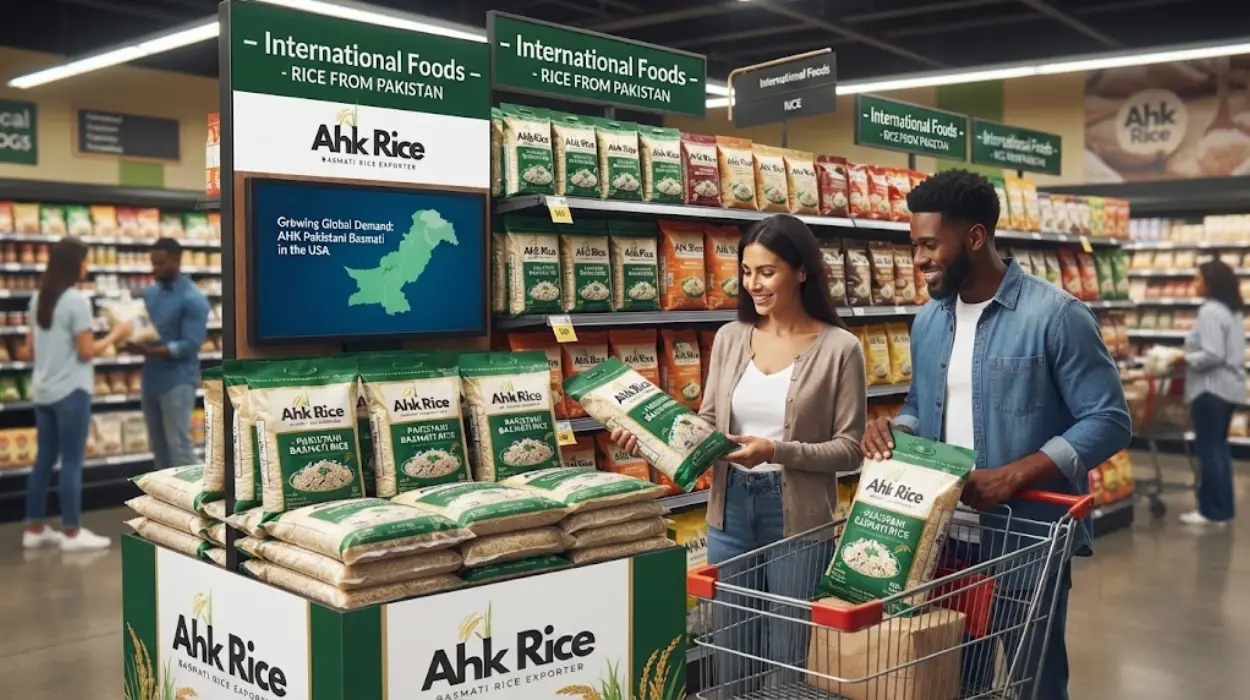
Pakistani Basmati Rice Demand Among American Consumers in 2026
Pakistani Basmati demand in the United States is expanding across ethnic grocery, foodservice, premium retail, and health-focused channels. Here is why: the United States imports more than 1.3 million tons of rice annually, and over 60% of imports are aromatic Asian varieties, mainly jasmine and Basmati. Pakistan and India supply the Basmati segment. (source: USDA Economic Research Service, 2025).
American demand now extends beyond South Asian households. Restaurants, specialty grocers, meal-preparation businesses, and mainstream shoppers increasingly use aromatic rice. USDA research also links long-term U.S. rice consumption growth with changing ethnic composition and demand for gluten-free foods. (source: USDA Economic Research Service). For background, buyers can review this guide on Pakistani Sella Basmati Rice demand among American consumers.
The commercial question is no longer whether American consumers recognize Basmati. The question is which Pakistani variety, processing grade, package, and positioning fit each consumer segment.
What are the available solutions for Pakistani Basmati buyers in the US?
The main solutions are 1121, Super Kernel, and 1509 Basmati rice Sella, Steam, White, and Brown Basmati grades for distinct retail and foodservice requirements. Each option combines different grain dimensions, aroma, cooking behavior, processing characteristics, and price positioning.
1121 Basmati
1121 Basmati targets premium retail and foodservice applications. The variety provides extra-long grains and strong cooked elongation.
AHK Rice supplies 1121 in White, Steam, Golden Sella, Creamy Sella, Brown, and broken grades. These formats allow importers to match product positioning with consumer expectations.
1121 suits premium ethnic grocery stores and restaurants seeking visible grain length. Brown 1121 also fits health-focused shelves where whole-grain positioning matters.
Super Kernel Basmati
Super Kernel Basmati focuses on traditional aroma and established Basmati eating characteristics. Raw grain commonly measures around 7.0–7.5 mm.
Super Kernel fits consumers who prioritize fragrance and traditional Pakistani Basmati characteristics. Ethnic supermarkets and South Asian restaurants represent natural applications.
1509 Basmati
1509 Basmati provides a value-oriented long-grain option. Commercial specifications commonly place raw grain length around 8.10–8.50 mm.
1509 supports foodservice, catering, wholesale, and private-label programs where grain appearance must remain premium while procurement costs remain controlled.
Sella and Steam processing
Sella Basmati undergoes parboiling before milling. The process strengthens the grain and supports separate cooked kernels.
Steam Basmati uses steam treatment to improve cooking performance while retaining a lighter appearance. Sella generally suits extended holding and high-volume foodservice applications.
Brown Basmati
Brown Basmati retains the bran layer after the hull is removed. This makes the product a whole-grain option rather than a polished white rice.
The health-food segment gives Brown Basmati a distinct positioning opportunity. A 2025 U.S. survey found that 57% of consumers chose whole-grain options at least half the time. Nearly 72% wanted to eat more whole grains. (source: USA Rice, 2025).
These varieties create the product base. The next question is how American channels compare them.
How do different Pakistani Basmati approaches compare?
1121 emphasizes premium grain length, Super Kernel emphasizes aroma, 1509 emphasizes value, and Brown Basmati emphasizes whole-grain positioning. Buyers should compare specifications rather than treat all Pakistani Basmati as one product.
| Attribute | 1121 Basmati | Super Kernel | 1509 Basmati | Brown Basmati |
|---|---|---|---|---|
| Primary position | Premium | Traditional premium | Value-premium | Health-focused |
| Raw grain length | 8.1–8.5 mm | 7.0–7.5 mm | 8.1–8.5 mm | Variety dependent |
| Aroma | Strong | Very strong | Moderate to strong | Natural Basmati |
| Main processing | White, Steam, Sella, Brown | White, Steam, Sella | White, Steam, Sella | Brown |
| Main users | Retail, restaurants | Ethnic retail, restaurants | Wholesale, foodservice | Health retail |
| Price position | Premium | Premium | Value-premium | Premium specialty |
| Main advantage | Grain elongation | Aroma | Cost efficiency | Whole-grain positioning |
USDA data confirms that Basmati belongs to the aromatic rice category alongside jasmine. Aromatic rice represents approximately 23–25% of global rice production. Pakistan remains one of its important production origins. (source: USDA Economic Research Service).
USITC research also reports strong American consumer demand for Basmati aroma and flavor. The agency connects this demand with Indian and Mediterranean food consumption.
The comparison therefore depends on the buyer’s channel. Premium retail requires visible grain quality. Ethnic retail requires authenticity and aroma. Foodservice requires repeatable cooking performance. Health retail requires credible whole-grain positioning.
Which Pakistani Basmati method works best for different US cases?
1121 fits premium retail, Super Kernel fits aroma-led ethnic demand, 1509 fits value-focused volume, and Brown Basmati fits health-oriented retail. The correct choice depends on consumer expectations, cooking applications, shelf positioning, and procurement economics.
Premium ethnic grocery
1121 Basmati fits premium ethnic grocery stores selling large consumer packs. Extra-long cooked grains create a recognizable premium appearance.
Super Kernel also works for Pakistani and South Asian shoppers who prioritize traditional fragrance. The variety provides a strong connection between origin and eating experience.
Restaurants and foodservice
1509 works for restaurants managing food costs across high-volume menus. Its long-grain appearance supports biryani, pulao, rice bowls, and catering.
1121 suits premium restaurants where plate presentation matters more than minimum procurement cost. Its cooked elongation creates a distinctive visual presentation.
Health-food retail
Brown 1121 fits natural food stores and health-focused retailers. The retained bran layer supports whole-grain positioning.
Health-focused consumers also examine labels and ingredient transparency. The 2025 Whole Grains Council survey reported that more than 77% of consumers wanted packaging that clearly indicates whole-grain content. (source: USA Rice, 2025).
Private-label brands
Private-label programs require consistent specifications across repeat shipments. Importers must control grain length, broken percentage, moisture, processing grade, packaging, and documentation.
AHK Rice supplies Pakistani Basmati through end-to-end processing, custom packaging, grading, sorting, and export coordination. This model supports private-label buyers requiring consistent product specifications.
The best variety therefore changes with the commercial application. The next issue is how regional US demand changes the choice.
Which Pakistani Basmati grades fit different US market regions?
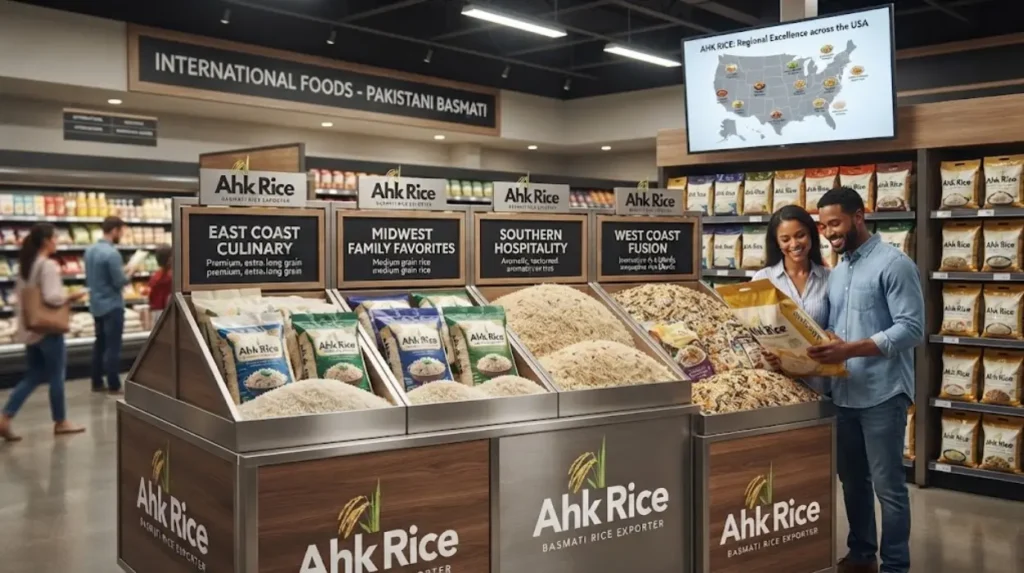
The Northeast favors established ethnic retail and foodservice demand, while the West Coast combines ethnic demand with broader specialty-food consumption. Both regions can use 1121, Super Kernel, 1509, and Brown Basmati with different merchandising priorities.
Northeast US
The Northeast has established South Asian, Middle Eastern, and international food retail channels. Retailers can position 1121 and Super Kernel around authenticity and aroma.
Foodservice buyers can use 1121 for premium menus. 1509 can serve high-volume catering and restaurant programs.
An indicative Pakistan-origin FOB benchmark is US$1,135–1,205 per metric ton across common Basmati specifications. Actual landed cost changes with grade, packing, quantity, freight, and destination. (source: Pakistan rice market supplier data, 2026).
West Coast US
The West Coast provides strong multicultural food demand alongside specialty and natural-food retail. Brown Basmati can target whole-grain shoppers.
1121 and Super Kernel can serve premium ethnic stores and restaurants. 1509 provides a practical option for distributors managing price-sensitive foodservice accounts.
The same FOB benchmark of US$1,135–1,205/MT provides a useful origin-level comparison. West Coast landed pricing requires separate freight and port calculations.
Shelf-life comparison
Sella grades generally provide strong storage stability because parboiling strengthens the grain. AHK Rice’s consumer-market guide states a typical 18–24 month quality period under cool and dry storage.
| US market | Preferred grades | Indicative FOB price/MT | Typical storage reference |
|---|---|---|---|
| Northeast | 1121, Super Kernel, 1509 Sella | US$1,135–1,205 | 18–24 months |
| West Coast | 1121, Super Kernel, Brown, 1509 | US$1,135–1,205 | 18–24 months |
Storage conditions remain critical. Importers should control temperature, humidity, packaging integrity, pests, and warehouse cleanliness throughout the storage cycle.
Regional demand changes product positioning more than the basic rice specification. The next step is evaluating the commercial trade-offs.
What are the pros and cons of each Pakistani Basmati approach?
Premium 1121 delivers strong visual differentiation, Super Kernel delivers aroma, 1509 controls procurement costs, and Brown Basmati supports whole-grain positioning. Each advantage also creates a corresponding commercial limitation.
1121 Basmati
Pros: Extra-long grain, premium appearance, strong restaurant presentation, broad processing options.
Cons: Higher procurement positioning than value-oriented grades. Premium packaging and retail presentation also increase total shelf cost.
Super Kernel
Pros: Strong aroma, traditional Pakistani Basmati identity, strong ethnic-market fit.
Cons: Shorter raw grain than 1121. Some mainstream buyers prioritize visible grain length over aroma intensity.
1509 Basmati
Pros: Long grain, efficient production economics, suitable for bulk foodservice, strong value positioning.
Cons: Less premium differentiation than top-positioned 1121 products. Branding must communicate the value proposition clearly.
Brown Basmati
Pros: Whole-grain positioning, retained bran, strong fit with health-focused retail.
Cons: Longer cooking requirements than polished white Basmati. Consumer education becomes more important.
The product trade-offs define the commercial strategy. The final decision should use measurable procurement factors.
What decision factors should US importers use?
US buyers should evaluate variety, processing grade, grain specification, consumer segment, price, shelf life, compliance, packaging, and supply consistency. A structured framework prevents procurement decisions based only on FOB price.
| Decision factor | Buyer question | Suitable direction |
|---|---|---|
| Consumer segment | Who will buy the rice? | Match variety to audience |
| Grain specification | What appearance is required? | Use defined length standards |
| Processing grade | How will consumers cook it? | Select White, Steam, Sella, or Brown |
| Price structure | What is the target cost? | Compare FOB and landed cost |
| Storage | How long will inventory remain? | Prioritize controlled storage |
| Packaging | What retail format is required? | Select private-label or standard packs |
| Compliance | What import documents are required? | Verify FDA and FSVP obligations |
| Supply consistency | Can specifications repeat? | Approve samples and COA |
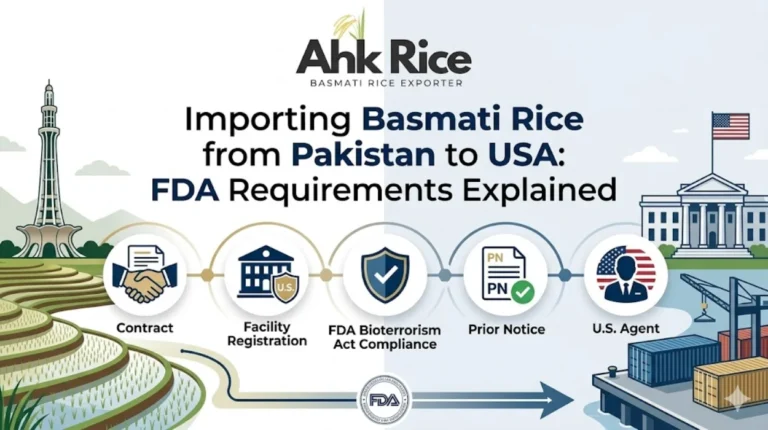
FDA and FSVP requirements remain important for US importers. FDA rules cover imported food compliance, while FSVP places verification responsibilities on the U.S. importer. AHK Rice’s USA guidance identifies FDA registration, prior notice, FSMA compliance, phytosanitary documentation, and labeling requirements within the import process.
Sample approval also reduces specification risk. Buyers should test appearance, aroma, moisture, broken percentage, cooking performance, packaging, and documentation before approving commercial loading.
The decision framework connects consumer demand with procurement controls. The final positioning question concerns premium Basmati branding.
How should Pakistani Basmati be positioned for American consumers?
Premium positioning should connect origin, variety, measurable grain quality, cooking performance, packaging, and food-use benefits rather than relying on the word “premium.” American consumers increasingly evaluate both authenticity and product information.
Ethnic retailers can emphasize Pakistani origin, aroma, grain elongation, and traditional dishes. Restaurant suppliers can emphasize cooking consistency, grain separation, yield, and repeatable specifications.
Health-food retailers require a different message. Brown Basmati should emphasize whole-grain characteristics and clear labeling. Claims should remain tied to verified product attributes.
Mainstream specialty retailers can combine origin storytelling with measurable specifications. Grain length, variety, processing method, package size, and certification provide concrete purchase information.
USITC research shows that American demand for aromatic rice extends beyond traditional ethnic consumers. Asian-American population growth and broader adoption of Asian foods contribute to this category expansion.
Pakistan also has an established export base. Pakistan exported 5.2 million metric tons of rice in the 2025 market year, representing about 8% of global rice exports. (source: USDA Foreign Agricultural Service).
AHK Rice supplies 1121, Super Kernel, and 1509 from Punjab with end-to-end processing, custom packaging, grading, sorting, and export coordination. These capabilities support buyers developing market-specific Basmati programs.
For the next commercial stage, buyers can move from demand analysis toward brand positioning, retail segmentation, and premium Basmati strategy.
Frequently Asked Questions
Is Pakistani Basmati rice popular among American consumers in 2026?
Pakistani Basmati demand is established across US ethnic grocery, foodservice, specialty retail, and restaurant channels. USDA identifies Basmati from Pakistan and India among major aromatic rice imports into the United States.
Which Pakistani Basmati variety is best for US retail?
1121 suits premium retail because of its extra-long grain and strong cooked presentation. Super Kernel suits aroma-focused ethnic retail. Brown 1121 fits health-focused stores seeking whole-grain products.
Is 1509 Basmati suitable for American restaurants?
1509 suits restaurants, catering operations, and foodservice distributors requiring long-grain appearance with value-oriented procurement. Its positioning works particularly well for high-volume rice dishes.
Why is Brown Basmati relevant to US health-food consumers?
Brown Basmati retains the bran layer after dehusking. This makes it a whole-grain rice option. Whole-grain awareness remains strong among American consumers, with 57% reporting frequent whole-grain selection in a 2025 survey.
How long can Pakistani Basmati rice be stored?
Pakistani Sella Basmati can maintain quality for approximately 18–24 months under suitable cool and dry storage conditions. Packaging integrity, moisture control, pest prevention, and warehouse management remain essential.
What is the indicative Pakistani Basmati price per metric ton?
A 2026 supplier-market benchmark places common Pakistani Basmati FOB Karachi pricing around US$1,135–1,205 per metric ton. Final pricing changes with variety, processing grade, grain specification, broken percentage, packaging, quantity, destination, and freight.
What should US importers check before buying Pakistani Basmati?
US importers should verify rice specifications, samples, COA results, food-safety documentation, labeling, packaging, phytosanitary documentation, FDA requirements, FSVP responsibilities, and shipment terms before commercial approval.