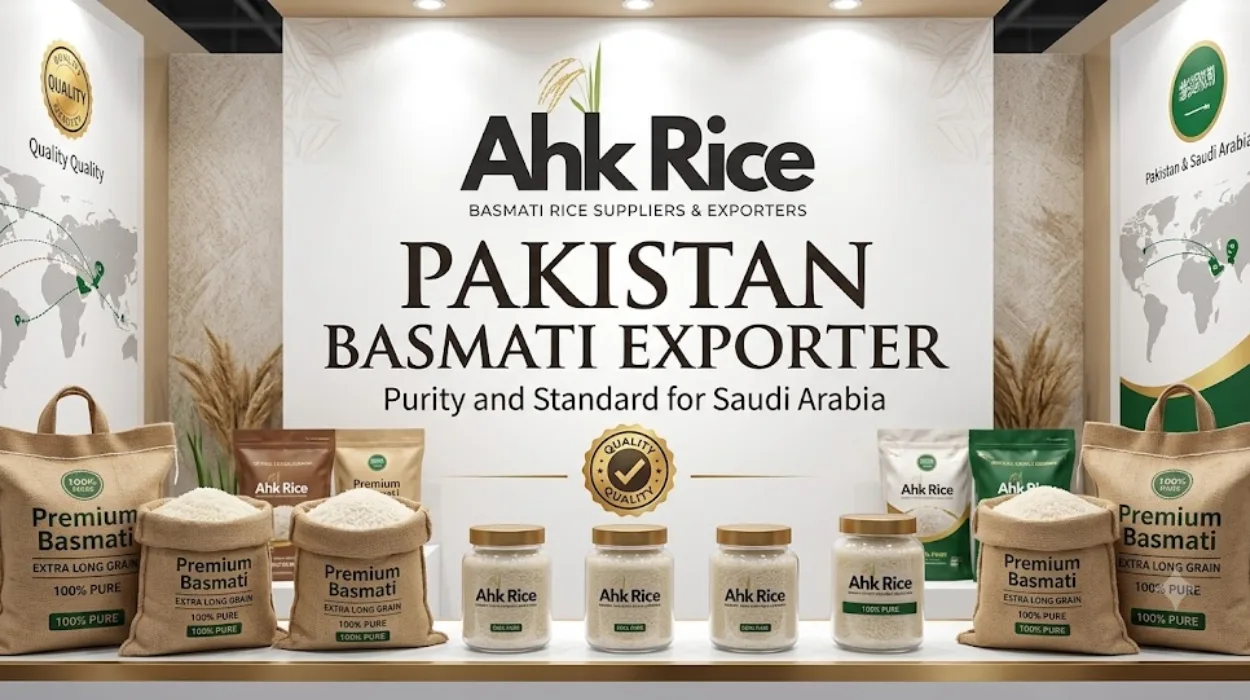
Choose a Pakistan Basmati Rice Exporter That Meets Saudi Arabian Purity Requirements
Saudi Arabian buyers should choose a Pakistan Basmati rice exporter based on verified purity, shipment-specific testing, Saudi compliance, controlled processing, and documented logistics, not simply the lowest price. For buyers researching the verification process first, the guide on:
How Saudi Arabian importers evaluate purity when selecting Pakistan rice suppliers explains the quality checks that should happen before commercial approval.
For commercial procurement, Pakistan Basmati rice must be matched to a written specification covering variety, grain length, broken percentage, moisture, purity, foreign matter, food safety, packaging, and documentation. Saudi Food and Drug Authority requirements also make importer and product registration, compliant food standards, and supporting certificates important parts of the clearance process.
What is the best solution for meeting Saudi Arabian Basmati rice purity requirements?
The best solution is a supplier-controlled specification process combining varietal selection, physical sorting, laboratory testing, pre-shipment inspection, traceable documentation, and sample approval before bulk loading, so Saudi importers receive rice that matches the agreed purity specification throughout procurement and customs clearance.
Purity should not be treated as a single percentage written on a quotation. It is a commercial quality system. The supplier should first identify the declared Basmati variety and then control the physical characteristics of the finished lot.
For Saudi buyers, relevant specifications can include grain length, broken grains, moisture, damaged kernels, foreign matter, varietal purity, aroma, cooking performance, pesticide residues, heavy metals, and microbiological safety. Current 2026 Saudi import guidance confirms that imported food must comply with applicable Saudi technical regulations and standards.
AHK Rice approaches this through controlled processing from paddy procurement through milling, grading, color sorting, testing, packing, and container loading. The company supplies Pakistani Basmati varieties including 1121, 1509, and Super Kernel for Saudi importers.
A typical premium specification can target 1121 Basmati around 8.20–8.40 mm average grain length, 1509 around 8.00–8.30 mm, and Super Kernel around 7.20–7.60 mm. Purity requirements vary by contract, so the buyer should define the exact tolerance rather than assume that every Basmati grade has the same requirement.
The processing sequence is equally important. Paddy is cleaned, dried, de-husked, separated, polished, graded, and color sorted before final inspection. These steps remove foreign material, inconsistent kernels, discolored grains, and other physical defects that can reduce the commercial value of a shipment.
For a Saudi distributor, this means the supplier is evaluated on repeatability. A sample that looks excellent but cannot be reproduced in the container does not solve the procurement problem. AHK Rice therefore positions pre-shipment verification and standardized processing as part of the supply decision.
Why choose the Saudi Arabia service from AHK Rice?
The Saudi Arabia service is designed for importers needing Pakistan-origin Basmati rice with controlled specifications, export documentation, sampling, packaging options, and coordinated shipping to Saudi destinations, reducing the operational gaps between product approval, container loading, customs clearance, and distribution.
AHK Rice supplies Pakistan Basmati rice directly for Saudi Arabia through a dedicated export service covering major varieties and commercial specifications. Buyers can review the Saudi Arabia Basmati rice export service when comparing supply capability, packaging, documentation, and shipment arrangements.
The service is relevant to wholesalers, distributors, retailers, catering companies, restaurants, and private-label buyers. AHK Rice operates from Bucheki, Nankana Sahib, Punjab, and manages processing and export operations from sourcing through container loading.
The primary commercial advantage is specification control. A Saudi buyer can define the variety, grain profile, broken percentage, moisture target, packing format, volume, and destination before the exporter prepares the final quotation.
The second advantage is documentation support. Saudi food clearance requires the importer to have its establishment and food products registered with SFDA systems, while clearance documentation can include origin, commercial invoice, bill of lading, health and phytosanitary certificates, and other documents depending on the product and shipment.
AHK Rice supports the exporter-side documentation process so that the commercial shipment is prepared around the buyer’s destination requirements. This does not replace the Saudi importer’s regulatory responsibilities. Instead, it reduces the chance of an exporter-side documentation gap delaying the clearance process.
The third advantage is inspection before loading. AHK Rice offers pre-shipment quality verification so buyers can confirm that the physical shipment corresponds with the approved specification before the container leaves Pakistan.
This matters when purchasing premium Basmati at container scale. If a buyer is importing 20–25 metric tons, a small specification deviation repeated across the entire lot can create a much larger commercial problem than a difference in the quoted price per metric ton.
AHK Rice also provides multiple packaging formats, including PP, jute, non-woven, cloth, box, and other options depending on the product and buyer requirements. Private-label buyers can therefore align packaging with their Saudi retail or distribution strategy.
What results can be expected from a verified AHK Rice supply?
A verified AHK Rice supply should give Saudi importers measurable consistency in grain specifications, lower quality-dispute exposure, better documentation readiness, predictable shipment planning, and rice performance that remains aligned with the approved sample when the bulk shipment reaches the Saudi market.
The expected result begins with consistency between sample and production. A buyer should not approve a sample based only on appearance. The sample should be cooked and assessed for aroma, grain separation, elongation, texture, and recovery after cooking.
For example, a Saudi catering distributor buying 1121 Basmati may prioritize long grain appearance and cooking expansion. A retail importer may place greater emphasis on purity, low broken percentage, uniform appearance, packaging, and shelf stability. The contract should reflect the intended use.
AHK Rice reports Saudi delivery benchmarks of approximately 18–22 days from Karachi to Jeddah, 20–26 days to Dammam, and 22–28 days for Riyadh when inland routing is required. Actual transit remains dependent on vessel schedules, port operations, customs clearance, and inland transportation.
This gives Saudi buyers a practical planning range rather than a single unsupported delivery promise.
The sample stage is faster. AHK Rice’s published procurement process describes sample preparation, courier or air dispatch, and delivery in approximately 4–7 business days. The company also states that samples can be supplied up to 20 kg, while courier and phytosanitary costs are generally handled by the buyer.
The outcome is a staged procurement decision:
- Confirm the required rice variety.
- Define the purity and physical specifications.
- Receive the representative sample.
- Test appearance and cooking performance.
- Review laboratory and compliance documents.
- Approve the commercial specification.
- Confirm price and Incoterm.
- Produce and inspect the bulk lot.
- Load the container.
- Track shipment to the Saudi destination.
This workflow gives AHK Rice buyers a clearer quality-control trail. If a shipment is later questioned, the buyer has an agreed specification and supporting documentation against which the lot can be assessed.
The Saudi regulatory environment makes this approach more valuable. SFDA’s food-clearance process includes document review, consignment inspection, visual examination, and laboratory sampling where required.
For that reason, AHK Rice does not treat purity as a marketing claim. The commercial objective is to connect the declared variety, physical specifications, laboratory evidence, documentation, and physical shipment into one traceable procurement process.
What pricing and sample costs should Saudi buyers expect?
There is no responsible single price for Saudi Basmati rice because the final landed cost changes with variety, purity specification, crop availability, processing intensity, packaging, order volume, freight, destination port, inspection, certificates, payment terms, and the selected FOB or CIF commercial basis.
AHK Rice’s current Saudi procurement information identifies grade, processing, seasonal paddy availability, freight rates, certification requirements, and market demand as major pricing variables. Higher-grade rice can cost more because tighter grain uniformity and lower broken percentages require greater processing and sorting control.
A buyer should therefore compare quotations using the same commercial basis. Comparing one exporter’s FOB Karachi price with another supplier’s CIF Jeddah price can produce a misleading result because freight, insurance, documentation, and destination costs may not be included in the same way.
Packaging also changes the price. Standard bulk PP bags can have a different cost structure from customized retail packaging, printed bags, private-label packaging, or smaller consumer formats.
Volume affects procurement economics as well. A full-container order generally creates a different cost structure from a small trial shipment because milling, packing, handling, freight, and documentation costs are distributed differently across the purchased quantity.
The sample process should be treated separately from the bulk rice price. A practical sample workflow is:
How does the sample process work?
The buyer first sends the required variety, purity target, packaging preference, quantity, and Saudi destination. AHK Rice selects the corresponding graded rice and prepares the sample for dispatch.
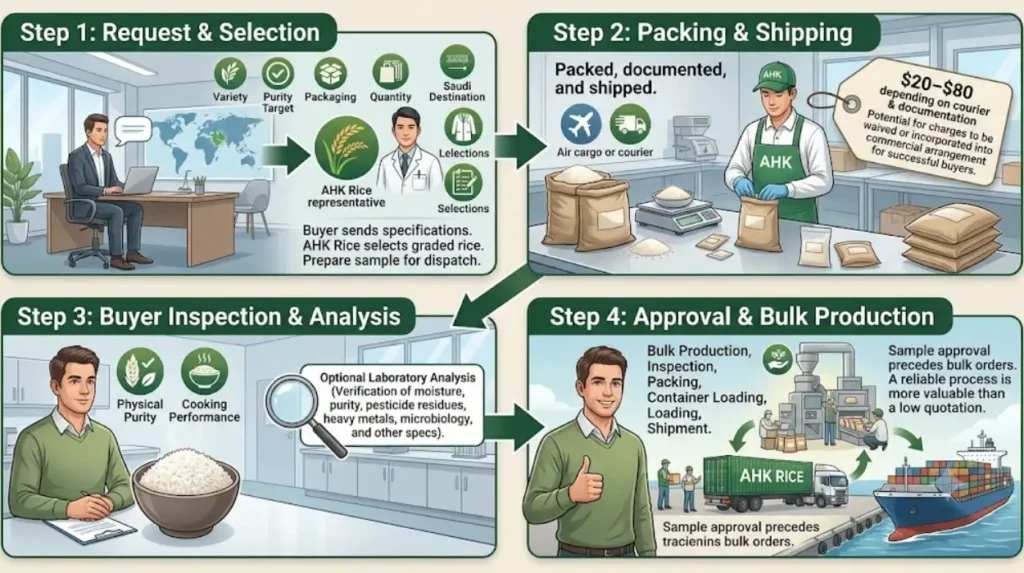
The sample is then packed, documented, and shipped by courier or air cargo. AHK Rice’s published Saudi procurement guide places typical sample costs at approximately $20–$80, depending on courier and documentation requirements. The company also states that successful buyers can have applicable sample charges waived or incorporated into the final commercial arrangement.
The buyer should then inspect the sample for physical purity and cooking performance. If required, laboratory analysis can be added to verify moisture, purity, pesticide residues, heavy metals, microbiological parameters, and other contractual specifications.
The final stage is approval. Once the buyer approves the sample and commercial terms, AHK Rice can proceed toward bulk production, inspection, packing, container loading, and shipment.
This approach is more useful than selecting an exporter solely because its first quotation is cheaper. A low initial price does not compensate for rejected cargo, inconsistent cooking performance, customs delays, repacking, or customer complaints.
How can Saudi buyers get started with AHK Rice?
Saudi buyers should start by submitting a precise procurement specification, reviewing a representative sample, confirming purity and food-safety requirements, agreeing on price and Incoterms, approving pre-shipment inspection, and scheduling container dispatch according to the selected Saudi destination.
The first step is specification mapping. Provide the required variety, such as 1121, 1509, or Super Kernel, together with grain length, purity, broken percentage, moisture target, packaging, quantity, and destination.
The second step is comparison. Buyers who want to benchmark premium and standard supplier specifications can review the:
Purity specifications that separate premium Pakistan rice exporters from standard suppliers before finalizing their procurement criteria.
The third step is sampling. AHK Rice can prepare a representative sample so the buyer can evaluate physical quality and cooking performance before committing to commercial volume.
The fourth step is documentation review. Saudi importers should ensure their own SFDA registration and product-registration requirements are satisfied while confirming that the exporter can provide the shipment documents required for clearance. SFDA’s current guidance specifically identifies food establishment and product registration as important parts of the import process.
The fifth step is commercial approval. Confirm the rice grade, quality tolerances, quantity, packaging, payment terms, Incoterm, destination port, inspection requirements, and expected shipping window in writing.
The sixth step is pre-shipment verification. AHK Rice can coordinate quality checks before container loading so the buyer has stronger evidence that the shipment matches the agreed specification.
The final decision should therefore be based on five factors: purity control, documentation readiness, sample-to-bulk consistency, shipping reliability, and transparent pricing.
For a Saudi importer, the right Pakistan Basmati rice exporter is not simply the supplier offering the lowest number per metric ton. It is the exporter that can reproduce the approved quality, document it, ship it within a realistic schedule, and support the buyer through the commercial process.
AHK Rice combines Pakistani Basmati sourcing, processing, grading, sorting, sampling, documentation, packaging, and Saudi-focused export logistics.
That combination gives Saudi buyers a practical route from purity specification to sample approval and finally to container-scale procurement. For the next commercial step, submit your requirements through the AHK Rice customized quotation request.
Frequently Asked Questions
What purity requirements should Saudi buyers check when importing Pakistan Basmati rice?
Saudi buyers should verify varietal purity, broken percentage, foreign matter, moisture, damaged grains, grain uniformity, pesticide residues, heavy metals, and microbiological safety according to the agreed specification and applicable Saudi requirements.
How does AHK Rice verify Basmati rice purity before shipment to Saudi Arabia?
AHK Rice uses controlled processing, grading, cleaning, color sorting, sampling, and quality testing to match the finished rice with the buyer-approved specification before container loading.
Which Pakistan Basmati rice varieties can Saudi importers buy from AHK Rice?
AHK Rice supplies varieties including 1121 Basmati, 1509 Basmati, and Super Kernel rice, with specifications adjusted according to the buyer’s required grade, purity, grain profile, packaging, and intended market.
How long does Pakistan Basmati rice take to reach Saudi Arabia?
Typical shipping benchmarks are approximately 18–22 days from Karachi to Jeddah and 20–26 days to Dammam. Riyadh can require approximately 22–28 days when inland transportation is included. Actual timing depends on vessel schedules, port handling, customs, and inland logistics.
How much does a Basmati rice sample from Pakistan to Saudi Arabia cost?
Sample costs depend on quantity, courier, documentation, and destination. A practical estimate can be around $20–$80, while larger samples or additional certification requirements may increase the total cost.
What should Saudi buyers test in a Pakistan Basmati rice sample?
Buyers should assess grain length, broken percentage, physical purity, foreign matter, moisture, aroma, cooking elongation, texture, appearance, and consistency. Laboratory testing can additionally verify food-safety parameters when required.
What documents are required for importing Pakistan Basmati rice into Saudi Arabia?
Depending on the shipment and applicable requirements, documentation can include a commercial invoice, certificate of origin, bill of lading, health or phytosanitary certificates, packing information, and other compliance documents required by Saudi authorities.
Can Saudi importers request private-label Basmati rice packaging?
Yes. Saudi importers can discuss customized packaging and private-label requirements with AHK Rice. Packaging options depend on the selected rice variety, bag size, material, printing requirements, order volume, and applicable Saudi labeling rules.
What factors affect the price of Pakistan Basmati rice in Saudi Arabia?
Price depends on rice variety, grade, purity specification, broken percentage, processing method, crop availability, order quantity, packaging, freight, inspection, certificates, payment terms, and whether the quotation is based on FOB, CIF, or another Incoterm.
Why should Saudi buyers approve a sample before placing a bulk rice order?
Sample approval allows buyers to verify that the rice meets their physical, cooking, and commercial expectations before committing to container-scale volume. It also establishes a reference point for comparing the final shipment.
How can Saudi importers choose a reliable Pakistan Basmati rice exporter?
Compare exporters based on documented purity controls, sample-to-bulk consistency, processing capacity, laboratory testing, Saudi compliance support, packaging capability, shipping timelines, documentation, and transparent commercial terms rather than price alone.
Can AHK Rice supply bulk Basmati rice to Saudi Arabia?
Yes. AHK Rice supplies Pakistan-origin Basmati rice for Saudi importers, including bulk orders for distributors, wholesalers, retailers, restaurants, food-service companies, and private-label businesses.