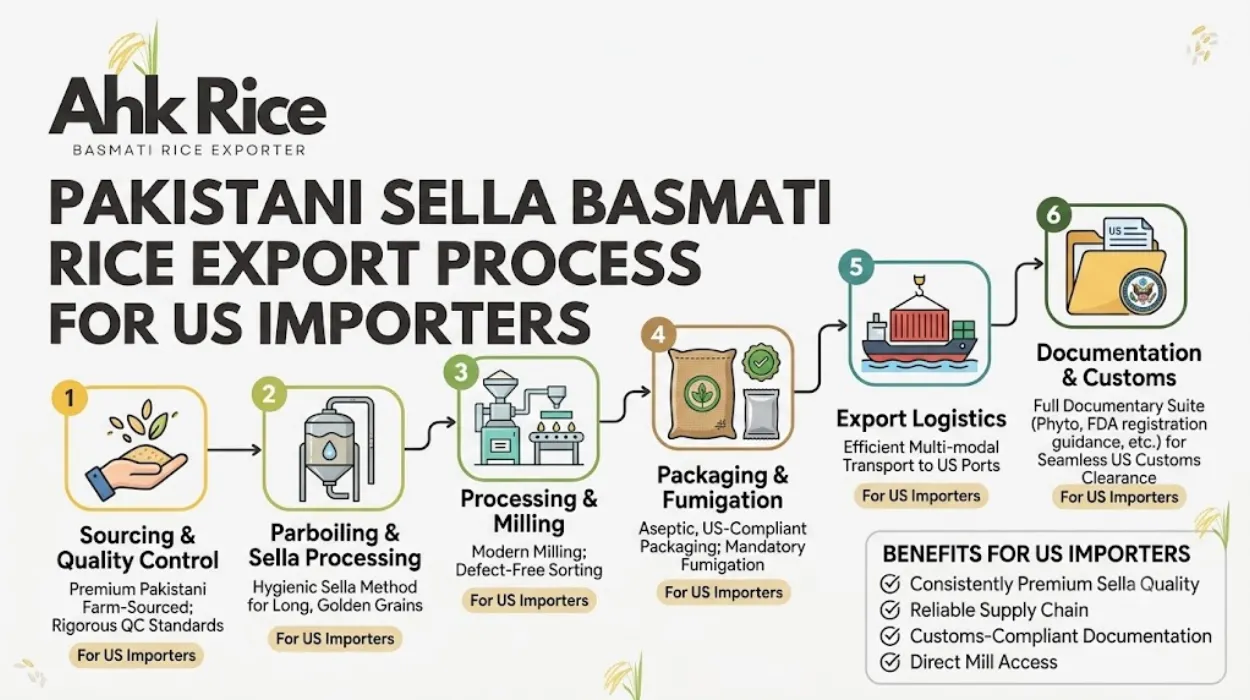
Pakistani Sella Basmati Rice Export Process for US Importers
Importing Pakistani Sella Basmati rice into the United States requires more than finding a supplier. US importers must evaluate quality standards, documentation, logistics, packaging specifications, and supplier reliability before placing commercial orders. Businesses that understand the complete export process reduce risk, avoid shipment delays, and secure consistent supply.
If you are evaluating opportunities in the US market, understanding current demand patterns through our guide on US market developments and buyer preferences provides useful context before selecting an exporter.
For importers seeking dependable sourcing, AHK Rice provides a structured export process designed specifically for international buyers. AHK Rice exports premium Pakistani Sella Basmati rice to multiple international markets while maintaining quality control, documentation compliance, and shipment consistency. This guide explains the complete export process from inquiry to delivery.
What is the best solution for importing Pakistani Sella Basmati rice into the United States?
The most effective solution is partnering with an experienced exporter that controls procurement, processing, quality inspection, packaging, documentation, and shipping under one system. This reduces operational risks, improves consistency, shortens lead times, and helps importers maintain reliable inventory availability throughout the year.
Many US importers face challenges when sourcing rice internationally. Common problems include inconsistent grain quality, delayed documentation, shipment scheduling issues, and communication gaps between suppliers and buyers.
A structured export process eliminates these challenges. AHK Rice follows a step-by-step system beginning with requirement analysis and ending with shipment delivery. Every stage is documented and verified before the next stage begins.
The process starts when a buyer submits product specifications. These specifications typically include rice variety, grain length, moisture requirements, broken percentage, packaging type, labeling requirements, and destination port.
After receiving the inquiry, AHK Rice prepares a detailed quotation. The quotation outlines product specifications, estimated shipping costs, minimum order quantity, payment terms, and expected production schedules.
Once pricing is accepted, sample preparation begins. This allows buyers to evaluate quality before committing to a commercial order.
Complete Sample Process for US Importers
Sample evaluation is one of the most important stages of the export process.
AHK Rice typically offers three sample options.
Standard Product Sample
- Sample weight: 500 grams to 1 kilogram
- Product cost: Usually complimentary
- Courier charges: USD 40–80 depending on destination
- Delivery time: 4–7 business days
Customized Sample
- Specific grading requirements
- Customized packaging requests
- Product cost: USD 20–50
- Courier charges apply separately
Commercial Evaluation Sample
- Larger quantity for laboratory testing
- Weight: 5–20 kilograms
- Product and shipping costs calculated according to quantity
After receiving the sample, importers can evaluate cooking performance, grain elongation, aroma, texture, moisture levels, and overall quality consistency.
Once the sample is approved, commercial production begins.
Why choose AHK Rice as your Pakistani Sella Basmati rice exporter?
US importers benefit from working with suppliers that provide transparent quality systems, export experience, consistent production standards, regulatory documentation, and responsive communication. These factors directly influence shipment reliability, customer satisfaction, and long-term profitability in competitive retail and wholesale markets.
Selecting the right exporter affects every stage of the supply chain.
AHK Rice has developed a process designed specifically for international importers seeking predictable results.
As a specialized exporter, AHK Rice manages sourcing from premium rice-growing regions of Punjab, Pakistan. This allows AHK Rice to maintain quality consistency throughout production cycles.
Importers also benefit from direct access to export specialists who coordinate orders, documentation, quality inspections, and shipping schedules.
For buyers comparing packaging specifications and compliance requirements, our guide covering quality standards, packaging formats, and US market requirements provides additional decision-making support.
Export Documentation Provided
AHK Rice provides export documentation commonly required for international trade transactions.
Documentation may include:
- Commercial Invoice
- Packing List
- Certificate of Origin
- Phytosanitary Certificate
- Fumigation Certificate
- Bill of Lading
- Quality Inspection Reports
- Health Certificates where applicable
Accurate documentation reduces customs clearance risks and supports smooth import operations.
Quality Control Process
Every shipment undergoes multiple quality verification stages.
The quality process includes:
- Raw material inspection
- Cleaning and sorting
- Color sorting
- Length grading
- Metal detection
- Moisture testing
- Packaging inspection
- Final loading verification
This systematic approach helps ensure that rice shipped matches approved specifications.
What results can US importers expect?
Importers working with an organized export process can expect improved supply reliability, better inventory planning, reduced quality complaints, stronger customer retention, and more predictable landed costs that support profitable growth in wholesale and retail distribution channels.
Results depend on product selection, order volume, logistics planning, and market positioning.
Many US distributors prioritize Pakistani Sella Basmati rice because of its cooking performance and value proposition.
When sourced through AHK Rice, importers gain access to consistent product grades that support repeat purchases and long-term customer relationships.
Typical Product Options
AHK Rice exports:
- 1121 Sella Basmati Rice
- Super Kernel Sella Basmati Rice
- 1509 Sella Basmati Rice
- White Basmati Rice
- Steam Basmati Rice
Each variety serves different customer segments and price points.
Importers can also request private labeling and customized packaging solutions to strengthen brand positioning in local markets.
Shipping Time by Market
Shipping schedules vary according to destination and vessel availability.
Typical transit times include:
| Destination Market | Estimated Transit Time |
|---|---|
| East Coast USA | 30–40 Days |
| Gulf Coast USA | 35–45 Days |
| West Coast USA | 40–50 Days |
| Canada East | 35–45 Days |
| Canada West | 45–55 Days |
| United Kingdom | 20–30 Days |
| Europe | 25–35 Days |
| Middle East | 10–20 Days |
Production lead times are generally added before shipment departure depending on order volume and packaging requirements.
AHK Rice provides estimated schedules during order confirmation to help importers plan inventory replenishment.
What factors affect pricing for Pakistani Sella Basmati rice exports?
Export pricing depends on rice variety, grain specifications, packaging requirements, order quantity, freight rates, seasonal harvest conditions, certification needs, and destination market requirements. Understanding these variables helps importers estimate costs accurately and negotiate supply contracts more effectively.
Several cost components influence final pricing.
Product Grade
Premium grades typically command higher prices due to longer grain length and stricter quality specifications.
Packaging Requirements
Customized packaging increases production costs because of printing, design, labeling, and material requirements.
Order Volume
Larger container volumes generally achieve better pricing efficiency.
Freight Rates
Ocean freight costs fluctuate according to market conditions and shipping routes.
Certification Requirements
Additional certifications may increase inspection and compliance costs.
Seasonal Supply Conditions
Harvest periods and crop availability influence raw material pricing throughout the year.
AHK Rice provides detailed quotations so buyers understand every component contributing to the final export price.
How does the commercial order process work?
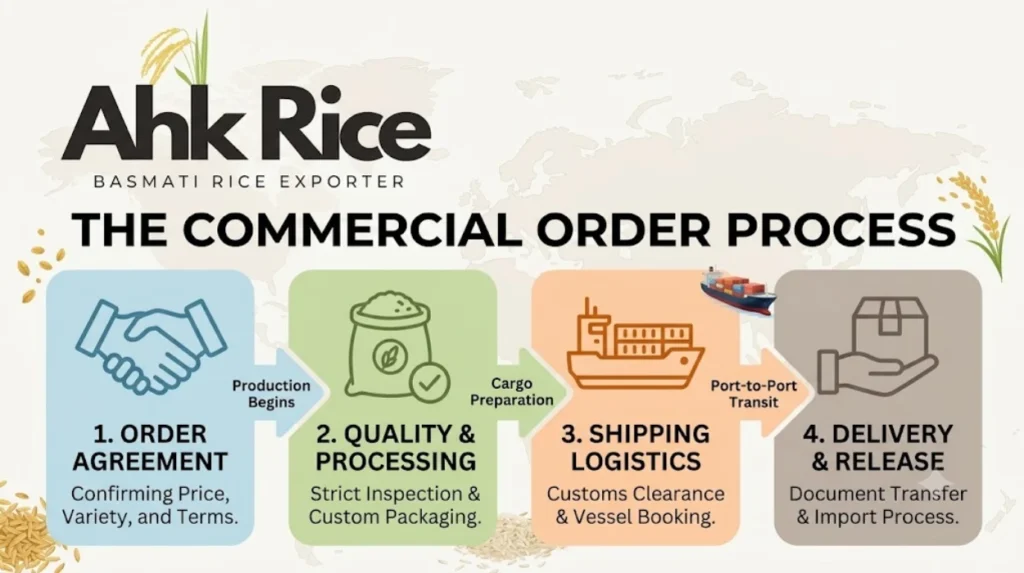
A structured commercial process reduces uncertainty by providing clear milestones, quality checkpoints, production schedules, documentation management, and shipment tracking. Importers gain visibility throughout the transaction and can make informed decisions at every stage of procurement.
The process generally follows these steps:
- Initial inquiry
- Specification review
- Quotation submission
- Sample approval
- Contract confirmation
- Production scheduling
- Quality inspection
- Packaging and labeling
- Export documentation preparation
- Container loading
- Shipment dispatch
- Delivery tracking
AHK Rice assigns export representatives who communicate updates throughout the process.
This transparency helps buyers coordinate inventory planning and customer commitments more effectively.
How to get started with AHK Rice?
The fastest way to begin is by sharing product specifications, destination information, packaging requirements, and estimated order volumes. This allows the exporter to prepare accurate quotations, recommend suitable rice grades, and initiate the sample approval process immediately.
The first step is identifying your target market requirements.
Determine the rice variety, package size, labeling specifications, and anticipated purchase volume.
Once requirements are defined, AHK Rice can recommend suitable product grades and provide export pricing.
After reviewing the quotation, request a sample for evaluation. The sample stage provides confidence before committing to commercial quantities.
Following sample approval, production planning, quality verification, and shipping arrangements are completed according to agreed timelines.
AHK Rice supports importers throughout the entire procurement cycle, helping businesses reduce sourcing risks and maintain consistent product availability in the US market.
Whether you are launching a new rice brand, expanding wholesale distribution, or adding premium Basmati products to your portfolio, a structured export process creates measurable advantages. Contact AHK Rice today and submit your requirements through our quotation request form to receive a customized export proposal.
Frequently Asked Questions
How long does it take to import Pakistani Sella Basmati rice into the USA?
The complete process usually takes between 45 and 70 days depending on production schedules, packaging requirements, and shipping routes. Sample approval is completed first, followed by production and documentation. Ocean transit times vary by destination port. Importers should plan inventory requirements in advance. Working with an experienced exporter helps minimize delays.
What is the minimum order quantity for commercial imports?
Most exporters supply rice in full container loads for optimal shipping efficiency. The exact quantity depends on packaging size and container type. Buyers can discuss customized requirements before placing orders. Sample orders are usually available before commercial commitments. MOQ flexibility may vary by product grade.
What quality certifications are commonly provided with exports?
Export shipments typically include certificates such as phytosanitary certificates, certificates of origin, fumigation certificates, and quality inspection reports. Additional certifications may be available depending on destination market requirements. Documentation helps facilitate customs clearance. Buyers should confirm compliance requirements before shipment. Exporters generally prepare documents before vessel departure.
Can US importers request private label packaging?
Yes, many importers choose customized retail packaging to build their own brand presence. Packaging can include custom artwork, logos, nutritional information, and market-specific labeling. Design approval is completed before production starts. Customized packaging may affect lead times and pricing. It also helps strengthen market differentiation.
Why is sample approval important before placing an order?
Sample approval allows importers to verify grain quality, cooking performance, moisture levels, and overall specifications. It reduces the risk of receiving products that do not meet expectations. Samples can also be tested internally before procurement decisions. This stage creates confidence for both buyer and supplier. Most successful import programs begin with thorough sample evaluation.