Private Label vs Standard Rice Packaging: Which Should You Choose?
Private label rice packaging suits retailers building their own brand, while standard rice packaging suits distributors prioritizing straightforward procurement and lower setup costs. Here is why: private label creates brand differentiation, and standard packaging simplifies purchasing, inventory, and market entry. The right choice depends on your sales channel, order volume, packaging budget, and long-term distribution strategy.
Packaging influences how buyers protect, transport, store, and sell Pakistani Basmati rice. Retailers need recognizable products, while wholesalers need practical bags that support efficient handling. Understanding the available formats and their commercial differences helps importers select a packaging strategy before signing a supply contract.
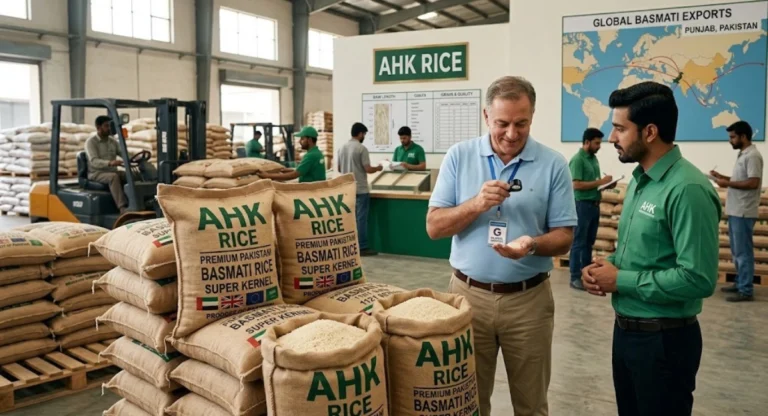
Explore how packaging protects Pakistani Basmati rice during shipment to Indonesia.
What Are the Available Rice Packaging Solutions?
Private label packaging creates a branded retail product, while standard packaging uses established designs and specifications for distribution. Both solutions protect rice through transport and storage. Their differences involve artwork, bag materials, minimum order quantities, printing, and commercial positioning.
What Is Private Label Rice Packaging?
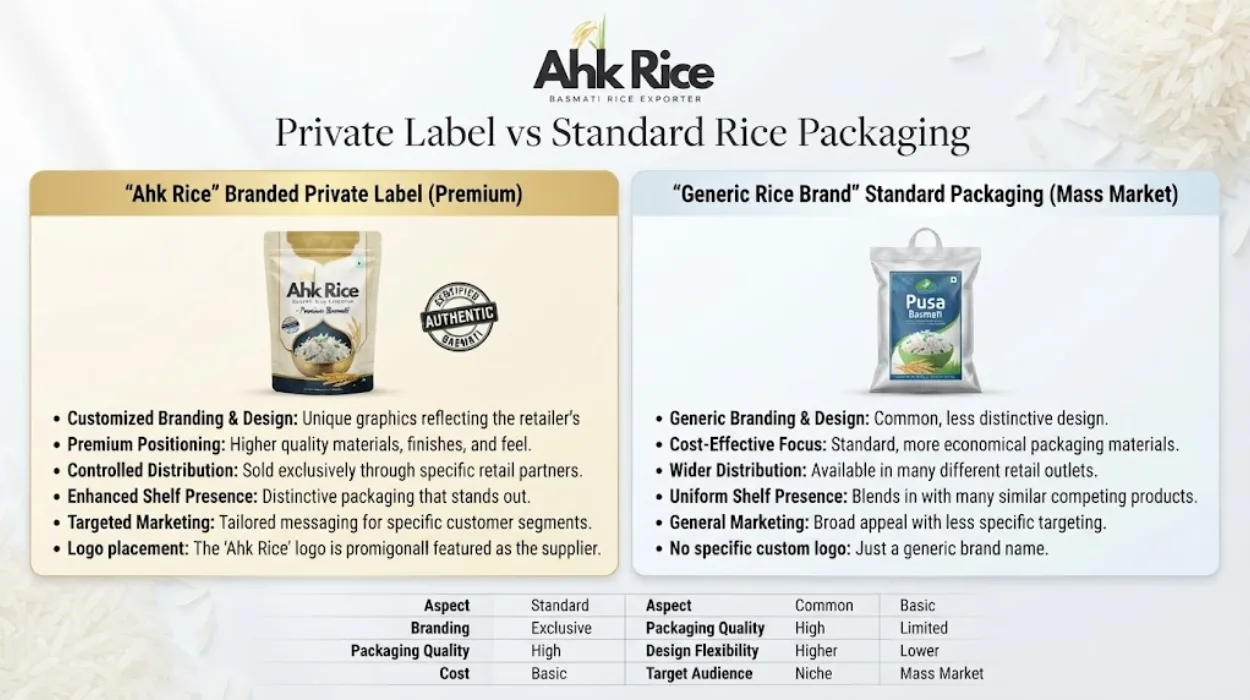
Private label rice packaging means a manufacturer or exporter packs rice under the buyer’s brand name. The retailer owns the brand presentation, including the logo, product name, packaging design, and market positioning.
A supermarket importing Pakistani 1121 Basmati rice can sell the product under its own brand. The exporter supplies the rice, packaging materials, and agreed specifications. The retailer controls the final customer-facing identity.
Private label packaging commonly uses printed polypropylene bags, laminated pouches, woven sacks, or retail cartons. The selected format depends on product weight, retail shelf requirements, storage conditions, and distribution costs.
What Is Standard Rice Packaging?
Standard rice packaging uses established bag formats, generic designs, or the exporter’s existing packaging specifications. The buyer purchases rice without developing a fully customized retail identity.
Common standard formats include 5 kg, 10 kg, 25 kg, and 40 kg bags. A distributor can import standard 1121 Steam or Super Kernel Basmati rice and sell it through wholesale channels.
Standard packaging reduces design work and simplifies procurement. The buyer can focus on rice specifications, order quantities, shipping documents, and distribution.
What Packaging Formats Can Buyers Choose?
Five common packaging formats cover most retail and wholesale requirements: woven polypropylene bags, laminated bags, retail pouches, vacuum packs, and cartons. Each format provides different protection, presentation, and handling benefits.
| Packaging format | Typical use | Main benefit |
|---|---|---|
| Woven PP bags | Wholesale and foodservice | Strong handling performance |
| Laminated PP bags | Retail and wholesale | Printed branding and durability |
| Retail pouches | Supermarkets | Shelf presentation |
| Vacuum packs | Premium retail | Reduced air exposure |
| Cartons | Specialty retail | Structured presentation |
Woven polypropylene bags provide strength during loading and unloading. Laminated bags combine a woven base with a printed outer layer. Retail pouches support smaller consumer quantities. Vacuum packaging removes air before sealing. Cartons create a structured retail presentation.
The packaging format must match the rice grade and distribution channel. A 40 kg wholesale bag serves a different commercial purpose from a 1 kg premium retail pouch.
How Do Private Label and Standard Rice Packaging Compare?
Private label packaging offers greater brand control, while standard packaging offers simpler procurement and lower initial customization costs. The comparison becomes clearer through packaging specifications, commercial requirements, and distribution objectives.
What Are the Seven Main Specification Differences?
The following table compares the two approaches across seven attributes that influence rice procurement.
| Attribute | Private label packaging | Standard packaging |
|---|---|---|
| Brand identity | Buyer-owned brand | Generic or established brand |
| Artwork | Customized design | Existing design |
| Minimum order quantity | Often higher | Often lower |
| Setup cost | Artwork and printing costs | Lower setup requirements |
| Retail positioning | Strong differentiation | Limited differentiation |
| Procurement speed | Design approval required | Faster ordering |
| Distribution flexibility | Brand-specific inventory | Easier channel movement |
Brand identity is the most visible difference. Private label packaging allows a retailer to create a consistent identity across multiple rice grades. Standard packaging gives distributors a ready-to-sell or ready-to-repack product.
Artwork affects production preparation. Private label bags require approved designs, accurate product information, and printing specifications. Standard bags use existing artwork or plain packaging.
Minimum order quantity influences working capital. Custom printed bags require production planning. A buyer ordering 10,000 bags may face different costs from a buyer ordering 1,000 bags.
Setup cost includes artwork preparation, cylinder charges, printing plates, packaging material, and sample approval. Standard packaging avoids most of these initial expenses.
Retail positioning determines how the product competes on shelves. Private label products support a consistent brand experience. Standard packaging emphasizes product availability and distribution efficiency.
Procurement speed matters during seasonal demand. Standard packaging can move directly into production. Private label orders require design confirmation before printing.
Distribution flexibility depends on brand ownership. Standard packaging can serve several wholesale customers. Private label packaging serves the buyer’s specific brand and market.
How Do Costs Differ Between the Two Approaches?
Private label packaging usually carries higher initial packaging development costs. Standard packaging usually reduces those costs through established materials and designs.
A simplified example illustrates the difference. A buyer orders 10,000 bags for a retail launch. Standard packaging may require only the bag and filling cost. Private label packaging adds artwork, printing, and packaging setup.
| Cost component | Standard packaging | Private label packaging |
|---|---|---|
| Rice product | Required | Required |
| Bag material | Required | Required |
| Artwork development | Usually absent | Required |
| Printing setup | Usually absent | May apply |
| Packaging approval | Basic | Detailed |
| Inventory planning | Standard | Brand-specific |
Actual prices depend on bag material, printing method, bag size, order volume, and destination. A packaging quotation must separate rice cost from packaging cost.
How Does Shelf Life Compare?
Shelf life depends primarily on rice quality, moisture, processing, packaging protection, and storage conditions. Private label packaging does not automatically extend shelf life. Standard packaging does not automatically reduce it.
Rice stored in a dry, clean warehouse maintains quality more effectively than rice exposed to humidity, heat, pests, or direct sunlight. Packaging protects against handling damage and environmental exposure, but storage conditions remain essential.
For example, a 1121 Basmati rice shipment in laminated bags requires suitable warehouse ventilation and moisture control. The same rice in standard woven bags requires the same basic storage discipline.
Packaging selection should therefore focus on protection requirements rather than assuming that branding determines shelf life.
Which Packaging Method Works Best for Different Markets?
Private label packaging fits branded retail markets, while standard packaging fits wholesale and foodservice distribution. The most suitable approach changes according to customer expectations, order size, and sales channel.
What Packaging Suits South Asian Retail Markets?
South Asian retail markets commonly use branded rice bags in 1 kg, 2 kg, 5 kg, and 10 kg formats. Retailers need recognizable packaging that communicates rice variety, cooking characteristics, and product quality.
Private label packaging suits supermarkets and grocery chains building their own rice range. A retailer can use separate packaging for 1121, Super Kernel, and 1509 Basmati rice.
Standard packaging suits distributors supplying independent stores. These buyers prioritize stock availability, competitive pricing, and straightforward handling.
What Packaging Suits Gulf Markets?
Gulf markets include the UAE, Saudi Arabia, Qatar, Kuwait, Bahrain, and Oman. Retailers and foodservice distributors require packaging that supports long-distance transport, warehouse storage, and local distribution.
Private label packaging suits supermarket groups and specialty food retailers. Standard packaging suits catering suppliers and wholesalers purchasing larger quantities.
A 40 kg bag of 1121 Golden Sella Basmati rice serves a different purpose from a 5 kg retail bag. The larger format supports foodservice and wholesale handling. The smaller format supports household purchases.
How Do Prices Compare Across the Two Regions?
Packaging costs vary by material, order volume, printing requirements, and market destination. Private label orders usually add design and printing expenses, while standard orders usually simplify the packaging component.
The following indicative comparison illustrates how packaging choices affect landed cost planning. These figures are planning examples, not current supplier quotations.
| Market | Standard packaging | Private label packaging |
|---|---|---|
| South Asian retail | $1,000–$1,200 per MT | $1,050–$1,300 per MT |
| Gulf retail | $1,050–$1,250 per MT | $1,100–$1,350 per MT |
The figures represent hypothetical packaging-inclusive planning ranges. Actual export prices require a confirmed rice grade, quantity, packaging format, destination, and Incoterm.
Gulf buyers often require additional documentation and packaging compliance checks. South Asian buyers may prioritize smaller retail formats and rapid replenishment. Both markets require accurate product specifications before production.
How Does Shelf Life Compare Across These Regions?
Shelf life remains dependent on storage conditions rather than the market name. Gulf warehouses require careful heat management, while South Asian warehouses require moisture and pest control.
A 1121 Golden Sella shipment stored in a dry, ventilated warehouse can maintain quality under suitable conditions. A Steam shipment stored in excessive heat or humidity faces quality deterioration regardless of packaging type.
Packaging selection must therefore reflect warehouse conditions, shipment duration, and expected inventory turnover.
What Are the Pros and Cons of Private Label Packaging?
Private label packaging strengthens brand ownership but increases preparation, approval, and inventory commitments. The benefits become valuable when a retailer plans repeated orders and consistent market positioning.
What Are the Advantages?
Brand ownership allows retailers to build customer recognition. A supermarket can sell multiple rice grades under one brand identity.
Product differentiation helps retailers separate their rice range from competing products. Packaging can communicate grain length, processing type, cooking use, and quality specifications.
Customer loyalty develops through consistent product presentation. A buyer who prefers one rice brand can recognize the same packaging across different stores.
Margin control gives retailers greater control over pricing. The brand owner decides the retail positioning and promotional strategy.
What Are the Disadvantages?
Higher setup costs create an initial financial commitment. Artwork and printing require approval before production.
Minimum order quantities can increase inventory exposure. A retailer launching a new brand must forecast demand accurately.
Longer preparation time affects urgent procurement. Design approval and printing add steps before dispatch.
Brand-specific inventory reduces flexibility. Unsold bags cannot easily serve another retailer’s brand.
What Are the Advantages and Disadvantages of Standard Packaging?
Standard packaging offers lower setup complexity and faster procurement. Distributors can focus on rice specifications, order quantity, and shipment planning.
The main limitation is weaker brand differentiation. A distributor selling generic packaging competes more directly on price, availability, and service.
Standard packaging also provides less control over retail presentation. Buyers who need a distinctive supermarket identity may require customized packaging later.
What Decision Factors Should Buyers Evaluate Before Ordering?
The best packaging choice depends on sales channel, order volume, budget, brand strategy, and distribution requirements. Buyers should evaluate these factors before approving packaging specifications.
What Five Factors Belong in the Decision Framework?
| Decision factor | Private label packaging | Standard packaging |
|---|---|---|
| Sales channel | Branded retail | Wholesale and foodservice |
| Order volume | Repeated larger orders | Small or mixed orders |
| Budget | Higher initial investment | Lower setup cost |
| Brand strategy | Long-term brand building | Product distribution |
| Procurement speed | Longer preparation | Faster production |
Sales channel determines the packaging’s commercial role. Retailers need customer-facing identity. Wholesalers need practical handling and efficient distribution.
Order volume affects printing economics. Larger orders spread setup costs across more bags. Smaller orders may make standard packaging more economical.
Budget includes packaging development and inventory. A retailer launching a new brand needs funds for artwork, packaging, and initial stock.
Brand strategy determines whether packaging should build long-term recognition. Private label supports a consistent identity across product lines.
Procurement speed matters during seasonal demand. Standard packaging supports faster production when stock is needed quickly.
How Should Buyers Match Packaging to Rice Grade?
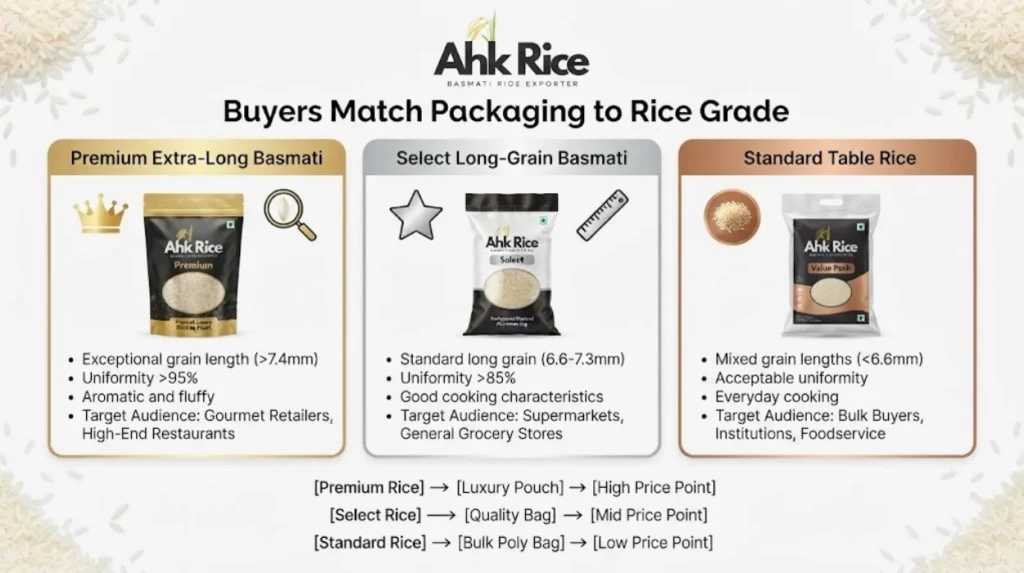
1121 Basmati rice suits premium retail and foodservice applications. Its packaging should communicate grain length, cooking performance, and product quality.
Super Kernel Basmati rice suits buyers seeking aromatic rice with long grains. Packaging should support the intended retail or wholesale positioning.
1509 Basmati rice suits buyers seeking a practical balance between grain length, quality, and price. Its packaging should match the target customer segment.
A buyer can use private label packaging across all three grades. The key requirement is consistent product specifications and accurate labeling.
How Can AHK Rice Support Packaging Selection?
AHK Rice supplies Pakistani Basmati rice with packaging options suited to different buyer requirements. The exporter offers 1121, Super Kernel, and 1509 varieties with end-to-end processing, custom packaging, and export support.
AHK Rice is based in Punjab and supplies customers in 15+ countries. Its product range supports retail, wholesale, and foodservice procurement.
The packaging decision begins with the rice specification. Buyers must confirm grade, processing type, grain length, broken percentage, moisture, packaging material, bag size, and destination requirements.
What Should Buyers Confirm Before Production?
- Rice variety and processing type
- Grain length and broken percentage
- Moisture specification
- Packaging material
- Bag size and net weight
- Artwork requirements
- Printing method
- Minimum order quantity
- Destination and shipping terms
- Required export documents
A packaging specification should define the product and the bag separately. This prevents confusion between rice quality and packaging appearance.
AHK Rice can support buyers through product selection, processing, packaging coordination, and export preparation. The final specification should match the buyer’s market and distribution model.
What Is the Final Recommendation for Rice Importers?
Choose private label packaging for long-term retail branding, and choose standard packaging for faster procurement and practical distribution. The decision should follow commercial objectives rather than packaging appearance alone.
Private label packaging supports retailers building a recognizable rice brand. Standard packaging supports distributors who prioritize availability, cost control, and flexible inventory.
Both approaches require accurate rice specifications, suitable packaging materials, proper storage, and reliable export documentation. The packaging format should protect the product and support the buyer’s sales channel.
Where Should You Insert the BOFU Article Link?
Add the BOFU link in the final decision section, immediately after explaining that buyers should confirm rice grade, packaging, quantity, and destination before requesting a quotation.
Use the contextual anchor text custom rice export quote and link it to the BOFU article:
Contact AHK Rice for a Custom Rice Export Quote.
This placement connects the informational comparison with the next commercial step without interrupting the main discussion.
Frequently Asked Questions
Is private label rice packaging more expensive than standard packaging?
Private label packaging usually costs more initially because it requires artwork, printing, and packaging setup. Standard packaging reduces these preparation costs. The final price depends on bag material, size, order volume, and printing requirements.
What is the minimum order quantity for private label rice packaging?
The minimum order quantity depends on the bag material, printing method, and supplier production process. Buyers should request a packaging quotation that separates setup costs from per-bag costs.
Which rice varieties work with private label packaging?
1121, Super Kernel, and 1509 Basmati rice can support private label packaging. The buyer should match each grade with the intended market, retail positioning, and cooking requirements.
Does private label packaging extend rice shelf life?
Private label packaging does not automatically extend shelf life. Rice quality, moisture, processing, packaging protection, and warehouse conditions determine storage performance.
Which packaging is better for wholesalers?
Standard packaging usually suits wholesalers because it supports straightforward procurement and practical handling. Private label packaging suits wholesalers building a branded retail business.
Can buyers customize bag sizes and designs?
Buyers can request custom bag sizes, printed artwork, and packaging materials. The final options depend on production requirements, order quantity, and destination regulations.
Should retailers choose private label packaging for a new rice brand?
Retailers planning long-term brand development should evaluate private label packaging. The decision requires a realistic demand forecast, packaging budget, and consistent rice supply.
What should buyers include in a rice packaging quotation?
A quotation should include rice variety, processing type, grain length, broken percentage, moisture, bag material, bag size, printing requirements, quantity, destination, and shipping terms.