AHK Rice Delivers Reliable Basmati Rice Supply to Tennessee, USA
Tennessee distributors sourcing Pakistani Basmati rice need more than a competitive FOB price. They need repeatable specifications, predictable production, dependable ocean logistics, compliant documentation, and a supplier capable of supporting replenishment cycles. AHK Rice addresses this requirement through an integrated Pakistan-to-USA export model covering sourcing, processing, grading, packing, inspection, documentation, and shipment coordination.
The commercial case is stronger in 2026 because the U.S. rice market is operating with tighter domestic supply. USDA’s August 14, 2026 Rice Outlook keeps 2026/27 U.S. rice imports at a record 49.8 million cwt, while July projections showed long-grain imports at 43.0 million cwt, up 16% year over year. USDA identifies Asian aromatic varieties, including Basmati from India and Pakistan, as a major component of U.S. long-grain imports.
For Tennessee distributors, this makes supply planning more important. The guide to:
Why supply reliability matters for rice distributors explains the operational risks behind delayed or inconsistent imports. The decision here is narrower: which supplier, product specification, shipping route, and purchasing model gives a Tennessee distributor reliable Basmati inventory at a commercially controlled landed cost?
What is the best solution for reliable Basmati rice supply to Tennessee?
The best solution is a specification-led Pakistan-to-USA supply program that combines approved Basmati grades, controlled processing, pre-shipment verification, documented export procedures, scheduled ocean freight, and replenishment planning aligned with Tennessee warehouse demand.
Tennessee buyers generally receive imported rice through U.S. gateway ports before inland transportation moves containers toward Memphis, Nashville, Knoxville, Chattanooga, or other distribution points. The correct procurement model therefore starts with the destination warehouse, not only the product price.
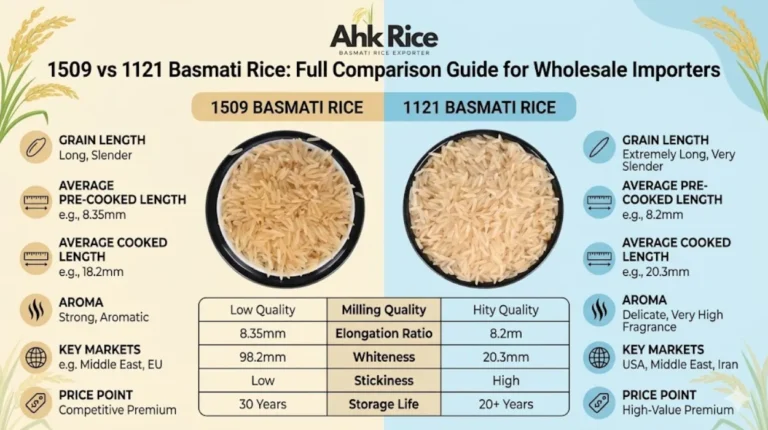
AHK Rice operates from Punjab, Pakistan, and manages sourcing, processing, grading, packaging, documentation, and container loading. Its portfolio includes 1121, Super Kernel, and 1509 Basmati varieties.
For a Tennessee distributor, 1121 Basmati is a strong premium specification when extra-long grain appearance, aroma, and cooking performance are central to the sales proposition. The USA Basmati rice supply service provides access to Pakistan-origin Basmati, packaging options, export documentation, shipment coordination, and wholesale ordering support.
The supply program should establish the following specification before commercial production:
| Specification | Procurement requirement |
|---|---|
| Variety | 1121, Super Kernel, or 1509 |
| Processing | White, Steam, Sella or approved grade |
| Grain | Contracted length and appearance |
| Broken percentage | Agreed maximum |
| Moisture | Agreed maximum |
| Purity | Foreign matter and admixture limits |
| Packaging | Bulk, foodservice, retail or private label |
| Quantity | Container-level metric-ton requirement |
| Inspection | Pre-shipment inspection where required |
| Incoterm | FOB, CFR/CNF, CIF or agreed alternative |
This structure prevents the common procurement mistake of approving a sample described only as “premium Basmati” and then discovering specification differences in the commercial container.
Why should Tennessee distributors choose AHK Rice?
Tennessee distributors should choose AHK Rice when they require Pakistan-origin Basmati with controlled specifications, integrated processing, flexible packaging, export documentation, quality inspection, and a repeat-order structure designed for wholesale and distribution requirements.
AHK Rice has supplied international buyers across more than 15 countries and states that its integrated facility manages the export chain from paddy procurement through processing and container loading.
The first commercial advantage is specification control. The buyer defines the grade before production. This gives the distributor a measurable reference for future orders.
The second advantage is product choice. A Tennessee distributor serving premium ethnic grocery stores can use 1121 Basmati. A foodservice distributor requiring a different price-to-performance balance can evaluate Super Kernel or 1509. The selection is based on customer segment rather than a one-grade-fits-all approach.
The third advantage is packaging flexibility. AHK Rice supports private-label and customized packaging, which allows distributors to separate foodservice inventory from consumer retail inventory. The packaging specification needs to be finalized before production because bag material, printing, weight, labeling, and packing configuration affect production scheduling.
The fourth advantage is quality verification. AHK Rice states that pre-shipment inspections can be conducted through internationally recognized inspection organizations such as SGS and Bureau Veritas.
The fifth advantage is export coordination. A distributor does not only purchase rice. It purchases a sequence of activities covering production, packing, documentation, container loading, ocean transportation, U.S. entry, and inland delivery.
U.S. food import compliance also requires attention. FDA states that imported food must be safe, sanitary, and properly labeled, and applicable facilities must be registered with FDA with prior notice provided for incoming food shipments.
That means the exporter and U.S. importer need a clearly defined documentation workflow. The importer remains responsible for its applicable U.S. import obligations, including relevant FSVP responsibilities.
How many shipping days should Tennessee buyers plan for?
Tennessee buyers should plan approximately 30–40 days for ocean movement to major East or Gulf Coast gateways, then add port clearance and inland transportation to Tennessee; a complete procurement schedule therefore requires production time, vessel timing, customs, and final-mile planning.
Shipping time is not one fixed number because Tennessee is an inland destination. The container first reaches a U.S. gateway and then moves by rail or truck.
Current 2026 market references show meaningful route differences. AHK Rice currently publishes approximately 28–35 days for New York/New Jersey, 30–40 days for Houston and Savannah, and 35–45 days for Los Angeles, with Chicago via inland logistics at approximately 40–50 days.
Public freight data also shows that actual sailing conditions change. Flexport recently displayed approximately 27 days for Karachi-to-New York 40-foot FCL service and approximately 32 days for Karachi-to-Los Angeles, while Savannah-related routes showed longer total transit profiles when inland destinations were included.
For Tennessee procurement, the practical planning model is:
| Stage | Planning range |
| Order/specification confirmation | 1–2 days |
| Sample approval | 5–7 days by air courier |
| Production after approval | 7–10 days for specified products |
| Container booking/loading | 2–5 days |
| Ocean movement | 28–45 days depending on gateway |
| U.S. clearance/port handling | Variable |
| Inland movement to Tennessee | Variable |
| Total planning window | Commonly 45–70+ days |
AHK Rice states that U.S. samples can be sent by air courier and that 1–5 kg samples can reach U.S. buyers in approximately 5–7 days. Its USA service also identifies a typical 20-foot container starting point at approximately 20 MT.
Tennessee distributors therefore need reorder planning before warehouse inventory reaches its minimum level. A container ordered after a stockout begins is already late.
What does the complete AHK Rice sample-to-shipment process look like?
The commercial process begins with specification confirmation, moves through sample approval and production scheduling, continues with inspection and documentation, and ends with container loading, ocean shipment, U.S. import handling, and inland delivery to the Tennessee distribution point.
Step 1: Define the purchasing specification
The buyer provides the required variety, processing type, grain characteristics, broken percentage, moisture target, packaging, quantity, destination, and Incoterm.
For example, a Tennessee wholesaler can request 20 MT of 1121 Basmati in a specified processing grade with a defined PP bag format.
Step 2: Request the sample
AHK Rice states that samples up to 20 kg can be provided, while the buyer covers courier and applicable phytosanitary certificate costs.
A practical sample budget is approximately $50–$150 for courier and handling, with laboratory testing potentially adding approximately $50–$200+, depending on the testing scope. These are planning figures, not a fixed AHK Rice quotation.
Step 3: Approve the sample
The buyer evaluates grain length, appearance, aroma, cooking performance, broken percentage, moisture, purity, and packaging suitability.
Approval should be recorded against a written product specification.
Step 4: Schedule production
After approval, AHK Rice schedules production. Its published USA product workflow gives approximately 7–10 days for production of specified 1121 Basmati parboiled orders, depending on volume.
Step 5: Complete quality checks
The production batch is checked against the approved specification. Third-party inspection can be included when required by the buyer.
Step 6: Prepare export documentation
The shipment documentation can include commercial invoice, packing list, certificate of origin where applicable, phytosanitary certificate, fumigation documentation where required, bill of lading, product specifications, and other destination-specific records.
Step 7: Load and dispatch
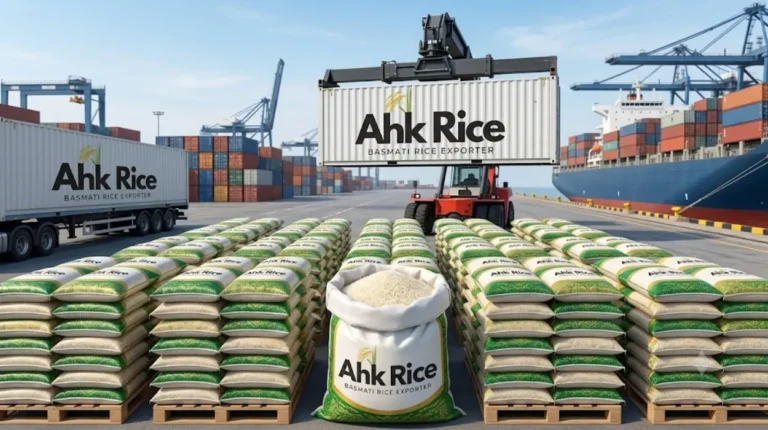
The approved rice is packed, loaded into the container, and dispatched through Karachi or Port Qasim according to the agreed shipping plan.
Step 8: Ocean transport
The container moves toward the selected U.S. gateway. Current 2026 freight conditions demonstrate why freight should be priced against the actual cargo-ready date rather than assumed from an old quotation. Flexport explicitly notes that displayed rates are subject to change according to cargo-ready timing.
Step 9: U.S. entry and Tennessee delivery
The U.S. importer coordinates customs, FDA requirements, port handling, and inland transportation. FDA confirms that imported food is subject to inspection and must meet U.S. requirements.
The final movement then takes the container from the gateway to the Tennessee warehouse.
What does a realistic 20 MT shipment cost?
A realistic 20 MT shipment requires separate budgeting for rice, packaging, origin charges, ocean freight, inspection, destination charges, customs-related costs, and Tennessee inland delivery; the final landed price must therefore be calculated from the live quotation.
A published AHK Rice USA product page currently lists Basmati 1121 pricing starting around $1,100 per MT FOB Karachi, subject to specification and commercial terms.
Using that published starting point for an illustrative calculation:
| Cost component | Example calculation | Illustrative amount |
| Rice | 20 MT × $1,100 | $22,000 |
| Sample/courier | Planning allowance | $50–$150 |
| Ocean freight | Live route quotation | Variable |
| Inspection | If requested | Variable |
| Export/origin charges | Quoted per shipment | Variable |
| Destination charges | Port/broker/handling | Variable |
| Inland delivery | Gateway to Tennessee | Variable |
| U.S. import costs | Applicable charges | Variable |
| Illustrative FOB goods value | 20 MT | $22,000 |
For freight context, a recent public 2026 Cogoport listing showed Karachi-to-New York 20-foot FCL indicative pricing around $5,342–$5,814, while route and service conditions vary substantially by carrier, equipment, Incoterm, and date.
Therefore, adding an old freight number to a rice quotation does not produce a reliable Tennessee landed cost.
A buyer should request the commercial calculation against the exact destination, container size, quantity, packaging, Incoterm, and cargo-ready date. This also matters because Maersk announced a $4,000 peak-season surcharge for 20DRY containers from the Indian Subcontinent and Middle East to the U.S. West Coast effective August 4, 2026 for applicable non-spot bookings.
That update demonstrates why Tennessee buyers should compare gateway options and request current freight rather than treating shipping as a fixed percentage of rice value.
What results can Tennessee distributors expect?
Tennessee distributors can expect a more controlled procurement cycle, consistent product specifications, clearer shipment visibility, flexible packaging options, and improved inventory planning when the supplier relationship is managed around an approved specification and repeat shipment schedule.
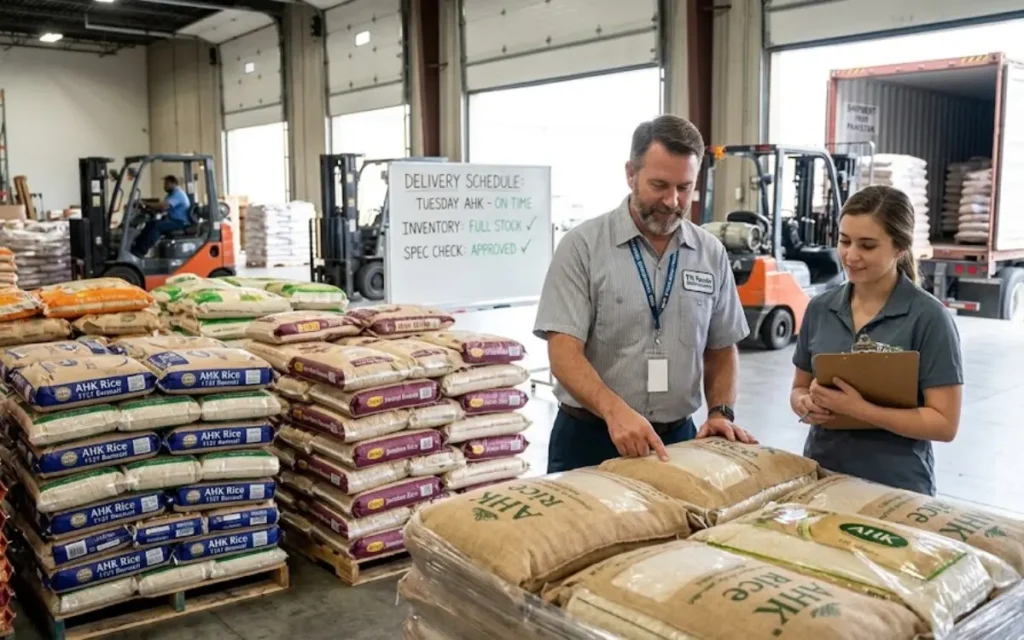
The first result is product consistency. Every reorder uses the approved specification as the reference point.
The second result is better inventory planning. When production and shipping windows are known, purchasing teams can place replenishment orders before warehouse stock reaches critical levels.
The third result is better margin visibility. Instead of comparing only FOB prices, the distributor calculates the full landed cost for each shipment.
The fourth result is lower specification risk. Pre-shipment inspection and documented product requirements create measurable checkpoints before cargo leaves Pakistan.
The fifth result is commercial flexibility. AHK Rice supplies multiple Basmati varieties and packaging formats, allowing distributors to create separate SKUs for retail, foodservice, wholesale, and private-label customers.
The strongest result is repeatability. A supplier earns long-term value by reproducing the approved product across successive containers, not by delivering one successful shipment.
How should Tennessee distributors decide whether AHK Rice is the right supplier?
Tennessee distributors should approve AHK Rice when its sample matches the required specification, the commercial quotation meets the target landed-cost model, documentation satisfies the import workflow, and production and shipping schedules support the distributor’s required replenishment cycle.
The decision should use five measurable criteria:
| Decision factor | Approval test |
| Product | Sample matches written specification |
| Quality | Inspection and documentation are acceptable |
| Cost | Landed cost meets target margin |
| Logistics | Production and shipping window fits inventory plan |
| Continuity | Supplier can support repeat containers |
A buyer should also compare supplier performance using more than price. The long-term importer evaluation framework covers quality consistency, delivery, documentation, pricing, communication, production capability, and supplier performance across multiple shipments.
For Tennessee, the most practical model is a documented supply cycle:
Specification → Sample → Approval → Quotation → Production → Inspection → Loading → Ocean Transit → U.S. Entry → Tennessee Delivery → Reorder.
AHK Rice fits this model because its USA export operation covers Basmati selection, processing, packaging, documentation, inspection support, and shipment coordination. AHK Rice also publishes USA-specific product and shipping information, giving buyers a direct basis for specification and quotation discussions.
In 2026, the commercial environment makes this approach particularly relevant. U.S. rice imports are forecast at a record level while domestic supply remains tighter, increasing the importance of reliable imported long-grain supply.
The correct procurement decision is therefore not simply “Which exporter offers the lowest FOB price?” It is “Which exporter can repeatedly deliver the approved Basmati specification to my Tennessee distribution network at a controllable landed cost and schedule?”
For a distributor ready to move from supplier evaluation to a specification-based commercial quotation, submit the required product, quantity, packaging, destination, and delivery details through the AHK Rice quotation request.
Frequently Asked Questions
How does AHK Rice supply Basmati rice to Tennessee?
AHK Rice supplies Pakistan-origin Basmati rice through a structured export process covering product selection, processing, grading, packaging, documentation, inspection, container loading, ocean freight, and U.S. delivery coordination.
Which Basmati rice varieties does AHK Rice supply to the USA?
AHK Rice supplies Basmati varieties including 1121, Super Kernel, and 1509. Buyers can select the variety and processing specification according to retail, wholesale, foodservice, or private-label requirements.
How long does Basmati rice shipping to Tennessee take?
Ocean transit commonly takes about 28–45 days depending on the selected U.S. gateway and shipping conditions. Tennessee delivery requires additional time for U.S. clearance, port handling, and inland transportation.
What is the minimum order quantity for AHK Rice USA shipments?
A typical 20-foot container can accommodate approximately 20 metric tons, although the final quantity depends on packaging, product specification, container configuration, and commercial requirements.
How much does Basmati rice from AHK Rice cost?
Pricing depends on the Basmati variety, processing grade, quantity, packaging, Incoterm, freight rate, inspection requirements, and destination. A live quotation provides the correct landed-cost calculation for Tennessee.
Can AHK Rice provide Basmati rice samples before an order?
Yes. AHK Rice provides samples for product evaluation. Buyers can assess grain appearance, aroma, cooking performance, broken percentage, moisture, and other agreed specifications before confirming commercial production.
Does AHK Rice support private-label Basmati rice?
Yes. AHK Rice supports customized and private-label packaging for buyers requiring their own brand presentation. Packaging specifications, bag sizes, artwork, and labeling requirements are confirmed before production.
What quality checks apply to AHK Rice Basmati shipments?
Quality checks cover agreed product specifications such as variety, grain characteristics, broken percentage, moisture, purity, and packaging. Third-party pre-shipment inspection can also be arranged when required by the buyer.
What documents are required for importing Basmati rice into Tennessee?
Typical documentation includes a commercial invoice, packing list, bill of lading, certificate of origin where applicable, phytosanitary documentation, fumigation documentation where required, and other records required for U.S. food import compliance.
How can Tennessee distributors compare AHK Rice with other suppliers?
Tennessee distributors should compare suppliers by specification consistency, quality controls, production capacity, shipping reliability, documentation, packaging flexibility, landed cost, communication, and repeat-order performance rather than FOB price alone.