Rice Import Regulations and SFDA Compliance Requirements in Saudi Arabia 2026
Rice import regulations in Saudi Arabia under SFDA 2026 are a defined set of legal, safety, labeling, and quality requirements enforced by the Saudi Food and Drug Authority to ensure all imported rice meets food safety, halal compliance, and traceability standards before market entry.
Rice import regulations are national rules that control how food products enter a country. In Saudi Arabia, these rules are governed by the Saudi Food and Drug Authority (SFDA). The SFDA operates as the central regulatory body responsible for food safety, public health protection, and import clearance systems.
The 2026 framework integrates digital compliance systems, stricter documentation validation, and real-time shipment tracking. It requires importers to register products, verify certifications, and comply with labeling and packaging laws before shipment arrives at Saudi ports such as Jeddah Islamic Port or King Abdulaziz Port.
Rice, as a staple food, falls under strict monitoring due to its high consumption rate in Saudi Arabia. All rice varieties, including Basmati, non-Basmati, white rice, and parboiled rice, must comply with these regulations.
How does SFDA regulate rice imports into Saudi Arabia?
SFDA regulates rice imports through a structured system that includes product registration, conformity certification via SABER, pre-shipment documentation, port inspection, and post-market surveillance to ensure compliance with Saudi food safety laws and halal standards.
The regulation process starts before shipment. Importers must register rice products in the SFDA system. Each product receives a unique identification number. This step ensures traceability.
The SABER system plays a central role. SABER is an electronic platform that verifies product conformity. Importers upload certificates, test reports, and product specifications into SABER. Once approved, a Product Certificate of Conformity (PCoC) is issued.
Before shipment, a Shipment Certificate of Conformity (SCoC) is required. This certificate confirms that the specific shipment matches the approved product specifications.
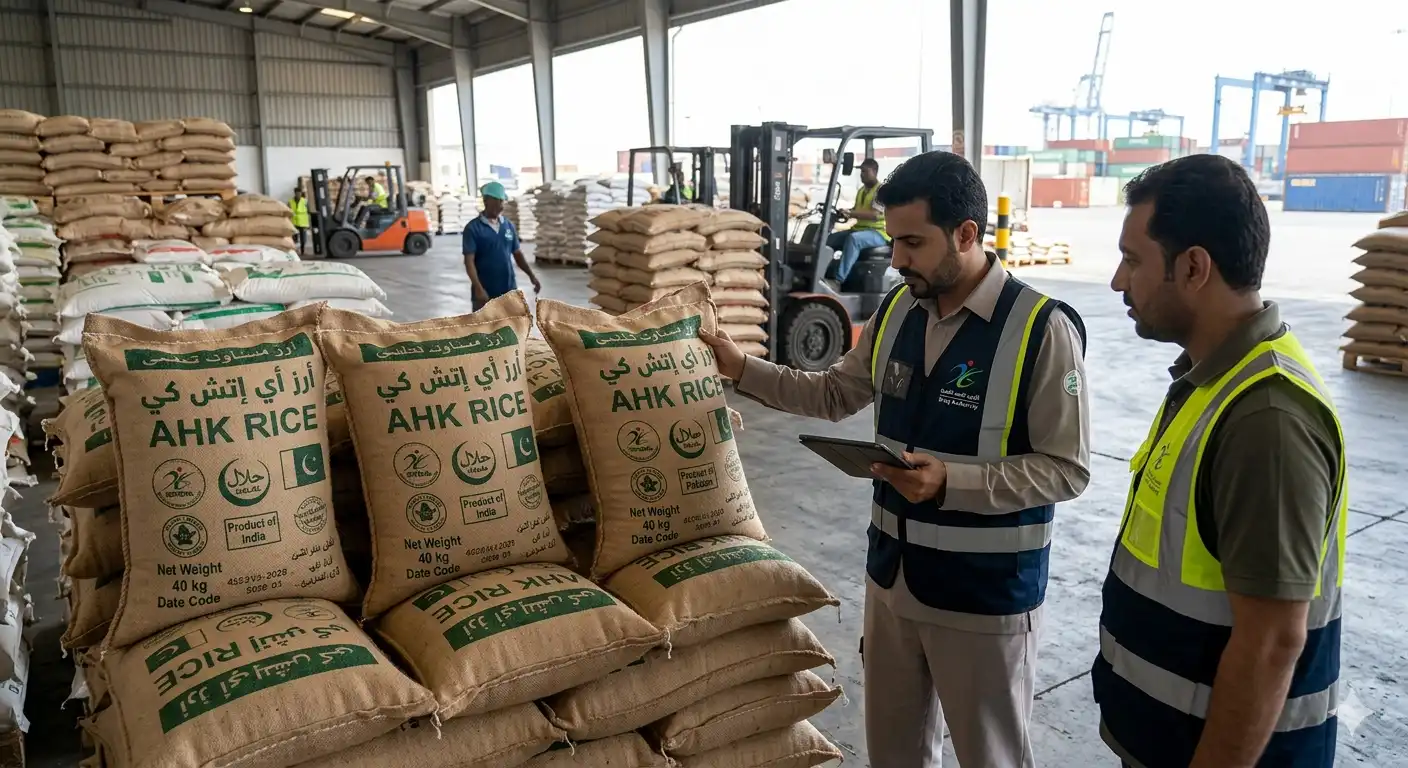
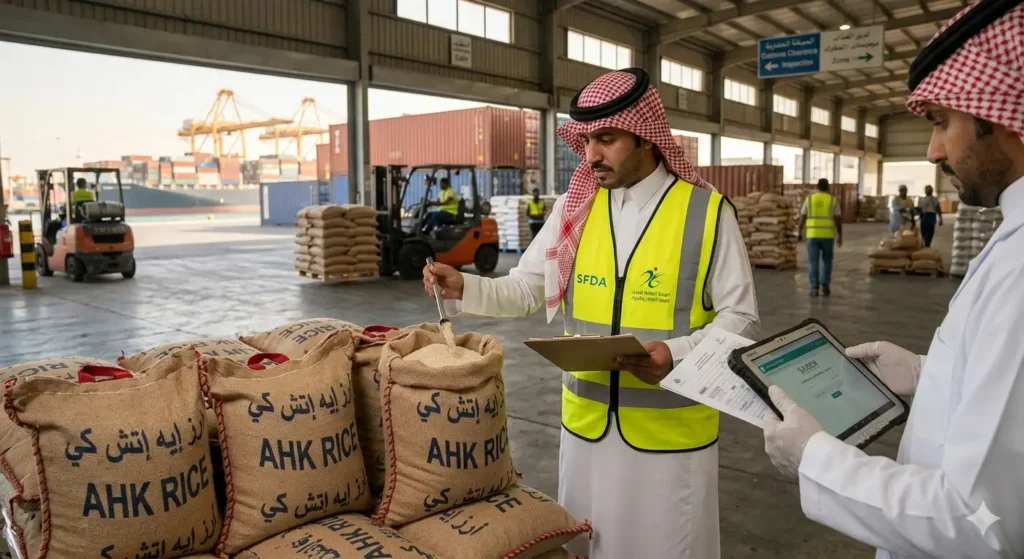
At arrival, Saudi customs authorities and SFDA inspectors check documentation and perform physical inspections. They examine packaging, labeling, and quality parameters such as grain length, moisture content, and contamination levels.
Post-clearance, SFDA conducts market surveillance. Random samples are tested to ensure continued compliance.
What are the key components of rice import regulations in Saudi Arabia?
The key components include SFDA product registration, SABER certification, halal certification, labeling compliance, phytosanitary certification, customs duties, and quality inspection protocols that collectively ensure safety, traceability, and regulatory alignment for imported rice.
Product Registration
Every rice product must be registered in the SFDA database. This includes detailed product information such as origin country, variety type, processing method, and packaging specifications.
SABER Certification
SABER certification ensures conformity with Saudi standards. It includes two documents:
- Product Certificate of Conformity (PCoC)
- Shipment Certificate of Conformity (SCoC)
These certificates validate that rice meets Saudi technical regulations.
Halal Certification
Rice must comply with halal standards. Although rice is plant-based, halal certification ensures no cross-contamination during processing, storage, or transportation.
Labeling Requirements
Labels must be in Arabic. They must include:
- Product name
- Country of origin
- Net weight
- Production and expiry dates
- Storage instructions
Incorrect labeling leads to rejection at port.
Phytosanitary Certificate
Exporting countries must issue a phytosanitary certificate. This document confirms that rice is free from pests, diseases, and harmful contaminants.
Customs Duties
Saudi Arabia applies customs duties on rice imports. Rates vary based on trade agreements and origin country.
Quality Inspection
Inspection includes laboratory testing. Parameters include:
- Moisture content below 14%
- Broken grain percentage within declared limits
- Absence of foreign matter such as stones or husk
Why are SFDA rice regulations important for Saudi Arabia?
SFDA rice regulations ensure food safety, protect public health, maintain halal integrity, prevent contaminated imports, and standardize quality across all imported rice products, supporting a stable and transparent food supply chain in Saudi Arabia.
Saudi Arabia imports a large portion of its food. Rice is one of the most consumed staples. Strict regulations prevent unsafe products from entering the market.
Food safety is the primary objective. Contaminated rice can contain pesticides, heavy metals, or microbial hazards. Regulations eliminate these risks.
Halal integrity is equally important. Saudi Arabia enforces halal compliance across all food imports. This requirement aligns with religious and cultural expectations.
Standardization ensures consistency. Consumers expect uniform quality in grain length, aroma, and cooking performance. Regulations define measurable standards.
Trade transparency improves through digital systems like SABER. Importers and regulators can track shipments, verify documents, and reduce fraud.
How does SABER certification work for rice imports?
SABER certification works by digitally verifying rice product compliance through approved certification bodies, issuing a Product Certificate of Conformity for the product and a Shipment Certificate of Conformity for each shipment before customs clearance in Saudi Arabia.
SABER operates as an online compliance platform. Importers create accounts and register products.
Certification bodies approved by Saudi authorities review submitted documents. These include:
- Test reports
- Product specifications
- Quality certificates
Once verified, the Product Certificate of Conformity is issued. This certificate remains valid for one year.
For each shipment, a Shipment Certificate of Conformity is generated. This document links the shipment to the approved product.
Without SABER certification, shipments cannot clear customs. This system reduces delays and ensures pre-arrival compliance.
What are the benefits of complying with Saudi rice import regulations?
Compliance ensures faster customs clearance, reduced shipment rejection, consistent product quality, legal market access, improved brand credibility, and alignment with Saudi food safety and halal standards, enabling smooth trade operations in one of the largest rice-importing markets.
Faster clearance is a direct benefit. Pre-approved documentation reduces inspection delays.
Rejection rates decrease. Non-compliant shipments face penalties, re-export, or destruction. Compliance eliminates these risks.
Market access becomes stable. Importers can distribute rice across Saudi retail and wholesale networks without interruption.
Brand credibility improves. Consistent quality builds trust among distributors and consumers.
Regulatory alignment ensures long-term sustainability. Businesses avoid legal complications and maintain uninterrupted trade.
What are common use cases of rice import regulations in Saudi Arabia?
Rice import regulations apply to commercial importers, food distributors, retail chains, government procurement programs, and hospitality sectors that require consistent, safe, and halal-compliant rice supplies across large-scale operations.
Commercial Importers
Importers handle bulk shipments. They manage documentation, certification, and logistics.
Food Distributors
Distributors supply rice to supermarkets and wholesalers. They rely on compliant imports to maintain supply chains.
Retail Chains
Retailers require properly labeled rice for consumer sales. Compliance ensures shelf readiness.
Government Procurement
Public institutions procure rice in large quantities. Regulations ensure quality and safety.
Hospitality Sector
Hotels and restaurants depend on consistent rice quality for menu standards.
Examples include:
- Bulk Basmati rice for restaurants
- Packaged rice for supermarkets
- Government food supply programs
What are common problems and misconceptions about SFDA rice regulations?
Common problems include incomplete documentation, misunderstanding SABER requirements, incorrect labeling, and assuming rice does not need halal certification, while misconceptions include believing regulations are optional or only apply after shipment arrival.
Incomplete Documentation
Missing certificates delay clearance. Importers must provide all required documents before shipment.
SABER Misunderstanding
Some importers treat SABER as optional. It is mandatory for all regulated products.
Labeling Errors
Incorrect Arabic labeling leads to rejection. Labels must match SFDA standards exactly.
Halal Assumptions
Rice is plant-based, but processing environments require halal verification. Cross-contamination risks exist.
Timing Misconception
Compliance must occur before shipment. Post-arrival corrections are not accepted.
Quality Assumptions
Declaring quality without testing leads to failure during inspection. Laboratory reports must support claims.
How is rice processed and prepared for export compliance to Saudi Arabia?
Rice is processed through cleaning, husking, milling, grading, polishing, sorting, and packaging, followed by quality testing and certification to meet SFDA standards, ensuring the final product complies with moisture, purity, and labeling requirements.
Processing begins at the farm level. Paddy rice is harvested and transported to mills.
Cleaning removes dust, stones, and impurities. Machines separate foreign matter.
Husking removes the outer shell. This step converts paddy into brown rice.
Milling removes the bran layer. This produces white rice.
Grading classifies rice based on size, length, and broken percentage.
Polishing improves appearance and texture.
Sorting uses optical machines to remove defective grains.
Packaging follows strict guidelines. Bags must protect rice from moisture and contamination.
Quality testing verifies compliance. Laboratories measure moisture levels, grain quality, and absence of contaminants.
Certification completes the process. Documents are prepared for SFDA and SABER systems.
Which rice grades are imported into Saudi Arabia under SFDA regulations?
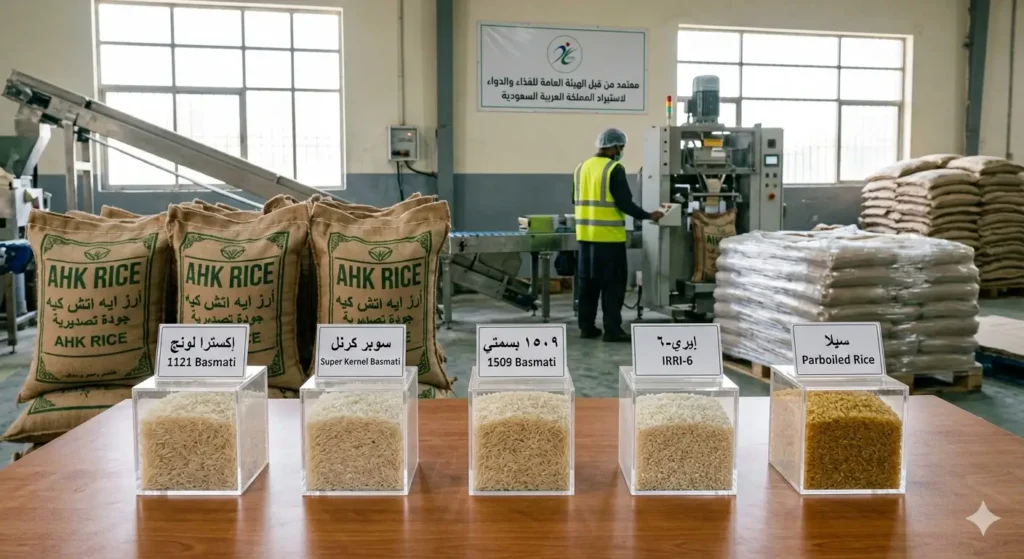
Saudi Arabia imports multiple rice grades including 1121 Basmati, Super Kernel Basmati, 1509 Basmati, IRRI-6, and parboiled rice, each classified based on grain length, aroma, broken percentage, and processing method.
1121 Basmati
Extra-long grain rice. Known for aroma and elongation after cooking.
Super Kernel Basmati
Traditional long-grain variety. Widely consumed in Middle Eastern cuisine.
1509 Basmati
Early maturity variety. Offers cost efficiency and good cooking performance.
IRRI-6
Non-Basmati rice. Used for bulk consumption due to affordability.
Parboiled Rice
Partially boiled before milling. Retains nutrients and has firm texture.
Each grade must meet SFDA quality parameters. Documentation must clearly define grade specifications.
Which markets and exporters are involved in Saudi rice imports?
Saudi Arabia imports rice from major exporting countries including Pakistan, India, Thailand, and Vietnam, with each market supplying specific rice varieties and complying with SFDA and SABER requirements for legal entry.
Pakistan exports Basmati varieties. These include 1121, Super Kernel, and 1509.
India supplies both Basmati and non-Basmati rice.
Thailand exports jasmine rice and white rice.
Vietnam focuses on non-Basmati rice.
Each exporting country must provide:
- Phytosanitary certificates
- Quality reports
- Halal certification where applicable
Trade relationships depend on compliance consistency and quality standards.