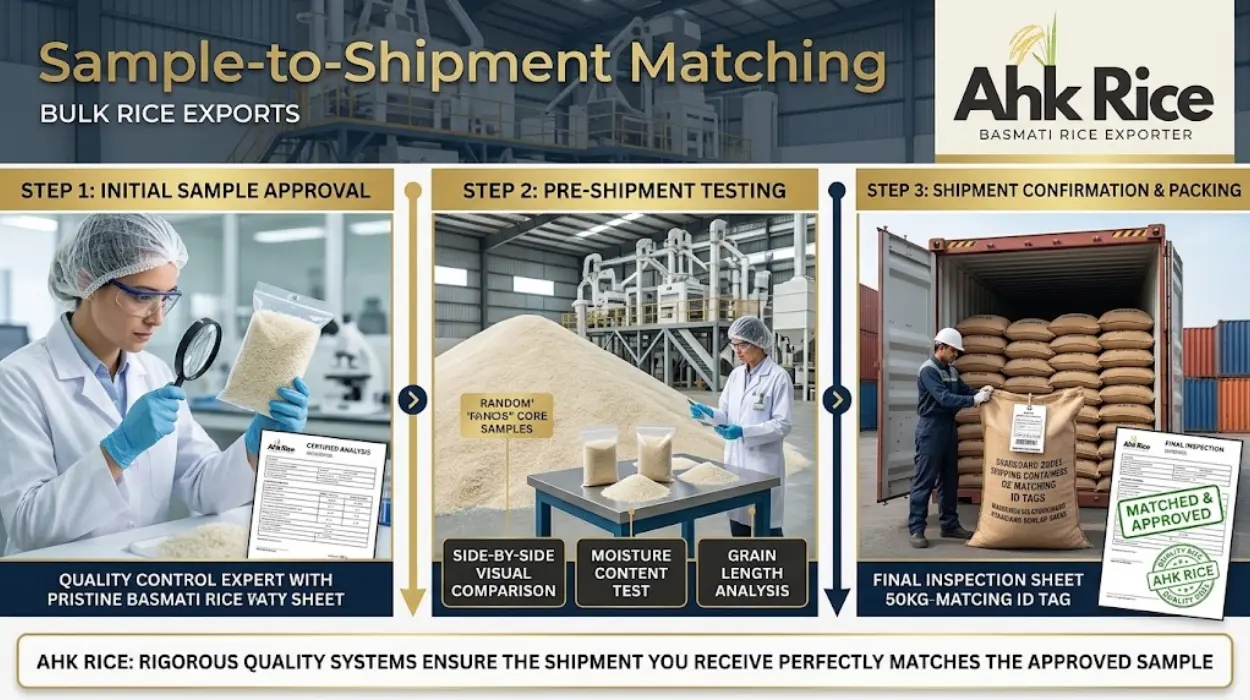
Sample-to-Shipment Matching: How Exporters Guarantee Bulk Rice Matches the Approved Sample
Sample-to-shipment matching works best when exporters convert an approved rice sample into a documented specification, apply the same quality controls throughout production, and verify the finished shipment before loading. For importers, this approach provides stronger protection than relying on a sample alone.
Why does bulk rice sometimes differ from the approved sample?
Bulk rice differs from an approved sample when the production lot, milling settings, raw material, grading process, or inspection method changes between sampling and shipment. Buyers reduce this risk by defining measurable specifications, tracing production batches, and checking the final cargo against the approved reference.
A commercial rice sample represents the quality a buyer expects to receive in a bulk order. It allows importers to assess grain appearance, aroma, cooking performance, broken percentage, and suitability for their customers. However, a small sample does not automatically represent every tonne produced later.
Several factors create differences between samples and shipments. An exporter might prepare a carefully selected sample while the bulk order comes from a different paddy lot. A milling line might also produce different grain lengths or broken percentages after its settings change. Storage conditions can affect moisture, aroma retention, and grain integrity.
For example, a U.S. distributor approves Pakistani 1121 Basmati rice with long, slender grains, a defined broken percentage, and a specific cooking profile. The container arrives with excessive broken grains and inconsistent grain lengths. Even if the rice remains edible, the shipment fails to meet the buyer’s commercial expectations.
The solution starts with a clear specification rather than a verbal promise. Buyers should understand how Basmati rice varieties and their specifications differ before selecting a grade and approving a commercial sample.
What are the available solutions for sample-to-shipment matching?
Exporters use five principal controls: specification-based contracts, representative sampling, batch traceability, laboratory testing, and independent pre-shipment inspection. Combining these controls connects the approved sample to the actual production lot and provides documented evidence that the delivered rice meets agreed requirements.
1. Specification-based contracts
A specification-based contract records the measurable characteristics of the approved rice. It identifies the variety, processing type, grain length, moisture limit, broken percentage, packaging, quantity, and applicable inspection procedure.
This method establishes the acceptance criteria before production begins. It also gives the buyer and exporter a shared reference when evaluating a quality dispute.
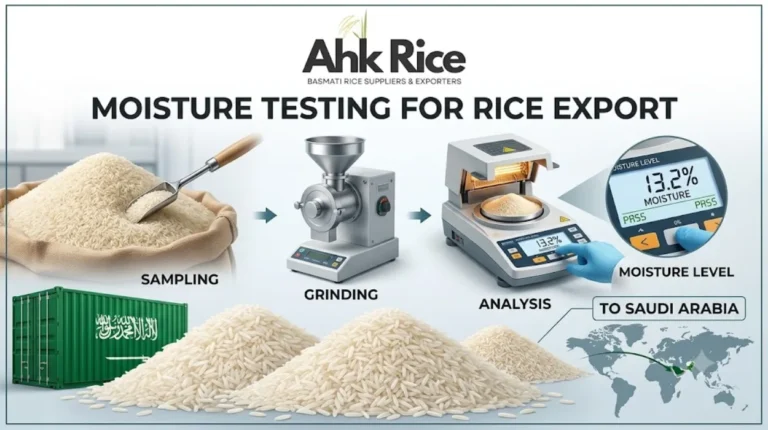
For example, a contract can specify Pakistani 1121 Basmati, steam processing, a maximum moisture content of 13%, and an agreed broken percentage. These values are illustrative commercial terms, not universal specifications for every 1121 shipment. The parties must approve the exact limits for their order.
2. Representative production sampling
Representative sampling means collecting samples from different parts of a production lot instead of relying on a handful of selected grains. The method reduces the risk of approving rice that does not reflect the wider batch.
Samples can be collected during milling, grading, blending where permitted, and final packing. The sampling plan should define collection points, sample quantities, identification procedures, and the person responsible for sampling.
A representative sample provides stronger evidence of consistency than a sample taken only from the best-looking portion of a batch.
3. Batch traceability
Batch traceability connects incoming paddy or milled rice to processing records, quality checks, packing dates, and shipment documents. It helps exporters identify the source of a quality deviation and determine which production lot requires corrective action.
For example, a shipment containing several production batches should have records showing which batches entered the finished consignment. If testing identifies excessive moisture in one batch, traceability helps isolate the affected quantity.
4. Laboratory testing
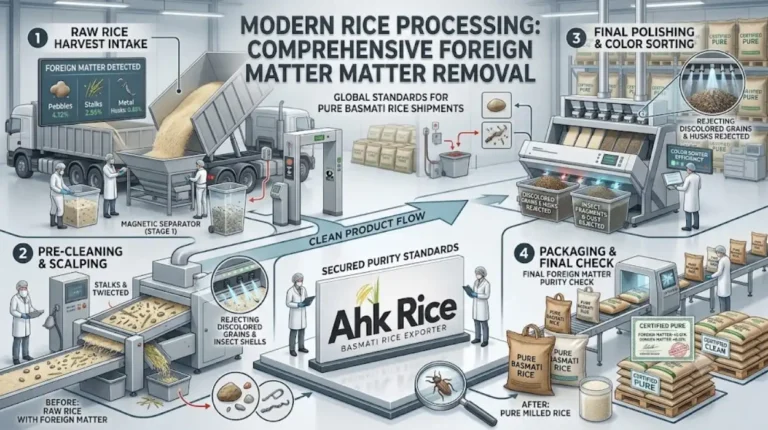
Laboratory testing measures characteristics that visual inspection cannot establish reliably. Depending on the contract and destination, testing can cover moisture, broken percentage, foreign matter, pesticide residues, heavy metals, and other relevant food-safety parameters.
A laboratory certificate does not replace every physical inspection. It complements visual assessment by providing analytical evidence for specified characteristics.
5. Independent pre-shipment inspection
A pre-shipment inspection evaluates the finished goods before dispatch. An independent inspector can check grain appearance, packaging, markings, quantity, container condition, and agreed quality parameters.
The inspection scope must be documented. A report that confirms packaging and quantity alone does not establish compliance with every chemical, microbiological, or cooking-performance requirement.
How do different sample-to-shipment approaches compare?
Specification-based contracts define the target, production sampling checks consistency, traceability connects the records, laboratory testing measures selected characteristics, and independent inspection verifies the finished order. The strongest approach combines these methods according to product risk, order value, and destination requirements.
The following table compares seven attributes that buyers should assess when selecting a quality assurance method.
| Comparison attribute | Contract specifications | Production sampling | Laboratory testing | Independent inspection |
|---|---|---|---|---|
| Main purpose | Defines acceptance criteria | Checks batch consistency | Measures selected properties | Verifies finished goods |
| Timing | Before production | During production | During production or before dispatch | Before shipment |
| Grain appearance | Defines required limits | Identifies visible variation | Limited role | Direct visual assessment |
| Moisture and broken percentage | Records agreed limits | Tracks production variation | Measures moisture where included; broken percentage may require physical grading | Checks according to inspection scope |
| Food-safety verification | Specifies applicable requirements | Supports sample collection | Measures selected hazards or residues | Reviews documents or coordinates testing |
| Traceability | Establishes contractual records | Identifies sampled batches | Links results to submitted samples | Connects inspection findings to the shipment |
| Main limitation | Does not prove actual compliance | Depends on sampling quality | Covers only tested parameters | Results depend on scope and sampling plan |
No single method guarantees every aspect of shipment quality. Contracts without verification rely heavily on supplier performance. Sampling without traceability can produce results that cannot be linked to the shipped goods. Laboratory reports covering only moisture cannot prove varietal authenticity or cooking quality.
The practical solution is to connect each control to a defined risk. Grain appearance requires physical assessment, moisture requires measurement, food-safety risks require appropriate analytical testing, and shipment identity requires traceable documentation.
Which rice specifications should buyers compare before approving a sample?
Buyers should compare the approved sample against seven measurable attributes: variety, grain length, broken percentage, moisture, processing type, cooking performance, and packaging. These characteristics establish a practical quality baseline and help prevent disagreements between the original sample and the delivered shipment.
Seven essential specification attributes
| Attribute | What buyers should confirm | Why it matters |
|---|---|---|
| Variety | 1121, Super Kernel, or 1509 Basmati | Establishes the commercial product identity |
| Grain length | Agreed raw-grain measurement and tolerance | Supports grading and retail positioning |
| Broken percentage | Contractual maximum | Influences appearance, yield, and market value |
| Moisture | Agreed maximum moisture level | Supports storage stability and quality control |
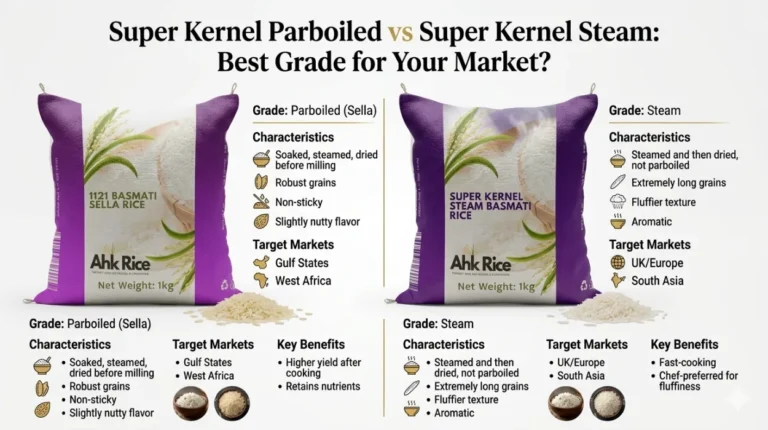
| Processing type | Raw, steam, Golden Sella, or Creamy Sella | Changes appearance, texture, and cooking behaviour |
| Cooking performance | Agreed elongation, aroma, texture, and separation criteria | Determines suitability for the intended dishes |
| Packaging | Bag weight, material, printing, and labelling | Supports retail presentation, handling, and destination compliance |
These specifications must describe the same product. A buyer approving 1121 Steam rice should not accept a substitute processing type simply because the raw grain length appears similar.
Grain length also requires a consistent measurement method. Raw-grain length, average grain length, and cooked-grain elongation describe different properties. They should not be treated as interchangeable measurements.
Moisture and broken percentage require equally clear definitions. Buyers should specify the testing or grading method, the applicable tolerance, and whether the limit applies to each batch or the composite shipment. These details make the specification suitable for quality verification rather than general marketing.
How do U.S. and Gulf markets differ in rice quality expectations?
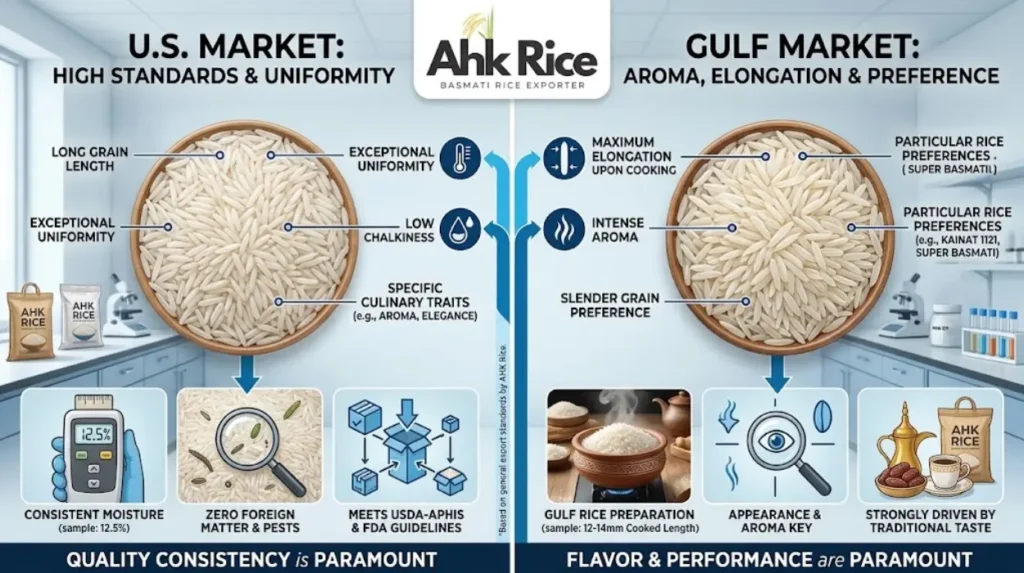
U.S. buyers often prioritise consistent premium-grade appearance, retail specifications, traceability, and documented food-safety controls. Gulf buyers commonly serve a mix of premium retail, wholesale distribution, restaurants, and catering businesses, creating demand for several Basmati grades and processing types.
U.S. market: premium retail and distribution
U.S. importers purchasing Pakistani Basmati frequently evaluate 1121 for premium long-grain positioning. Super Kernel also suits buyers seeking aromatic Basmati for ethnic grocery stores and South Asian food distribution. The appropriate choice depends on the buyer’s target price, brand positioning, and cooking requirements.
For retail orders, the approved sample should match the intended package specification and the quality claims used in product listings. Buyers should also establish applicable food-safety, labelling, and import requirements before shipping.
The following price figures are planning examples, not current market quotations. Actual prices depend on grade, crop year, processing, order quantity, packaging, shipment terms, and destination.
Gulf market: wholesale, foodservice, and retail
Gulf markets accommodate premium Basmati as well as products intended for high-volume foodservice. Buyers may select 1121 Steam or Sella for premium presentation and long-grain cooking performance, while 1509 can suit price-sensitive wholesale and institutional demand.
The right grade depends on the intended use. A restaurant supplying large rice dishes may prioritise cooking consistency and cost per serving. A premium retailer may place greater weight on aroma, grain appearance, packaging, and brand differentiation.
Indicative price and shelf-life comparison
| Factor | U.S. market | Gulf market |
|---|---|---|
| Common premium choices | 1121 and Super Kernel | 1121 and Super Kernel |
| Other commercial option | 1509 for selected retail or foodservice segments | 1509 for price-sensitive wholesale and foodservice |
| Illustrative FOB planning range | US$1,100–1,400/MT | US$950–1,250/MT |
| Shelf-life planning | Commonly 12–24 months when supported by product validation and packaging | Commonly 12–24 months when supported by product validation and packaging |
| Key commercial consideration | Retail consistency, import compliance, and traceability | Grade suitability, price competitiveness, storage, and distribution |
Important pricing note: The figures above are broad illustrative planning ranges, not verified October 2026 market prices or firm AHK Rice offers. Buyers should obtain current quotations for the exact grade, processing type, crop year, quantity, and Incoterm. U.S. and Gulf prices are not directly comparable unless freight, insurance, duties, and other landed costs are treated consistently.
Shelf life also requires careful interpretation. The stated period depends on the product, moisture at packing, packaging barrier properties, storage conditions, and validation data. Buyers should confirm the manufacturer’s declared shelf life rather than assuming every Basmati product remains suitable for 24 months.
In both markets, sample approval should include the packaging format and storage conditions expected during distribution. Rice that meets specifications at dispatch can deteriorate if exposed to moisture, pests, unsuitable temperatures, or damaged packaging.
What are the advantages and disadvantages of each quality control method?
Contract specifications offer clear acceptance criteria, representative sampling reveals batch variation, laboratory testing measures defined properties, and independent inspection adds verification. Each method has limitations, so buyers should select a combination that matches the risks, shipment value, and regulatory requirements of their market.
| Method | Main advantage | Main disadvantage | Practical example |
|---|---|---|---|
| Contract specifications | Establishes measurable obligations | Cannot prove the goods meet them | A 1121 order specifies moisture and broken limits |
| Representative sampling | Reveals variation across production | Poor sampling can miss defects | Samples are collected from multiple packing stages |
| Laboratory testing | Produces analytical results | Tests only the parameters requested | A report measures moisture and selected contaminants |
| Batch traceability | Connects quality results to production | Requires accurate records | A nonconforming lot is isolated before loading |
| Independent inspection | Adds third-party verification | Adds cost and requires a clear scope | An inspector checks cargo quality and bag markings |
Consider an importer purchasing 25 tonnes of Super Kernel Basmati for a private-label launch. A specification sheet alone establishes the target but does not verify the cargo. A sample from the production batch provides a stronger comparison, laboratory testing checks specified parameters, and pre-shipment inspection verifies the finished consignment.
For a repeat order with a proven supplier, the buyer can use established specifications, routine production records, risk-based testing, and periodic independent inspection. For a first order or a high-value private-label shipment, broader verification provides stronger protection against costly discrepancies.
How should buyers decide which matching method to use?
Buyers should select controls according to supplier history, order value, destination requirements, product sensitivity, and the consequences of a rejected shipment. First-time orders need stronger verification, while repeat orders can use a documented risk-based programme with clear acceptance limits and corrective-action procedures.
The following five-row framework connects common purchasing situations with appropriate controls.
| Decision factor | Buyer situation | Recommended approach | Reason |
|---|---|---|---|
| Supplier history | First order with a new exporter | Approved specifications, representative sampling, and independent inspection | Establishes a reliable baseline |
| Order value | High-value private-label shipment | Batch traceability, relevant laboratory tests, and pre-shipment inspection | Reduces the cost of quality disputes |
| Destination | Market with defined import controls | Destination-specific testing and documentation | Supports regulatory compliance |
| Product requirements | Premium long-grain Basmati | Grain grading, cooking evaluation, and agreed tolerances | Protects product identity and performance |
| Repeat purchasing | Established supplier with consistent results | Routine batch checks and periodic independent verification | Maintains oversight without duplicating every control |
The buyer and exporter should also agree on what happens when a result falls outside the specification. The contract should identify the responsible party, retesting procedure, treatment of nonconforming goods, and process for resolving disputes.
A retained reference sample can support later comparisons. Both parties should identify it clearly, record the approval date, and store it under appropriate conditions. The retention period should reflect the contract, product stability, and likely dispute timeline.
How does AHK Rice connect sample approval with bulk shipment quality?
AHK Rice can align a buyer’s approved Basmati sample with documented product specifications, processing controls, packaging requirements, and shipment records. Buyers should confirm the applicable quality checks, inspection scope, and documentation for each order before production and dispatch.
For a U.S. bulk order, the process starts with selecting the required variety and processing type. The buyer then confirms grain length, broken percentage, moisture, packaging, quantity, and any applicable testing requirements. These details form the reference specification for the commercial sample and subsequent order.
Once the buyer approves the sample, the exporter should preserve the approval record and link it to the relevant production lot. Processing and grading records help identify changes, while final checks establish whether the packed rice meets the contractual requirements.
AHK Rice supplies Pakistani Basmati varieties including 1121, Super Kernel, and 1509 to international markets. Its end-to-end processing, custom packaging, and export coordination provide a framework for managing the sample-to-order process. The precise controls and certificates remain dependent on the product, destination, contract, and agreed inspection plan.
Buyers should request written confirmation of the specification, sampling procedure, testing scope, and pre-shipment inspection arrangements before placing a bulk order. This approach turns sample approval into a verifiable commercial process instead of an informal quality promise.
Importers planning their first U.S. purchase can review the decision-focused guide to requesting Basmati rice samples before a USA bulk order to understand the next steps before committing to a larger shipment.
What should buyers confirm before shipment?
Buyers should confirm that the final production lot matches the approved specification, required tests are complete, packaging is correct, and shipment documents identify the goods accurately. They should also resolve quality deviations before loading rather than relying on arrival inspections to discover preventable problems.
A practical pre-shipment checklist includes:
- Approved sample and signed specification.
- Confirmed variety, processing type, and crop year where applicable.
- Recorded grain length, broken percentage, and moisture results.
- Relevant laboratory reports and destination-specific compliance documents.
- Production batch identification and traceability records.
- Correct bag weight, packaging material, and printed information.
- Agreed inspection report and loading records.
- Clear procedures for nonconforming goods and disputes.
These checks provide a documented connection between the product the buyer approved and the cargo the exporter dispatches. They also help both parties identify responsibility when a discrepancy occurs.
The central principle is straightforward: an approved sample defines the target, documented production controls maintain consistency, and final verification establishes whether the shipment meets the agreement. Buyers who combine these steps gain a stronger basis for repeat orders, supplier evaluation, and long-term quality management.
Frequently Asked Questions
What is sample-to-shipment matching in rice exports?
Sample-to-shipment matching is the process of ensuring that bulk rice meets the quality and specifications established by an approved commercial sample. It uses documented specifications, representative sampling, production records, testing, and shipment inspection.
Does an approved rice sample guarantee that the bulk shipment will match?
No. Sample approval establishes the expected quality but does not independently prove that the entire production lot conforms. Buyers need documented production controls, representative sampling, and appropriate pre-shipment verification.
Which tests help verify Basmati rice quality?
Common checks include grain length, broken percentage, moisture, foreign matter, and cooking performance. Depending on the destination and contract, laboratory testing can also cover pesticide residues, heavy metals, and other relevant food-safety parameters.
Should buyers use an independent rice inspection company?
Independent inspection is particularly useful for first orders, high-value shipments, private-label contracts, and transactions with strict acceptance criteria. Buyers should define the inspection scope and confirm whether laboratory testing is included.
How long should buyers retain an approved rice sample?
Buyers should agree on a retention period based on the contract, product stability, and potential dispute timeline. The sample should be labelled with the product specification, batch reference, approval date, and storage requirements.