How Is Foreign Matter Removed During Modern Rice Processing?
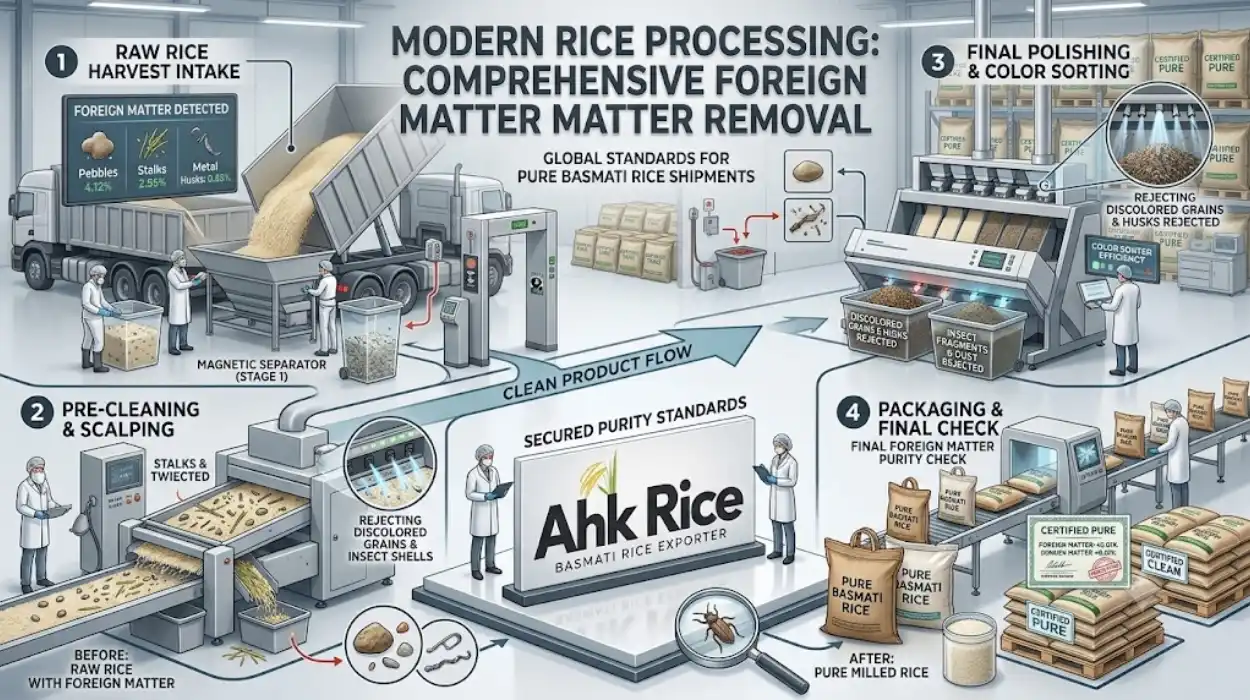
Foreign matter removal is the most important stage in modern rice processing. Here is why: clean rice meets import specifications, reduces buyer complaints, improves shelf life, and helps exporters comply with food safety standards. Modern rice mills use a combination of pre-cleaning, destoning, magnetic separation, grading, and optical colour sorting to remove contaminants before export.
AHK Rice is a trusted Pakistani Basmati rice exporter based in Punjab, supplying 1121, Super Kernel, and 1509 varieties to more than 15 countries. The company processes rice through advanced cleaning and grading systems to meet international import requirements. Learn more about its rice export capabilities through the custom export and processing solutions offered for global buyers.
Importers, wholesalers, and retailers increasingly demand low foreign matter levels because food safety regulations have become stricter. Buyers who want to understand rice quality standards can also read our guide on how rice quality grading works from farm to export.
What Is Foreign Matter in Rice?
Foreign matter includes stones, dust, straw, metal particles, husks, weed seeds, damaged grains, plastic fragments, and other contaminants that reduce rice quality and food safety.
Foreign matter refers to any material that is not part of the intended rice specification. Rice can accumulate contaminants during cultivation, harvesting, transport, storage, and milling.
Rice processors classify foreign matter into three categories:
- Physical contaminants
- Organic contaminants
- Metallic contaminants
Physical contaminants include stones, soil, glass, and plastic. Organic contaminants include straw, husks, weed seeds, and insects. Metallic contaminants include iron fragments from machinery.
Export markets establish maximum limits for foreign matter. UK buyers often require foreign matter levels below 0.1%, while premium retail brands demand even stricter specifications.
Why Foreign Matter Matters
Foreign matter affects food safety, product appearance, and consumer trust.
Contaminated rice causes processing losses during packing. Contaminated rice also increases rejection risks during import inspections.
According to REAP export statistics, premium Basmati shipments achieve higher acceptance rates when foreign matter levels remain below importer specifications (source: REAP export data, December 2025).
With foreign matter defined, the next question is how modern processors remove it efficiently.
What Are the Available Solutions for Removing Foreign Matter?
Modern rice mills use mechanical cleaning, gravity separation, magnetic separation, grading systems, and optical colour sorting to achieve export-grade purity.
Different contaminants require different removal technologies.
9 Main Processing Steps
- Clean the incoming paddy.
- Remove large impurities.
- Separate dust particles.
- Extract stones.
- Remove metal fragments.
- Dehusk the grain.
- Polish the rice.
- Sort by size.
- Sort by colour.
Each stage targets specific contamination risks.
Mechanical Pre-Cleaning
Mechanical cleaners remove large impurities before milling.
These systems remove straw, twigs, paper, and oversized particles.
Mechanical cleaning improves downstream equipment efficiency.
Destoning Systems
Destoners separate stones using vibration and airflow.
Stones have a higher density than rice kernels. The machine exploits this density difference.
Destoners are essential for rice sourced from regions with soil contamination.
Magnetic Separation
Magnetic separators extract metallic contaminants.
Metal fragments originate from harvesting equipment and milling machinery.
Magnetic systems protect consumers and processing equipment.
Length and Thickness Grading
Graders sort kernels according to dimensions.
Graders remove broken grains and improve uniformity.
Uniform grain sizes improve cooking performance and retail presentation.
Optical Colour Sorting
Colour sorters use cameras and artificial intelligence.
Colour sorters detect discoloured grains, foreign seeds, insects, and dark contaminants.
Premium exporters rely heavily on optical sorting technology.
Having examined available solutions, the next step is comparing their effectiveness.
How Do Different Foreign Matter Removal Approaches Compare?
Optical colour sorting provides the highest precision, while mechanical cleaning offers the lowest operating cost and highest throughput.
Comparison of Major Foreign Matter Removal Methods
| Attribute | Mechanical Cleaning | Destoning | Magnetic Separation | Colour Sorting |
|---|---|---|---|---|
| Main Target | Straw, dust | Stones | Metal | Visual defects |
| Detection Method | Screens | Density | Magnetism | Cameras |
| Precision Level | Medium | High | Very High | Extremely High |
| Operating Cost | Low | Medium | Low | High |
| Processing Speed | Very High | High | High | Medium |
| Export Importance | Essential | Essential | Essential | Critical |
| Premium Market Suitability | Moderate | High | High | Excellent |
Mechanical cleaning removes bulk contaminants efficiently.
Destoning removes mineral contamination accurately.
Magnetic systems remove hazardous metallic fragments.
Colour sorting identifies defects invisible to traditional equipment.
Premium UK retailers frequently require colour-sorted rice because visual consistency directly influences shelf appeal.
Middle Eastern foodservice buyers often prioritize throughput and cost efficiency over retail-level appearance standards.
Cost Comparison Per Metric Ton
| Processing Method | Typical Cost Impact (£/MT) |
|---|---|
| Mechanical Cleaning | £3–£6 |
| Destoning | £4–£8 |
| Magnetic Separation | £1–£3 |
| Colour Sorting | £10–£20 |
Colour sorting costs more but produces significantly cleaner rice.
With comparison established, buyers should understand regional preferences.
Which Methods Work Best for Different Markets?
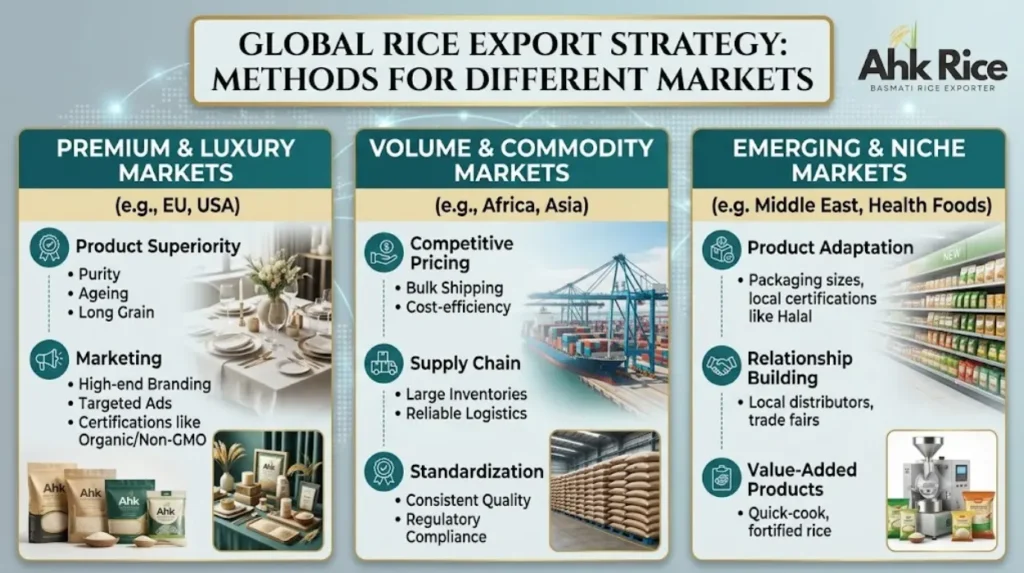
UK retail markets prefer intensive colour sorting, while Middle Eastern foodservice markets often prioritize efficient mechanical cleaning and grading.
Different import regions demand different specifications.
UK Market Preferences
UK retailers focus on:
- Visual consistency
- Food safety compliance
- Minimal foreign matter
- Premium packaging
- Retail shelf appearance
Colour sorting and multiple grading passes perform best for this market.
Premium Basmati brands sold in UK supermarkets commonly require near-zero visible contaminants.
Gulf Market Preferences
Gulf importers prioritize:
- Competitive pricing
- Large shipment volumes
- Consistent cooking performance
- Commercial foodservice suitability
Mechanical cleaning combined with destoning and grading often meets requirements.
Market Grade Preferences
| Region | Preferred Grade | Purity Requirement |
|---|---|---|
| United Kingdom | Premium 1121 Basmati | Very High |
| European Union | Premium Basmati | Very High |
| UAE | 1121 Steam | High |
| Saudi Arabia | 1121 Sella | High |
| Qatar | Super Kernel | High |
Regional preferences influence processing decisions.
The next consideration involves shelf life and quality preservation.
How Does Cleaner Rice Improve Shelf Life?
Rice with lower contamination levels maintains quality longer because contaminants introduce moisture, insects, and spoilage risks.
Foreign matter accelerates product deterioration.
Dust and organic residues increase moisture retention.
Organic contamination attracts pests during storage.
Shelf Life Comparison
| Quality Level | Expected Shelf Life |
|---|---|
| Standard Cleaned Rice | 12–18 Months |
| Export Grade Rice | 18–24 Months |
| Premium Colour-Sorted Rice | 24+ Months |
Premium colour-sorted rice maintains appearance longer.
Premium colour-sorted rice reduces customer complaints.
Premium colour-sorted rice performs better in long-distance shipping.
For UK importers holding inventory for extended periods, cleaner rice delivers measurable operational advantages.
With shelf life benefits explained, buyers can evaluate advantages and limitations.
What Are the Pros and Cons of Different Processing Methods
No single system removes every contaminant. The most effective mills combine multiple technologies into one integrated process.
Mechanical Cleaning
Pros
- Low cost
- High throughput
- Essential first stage
Cons
- Limited precision
- Cannot remove visual defects
Destoning
Pros
- Excellent stone removal
- Reliable operation
Cons
- Cannot identify colour defects
Magnetic Separation
Pros
- High safety value
- Low operating cost
Cons
- Removes only metallic contaminants
Colour Sorting
Pros
- Highest purity
- Premium appearance
- Export compliance support
Cons
- Higher capital investment
- Increased processing cost
Processors achieve the best outcomes by combining all technologies.
The final consideration is selecting the right cleaning specification.
Which Factors Should Buyers Consider Before Selecting a Processing Standard?
Market destination, product positioning, shelf-life expectations, compliance requirements, and budget determine the correct processing specification.
Decision Framework
| Decision Factor | Basic Cleaning | Premium Export Cleaning |
|---|---|---|
| Retail Sales | Moderate | Excellent |
| Foodservice Use | Good | Excellent |
| Long Storage | Moderate | Excellent |
| Import Compliance | Good | Excellent |
| Brand Reputation | Good | Excellent |
Buyers supplying supermarkets should prioritize premium cleaning.
Buyers supplying catering businesses can balance quality and cost.
Buyers serving multiple markets often choose higher processing standards to simplify inventory management.
Modern rice processing succeeds because each technology removes specific contamination risks. Combined systems produce cleaner rice, longer shelf life, better appearance, and stronger import compliance.
Frequently Asked Questions
How much foreign matter is acceptable in export-quality rice?
Premium export rice typically contains less than 0.1% foreign matter. Many retailers require even stricter specifications.
What machine removes stones from rice?
Destoners remove stones using density differences between rice kernels and mineral contaminants.
Why is colour sorting important?
Colour sorting removes discoloured grains, foreign seeds, insect-damaged kernels, and contaminants that mechanical systems cannot detect.
Does cleaner rice last longer?
Yes. Cleaner rice stores longer because contaminants contribute to moisture retention, insect activity, and spoilage risks.
Which export markets require the cleanest rice?
UK and European retail markets generally require the highest purity standards because food safety regulations are stricter.