Secure Consistent Basmati Rice Supply for Georgia with AHK Rice
Georgia importers buying Pakistani Basmati rice at commercial scale should choose a supplier based on production capacity, specification control, documentation, sampling, and shipment reliability—not simply the lowest FOB price. For buyers planning recurring supply into Atlanta, Savannah, and wider Southeast distribution, the supplier must be able to repeat the same grade across multiple containers and production cycles.
Large import programs become difficult when an exporter can quote the required volume but cannot maintain grain length, broken percentage, moisture, packing, or dispatch timing. Understanding:
Why production capacity is critical for large rice import programs helps Georgia buyers evaluate supply risk before signing a purchase contract.
What is the best solution for securing consistent Basmati rice supply in Georgia?
The best solution is a contracted supply program combining approved rice specifications, production scheduling, pre-shipment inspection, controlled packaging, export documentation, and planned container bookings. This approach reduces variation between shipments while giving Georgia importers clearer purchasing costs, delivery expectations, and replenishment planning.
A reliable supply program starts with one approved specification. The importer should define variety, processing grade, grain length, broken percentage, moisture, foreign matter, packaging, quantity, and destination before production begins.
For Georgia buyers, suitable Pakistani Basmati options include 1121, Super Kernel, and 1509. AHK Rice supplies these varieties for international wholesale programs and manages sourcing, processing, grading, color sorting, packaging, and export documentation within its export workflow.
The commercial objective is consistency. A distributor selling rice through Atlanta retailers or food-service customers cannot easily change specifications from one shipment to another. A different grain profile, cooking result, or packaging format can create complaints, relabeling costs, or slow inventory movement.
AHK Rice addresses this requirement by establishing the product specification before shipment rather than treating every container as an independent purchase. For recurring buyers, the same approved specification can become the reference point for subsequent purchase orders.
The supply model should also include a realistic replenishment schedule. If a Georgia distributor consumes 40 MT per month, ordering exactly 40 MT every month may create unnecessary stockout risk because ocean freight, port handling, customs clearance, and inland delivery do not operate on a perfectly fixed schedule.
A better approach is to establish a minimum stock level, reorder point, expected monthly consumption, and planned container frequency. This converts rice procurement from individual spot purchases into a managed supply program.
Why should Georgia importers choose the USA service from AHK Rice?
Georgia buyers benefit from a USA-focused export process because product specifications, packing, documentation, sampling, payment, shipment planning, and destination requirements can be organized around U.S. import conditions rather than handled as generic international orders.
AHK Rice’s USA Basmati rice export service is designed around U.S. buyers sourcing Pakistani Basmati. The service currently covers 1121 Sella, Super Kernel, and traditional white Basmati varieties, with customized packing options and export documentation support.
The service is particularly relevant to Georgia because the buyer can specify the destination port and final delivery requirements during quotation. Savannah is a logical gateway to Georgia, while some importers may route cargo through another U.S. port depending on freight availability, inland logistics, inventory location, and total landed cost.
AHK Rice states that U.S. shipments can move directly from Karachi to U.S. ports and gives an indicative 25–35-day door-to-door timeline for major U.S. destinations. Georgia buyers should treat this as a planning range rather than a guaranteed transit period because vessel schedules, transshipment, port congestion, customs processing, and inland transportation can change the final arrival date.
For a Georgia program, a practical purchasing plan should separate production time from ocean transit. A buyer should not calculate inventory requirements using ocean transit alone. Production, inspection, container positioning, port cut-off, sailing, customs clearance, and final trucking all affect the date on which usable stock reaches the warehouse.
How does AHK Rice maintain supply consistency during large orders?
Supply consistency depends on controlling the specification before production, matching raw material to the required grade, using controlled milling and sorting, checking finished rice, and maintaining shipment records so each container can be compared against the approved commercial specification.
AHK Rice operates an integrated processing and export workflow covering paddy procurement through container loading. Its published capabilities include rice processing, grading, color sorting, customized packaging, blending, and export documentation.
This matters when a buyer moves from one container to ten or twenty containers. The procurement question changes from “Can you supply this rice?” to “Can you reproduce this rice repeatedly?”
The answer should be supported by measurable controls. A commercial specification can include average grain length, broken grains, moisture, foreign matter, chalkiness, polish, processing type, crop year, packaging material, net weight, and tolerance limits.
AHK Rice’s USA service page currently lists a specification example of 8.3 mm or higher average grain length, moisture under 12.5%, and broken grains under 1% for its listed USA export specification. Buyers should confirm the exact specification for the selected variety and contract because product grades can differ.
The company also states that third-party rice inspection is available. For a high-value recurring program, an importer can use independent inspection as an additional release-control layer rather than relying only on supplier documentation.
This is especially useful for private-label programs. If the same 1121 Steam specification is sold under a Georgia distributor’s brand, the distributor needs confidence that the second and third containers will perform like the approved sample.
What shipping timeline should Georgia buyers expect?
Georgia buyers should plan around production, container loading, ocean transit, U.S. clearance, and inland delivery as separate stages. A practical planning window is roughly 25–35 days for the exporter’s stated U.S. door-to-door range, with additional contingency for port and inland variables.
The exact schedule depends on the destination port and shipping line. AHK Rice lists major carriers including Maersk, MSC, Hapag-Lloyd, Evergreen, PIL, ONE, and CMA CGM, while stating that shipment tracking is available from loading through U.S. delivery.
For Georgia, the supply plan should therefore be built around three logistics stages:
| Stage | Planning consideration | Georgia buyer action |
|---|---|---|
| Production | Rice processing, grading, packing and inspection | Approve specification before production |
| Ocean shipment | Karachi sailing, transshipment and port arrival | Reserve freight against required inventory date |
| Georgia delivery | Clearance, release and inland trucking | Pre-plan warehouse receiving |
A buyer requiring a container in Atlanta on a specific date should work backward from the required warehouse delivery date. If the business waits until inventory becomes critically low before placing the order, even a normal vessel delay can create a stockout.
For recurring supply, AHK Rice should receive a rolling forecast rather than isolated purchase requests. A 60- or 90-day purchasing forecast gives the exporter better visibility for production and packing allocation.
The comparison of how rice exporters scale production during peak demand periods is useful when evaluating whether a supplier can support higher volumes without weakening specification control.
What is the complete sample process and how much does it cost?
A commercial sample process should confirm variety, grade, cooking performance, packaging, documentation, and freight suitability before bulk production. AHK Rice states that rice samples can be supplied in small quantities, with buyers generally covering courier and applicable certification costs.
The first step is to send the exporter the exact purchasing specification. The request should include variety, processing type, required broken percentage, moisture target, quantity, packing format, destination in Georgia, and intended application.
The second step is sample selection. AHK Rice states that samples of up to 20 kg can be supplied free of rice charge, while the client covers sample shipping costs. Its USA service page also states that 1–5 kg parcels can be shipped by air courier such as DHL or FedEx, with an indicative delivery time of 5–7 days to the USA.
The third step is commercial testing. The Georgia buyer should inspect raw appearance, grain uniformity, aroma, broken percentage, cooking elongation, texture, whiteness, and post-cooking separation. For a food-service program, the buyer should also conduct the actual recipe test used by its customers.
The fourth step is documentation review. The importer should confirm that the supplier can provide the documentation needed for the selected product and shipment structure. U.S. food importers have responsibilities under FDA requirements, including food facility registration and Prior Notice, while covered importers must maintain an FSVP for imported food and verify foreign suppliers on a risk-based basis.
USDA APHIS requirements also depend on the specific agricultural commodity and country of origin. APHIS advises importers to check its current Agricultural Commodity Import Requirements database rather than assuming that one rule applies to every plant product.
The fifth step is approval. Once the sample meets the buyer’s cooking and specification requirements, the approved sample or specification sheet becomes the benchmark for the bulk order.
Indicative sample cost structure
| Cost item | Typical treatment |
| Rice sample | May be supplied free within supplier limits |
| Courier | Paid by buyer; depends on weight and destination |
| Phytosanitary/document charges | Apply when required for the specific shipment or sample |
| Laboratory testing | Buyer-controlled cost if independent testing is requested |
| Bulk sample adjustment | May be credited against a confirmed order subject to quotation |
The exact cost should be quoted before dispatch because courier rates, sample weight, destination, and documentation requirements change. AHK Rice’s published USA page specifically states that clients cover sample shipping and phytosanitary certificate costs where applicable.
What factors determine the price of Basmati rice delivered to Georgia?
The delivered price depends on rice variety, grade, crop and raw-paddy cost, processing yield, broken tolerance, packaging, order quantity, inspection, freight, insurance, destination port, inland transport, and payment terms. A low FOB price does not necessarily produce the lowest landed cost.
For a Georgia importer, the most useful comparison is landed cost per metric ton rather than FOB price alone. The exporter may quote FOB Karachi, while the buyer separately pays ocean freight, insurance if selected, destination charges, customs-related costs, broker fees, drayage, and warehouse delivery.
Market quotations change frequently. A July 2026 market reference for Pakistani Basmati showed indicative FOB Karachi ranges around $1,135–$1,205 per MT for selected 1121 grades, demonstrating why firm pricing should be requested for the actual specification and shipment window rather than copied from an old price list.
AHK Rice states that USA pricing depends on variety, quantity, and current market conditions, with quotations provided against buyer requirements. It also states that volume discounts can apply to bulk or repeat purchases.
A 20 MT trial order and a 200 MT recurring program should therefore not be evaluated using the same commercial assumptions. Larger volumes can improve production planning and freight economics, but the buyer should also consider inventory carrying cost and warehouse capacity.
What results can Georgia distributors expect from a structured supply program?
A structured supply program can give Georgia distributors more predictable specifications, better inventory planning, fewer emergency purchases, clearer shipment visibility, and stronger supplier documentation. The commercial result is not merely cheaper rice; it is lower supply risk across repeated purchasing cycles.
Consider a Georgia distributor selling 1121 Steam Basmati to restaurants and ethnic retail stores. If monthly consumption is 60 MT, a single 20 MT container covers only part of demand. The distributor needs a rolling purchasing plan rather than waiting for stock to reach zero.
AHK Rice can structure the discussion around product specification, container quantity, packaging, shipment timing, payment terms, and destination requirements. The buyer can then compare the supplier’s commercial proposal against its actual inventory cycle.
The strongest result is specification continuity. If the approved sample has a particular grain length and cooking profile, future shipments should be purchased against that same specification rather than a generic product name.
Documentation also becomes easier to manage. FDA explains that covered FSVP importers are responsible for evaluating foreign suppliers and maintaining appropriate verification activities, which can include supplier records, sampling and testing, or audits depending on risk.
For this reason, AHK Rice should be evaluated not only on the rice itself but also on the documentation and communication supporting every shipment.
How should a Georgia importer decide whether AHK Rice is the right supplier?
Choose AHK Rice when its proposed specification, production capacity, sample performance, documentation, shipment schedule, and landed cost match your recurring demand. The final decision should be based on measurable supply controls and commercial fit rather than brand claims or headline FOB price.
A practical supplier decision framework is:
| Decision factor | What Georgia buyers should verify |
| Product consistency | Approved specification repeated across containers |
| Capacity | Ability to support forecasted monthly volume |
| Quality control | Grading, sorting, inspection and testing procedures |
| Documentation | Export and U.S.-entry documentation support |
| Logistics | Karachi loading, ocean transit and Georgia delivery plan |
| Commercial terms | Price, MOQ, payment, packing and freight responsibilities |
| Replenishment | Ability to support repeat orders and peak demand |
AHK Rice has been operating since 2019 and states that it supplies buyers across 15 countries while managing processing and export operations from Punjab. Its published certifications include ISO 22000:2018, HACCP, ISO 9001:2015, GMP, and Halal. Buyers should still verify which certificates and documents apply to their specific purchase and U.S. import arrangement.
The decision should also include a sample approval before committing to a recurring program. AHK Rice’s USA process allows buyers to evaluate samples before bulk purchasing, giving a Georgia distributor an opportunity to test cooking performance and commercial specifications before committing container volume.
How can a Georgia buyer start a consistent Basmati rice supply program?
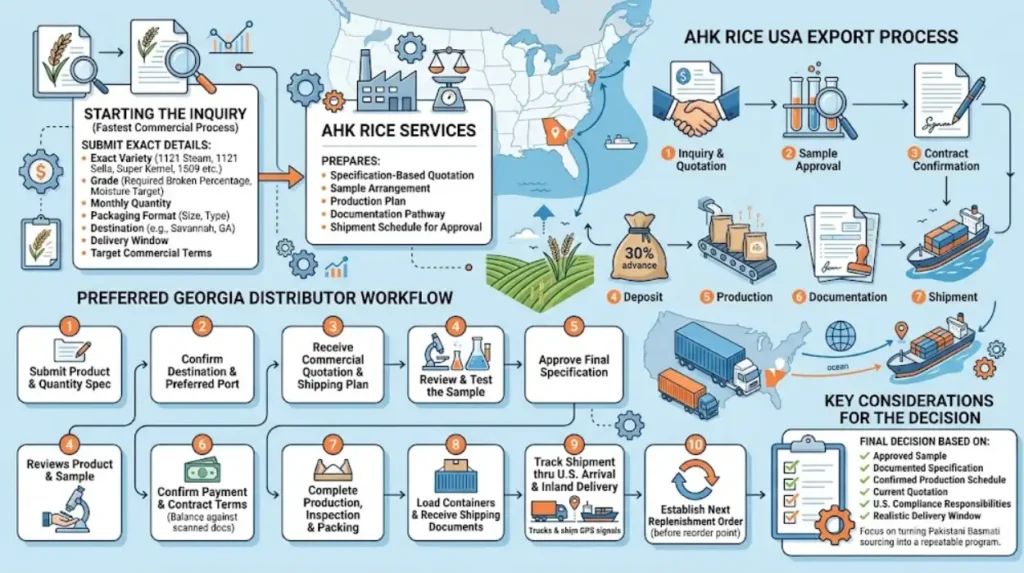
Start by submitting the exact variety, grade, monthly quantity, packaging format, destination, required delivery window, and target commercial terms. AHK Rice can then prepare a specification-based quotation, sample arrangement, production plan, documentation pathway, and shipment schedule for approval.
The fastest commercial process is to provide complete requirements in the first inquiry. A buyer should specify whether it needs 1121 Steam, 1121 Sella, Super Kernel, 1509, or another grade; the required broken percentage; moisture target; packing size; number of containers; destination; and expected purchasing frequency.
AHK Rice states that its USA export process begins with an inquiry and quotation, followed by sample approval, contract confirmation, deposit, production, documentation, and shipment. Its published payment structure includes 30% advance with the balance against scanned documents, although final terms should be agreed in the purchase contract.
For a Georgia distributor, the preferred workflow is therefore:
- Submit the product and quantity specification.
- Confirm the destination and preferred port.
- Receive the commercial quotation and shipping plan.
- Review and test the sample.
- Approve the final specification.
- Confirm payment and contract terms.
- Complete production, inspection and packing.
- Load containers and receive shipping documents.
- Track the shipment through U.S. arrival and inland delivery.
- Establish the next replenishment order before current inventory reaches the reorder point.
AHK Rice is most suitable for buyers who want to turn Pakistani Basmati sourcing into a repeatable procurement program rather than make isolated spot purchases. Its integrated processing, grading, packing, documentation, sampling, and USA export capabilities provide the structure needed to evaluate supply on commercial specifications.
For a Georgia importer, the final decision should be based on the approved sample, documented specification, confirmed production schedule, current quotation, U.S. compliance responsibilities, and realistic delivery window. That process gives the buyer a defensible basis for choosing a long-term supplier and scaling volumes as market demand grows.
To begin the specification and quotation process for your Georgia Basmati rice requirement, request a customized quote from AHK Rice.
Frequently Asked Questions
How can Georgia importers secure a consistent Basmati rice supply?
Georgia importers can secure consistent supply by approving a fixed rice specification, testing samples before bulk orders, planning recurring container volumes, and confirming production and shipping schedules with the exporter.
Which Basmati rice varieties can Georgia buyers import from Pakistan?
Georgia buyers can source varieties such as 1121 Basmati, Super Kernel, and 1509 Basmati. The final selection should depend on grain length, processing type, cooking performance, broken percentage, and target customer requirements.
How does AHK Rice support Basmati rice exports to Georgia?
AHK Rice supports international buyers through rice processing, grading, sorting, customized packaging, sampling, export documentation, production coordination, and container shipment planning for U.S. destinations, including Georgia.
How long does Basmati rice shipping to Georgia take?
AHK Rice provides an indicative 25–35-day door-to-door timeline for major U.S. destinations. Actual delivery to Georgia can vary because of vessel schedules, port congestion, customs clearance, and inland transportation.
How much does a Basmati rice sample cost?
AHK Rice states that qualifying rice samples can be supplied without a rice charge within specified limits, while the buyer generally pays courier and applicable certification costs. Exact charges depend on sample weight, destination, and documentation.
What should Georgia buyers check before approving a Basmati rice sample?
Buyers should evaluate grain length, broken percentage, moisture, appearance, aroma, cooking elongation, texture, whiteness, purity, packaging, and overall cooking performance against their commercial requirements.
What affects the price of Basmati rice for Georgia importers?
Price depends on variety, grade, crop conditions, processing yield, order volume, packaging, inspection, freight, insurance, destination port, inland transportation, and payment terms. Landed cost should be compared rather than FOB price alone.