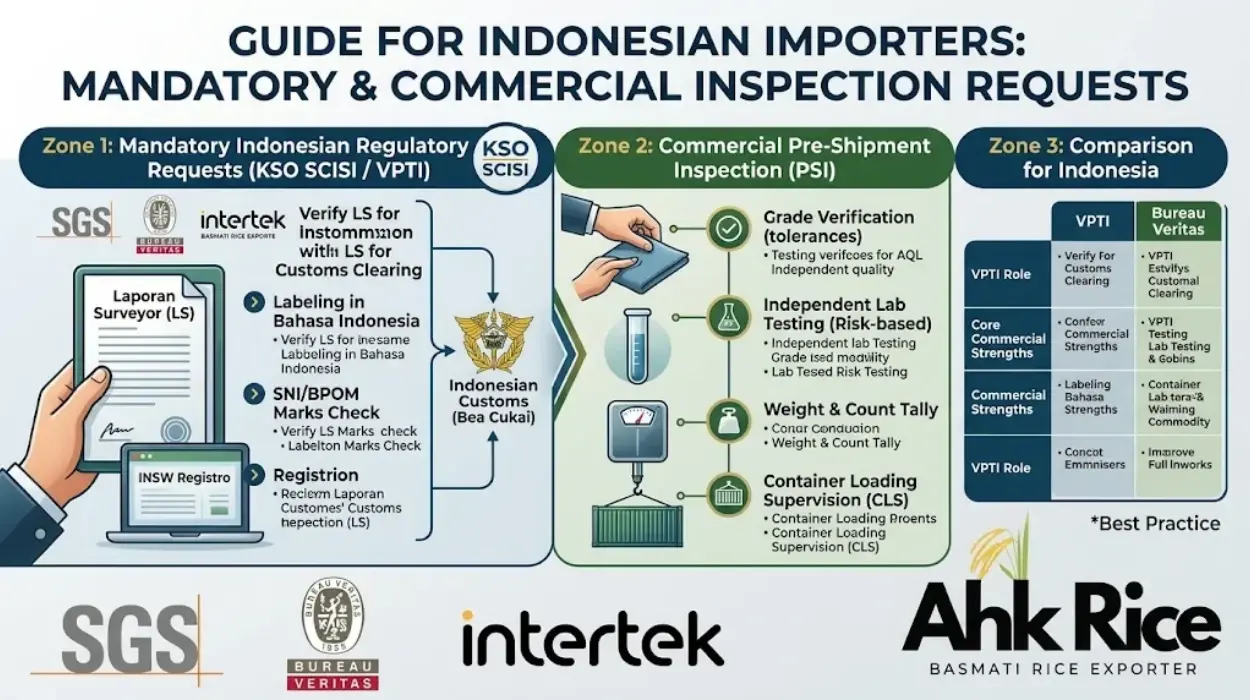
SGS, Bureau Veritas and Intertek Inspection: What Indonesian Importers Should Request
SGS, Bureau Veritas, and Intertek all provide independent inspection services, but Indonesian rice importers should select the inspection scope based on the shipment specification, contract terms, destination requirements, and commercial risk rather than choosing a company by name alone.
For buyers comparing Pakistani Basmati suppliers, inspection starts with defining the exact characteristics that must be verified before loading. This includes rice variety, grain length, broken percentage, moisture, foreign matter, milling quality, packaging, weight, and shipment quantity. A detailed guide to Basmati rice quality inspection and testing helps establish these specifications before a third-party inspector is appointed.
What are SGS, Bureau Veritas and Intertek inspection services?
SGS, Bureau Veritas, and Intertek are independent conformity and inspection companies that verify cargo against defined specifications, sampling procedures, quantity requirements, packaging conditions, and contractual standards before or during shipment. Their value comes from independent evidence, not from replacing Indonesian regulatory controls.
SGS stands for Société Générale de Surveillance. It operates inspection, testing, certification, and verification services across international supply chains. For rice shipments, its inspection scope can be structured around product quality, quantity, packaging, loading conditions, and sampling.
Bureau Veritas is an international testing, inspection, and certification organization. Its commodity inspection services can support buyers that require independent verification of cargo before shipment.
Intertek provides testing, inspection, and certification services for traded goods. An importer can define an inspection protocol around the commercial specification and use the resulting report as part of supplier and shipment verification.
These companies do not automatically inspect every requirement an Indonesian importer needs. The buyer must define the inspection scope in advance.
For example, a contract can require 1121 Basmati with a specified moisture level, broken percentage, grain length, packaging format, and net weight. The inspection request should identify each requirement as a measurable acceptance criterion.
The report should then show what was inspected, where sampling occurred, how samples were selected, what tests were performed, and whether the shipment met the agreed specification.
What should Indonesian importers request from an inspection company?
Indonesian importers should request a pre-shipment inspection covering identity, quality, quantity, moisture, broken grains, foreign matter, packaging, marking, container condition, loading supervision, and sample retention, with every acceptance criterion tied to the commercial specification.
The first requirement is a written inspection protocol. Do not request a generic “rice inspection.” State the exact product and contractual tolerances.
For example, an importer buying Pakistani Super Kernel Basmati can request verification of variety, grain dimensions, moisture, broken grains, foreign matter, milling characteristics, packaging, and quantity.
The second requirement is representative sampling. Rice quality can vary between bags, lots, production batches, and container positions. The inspection procedure therefore needs a defined sampling plan rather than a visual check of a few bags.
The third requirement is quantity verification. The inspector can verify the number of bags, package weight, loading records, and container information according to the agreed inspection scope.
The fourth requirement is container inspection. The report should identify container numbers and record cleanliness, dryness, structural condition, odor, evidence of contamination, and suitability for loading.
The fifth requirement is seal verification. The final report should connect the inspected cargo with the container and seal information recorded during loading.
The sixth requirement is photographic evidence. Photos of packaging, labels, container interiors, loading, sealing, and representative product samples strengthen the inspection record.
The seventh requirement is a final inspection report. The buyer should receive a document that clearly distinguishes tested results from observations and states whether the cargo conforms to the agreed specification.
How do SGS, Bureau Veritas and Intertek compare?
The three inspection providers can deliver comparable commercial verification when they receive the same inspection protocol, sampling requirements, laboratory criteria, and reporting instructions. The decisive factor is usually inspection scope, location, testing capability, turnaround, and contractual acceptance criteria.
| Attribute | SGS | Bureau Veritas | Intertek |
|---|---|---|---|
| Core role | Inspection, testing and verification | Inspection, testing and certification | Testing, inspection and certification |
| Rice quality inspection | Available through defined scope | Available through defined scope | Available through defined scope |
| Quantity verification | Can be included | Can be included | Can be included |
| Loading supervision | Can be requested | Can be requested | Can be requested |
| Laboratory testing | Scope and location dependent | Scope and location dependent | Scope and location dependent |
| Report evidence | Results, observations and photos according to scope | Results, observations and photos according to scope | Results, observations and photos according to scope |
| Best selection criterion | Required test and inspection capability | Required test and inspection capability | Required test and inspection capability |
The table shows why an importer should not treat the three brands as three completely different inspection methods. They are service providers operating against an agreed inspection scope.
The buyer should compare the exact service proposal. A low inspection fee does not compensate for an incomplete specification.
If one provider includes container loading supervision, laboratory testing, representative sampling, photographs, and a final conformity report while another only provides visual inspection, the services are not commercially equivalent.
What is the difference between visual inspection, laboratory testing and loading supervision?
Visual inspection checks physical characteristics and shipment conditions, laboratory testing measures defined product parameters, and loading supervision confirms cargo handling and containerization. A strong rice inspection combines these methods when quality, quantity, and shipment integrity all matter.
Visual inspection
Visual inspection examines characteristics such as grain appearance, broken grains, discoloration, foreign matter, packaging condition, labels, and container cleanliness.
It is useful for identifying obvious defects but does not replace laboratory analysis.
Laboratory testing
Laboratory testing measures parameters that require analytical equipment or controlled testing procedures.
For rice, this can include moisture, milling quality, broken percentage, grain dimensions, and other contractual or regulatory parameters.
The buyer should specify the required test method before inspection. Different analytical methods can produce different reporting formats, so the contract needs a defined basis for acceptance.
Loading supervision
Loading supervision focuses on the physical shipment process.
The inspector verifies the cargo being loaded, container condition, package counts where included in the scope, loading practices, and seal information.
This is particularly valuable for containerized Basmati rice because the commercial shipment is ultimately identified by its container and seal records.
Combined inspection
A combined inspection provides a stronger chain of evidence. The product specification establishes what the buyer expects. Laboratory testing verifies measurable characteristics. Visual inspection verifies physical condition. Loading supervision connects the approved cargo to the actual exported container.
Which inspection method works best for different Indonesian import cases?
The best inspection approach depends on shipment value, buyer risk, contract complexity, product grade, destination requirements, and supplier history. Routine buyers can use focused inspections, while new suppliers and premium shipments benefit from broader quality and loading verification.
New supplier qualification
A new supplier requires the broadest initial inspection scope because the buyer has limited historical performance data.
The inspection should cover identity, grade, quality, packaging, quantity, container condition, and loading.
For a first shipment of Pakistani 1121 or Super Kernel Basmati, laboratory verification adds stronger evidence than visual inspection alone.
Repeat supplier with stable performance
A repeat importer with consistent supplier records can use a narrower inspection protocol.
The buyer can focus on critical acceptance points such as moisture, broken percentage, grain length, packaging, quantity, and container condition.
Previous inspection reports then provide a benchmark for comparing new shipments.
Premium Basmati shipment
Premium rice requires tighter product verification because the commercial value depends heavily on specification.
A buyer purchasing a defined premium grade should verify grain length, broken percentage, moisture, milling quality, aroma-related commercial characteristics where applicable, and packaging.
The supplier should receive the same specification before production and inspection.
Private-label shipment
Private-label cargo requires additional packaging and marking controls.
The inspector can verify printed bags, product descriptions, net weight, batch information, shipping marks, and packaging condition according to the approved artwork and contract.
This reduces the risk of receiving correctly processed rice in incorrectly prepared packaging.
What are the pros and cons of using SGS, Bureau Veritas or Intertek?
Third-party inspection reduces information gaps between exporters and importers, but it does not eliminate every quality or regulatory risk. The strongest benefit comes from a clearly defined scope, while the main weakness is incomplete inspection instructions that leave important acceptance criteria unverified.
Advantages
Independent inspection creates evidence that is separate from the supplier’s internal quality-control records.
This supports commercial decision-making before the shipment leaves Pakistan.
Inspection also creates a common reference point between the exporter and importer. If both parties agree to a specification before inspection, the final report provides a structured basis for acceptance.
Another benefit is supplier accountability. Repeated inspection results create a performance history that buyers can compare across shipments.
Limitations
Third-party inspection does not replace Indonesian import requirements.
An inspection certificate does not automatically establish regulatory compliance for every requirement involving Indonesian authorities, food registration, labeling, quarantine, customs, or other applicable controls.
Sampling also has limitations. A sample represents the inspected lot according to the agreed sampling method. It does not provide an absolute guarantee that every grain in every bag has identical characteristics.
The inspection scope is therefore critical. A report cannot verify a parameter that was never included in the inspection request.
Which two Indonesian market regions should importers compare?
Jakarta and Surabaya represent different commercial priorities within Indonesia: Jakarta commonly supports major import, distribution, retail, and private-label programs, while Surabaya serves important eastern Indonesian distribution and industrial trade requirements. Grade choice should follow buyer segment rather than port preference alone.
Jakarta market
Jakarta-focused buyers commonly prioritize premium and branded Basmati specifications for modern retail, specialty food distribution, foodservice, and private-label programs.
1121 and Super Kernel can fit premium positioning when the buyer requires long grain, aroma, cooking performance, and consistent presentation.
Indicative commercial price comparisons should be based on the same grade, packaging, quantity, Incoterm, and shipment period. A 1121 quotation cannot be compared fairly with a lower-grade 1509 quotation simply because both are priced per metric ton.
For shelf life, properly processed and sealed white rice generally supports extended commercial storage under suitable dry, cool, pest-controlled conditions. The contract should specify the required remaining shelf life at arrival rather than relying on a generic number.
Surabaya market
Surabaya serves East Java and wider eastern Indonesian distribution networks. Importers serving wholesale and foodservice channels can prioritize cost efficiency, reliable cooking performance, and consistent bulk specifications.
1509 can become relevant where the buyer prioritizes price efficiency and volume availability. 1121 and Super Kernel remain stronger choices when long grain and premium Basmati positioning drive the purchasing decision.
For both regions, the meaningful price comparison is landed cost rather than FOB alone. Freight, insurance, port charges, customs costs, applicable duties, handling, inspection, and local distribution affect the final commercial position.
| Market region | Typical buyer priority | Suitable grade focus | Price comparison basis | Shelf-life decision |
|---|---|---|---|---|
| Jakarta | Premium retail, private label, specialty foodservice | 1121, Super Kernel | Compare landed cost per MT | Remaining shelf life at arrival |
| Surabaya | Wholesale, foodservice, regional distribution | 1509, 1121 | Compare landed cost per MT | Storage conditions and arrival age |
Exact current prices require a shipment-specific quotation. Grade, crop year, packaging, quantity, inspection scope, Incoterm, and destination all change the price per MT.
What five factors should determine the inspection decision?
Indonesian importers should choose the inspection scope using five factors: product value, supplier history, specification complexity, regulatory exposure, and shipment risk. These factors determine whether a basic inspection or a complete quality-and-loading protocol provides sufficient commercial control.
| Decision factor | Low-risk approach | Higher-risk approach |
|---|---|---|
| Product value | Basic visual and quantity checks | Full quality and laboratory verification |
| Supplier history | Reduced inspection scope | Comprehensive first-shipment inspection |
| Specification complexity | Key specification checks | Multi-parameter testing |
| Regulatory exposure | Commercial inspection | Inspection plus separate regulatory verification |
| Shipment risk | Pre-shipment sampling | Sampling, testing, loading and seal verification |
This framework prevents inspection from becoming a routine checkbox.
An importer should increase inspection depth when the financial consequence of a failed shipment increases.
The same principle applies to premium grades. If a buyer pays for a narrow grain-length and broken-percentage specification, those parameters belong in the inspection request.
How should an Indonesian importer structure the inspection request?
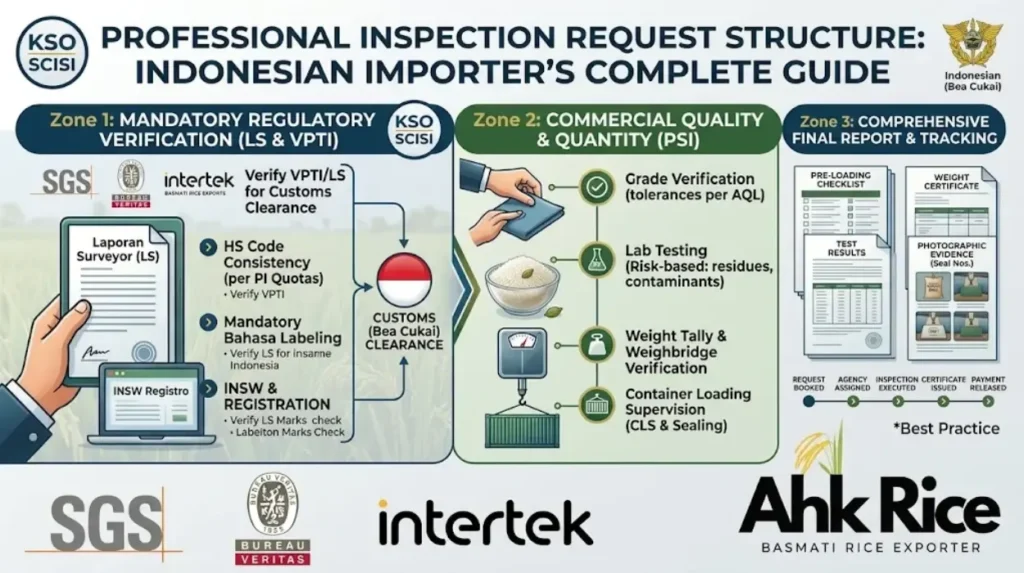
The importer should issue one written inspection specification covering product identity, grade, sampling, laboratory tests, quantity, packaging, container condition, loading, sealing, photographs, reporting, and acceptance criteria before the inspector visits the supplier.
Start with the commercial specification.
For example:
Product: Pakistani Super Kernel Basmati
Origin: Punjab, Pakistan
Inspection stage: Pre-shipment
Sampling: Representative samples from the defined lot
Quality: Agreed moisture, broken percentage, grain length and milling criteria
Packaging: Approved bag type, size, artwork and net weight
Quantity: Contracted metric-ton quantity
Container: Clean, dry, odor-free and suitable for food cargo
Loading: Supervised according to agreed procedure
Seal: Recorded in final report
Evidence: Photographs and inspection findings
Report: Conformity status against contractual specifications
The buyer should also define what happens if a result falls outside specification.
A contract can state whether the supplier must re-sort, replace, re-pack, retest, or hold the shipment before loading.
This turns inspection into a decision system rather than a simple certificate request.
What should Indonesian importers request from AHK Rice before inspection?
Importers should request the product specification, commercial sample, agreed quality parameters, packaging details, shipment quantity, inspection scope, and loading plan before appointing the inspection company, so the third-party report evaluates the actual contracted cargo.
AHK Rice supplies Pakistani Basmati varieties including 1121, Super Kernel, and 1509 from Punjab, with end-to-end processing, custom packaging, and export documentation support.
The importer should first approve the commercial specification. The inspection company can then verify the shipment against that approved specification.
For a first order, the buyer should align the product sample, final specification, packaging artwork, inspection criteria, and shipment documents before loading.
This sequence creates a clear chain:
Sample → Specification → Production → Inspection → Loading → Sealing → Shipment → Import
The inspector verifies the shipment. The exporter supplies the cargo and documentation. The Indonesian importer controls the commercial acceptance criteria.
That separation creates stronger accountability than relying on supplier claims or an inspection certificate alone.
What is the best overall inspection strategy for Indonesian Basmati buyers?
The strongest strategy is a specification-led third-party inspection that combines representative sampling, critical laboratory tests, packaging and quantity verification, container inspection, loading supervision, photographs, and a final report tied directly to contractual acceptance criteria.
SGS, Bureau Veritas, and Intertek can all fit this model. The decision should therefore start with the inspection protocol rather than the inspection brand.
For a new Indonesian buyer, the first shipment should use a comprehensive scope. After several consistent shipments, the buyer can narrow the inspection to critical parameters while maintaining controls on quality, quantity, packaging, and loading.
The most important principle is simple: inspect what the contract requires, and define the requirement before inspection begins.
For buyers moving from supplier evaluation to an actual shipment, the next decision is whether to arrange independent inspection before loading and define exactly what the inspector should verify. A decision-focused guide on booking third-party inspection for an AHK Rice shipment to Indonesia can follow this comparison stage.
Frequently Asked Questions
Is SGS better than Bureau Veritas for rice inspection?
Neither provider is automatically better. Indonesian importers should compare inspection scope, sampling procedure, laboratory capability, location, turnaround, reporting, and commercial cost against the shipment requirements.
What does SGS inspect in a Basmati rice shipment?
The inspection scope can cover rice identity, quality parameters, quantity, packaging, container condition, loading, sealing, photographs, and defined laboratory tests. The buyer must specify the required parameters before inspection.
Can Bureau Veritas inspect rice before shipment from Pakistan?
Yes, inspection services can be arranged according to the applicable service scope and location. The importer should confirm the exact inspection coverage before appointing the provider.
What can Intertek verify for an Indonesian rice importer?
Intertek can provide inspection and testing services against an agreed specification. The buyer should define the product parameters, sampling plan, tests, quantity checks, packaging requirements, and reporting requirements.
Does third-party inspection replace Indonesian import approval?
No. Third-party inspection provides independent commercial or technical verification. It does not automatically replace Indonesian import permits, food requirements, labeling rules, quarantine controls, customs procedures, or other applicable regulatory obligations.
Should Indonesian importers inspect every Basmati shipment?
The inspection frequency should reflect supplier performance, shipment value, product risk, contractual complexity, and buyer requirements. New suppliers and high-value shipments generally justify broader inspection coverage.
What is the difference between pre-shipment inspection and loading supervision?
Pre-shipment inspection verifies the product against the agreed specification before dispatch. Loading supervision focuses on the cargo entering the container, container condition, loading process, and sealing records.
How much does third-party rice inspection cost?
The cost depends on inspection location, shipment size, testing requirements, sampling scope, number of containers, laboratory work, reporting requirements, and service provider. The importer should request a quotation against a complete inspection protocol.
Can inspection verify rice shelf life?
Inspection can verify production dates, packaging information, condition, and other defined characteristics. Shelf-life acceptance should be established in the commercial specification, including the required remaining shelf life at arrival.
Should 1121, Super Kernel and 1509 use the same inspection criteria?
No. Each variety can have different commercial specifications. The inspection protocol should reflect the contracted variety, grain dimensions, broken percentage, moisture, milling requirements, packaging, and intended market position.