Partner with AHK Rice for USA Wholesale Rice Distribution
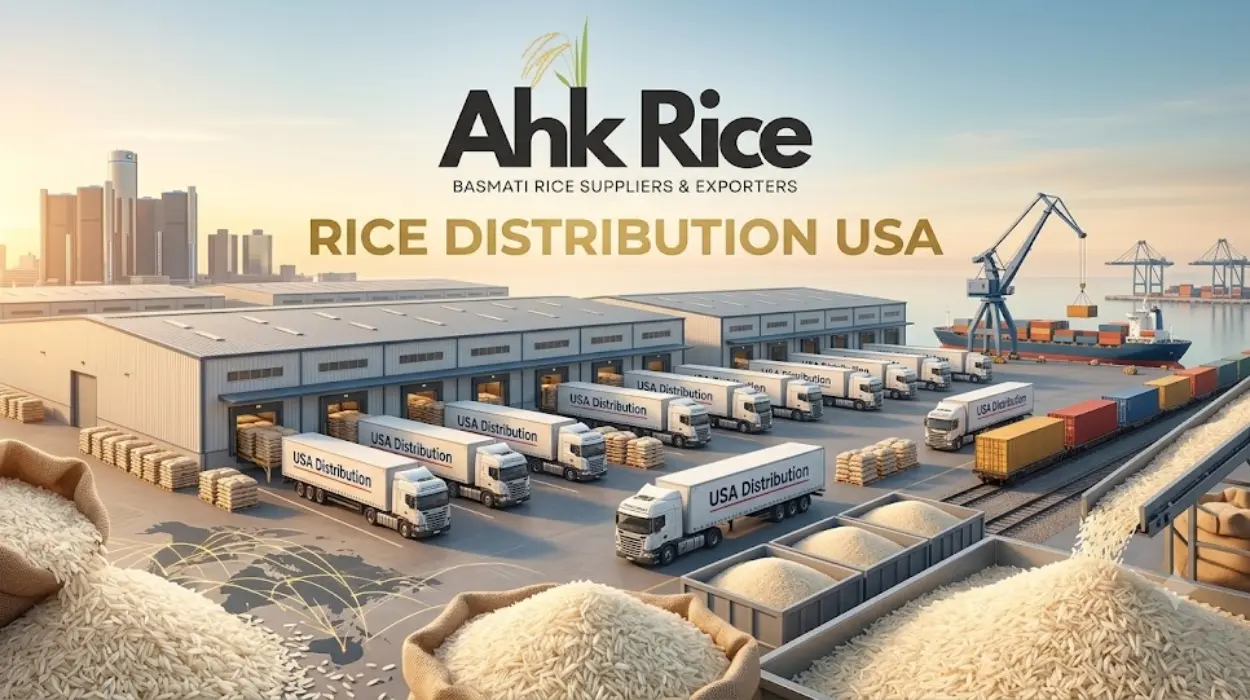
For U.S. wholesale distributors, the strongest solution is a Pakistani Basmati supplier that can maintain consistent specifications, documentation, packaging, production planning, and export execution across repeat containers. AHK Rice provides this model by combining Pakistan-origin Basmati sourcing with controlled processing, specification-based packing, quality documentation, and shipment coordination for U.S. buyers.
Wholesale distributors considering Pakistani Basmati imports should first understand the commercial reasons behind the category’s growth and supply requirements. This guide to:
Why wholesale distributors are increasing Pakistani Basmati rice imports provides the market context before a distributor evaluates an individual supplier.
The decision is not simply about finding the lowest rice price per metric ton. A distributor must protect landed cost, cooking performance, customer consistency, inventory availability, regulatory documentation, and reorder reliability. In 2026, U.S. import planning also requires attention to changing freight conditions and tariff exposure. Recent U.S. container-import reporting shows elevated shipping costs and continued supply-chain uncertainty, making predictable export execution more valuable.
What is the best solution for wholesale distributors importing Pakistani Basmati rice?
The best solution is a specification-led supply partnership where rice variety, grain quality, moisture, packaging, quantity, documentation, production timing, and shipment terms are agreed before each commercial order, reducing quality variation and unexpected landed-cost problems.
A distributor selling Pakistani Basmati rice needs more than access to physical inventory. The supplier must understand the distributor’s downstream requirements and translate them into a repeatable export specification.
For example, a U.S. wholesaler supplying restaurants may prioritize long grain, aroma, cooking elongation, low broken percentage, and consistent steam processing. A distributor supplying ethnic supermarkets may instead require retail-ready bags, private labeling, multiple pack sizes, and predictable replenishment.
AHK Rice can structure supply around these requirements rather than offering an unspecified commodity. Its Pakistan-origin portfolio includes varieties such as 1121 Basmati, Super Kernel, and 1509 Basmati, allowing distributors to position products at different price and quality levels.
The commercial objective is consistency. If the first container performs well but the second container changes materially in grain appearance, moisture, cooking behavior, or packaging, the distributor absorbs the resulting customer complaints and inventory risk.
That is why the supplier-selection process should begin with a written product specification covering variety, grade, processing type, grain characteristics, broken percentage, moisture, foreign matter, packaging, labeling, quantity, and inspection requirements.
Why should U.S. distributors choose AHK Rice?
AHK Rice is suited to distributors seeking Pakistan-origin Basmati supply with specification control, export coordination, product selection, customized packaging, and documentation support rather than purchasing disconnected rice lots from multiple intermediaries.
The first advantage is product control. A distributor can select the Basmati grade according to its customer segment instead of forcing every customer into one product.
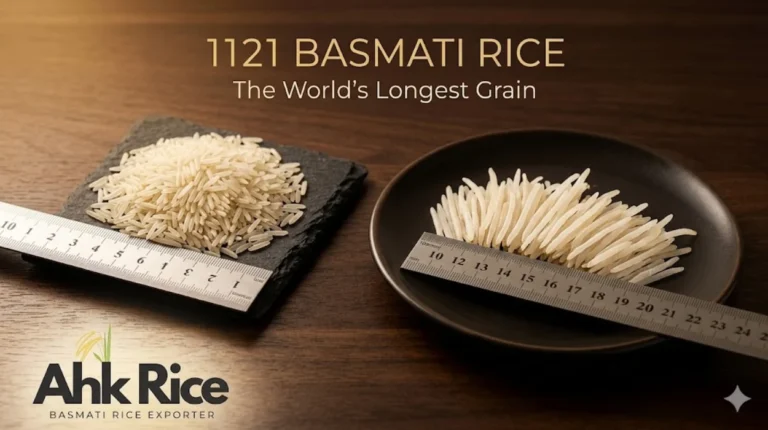
1121 Basmati is appropriate for premium positioning where extra-long grain appearance and cooking performance are important. Super Kernel can serve mainstream Basmati demand where distributors need a balance between quality and price. 1509 can provide another commercial option where buyers need long-grain characteristics with a different cost structure.
The second advantage is packaging flexibility. U.S. distributors may require bulk commercial sacks, foodservice formats, retail bags, or private-label packaging. Packaging specifications should be agreed before production because bag material, printing, labeling, weight, and pallet configuration influence both production planning and landed cost.
The third advantage is documentation discipline. U.S. food imports are subject to FDA requirements, including applicable food-facility registration, prior notice, and import compliance. FDA states that imported food must be safe, sanitary, and truthfully labeled in English, while food facilities subject to registration requirements must maintain registration.
For covered imports, the U.S. importer also has Foreign Supplier Verification Program responsibilities. FDA explains that FSVP requires risk-based activities to verify that imported food meets applicable U.S. requirements and is not adulterated or misbranded.
AHK Rice therefore becomes more useful when the distributor treats the relationship as a documented supply program rather than a one-time purchase.
How should distributors compare AHK Rice with alternative supply partners?
Distributors should compare suppliers using specification consistency, production capacity, documentation, sample accuracy, packaging capability, shipment planning, communication, and reorder performance rather than comparing only the quoted rice price per metric ton.
A practical supplier comparison should include the following factors:
| Decision factor | What the distributor should verify |
|---|---|
| Product specification | Variety, grade, grain length, broken percentage, moisture and purity |
| Sample consistency | Whether commercial production matches the approved sample |
| Processing | White, Steam, Sella or other agreed processing specification |
| Packaging | Bulk, foodservice, retail or private-label capability |
| Documentation | Commercial, quality and export documents required for the shipment |
| Production planning | Ability to schedule milling, packing and container loading |
| Reorder reliability | Ability to repeat the same specification on future orders |
AHK Rice should be evaluated against the same criteria applied to competing Pakistani exporters. This prevents brand familiarity from replacing commercial due diligence.
Distributors can also review the:
Supplier comparison framework for evaluating long-term Basmati supply partners before making a purchasing decision. The objective is to determine whether the supplier can support the distributor’s full purchasing cycle, from sample approval through repeat shipment.
The strongest relationship is one where the approved specification becomes the reference point for future production. That gives both sides a measurable standard instead of relying on descriptions such as “premium,” “extra-long,” or “high quality.”
What shipping timeline should U.S. distributors expect from Pakistan?
A realistic Pakistan-to-USA wholesale program should allow roughly 30–50 days from production readiness through ocean arrival planning, with the exact timeline depending on Karachi loading, vessel schedule, transshipment, destination port, customs clearance, and inland delivery.
The shipping timeline should be separated into operational stages rather than presented as one guaranteed number.
| Stage | Planning allowance |
|---|---|
| Final specification and order confirmation | 1–3 days |
| Production and processing | 5–10 days |
| Packaging and quality checks | 2–4 days |
| Container loading and export documentation | 2–5 days |
| Ocean transit and transshipment | 25–40+ days |
| U.S. port/customs and inland delivery | 3–10+ days |
These are planning ranges, not guaranteed transit commitments. Ocean schedules can change because of vessel availability, port congestion, transshipment, weather, security disruptions, and carrier decisions.
Current 2026 freight conditions make conservative planning particularly important. U.S. import volumes remain substantial, while fuel and canal-related surcharges are keeping shipping costs elevated.
For a distributor serving several U.S. regions, the destination should therefore be specified before calculating the commercial offer. New York/New Jersey, Houston, Savannah, and West Coast destinations can produce different landed-cost and inland-delivery outcomes.
AHK Rice can plan the export side around the agreed destination, container quantity, packaging format, and required shipment window. The distributor should then confirm the U.S. customs broker, importer-of-record responsibilities, FSVP responsibilities, and domestic transportation arrangements before dispatch.
FDA also requires Prior Notice for covered imported food shipments. For ocean shipments, FDA guidance states that Prior Notice must be received and confirmed no later than eight hours before arrival at the port.
How does the AHK Rice sample process work?
The sample process should move from buyer requirements to specification confirmation, physical sample approval, commercial quotation, production confirmation, pre-shipment inspection, and container dispatch so the distributor approves the product before committing to repeat wholesale volume.
A practical sample workflow starts with the distributor providing the required variety, grade, processing type, bag size, quantity, destination, and intended sales channel.
AHK Rice can then identify the closest available product specification and prepare a representative sample. For a serious wholesale program, the sample should be evaluated for appearance, grain uniformity, aroma, cooking behavior, broken percentage, moisture, and other agreed specifications.
The distributor should avoid approving a sample based only on appearance. Basmati is ultimately sold as a cooked food product, so cooking performance matters alongside physical grain characteristics.
What does a wholesale rice sample cost?
Sample costs vary according to sample weight, courier destination, testing requirements, packaging, and whether the buyer requests a laboratory report. A practical budgeting allowance for an international commercial sample is approximately $50–$150 for courier and handling, while laboratory testing, if requested, may add roughly $50–$200 or more, depending on the test panel and laboratory.
These figures should be treated as planning allowances rather than fixed AHK Rice charges. The actual sample cost should be confirmed before dispatch.
For a serious U.S. distributor, the sample cost is small compared with the value of a 20-foot or 40-foot commercial container. The important point is to document the approved sample and specification before production.
What quality and compliance documents should U.S. buyers request?
U.S. distributors should establish a documentation package covering product specifications, commercial documents, applicable food-safety records, facility information, testing where required, labeling details, and shipment documentation before the container is dispatched.
The exact documentation package depends on the product, importer structure, shipment terms, and regulatory obligations.
A typical commercial file can include:
- Commercial invoice
- Packing list
- Bill of lading
- Certificate of origin where applicable
- Product specification sheet
- Certificate of analysis or laboratory report where agreed
- Phytosanitary or other certificates where applicable
- Packaging and labeling information
- Food-facility registration information where applicable
- Documentation supporting the U.S. importer’s FSVP requirements
The U.S. importer remains responsible for meeting applicable U.S. import obligations. FDA does not pre-approve individual food shipments before importation; imported foods can be inspected and detained if they do not comply with applicable requirements.
This makes supplier documentation an important part of distributor risk management. A supplier that provides the physical rice but cannot support the required documentation can still create delays and additional costs for the importer.
What factors determine wholesale Basmati rice pricing?
Wholesale Basmati pricing depends on variety, grade, crop and market conditions, processing, grain specifications, order volume, packaging, testing, Incoterms, freight, destination, currency, and applicable U.S. import costs rather than one fixed price per metric ton.
The rice specification is the first major variable. 1121 Basmati, Super Kernel, and 1509 are not interchangeable products, so comparing their prices without comparing specifications can produce a misleading result.
Processing also affects cost. Steam and Sella products require different processing steps and can have different commercial positioning. Packaging creates another variable because plain bulk sacks, printed retail bags, private-label packaging, and specialized foodservice formats have different production costs.
Freight can then change the landed price materially. In 2026, global shipping costs remain sensitive to fuel and route-related surcharges.
The commercial quotation should therefore distinguish between the rice price and additional logistics or destination-related charges. A distributor should request a quotation based on the exact product specification, quantity, packing format, destination port, and agreed Incoterm.
This approach prevents the common mistake of selecting a supplier solely because its initial per-MT quotation is lower.
What results can a distributor expect from a long-term AHK Rice partnership?
A properly structured AHK Rice partnership can give distributors greater product consistency, clearer purchasing specifications, repeat-order planning, packaging flexibility, better shipment visibility, and a stronger basis for managing wholesale inventory and customer commitments.
Consider a distributor supplying restaurants and ethnic retailers across several U.S. states. Instead of sourcing each container from whichever supplier offers immediate availability, the distributor can establish approved specifications for several SKUs.
The first SKU may be 1121 Basmati for premium restaurant customers. The second may be Super Kernel for mainstream retail distribution. A third may be 1509 for customers seeking a competitive long-grain Basmati option.
Each SKU can have its own specification, packaging, target volume, and reorder point.
AHK Rice then becomes part of a procurement system rather than simply another rice vendor. The distributor can forecast monthly or quarterly requirements and communicate expected quantities earlier, giving production and shipping planning more structure.
The result is not a promise that every shipment will arrive without disruption. International logistics always carries variables. The commercial benefit is that the distributor has a defined process for managing those variables.
How can a U.S. distributor start working with AHK Rice?
Start with the exact product specification, destination, packaging requirement, target quantity, and delivery window; approve a representative sample, confirm commercial terms, complete compliance checks, then schedule production and shipment against the agreed specification.
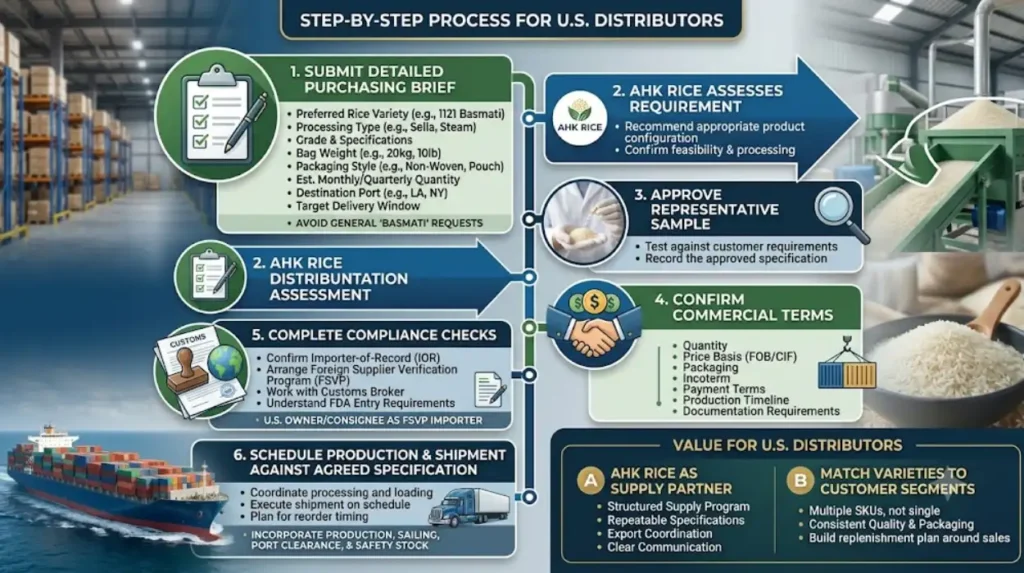
The first step should be a purchasing brief rather than a general request for “Basmati rice.” Include the preferred variety, processing type, grade, bag weight, packaging style, estimated monthly or quarterly quantity, destination port, and target delivery window.
AHK Rice can then assess the requirement and recommend the appropriate product configuration.
The second step is sample evaluation. The distributor should test the rice against its customer requirements and record the approved specification.
The third step is commercial confirmation. The quotation should identify quantity, price basis, packaging, Incoterm, destination, payment terms, production timeline, and documentation requirements.
The fourth step is compliance coordination. The U.S. buyer should confirm its importer-of-record and FSVP arrangements and work with its customs broker on the applicable entry requirements. FDA identifies the U.S. owner or consignee as the FSVP importer in the applicable circumstances and requires covered importers to maintain the necessary verification program.
The final step is shipment execution and reorder planning. A distributor should not wait until its warehouse is nearly empty before ordering the next container. Given ocean transit variability, reorder planning should incorporate production time, sailing schedules, port clearance, inland transportation, and safety stock.
For U.S. wholesale distributors, AHK Rice offers the most value when the relationship is built around repeatable specifications rather than one-off transactions. AHK Rice can support product selection, processing, packaging, documentation, and export coordination as part of a structured supply program.
AHK Rice also allows distributors to match different Pakistani Basmati varieties with different customer segments instead of relying on a single SKU. With AHK Rice, the commercial focus remains on specification control, shipment planning, and repeat supply. AHK Rice should be evaluated on its ability to reproduce the approved product and communicate clearly throughout the order cycle.
For distributors building a U.S. wholesale program, AHK Rice can therefore serve as a Pakistan-origin supply partner rather than simply a spot-market rice seller. AHK Rice is particularly relevant when consistent quality, packaging flexibility, and export execution are central to the distributor’s purchasing strategy. Ultimately, the right decision is to approve the specification first, validate the sample, calculate the complete landed cost, and then build a replenishment plan around the expected sales volume with AHK Rice.
Ready to discuss your required variety, quantity, packaging, and U.S. destination? Submit your requirements through the wholesale rice quotation request.
Frequently Asked Questions
Why should USA distributors partner with AHK Rice for wholesale Basmati rice?
AHK Rice provides Pakistan-origin Basmati rice with specification-based sourcing, processing, packaging, documentation, and export coordination. This helps U.S. distributors manage consistent product quality and repeat orders.
Which Basmati rice varieties does AHK Rice supply to USA distributors?
AHK Rice supplies varieties including 1121 Basmati, Super Kernel, and 1509 Basmati. Buyers can select the variety and processing type according to their retail, restaurant, foodservice, or wholesale requirements.
How long does it take to ship Basmati rice from Pakistan to the USA?
A typical Pakistan-to-USA wholesale shipment can require approximately 30–50 days from production readiness through ocean arrival and initial delivery planning. Actual timing depends on the destination port, vessel schedule, transshipment, customs clearance, and inland transportation.
What is included in the AHK Rice sample process?
The process generally includes confirming product specifications, preparing a representative sample, arranging courier delivery, evaluating grain and cooking quality, confirming the approved specification, and proceeding to commercial quotation and production.
How much does a Basmati rice sample cost?
International commercial samples may cost approximately $50–$150 for courier and handling, while laboratory testing can add around $50–$200 or more depending on the required tests. Actual costs should be confirmed before the sample is dispatched.
What factors affect the wholesale price of Pakistani Basmati rice?
Pricing depends on variety, grade, processing method, grain specifications, order volume, packaging, testing, freight, destination, Incoterms, currency movements, and applicable U.S. import costs.
Can AHK Rice provide custom packaging for USA wholesalers?
Yes. Wholesale programs can be structured around different packaging requirements, including bulk sacks, foodservice packaging, retail bags, and private-label formats, subject to the agreed specifications and production requirements.
What documents should USA rice importers request?
Depending on the shipment, buyers may require commercial invoices, packing lists, bills of lading, certificates of origin where applicable, product specifications, laboratory or quality reports, applicable certificates, labeling information, and documentation supporting U.S. food-import compliance.
What should USA distributors check before placing a bulk rice order?
Distributors should verify the variety, grade, grain specifications, moisture, broken percentage, processing method, packaging, sample consistency, documentation, production timeline, shipping terms, destination costs, and supplier’s ability to support repeat orders.
How can USA distributors start importing Basmati rice from AHK Rice?
Start by providing the required variety, specification, quantity, packaging format, destination, and delivery window. AHK Rice can then coordinate the sample, quotation, production, documentation, container loading, and export process.