Super Kernel vs 1121 Basmati Rice: Aroma Price and Market Fit Compared
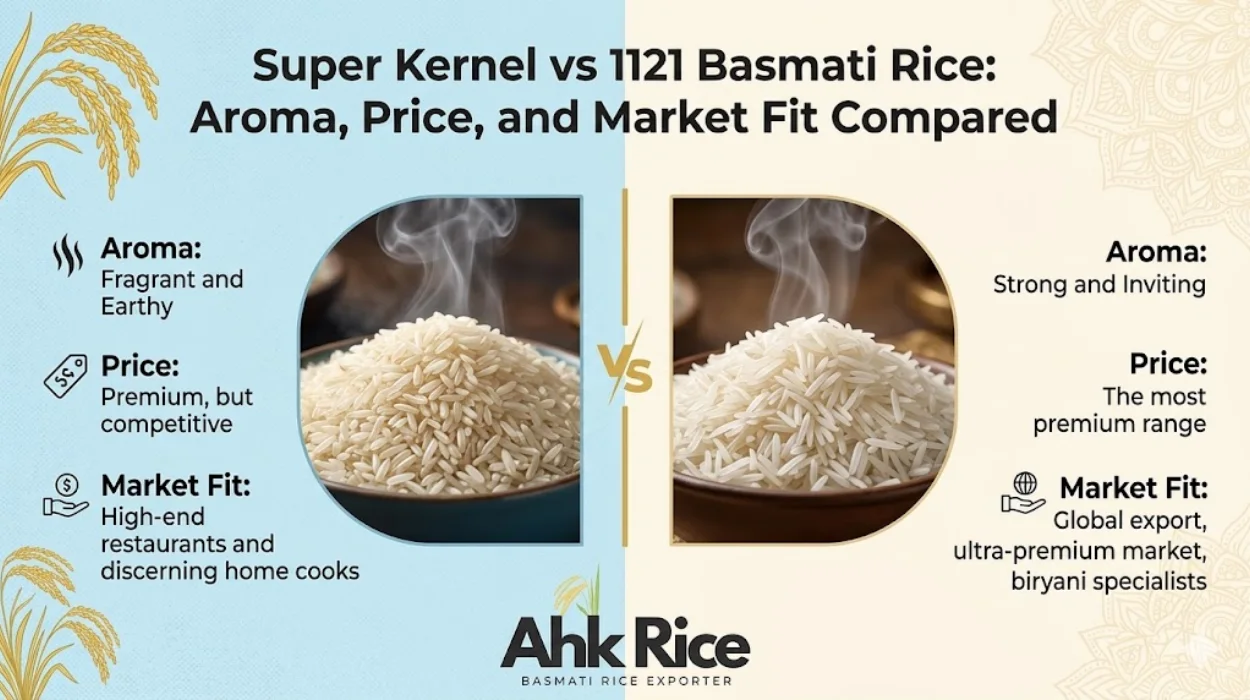
Super Kernel and 1121 Basmati differ in aroma intensity, grain length, and export price positioning, with 1121 dominating premium long-grain markets while Super Kernel delivers stable aroma and lower cost efficiency. Here is why: 1121 reaches 8.2–8.4 mm length after cooking, while Super Kernel averages 7.0–7.4 mm, and pricing reflects this physical and sensory difference across global markets.
Super Kernel and 1121 Basmati serve different buyer intents. Buyers compare them based on aroma strength, elongation ratio, and landed cost per metric ton. This comparison clarifies which specification matches each market and use case.
Buyers who need foundational knowledge of Basmati grading systems can review a broader explanation through this educational guide on Basmati classifications and processing standards before comparing premium export grades in detail.
What are the available solutions in Super Kernel vs 1121 Basmati comparison?
Super Kernel and 1121 Basmati offer two distinct export-grade solutions based on grain length, aroma concentration, and processing method, including Steam, Sella, and Golden Sella variations designed for retail, catering, and bulk import markets.
Understanding Super Kernel Basmati
Super Kernel Basmati defines a traditional export-grade rice cultivated in Punjab. Farmers cultivate it using controlled irrigation and harvest it at full maturity to preserve aroma.
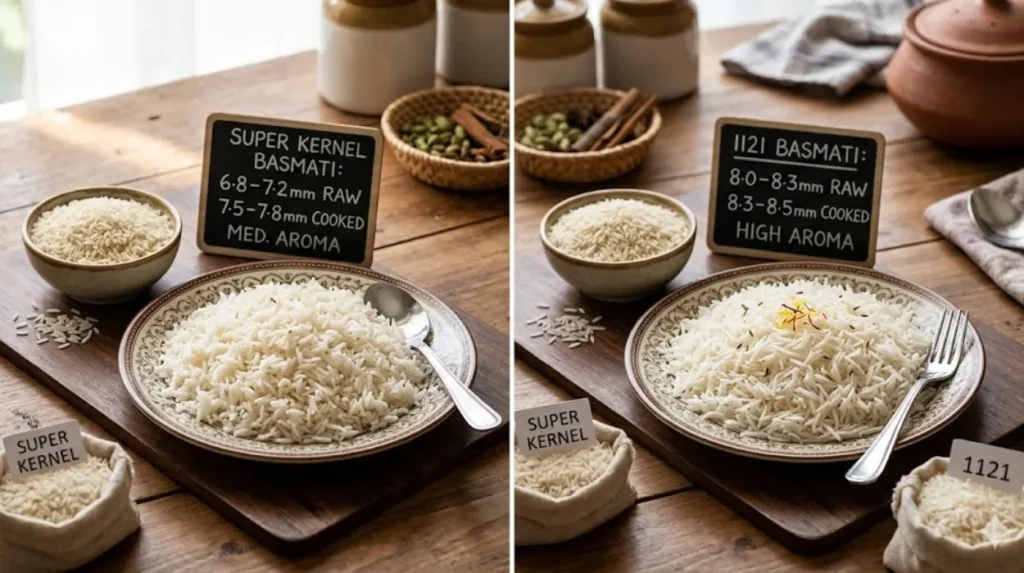
Super Kernel grain structure measures 6.8–7.2 mm raw length. Milling preserves moderate elongation after cooking. Buyers prefer it for balanced performance and consistent pricing.
Processing methods include:
- Steam processing
- White/raw milling
- Golden Sella parboiling
Each method changes moisture retention and shelf life.
Super Kernel delivers stable aroma. It performs well in markets where affordability matters more than maximum elongation.
Understanding 1121 Basmati
1121 Basmati defines an advanced hybrid variety with extended grain length. Farmers cultivate it for export due to its superior elongation ratio.
1121 grain length reaches 8.0–8.3 mm raw and expands beyond 8.4 mm after cooking. This makes it the longest Basmati available commercially.
Processing variations include:
- Steam 1121
- White 1121
- Golden Sella 1121
1121 delivers higher aroma concentration. It creates visual appeal in plated dishes, which drives demand in premium retail segments.
With both solutions defined, the next question is how these approaches compare in measurable specifications.
How do Super Kernel and 1121 Basmati compare across specifications?
1121 Basmati outperforms in grain length, elongation, and premium pricing, while Super Kernel leads in cost stability, moderate aroma, and wider accessibility across price-sensitive import markets.
Specification Comparison Table
| Attribute | Super Kernel Basmati | 1121 Basmati |
|---|---|---|
| Grain Length (Raw) | 6.8–7.2 mm | 8.0–8.3 mm |
| Grain Length (Cooked) | 7.5–7.8 mm | 8.3–8.5 mm |
| Aroma Intensity | Medium | High |
| Elongation Ratio | 1.8x | 2.2x |
| Average Price/MT | $850–$1050 | $1050–$1350 |
| Shelf Life | 12–18 months | 12–24 months |
| Market Position | Mid-range | Premium |
Interpretation of Differences
Grain length directly affects visual perception. Restaurants prefer longer grains because plated dishes appear more refined.
Aroma intensity impacts consumer perception. 1121 produces stronger fragrance due to varietal genetics and aging response.
Price difference reflects yield and demand. 1121 requires stricter grading and sorting, which increases export cost.
Shelf life varies by processing type. Golden Sella versions of both varieties extend storage duration significantly.
With specification differences established, the next step is understanding how different markets select between these options.
Which markets prefer Super Kernel vs 1121 Basmati?
Gulf and European markets prioritize 1121 premium grades, while African and Central Asian markets prefer Super Kernel for cost efficiency, with pricing differences reaching $200–$300 per metric ton depending on processing type.
Gulf Region (UAE, Saudi Arabia, Qatar)
Gulf importers prioritize grain length and aroma. 1121 dominates this region because catering businesses demand visual quality.
Golden Sella 1121 lasts longer in high-temperature warehouses. In 40°C storage conditions, it maintains quality for up to 24 months, while steam variants require faster turnover.
Restaurants in the Gulf select 1121 because plated biryani requires long, separate grains.
European Markets (UK, Germany)
European buyers focus on branding and retail packaging. 1121 Steam and White dominate because consumers associate long grains with premium quality.
Retail packaging uses 1kg–5kg formats. These require consistent grain appearance and low breakage.
African Markets (Kenya, Nigeria)
African markets prioritize affordability. Super Kernel dominates due to lower price per ton.
Bulk buyers prefer 25kg–50kg packaging. These markets value cooking volume and price stability over elongation.
Super Kernel Golden Sella performs well because it tolerates longer storage without refrigeration.
Central Asia (Kazakhstan, Uzbekistan)
Central Asian buyers select both varieties depending on price cycles. Super Kernel leads during high-price periods.
1121 demand increases during festive seasons when presentation matters.
With market preferences clear, the next step is evaluating which solution works best for specific buyer needs.
Which method works best for different buyer cases?
1121 Basmati works best for premium retail and hospitality, while Super Kernel works best for bulk distribution and price-sensitive markets, based on cooking performance, shelf life, and procurement budgets.
Case 1: Premium Retail Brand
Retail brands require consistent grain size and aroma. 1121 Steam provides uniform packaging results.
1121 supports higher retail margins. Consumers associate longer grains with quality.
Case 2: Catering and Food Service
Hotels and restaurants prioritize presentation. 1121 Golden Sella maintains structure during large-scale cooking.
Large batch cooking benefits from higher elongation. Grains remain separate after reheating.
Case 3: Bulk Import Distribution
Distributors focus on landed cost. Super Kernel reduces procurement cost per ton.
Super Kernel allows competitive resale pricing in developing markets.
Case 4: Long-Term Storage Buyers
Buyers storing rice in non-climate warehouses prefer Golden Sella variants. Super Kernel Golden Sella offers durability at lower cost.
1121 Golden Sella offers longer shelf life but increases initial investment.
With use cases defined, the next step is evaluating advantages and limitations.
What are the pros and cons of Super Kernel vs 1121 Basmati?
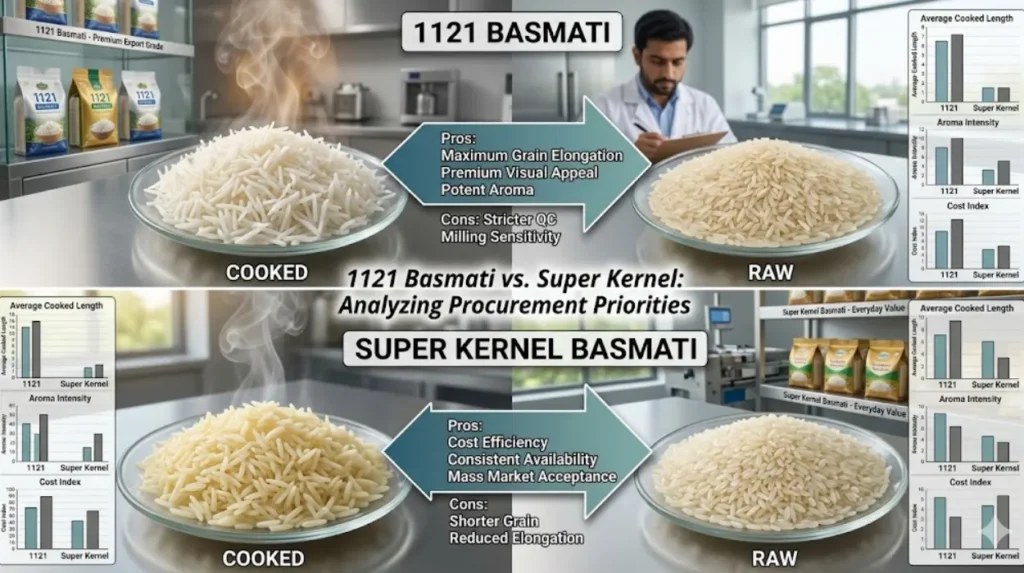
1121 delivers maximum visual appeal and aroma, while Super Kernel offers cost efficiency and stable performance, making each suitable for different supply chain priorities.
Super Kernel Pros
- Lower procurement cost
- Stable supply availability
- Moderate aroma suitable for mass markets
- Flexible packaging options
Super Kernel Cons
- Shorter grain length
- Lower elongation ratio
- Reduced premium positioning
1121 Pros
- Longest grain length available
- Strong aroma profile
- High elongation after cooking
- Premium branding potential
1121 Cons
- Higher export price
- Sensitive to breakage during milling
- Requires stricter quality control
Example variation: Golden Sella 1121 lasts longer than Steam. In Gulf storage conditions, Golden Sella maintains quality for 24 months, while Steam requires consumption within 12 months. For importers without climate control, Golden Sella becomes the correct specification.
With advantages and limitations clear, the next step is making a structured decision.
What decision factors should buyers use when choosing between Super Kernel and 1121?
Buyers should evaluate budget, market demand, storage conditions, packaging type, and resale strategy, using a structured decision framework to match product specifications with commercial goals.
Decision Framework Table
| Decision Factor | Super Kernel | 1121 |
|---|---|---|
| Budget | Low to medium | Medium to high |
| Target Market | Africa, bulk Asia | Gulf, Europe |
| Packaging Type | Bulk sacks | Retail packs |
| Storage Conditions | Moderate | Extended |
| Brand Positioning | Value | Premium |
Applying the Framework
Budget determines initial selection. Buyers with limited capital choose Super Kernel to maximize volume.
Market demand determines final grade. Premium markets require 1121 regardless of cost.
Storage conditions influence processing type. Golden Sella suits long storage cycles.
Packaging strategy impacts perception. Retail packaging benefits from 1121’s visual appeal.
Brand positioning defines long-term strategy. Premium brands cannot compromise on grain length.
With decision factors established, the final step is connecting evaluation to procurement action.
Where should buyers move next after comparing Super Kernel vs 1121?
Buyers should proceed to supplier evaluation, sample testing, and specification alignment, ensuring that grain length, moisture, and broken percentage match target market requirements before placing bulk orders.
Supplier selection defines outcome quality. Exporters must inspect, test, and certify each batch before shipment.
Sample testing confirms cooking performance. Buyers must cook samples to evaluate elongation and aroma.
Specification alignment ensures consistency. Contracts must define grain length, broken percentage, and moisture limits.
For buyers ready to move toward procurement decisions, a detailed supplier-focused guide explains how to source and evaluate export-grade Super Kernel Basmati from Pakistan (iNSERT) effectively.
Frequently Asked Questions
What is the main difference between Super Kernel and 1121 Basmati rice?
Super Kernel and 1121 Basmati differ in grain length and aroma intensity. 1121 offers longer grains and stronger fragrance, making it suitable for premium markets. Super Kernel provides moderate aroma and shorter grains at a lower cost, making it ideal for bulk buyers.
Which Basmati rice has better aroma, Super Kernel or 1121?
1121 Basmati has a stronger and more concentrated aroma due to its hybrid variety and aging response. Super Kernel has a milder aroma that performs well in mass-market consumption where cost matters more than fragrance intensity.
Why is 1121 Basmati more expensive than Super Kernel?
1121 Basmati costs more because it requires stricter grading, longer grains, and higher demand in premium markets. The processing and sorting stages increase production cost, which reflects in a higher price per metric ton.
Which Basmati rice is better for export markets?
1121 Basmati is better for premium export markets like the Gulf and Europe because of its long grain and aroma. Super Kernel is better for African and price-sensitive markets where buyers prioritize affordability and volume.
How does shelf life differ between Super Kernel and 1121 Basmati?
Shelf life depends on processing type. Both varieties last 12–18 months in standard conditions. Golden Sella versions extend shelf life up to 24 months, especially in hot climates where storage conditions are not controlled.