Support Rhode Island Rice Distribution with AHK Rice Supply
Rhode Island rice distributors need more than a low FOB price. They need specification consistency, predictable ocean transit, U.S. food-import compliance, documented quality control, and an inland route that keeps Providence-area inventory available. A reliable Pakistani exporter connects these requirements from Punjab processing through U.S. delivery. For background, the guide:
Why Do Distribution Networks Matter in Rice Import Operations? can be used to understand how distribution structure affects import performance.
The commercial decision becomes clearer when the supply model is compared against the buyer’s actual requirements. A Rhode Island wholesaler serving Providence restaurants needs different shipment planning from a retailer supplying multiple New England states. The strongest model therefore combines a defined rice specification, approved sample, repeatable production, controlled documentation, and a destination-specific freight plan.
What is the best solution for Rhode Island rice distribution?
The best solution is direct, specification-controlled Pakistani rice supply with approved samples, documented quality checks, coordinated export logistics, and planned U.S. delivery. This model reduces intermediary risk, protects grade consistency, supports inventory planning, and gives Rhode Island distributors stronger control over landed procurement costs.
Rhode Island buyers can source through domestic wholesalers, trading companies, or direct international exporters. Each model has a different cost structure. Domestic sourcing is simple but includes distributor margin and less control over origin. Trading companies add commercial flexibility but introduce another supply-chain layer. Direct export sourcing provides greater control over product specification and origin economics.
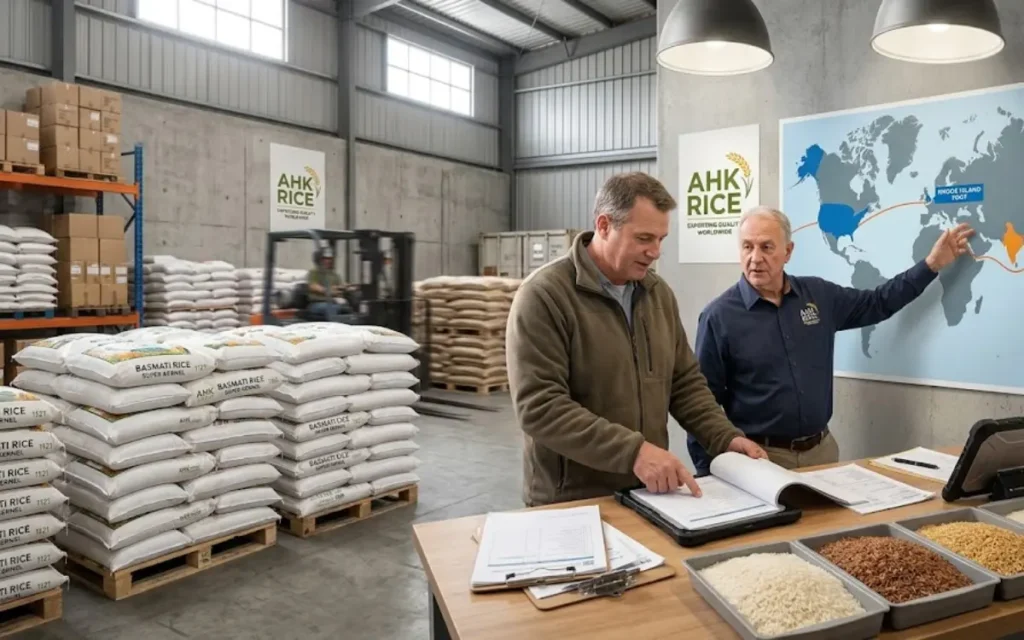
For Pakistani Basmati, the practical direct-sourcing route begins in Punjab. AHK Rice’s USA rice supply service covers Pakistani Basmati varieties for U.S. importers, wholesalers, retailers, and distributors. AHK Rice operates its processing and export workflow from Bucheki, Nankana Sahib, Punjab, with product options including 1121, Super Kernel, and 1509 Basmati.
The distribution decision should begin with the exact commercial specification. A Rhode Island buyer can define variety, processing type, grain length, broken percentage, moisture, foreign matter, packaging, quantity, inspection requirement, destination port, and Incoterm before requesting a quotation.
This prevents a common procurement error: comparing two prices for products that do not have identical specifications.
A 20 MT first container also gives a distributor a controlled commercial test. The buyer evaluates sample performance, documentation, delivery timing, customs handling, warehouse receiving, and customer acceptance before expanding into repeat orders.
Why is AHK Rice suitable for Rhode Island distributors?
AHK Rice suits Rhode Island distributors because its supply model connects Punjab sourcing, milling, grading, sorting, packaging, inspection, export documentation, and container loading. This gives buyers one controlled supply chain instead of managing separate product, quality, and logistics vendors.
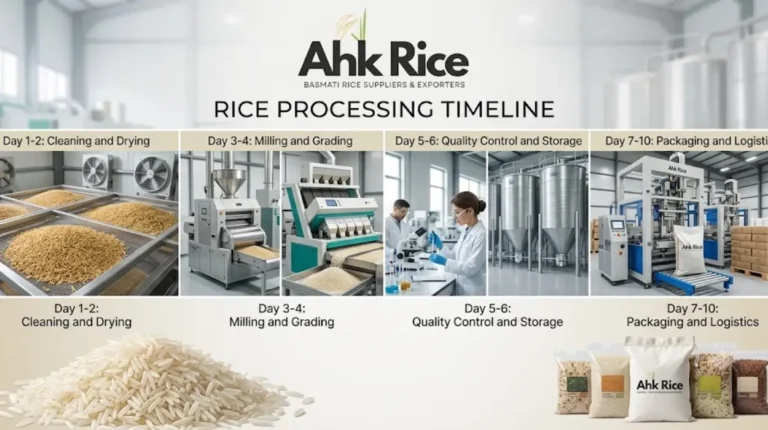
AHK Rice manages the major production stages internally. Its published process covers paddy procurement, pre-cleaning, de-husking, paddy separation, whitening, polishing, grading, length sorting, packaging, export documentation, container loading, fumigation, and shipment coordination.
That structure matters to a Rhode Island distributor because rice quality is a repeat-order issue. A restaurant customer expects the same cooking performance from the second shipment as the first. A retailer expects the same package specification. A wholesaler expects the same grade across multiple pallets.
The supplier therefore needs to control the specification before the container leaves Pakistan.
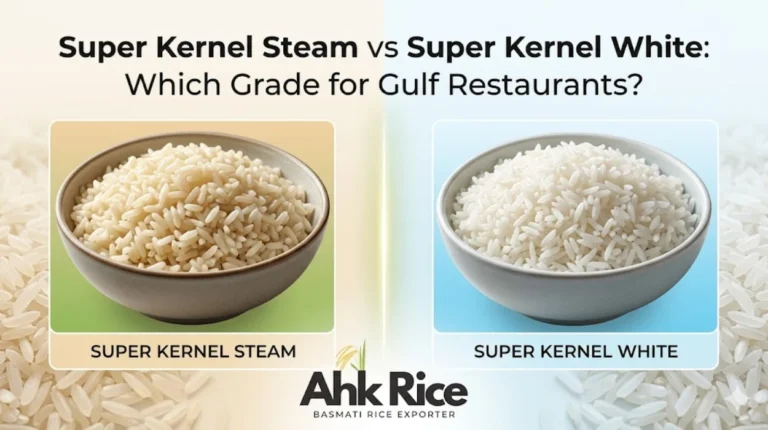
AHK Rice supplies 1121 Basmati, Super Kernel Basmati, and 1509 Basmati. The available processing formats include white, steam, brown, parboiled, Sella, Golden Sella, and Creamy Sella depending on the variety.
For a Rhode Island ethnic-food distributor, 1121 or Super Kernel can support premium Basmati positioning. For buyers prioritising a lower procurement cost while maintaining long-grain characteristics, 1509 provides another specification option. The final selection depends on retail positioning, food-service demand, cooking characteristics, and target landed cost.
Quality verification is also part of the decision. AHK Rice states that its quality framework includes ISO 22000:2018, HACCP, ISO 9001:2015, GMP, and Halal certifications. The company also identifies third-party pre-shipment inspections through organisations such as SGS and Bureau Veritas.
The importer remains responsible for meeting applicable U.S. requirements. FDA states that imported food must be safe, sanitary, and properly labelled, and food facilities involved in imported food must meet applicable registration requirements.
How does rice shipping from Pakistan to Rhode Island work?
A Rhode Island shipment normally moves from Punjab processing to Karachi, then by ocean freight to a U.S. gateway, followed by customs clearance, release, and inland delivery. A realistic planning window separates production, vessel transit, clearance, and final warehouse transportation.
A typical shipment sequence is straightforward:
- The buyer confirms product, quantity, packing, destination, Incoterm, and payment terms.
- A sample is approved when required.
- Production and packing are scheduled.
- Quality checks and requested inspection are completed.
- Export documentation is prepared.
- Containers move from Punjab to Karachi.
- The vessel departs Pakistan.
- The shipment arrives at the selected U.S. gateway.
- Customs and food-import procedures are completed.
- Cargo moves inland to Rhode Island.
- The distributor receives and checks the shipment.
For planning purposes, AHK Rice publishes a 25–35-day door-to-door expectation from Karachi to major U.S. ports such as New York and Los Angeles. A current freight-market listing for Karachi–New York shows approximately 35–38 days of ocean transit for a 40-foot high-cube FCL, demonstrating why buyers need to distinguish ocean transit from total delivery time.
For Rhode Island, New York/New Jersey gateways provide a practical comparison point because they connect into the Northeast distribution corridor. Providence itself has a deep-water commercial port with multimodal infrastructure, rail connections, covered storage, and highway access. ProvPort describes the Port of Providence as an international trade and domestic distribution facility serving New England.
What shipping timeline should a Rhode Island buyer use?
A practical planning model for a first order is:
| Stage | Planning window |
|---|---|
| Specification and commercial confirmation | 1–3 days |
| Sample approval, if required | 3–10+ days depending on courier |
| Production and packing | 7–15 days |
| Inspection and export documentation | 2–5 days |
| Karachi positioning and vessel booking | 3–7 days |
| Ocean transit to Northeast gateway | 25–38 days |
| U.S. clearance and release | Variable |
| Inland delivery to Rhode Island | 1–3 days after release |
These are planning ranges, not guaranteed arrival dates. Vessel schedules, transshipment, port congestion, customs review, inspections, and inland carrier availability affect actual delivery.
What U.S. compliance requirements affect Rhode Island rice imports?
Rhode Island rice importers must treat FDA compliance, Prior Notice, facility registration, FSVP responsibilities, accurate labeling, customs documentation, and product records as part of procurement. Compliance planning belongs before shipment, not after the container reaches the United States.
FDA requires Prior Notice for applicable imported food shipments. For ocean shipments, FDA’s guidance states that Prior Notice must be received and confirmed at least eight hours before arrival at the U.S. port of arrival.
FSVP is another important importer responsibility. FDA’s FSVP rule requires covered importers to conduct risk-based verification activities for imported food, including verifying that food is produced in a manner consistent with applicable U.S. food-safety requirements and is not adulterated or misbranded.
FDA specifically recognises rice among imported grain raw agricultural commodities covered by its FSVP guidance.
The compliance file should therefore connect the supplier, product, facility, shipment, and importer records. A Rhode Island buyer should confirm the foreign facility information, product description, importer-of-record details, supplier verification documentation, labels, commercial invoice, packing list, certificate of origin, phytosanitary documentation where applicable, fumigation documentation where required, bill of lading, and testing records.
This matters commercially as well as legally. FDA enforcement actions in 2026 demonstrate that FSVP failures remain an active compliance issue for food importers.
What does the AHK Rice sample process cost?
AHK Rice offers up to 20 kg of rice as a free product sample, while the buyer covers courier and phytosanitary certificate costs. The sample stage verifies physical quality before commercial commitment and creates a specification reference for production.
The sample process should be treated as a procurement control rather than a simple tasting exercise.
Step 1: Define the sample specification
The buyer identifies the required variety, processing method, grain profile, packaging preference, and intended application. For example, a Rhode Island wholesaler can request 1121 White Basmati for retail and food-service evaluation.
Step 2: Request up to 20 kg
AHK Rice states that up to 20 kg of sample rice is free. The buyer pays sample shipping costs and the phytosanitary certificate cost associated with the sample shipment.
Step 3: Receive and test
The buyer checks appearance, aroma, grain length, broken grains, cooking elongation, texture, taste, packaging, and consistency against the commercial specification.
Step 4: Approve the sample
Approval becomes the reference point for the commercial order. The buyer then confirms quantity, packaging, destination, Incoterm, inspection requirements, and shipment timing.
Step 5: Move to commercial production
AHK Rice states that sample charges are waived in the final quote when a buyer proceeds with an order after approval.
A sample does not replace regulatory verification. It proves commercial suitability. The importer still completes the required U.S. compliance process.
What pricing should Rhode Island distributors expect?
Rice pricing depends on variety, grade, processing, quantity, packaging, inspection, Incoterm, freight, destination, payment terms, and market conditions. Buyers must compare landed cost rather than FOB price because origin price alone excludes several destination-side expenses.
AHK Rice’s current USA product information shows commercial supply beginning at container-level quantities, with its USA export page identifying one 20-foot container as a typical 20 MT starting quantity.
Published AHK Rice product information also shows indicative U.S. pricing for some Super Kernel specifications from around $1,100 per MT on a CIF basis, while current procurement benchmarks vary by variety and processing. These figures are quotation references, not fixed Rhode Island delivered prices.
A Rhode Island landed-cost calculation should include:
| Cost component | What changes the cost |
| Rice value | Variety, grade, crop, processing |
| Packaging | Retail bags, bulk sacks, private label |
| Inland origin freight | Punjab-to-Karachi movement |
| Ocean freight | Destination, container type, carrier, schedule |
| Insurance | Required coverage and Incoterm |
| Inspection | Buyer-selected third-party inspection |
| Import costs | Customs, broker, applicable duties and fees |
| Inland U.S. freight | Gateway-to-Rhode-Island warehouse distance |
| Warehousing | Storage and handling requirements |
The strongest RFQ compares the same specification under the same Incoterm. A $1,100/MT quote and a $1,180/MT quote cannot be ranked correctly when one includes freight and the other does not.
What results can Rhode Island distributors expect?
A specification-led supply program gives Rhode Island distributors stronger quality consistency, clearer landed-cost control, planned replenishment, documented compliance, and direct communication with the origin exporter. These results improve purchasing decisions and reduce avoidable supply-chain uncertainty.
The first measurable result is specification consistency. The approved sample becomes a commercial reference rather than relying on verbal descriptions such as “premium Basmati.”
The second result is better inventory planning. A distributor can work backward from warehouse demand and schedule production and shipping before inventory reaches a critical level.
The third result is cost transparency. Direct sourcing separates rice value, freight, inspection, customs, and inland logistics so procurement teams can identify where the final landed cost originates.
The fourth result is stronger documentation control. AHK Rice describes an export process covering commercial invoice, packing list, phytosanitary certificate, certificate of origin, fumigation certificate, and bill of lading.
The fifth result is scalable procurement. A buyer can begin with one container, validate the supplier, and then establish recurring shipments based on actual consumption.
For distributors expanding beyond Providence, the same supply structure can feed customers across New England. The Port of Providence has highway and rail connections and serves as a multimodal distribution point for the region.
How should a Rhode Island buyer decide between rice suppliers?
The final supplier decision should score product specification, sample performance, compliance readiness, landed cost, shipment reliability, and repeat-order capacity together. The lowest quoted MT price is not the best commercial choice when quality variation or delivery risk threatens downstream distribution.
Use this five-point decision framework:
| Decision factor | Buyer test | Pass condition |
| Product specification | Does the sample match the required grade? | Written specification approved |
| Quality control | Are inspection and testing procedures documented? | Pre-shipment verification defined |
| Compliance | Are importer and supplier records ready? | FDA/FSVP responsibilities assigned |
| Logistics | Is the delivery route realistic? | Production and transit windows agreed |
| Commercial value | Is landed cost competitive? | Comparable all-in quotation |
AHK Rice becomes a stronger candidate when the buyer requires direct Pakistani origin, controlled Basmati specifications, custom packing, export documentation, and repeat container supply from one exporter.
The buyer should also compare the supplier’s communication process. A shipment that is technically on schedule but lacks timely documentation creates operational problems. The supplier needs to communicate production status, inspection completion, container loading, vessel departure, shipping documents, and expected arrival.
For buyers building a wider procurement model, the related guide on:
How Do Importers Build Efficient Rice Distribution Systems? provides useful comparison context before the final supplier decision.
How can a Rhode Island distributor get started with AHK Rice?
Start by sending the destination, rice variety, processing grade, quantity, packaging, Incoterm, target delivery window, and inspection requirements. AHK Rice can then structure the sample, specification, quotation, production, documentation, and shipment workflow around the buyer’s requirements.
A practical first-order brief should contain:
- Destination: Rhode Island warehouse or selected U.S. gateway.
- Product: 1121, Super Kernel, or 1509 Basmati.
- Processing: White, Steam, Sella, Golden Sella, Brown, or another required grade.
- Quantity: Start with the required container volume.
- Packaging: Bulk, retail, or private-label.
- Quality: Grain length, broken percentage, moisture, purity, and other tolerances.
- Inspection: In-house testing or independent inspection.
- Commercial term: FOB, CFR/CNF, CIF, or another agreed Incoterm.
- Delivery target: Required warehouse arrival period.
- Importer information: Details required for quotation and compliance coordination.
The supplier can then price the order against one defined specification. This is more effective than requesting a generic “best rice price.”
AHK Rice’s USA supply workflow is designed for U.S. importers and includes product selection, packing, quantity, destination port, and Incoterm as part of the quotation process.
For a Rhode Island distributor, the best buying decision is therefore not simply choosing Pakistani rice. It is choosing a controlled supply system that links product quality with documentation, shipping, compliance, and replenishment. AHK Rice provides that origin-side structure while the importer retains control of U.S. entry, FSVP responsibilities, customs, and downstream distribution.
For a specification-based Rhode Island shipment, request a customized rice quotation with your product, quantity, destination, packaging, and Incoterm requirements.
Frequently Asked Questions
Is AHK Rice a suitable supplier for Rhode Island rice distributors?
AHK Rice is suitable for Rhode Island distributors requiring Pakistani Basmati rice, container-level supply, defined product specifications, export documentation, quality controls, and coordinated shipment planning for the U.S. market.
What types of Pakistani rice can Rhode Island distributors source?
Rhode Island distributors can source 1121 Basmati, Super Kernel Basmati, and 1509 Basmati, with processing options including White, Steam, Sella, Golden Sella, Creamy Sella, Brown, and Parboiled rice.
What is the minimum order quantity for U.S. rice distribution?
AHK Rice identifies one 20-foot container, approximately 20 MT, as a typical starting commercial quantity for U.S. export orders. Final quantity depends on product, packaging, and shipment requirements.
How long does rice shipping from Pakistan to Rhode Island take?
A practical planning window is approximately 25–38 days for ocean movement from Karachi toward the U.S. Northeast, followed by customs clearance and inland delivery to Rhode Island. Total timing varies by route and shipment conditions.
Can Rhode Island buyers receive rice samples before placing an order?
Yes. AHK Rice states that buyers can receive up to 20 kg of free rice samples, while the buyer covers courier and phytosanitary certificate costs. The sample establishes a reference before commercial production.