Why Do Distribution Networks Matter in Rice Import Operations?
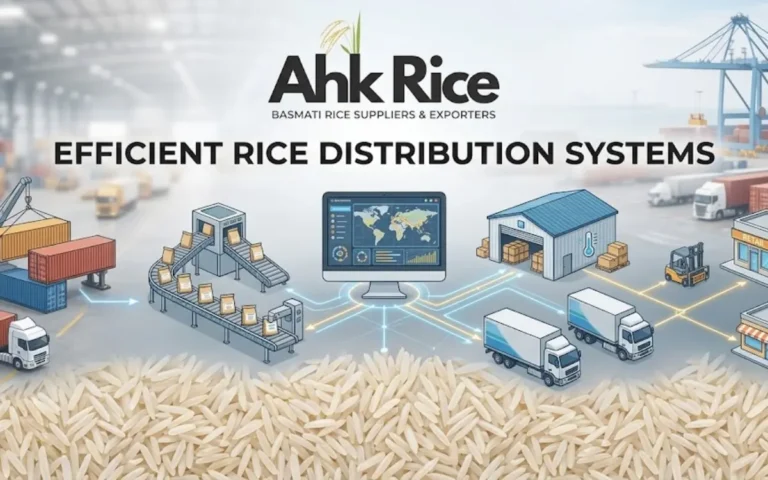
Distribution networks matter in rice import operations because they connect the exporting mill, international transport, port, warehouse, distributor, retailer, and final buyer. A strong network controls product flow, inventory, documentation, delivery timing, quality, and market coverage from origin to consumption.
For Pakistani rice, the network starts in major rice-growing areas of Punjab and Sindh and connects processing facilities with export ports, international shipping routes, destination warehouses, wholesalers, food-service operators, retailers, and institutional buyers. Punjab remains particularly important for Basmati production, including varieties such as 1121 Basmati, Super Kernel Basmati, and 1509 Basmati.
Pakistan remains a major rice exporter. Government and industry data reported in 2026 place annual rice production around 9–10 million metric tons, with an exportable surplus of approximately 4.5–5.5 million metric tons. Pakistan exports rice to more than 150 countries, while current trade patterns show stronger diversification toward Central Asia, Africa, the Gulf, Europe, and other destinations.
The importance of distribution becomes clearer when rice moves beyond the export transaction. An importer does not simply purchase containers from an exporter. The importer must move those containers through customs, storage, inventory control, regional distribution, wholesale channels, retail locations, restaurants, and other demand points. Each stage affects cost, availability, quality, and customer service.
What Is a Rice Distribution Network?
A rice distribution network is the connected system of suppliers, processors, exporters, transport providers, ports, warehouses, distributors, wholesalers, retailers, and buyers that moves rice from production areas to final markets while controlling inventory, quality, documentation, and delivery.
The network begins before international shipping. Farmers produce paddy, processors clean and mill the crop, exporters prepare commercial consignments, and logistics providers move cargo toward the export port. After loading, ocean freight connects the origin country with the destination market.
The destination side contains another network. A container arriving at Rotterdam, Jebel Ali, Jeddah, Umm Qasr, or another port enters customs clearance before moving into a warehouse or distribution center. From there, rice moves through wholesalers, supermarkets, ethnic food stores, restaurants, food manufacturers, or institutional procurement channels.
Distribution therefore represents a physical and commercial system rather than a single transportation activity.
For Pakistani Basmati rice, distribution also depends on product identity. 1121 Basmati, Super Kernel Basmati, and 1509 Basmati serve premium and mainstream consumer segments with different grain characteristics, processing formats, packaging requirements, and price positions.
The network must preserve those distinctions. Mixing specifications during storage or dispatch creates inventory errors and commercial disputes.
How Does a Rice Distribution Network Work?
A rice distribution network works by coordinating sourcing, processing, export documentation, international transport, customs clearance, warehousing, inventory allocation, regional delivery, and final sales so each rice consignment reaches the correct market in the required specification and quantity.
The process follows a connected sequence.
1. Rice is produced and sourced
Rice production starts with paddy cultivation. Pakistan’s Basmati-growing belt is concentrated in Punjab, where agro-climatic conditions support the long-grain aromatic varieties associated with Pakistani Basmati.
The crop is harvested and delivered to mills or processing facilities. Paddy quality at intake affects the final product, including moisture, impurities, broken grains, grain appearance, and milling performance.
2. Paddy is processed
Rice processing converts harvested paddy into an exportable product. The sequence normally includes cleaning, de-stoning, husking, separation, whitening or polishing, grading, sorting, quality inspection, and packaging.
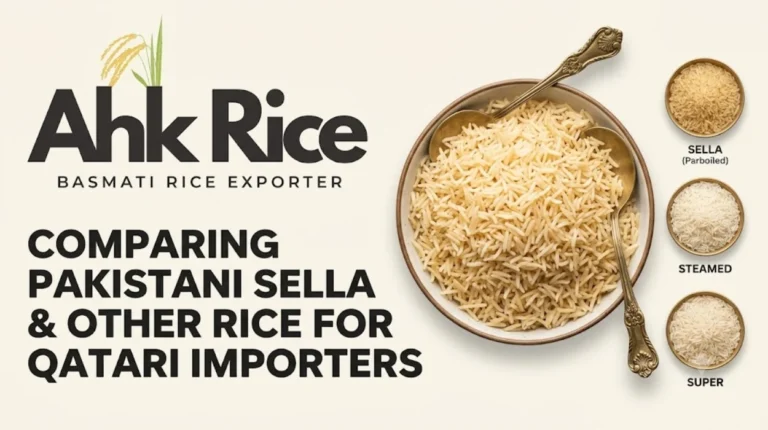
Parboiled or Sella rice follows additional soaking, steaming, and drying stages before milling. Steam rice uses controlled steaming during processing. White rice follows conventional milling without the same parboiling process.
Optical sorting removes discolored and defective grains. Mechanical grading separates grains according to size and quality specifications.
3. Rice is classified by commercial specification
Importers purchase rice against specifications rather than simply purchasing “rice.” A specification defines variety, grain length, broken percentage, moisture, foreign matter, milling degree, packaging, crop year, and other quality characteristics.
Common Pakistani Basmati varieties include:
| Commercial variety | Typical market positioning | Common processing forms |
|---|---|---|
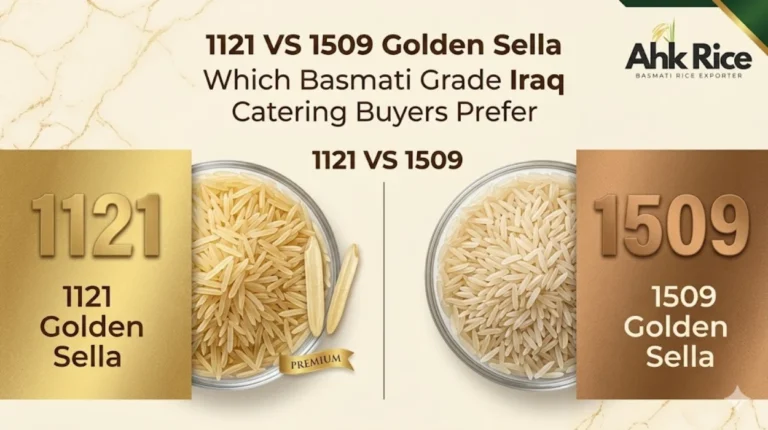
| 1121 Basmati | Premium long-grain Basmati | White, Steam, Sella, Golden Sella |
| Super Kernel Basmati | Premium traditional Basmati | White, Steam, Sella |
| 1509 Basmati | Long-grain aromatic Basmati | White, Steam, Sella |
| PK-386 | Long-grain non-Basmati | White, Sella |
| IRRI-6 | High-volume non-Basmati | White, Sella |
| IRRI-9 | Non-Basmati | White, Sella |
The exact grade is established by the contractual specification. For example, an importer can specify 1121 Basmati Sella with a defined broken-grain tolerance, moisture limit, grain-length requirement, packing format, and inspection procedure.
4. Export cargo is prepared
The exporter prepares commercial documents, packing lists, invoices, certificates, inspection documents, and other market-specific paperwork.
Food-safety documentation becomes increasingly important in regulated markets. Pakistan’s 2026 export environment places greater emphasis on pesticide residue control, aflatoxin management, laboratory testing, traceability, and agricultural good practices. Government reporting states that EU interceptions involving Pakistani food products have declined substantially, reaching five cases through April 2026 for the reported categories.
5. Cargo moves to the export port
Containers move from the processing facility to an export port, commonly Karachi or Port Qasim for Pakistani rice shipments.
The inland leg requires coordination between the exporter, trucking company, freight forwarder, shipping line, terminal, customs authorities, and inspection bodies. A delay at any one point can affect vessel cut-off times.
6. International transport connects markets
Ocean freight connects Pakistan with destination markets. The shipping route affects transit time, freight cost, inventory planning, insurance exposure, and safety-stock requirements.
A European importer, for example, plans differently from a Gulf importer because sailing time, customs procedures, warehouse positioning, and regional distribution structures differ.
7. Destination clearance and warehousing occur
After arrival, the importer completes customs and regulatory procedures. The container then moves to a warehouse or distribution center.
Warehouse management separates products by variety, grade, packaging, lot, production date, and customer allocation. This separation protects traceability and prevents dispatch errors.
8. Regional distribution completes the movement
The importer allocates inventory to regional warehouses, wholesalers, supermarkets, restaurants, food-service distributors, or industrial buyers.
A distributor serving London, Manchester, Birmingham, and Glasgow needs a different warehouse allocation model from an importer selling through one national wholesale market. Geographic demand determines where stock is positioned.
What Are the Key Components of a Rice Distribution Network?
The key components are suppliers, processing facilities, exporters, freight providers, ports, customs, warehouses, inventory systems, distributors, wholesalers, retailers, food-service buyers, documentation controls, and quality systems that connect physical rice movement with commercial demand.
Production and processing nodes
Production areas supply paddy while mills convert paddy into specified rice products. Processing capacity determines how consistently an exporter can meet recurring orders.
Logistics nodes
Trucks, ports, shipping lines, freight forwarders, customs brokers, and terminal operators connect the physical network.
Storage nodes
Warehouses protect inventory after arrival. Their functions include receiving, inspection, lot identification, palletization, stock rotation, order picking, and dispatch.
Information systems
Distribution networks also depend on information. Importers track purchase orders, container numbers, bills of lading, inventory balances, lot numbers, customer orders, and delivery status.
A physical shipment without accurate information creates operational risk. An importer can have rice in the warehouse and still lose sales if inventory records show incorrect quantities or unavailable stock.
Quality and compliance controls
Quality systems connect the shipment specification with testing and documentation. Depending on the market and buyer contract, these controls include laboratory analysis, pesticide residue testing, aflatoxin testing, microbiological testing, certificate verification, third-party inspection, traceability records, and food-safety management certification.
Certification requirements differ by buyer and destination. HACCP, ISO 22000, BRCGS, Halal certification, organic certification, and third-party inspection are separate compliance instruments and are not automatically required for every rice shipment.
Why Do Importers Need Efficient Rice Distribution Networks?
Importers need efficient distribution networks to maintain product availability, control landed costs, reduce inventory disruption, meet regulatory requirements, preserve rice quality, serve multiple customer segments, and respond to changing demand across geographic markets.
The first benefit is inventory availability. Rice is frequently sold through repeat purchasing channels. A wholesaler or supermarket needs predictable replenishment.
The second benefit is cost control. Landed cost includes the purchase price, freight, insurance, port charges, customs costs, storage, inland transport, handling, financing, and distribution expenses. Poor network design increases the cost after the rice has already reached the destination country.
The third benefit is service reliability. Customers expect the contracted variety and grade to arrive in the contracted quantity. A distribution network supports reliable order fulfillment by positioning inventory near demand centers.
The fourth benefit is quality preservation. Rice is a dry food, but poor storage conditions still affect quality. Excess moisture, pests, contamination, damaged packaging, and unsuitable warehouse conditions create losses.
The fifth benefit is market expansion. One central warehouse can supply several regional markets when transport economics support that structure. Importers can also use multiple distribution centers when delivery distance or demand concentration requires them.
Which Markets Depend on Rice Distribution Networks?
Rice distribution networks support import markets across the Gulf, Europe, Africa, Central Asia, Southeast Asia, North America, and other regions, with each destination applying different demand patterns, logistics structures, packaging formats, and regulatory requirements.
The Gulf remains a major destination for Pakistani rice. Markets include Saudi Arabia, the United Arab Emirates, Oman, Qatar, Kuwait, and Bahrain. Basmati and non-Basmati products serve retail, restaurant, catering, and food-service demand.
The UAE also functions as a regional trading and redistribution center. Its logistics infrastructure allows imported rice to enter the domestic market or move through regional commercial channels.
Europe represents a more compliance-intensive environment. The Netherlands is an important European trade location, and Rotterdam functions as a major logistics gateway. Pakistani Basmati rice entering the EU operates within strict food-safety and traceability requirements.
EU rules also contain specific provisions for Basmati rice. Current EU regulations maintain special procedures for Basmati imports, including authenticity documentation and import licensing requirements.
In 2026, EU controls also specify enhanced monitoring for rice from Pakistan involving contaminants and pesticide residues. Commission Implementing Regulation (EU) 2026/1206 lists rice under CN code 1006 from Pakistan with controls concerning aflatoxins, ochratoxin A, and pesticide residues.
African markets provide another distribution model. Pakistan is expanding rice trade toward destinations such as Côte d’Ivoire and Senegal as exporters diversify beyond traditional markets. Central Asian markets such as Kazakhstan and Uzbekistan are also gaining attention for Pakistani Basmati rice.
North American distribution requires destination-specific regulatory planning. In the United States, agricultural import requirements depend on the specific commodity and country of origin, with USDA APHIS directing importers to its Agricultural Commodity Import Requirements database.
Which Certifications and Documents Affect Rice Distribution?
Rice distribution depends on destination regulations and contractual requirements covering food safety, plant health, authenticity, origin, inspection, laboratory testing, and halal or organic claims rather than one universal certification applicable to every import shipment.
A phytosanitary certificate demonstrates compliance with applicable plant-health requirements. Exporters obtain destination-specific documentation through the competent plant protection authorities.
A certificate of origin identifies the country of origin. It becomes important for customs, preferential trade arrangements, and market documentation.
A health or food-safety certificate applies when required by the destination authority or buyer. Laboratory reports verify specified parameters such as pesticide residues, mycotoxins, moisture, heavy metals, or microbiological criteria.
Halal certification is commercially important in many Muslim-majority markets and for buyers specifying halal status. Organic certification applies when rice is sold as certified organic and requires compliance with the relevant organic production and certification framework.
HACCP and ISO 22000 address food-safety management. BRCGS Food Safety addresses food-safety and quality requirements used by many international retailers and food businesses. These certifications describe management systems; they do not replace destination-specific import regulations.
For the EU, Pakistani rice importers also need to account for applicable maximum residue limits and official controls. Current 2026 EU rules demonstrate why distribution planning must connect logistics with compliance rather than treating customs as a separate activity.
What Are the Common Problems in Rice Distribution Networks?
Common distribution problems include inaccurate demand forecasts, excessive inventory, stockouts, port delays, documentation errors, inadequate warehouse controls, specification mismatches, regulatory failures, damaged packaging, and dependence on a single logistics route or distribution point.
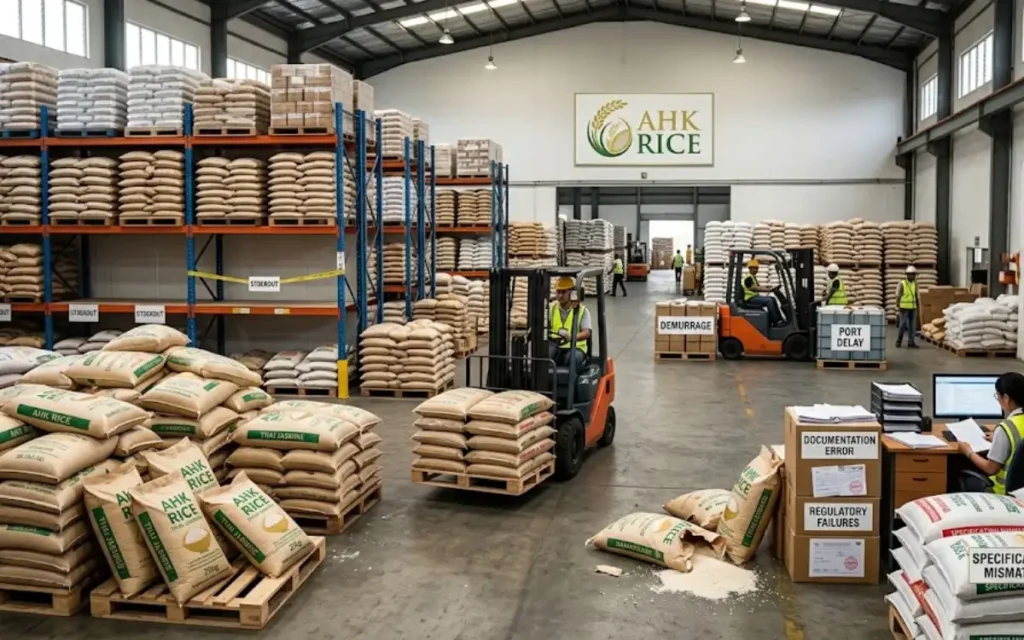
A common misconception is that distribution starts after the container reaches the destination port. In reality, distribution planning starts during procurement because shipment size, packaging, delivery terms, route selection, and arrival timing determine downstream inventory requirements.
Another misconception is that lower purchase price always produces lower landed cost. A cheaper rice contract loses its advantage when additional storage, demurrage, inland transport, inspection, financing, or inventory costs increase the final cost.
A third problem is treating every market identically. A 25 kg wholesale bag used for one market does not automatically suit another market where consumers prefer 5 kg or 10 kg retail packaging.
A fourth problem is insufficient traceability. Importers need to identify which lot entered which warehouse and which customers received it. This becomes especially important when regulatory testing identifies a problem.
A fifth problem is overdependence on one route. The 2026 Pakistan rice trade environment demonstrates the importance of route and market diversification. Border closures, geopolitical disruptions, freight increases, and port congestion can alter shipment economics and delivery schedules.
How Does Distribution Network Design Connect With Import Planning?
Distribution network design connects import planning with demand forecasting, supplier selection, shipment scheduling, inventory positioning, warehouse capacity, compliance controls, and customer delivery requirements to create a complete flow from rice origin to final market.
An importer first defines demand by product and location. The next step is matching those requirements with suppliers, grades, packaging, shipment sizes, and delivery schedules.
For example, an importer serving ethnic supermarkets can separate demand into 1121 Basmati, Super Kernel Basmati, and 1509 Basmati. Each product can receive its own stock target and replenishment schedule.
The importer then determines where inventory belongs. A single national warehouse reduces facility complexity but increases average delivery distance for remote customers. Multiple regional warehouses increase handling complexity but improve delivery responsiveness.
The next decision concerns replenishment. Importers compare container lead times with warehouse stock levels and customer order frequency. This establishes reorder points and safety stock.
The final layer is supplier and route management. Importers compare supplier reliability, quality consistency, documentation accuracy, shipment performance, and destination compliance rather than evaluating price alone.
For readers moving from distribution theory to operational design, the next stage is understanding:
How importers build efficient rice distribution systems, including network structure, warehouse positioning, inventory planning, logistics coordination, and market-specific allocation.
Frequently Asked Questions
What is a rice distribution network?
A rice distribution network is the system that connects rice producers, processors, exporters, shipping providers, ports, warehouses, distributors, wholesalers, retailers, and final buyers. It manages the movement of rice from production areas to destination markets.
Why are distribution networks important for rice importers?
Distribution networks help importers control inventory, transportation, storage, landed costs, delivery schedules, product quality, and regulatory compliance. An efficient network also supports reliable replenishment across multiple geographic markets.
How does rice move through an international distribution network?
Rice moves from farms to processing facilities, then to export warehouses and ports. After international shipping, it enters destination customs, warehouses, regional distribution centers, wholesalers, retailers, restaurants, and other commercial channels.
Which Pakistani rice varieties use international distribution networks?
Pakistani exporters distribute varieties including 1121 Basmati, Super Kernel Basmati, 1509 Basmati, PK-386, IRRI-6, and IRRI-9. Each variety follows a defined commercial specification covering quality, grain characteristics, packaging, and buyer requirements.
Which countries import Pakistani rice?
Pakistani rice reaches markets across the Gulf, Europe, Africa, Central Asia, North America, and Asia. Major destinations include Saudi Arabia, the UAE, Oman, Qatar, the United Kingdom, European markets, China, and several African and Central Asian countries.
What factors determine rice distribution costs?
Distribution costs depend on purchase price, inland transportation, port charges, ocean freight, customs expenses, insurance, warehousing, handling, financing, packaging, and final-mile delivery. Route distance and shipment volume also affect the landed cost.