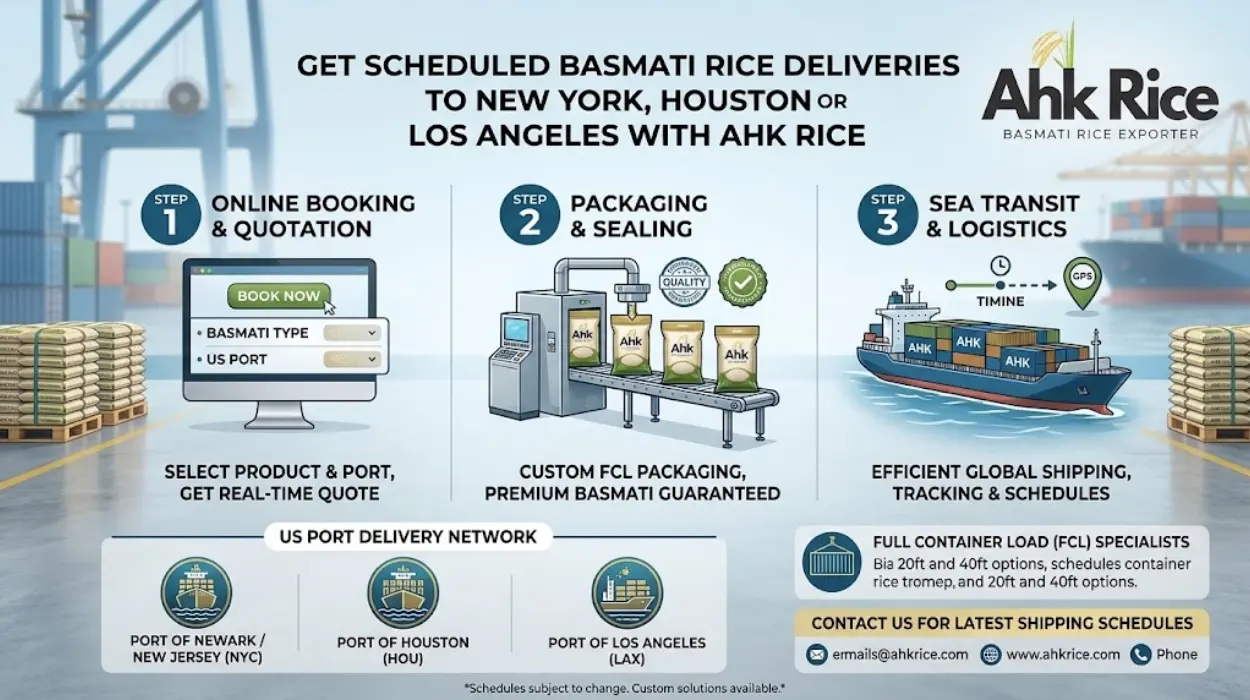
Get Scheduled Basmati Rice Deliveries to New York, Houston or Los Angeles with AHK Rice
Importers serving New York, Houston, and Los Angeles need more than a competitive basmati rice price. They need consistent specifications, predictable vessel schedules, export documentation, and delivery planning that supports inventory commitments. AHK Rice helps US importers source Pakistani basmati rice with defined product specifications, customized packaging, and coordinated export preparation.
For an overview of international transit planning, read our guide on how long basmati rice shipping takes from Karachi to US ports. Importers can use this information to establish realistic procurement windows before confirming purchase quantities and delivery requirements.
The best sourcing decision connects rice variety, shipment volume, destination port, shipping terms, and required arrival date. AHK Rice supports this process by coordinating product preparation and export arrangements around the buyer’s agreed order specifications.
What is the best solution for scheduling basmati rice deliveries to US markets?
The best solution combines confirmed rice specifications, an agreed shipment window, suitable ocean freight, and destination-specific clearance planning. Importers should confirm product availability before booking freight and establish delivery milestones that account for port handling, customs clearance, and final transportation.
A scheduled shipment begins with a clear purchase specification. Buyers identify the rice variety, processing type, grain length, broken percentage, moisture limit, packaging format, and total quantity. These details establish the basis for production, inspection, pricing, and shipment approval.
AHK Rice supplies Pakistani basmati varieties including 1121, Super Kernel, and 1509 Basmati rice, subject to availability and agreed specifications. Buyers can select raw, Steam, or parboiled Sella rice according to their retail, wholesale, catering, or foodservice requirements.
New York buyers may prioritize premium long-grain basmati for ethnic grocery stores and specialty distributors. Houston importers may require a combination of wholesale packs and foodservice quantities. Los Angeles buyers may prioritize retail-ready packaging for established South Asian grocery networks.
The shipment plan should identify the destination port, preferred arrival window, Incoterm, and responsibilities for freight, insurance, customs clearance, and inland delivery. This reduces misunderstandings and gives purchasing teams a practical framework for coordinating inventory.
Why choose AHK Rice for US basmati rice imports?
AHK Rice provides a coordinated sourcing and export process for buyers who need defined rice specifications, packaging options, and shipment documentation. Importers can establish product requirements before confirming an order, helping align procurement decisions with distribution needs and destination-specific import procedures.
Through the AHK Rice basmati rice export service, buyers can discuss product selection, processing requirements, packaging, and export arrangements for US-bound shipments.
The purchasing process starts with the required grade and intended use. Premium 1121 basmati suits buyers targeting long-grain presentation and aromatic cooked rice. Super Kernel supports buyers seeking traditional Pakistani basmati characteristics. Variety selection should follow the buyer’s quality specification rather than price alone.
For large-volume wholesale orders, 1509 basmati can provide another option when buyers prioritize procurement economics and consistent bulk supply. Steam and Golden Sella processing offer different product characteristics, so importers should approve the appropriate processing type before production.
AHK Rice can coordinate agreed specifications, packaging requirements, pre-shipment checks, and export paperwork. The buyer should confirm the exact scope of each service in the quotation and purchase contract.
US importers must also establish their own compliance arrangements. These may include applicable FDA requirements, facility registration where required, Prior Notice, Foreign Supplier Verification Program responsibilities, customs entry documentation, and relevant food-safety controls. Requirements depend on the product, parties, and shipment circumstances.
A supplier’s export documentation does not automatically satisfy every US importer obligation. Buyers should verify requirements with their customs broker and compliance team before dispatch.
How long does basmati rice shipping take to New York, Houston, and Los Angeles?
Ocean transit from Karachi to US ports commonly requires several weeks, with the actual duration depending on the vessel route, transshipment, sailing schedule, and port conditions. Importers should distinguish port-to-port transit from total delivery time, which also includes preparation, clearance, and inland transportation.
Indicative planning ranges for containerized shipments are shown below. These are estimates, not live vessel schedules or guaranteed delivery commitments.
| US destination | Indicative ocean transit from Karachi | Main planning considerations |
|---|---|---|
| New York / New Jersey | Approximately 30–45 days | Routing, transshipment, East Coast port congestion, customs clearance |
| Houston, Texas | Approximately 25–40 days | Gulf Coast routing, vessel schedules, terminal availability, inland delivery |
| Los Angeles, California | Approximately 25–40 days | West Coast routing, terminal congestion, customs clearance, local trucking |
Actual transit times can fall outside these ranges. The carrier’s booking confirmation and current sailing information should determine the shipment-specific estimate.
New York importers should plan for container availability and onward transportation to warehouses across the Northeast. Houston buyers should coordinate terminal release with local trucking or distribution arrangements. Los Angeles importers should account for terminal conditions and the distance between the port and their receiving facility.
The total procurement timeline also includes sample approval, production or stock allocation, inspection, container loading, export clearance, ocean transit, US customs release, and final delivery where included in the contract.
For a more detailed destination comparison, review our guide to transit times to East Coast, Gulf Coast and West Coast ports for rice containers. This comparison helps purchasing teams evaluate port selection against delivery deadlines and distribution costs.
What results can US importers expect from a scheduled delivery plan?
A structured delivery plan gives importers clearer purchasing milestones, better inventory visibility, and more time to coordinate customs clearance and warehouse receiving. Results depend on timely approvals, accurate documentation, confirmed freight bookings, and the performance of carriers and other logistics providers.
The first expected outcome is greater specification control. Buyers approve the variety, processing type, packaging, and quality parameters before shipment. This reduces the risk of receiving rice that does not match the agreed purchase order.
The second outcome is improved inventory planning. A distributor serving New York retailers can calculate replenishment requirements using the confirmed shipment window and existing stock levels. A Houston foodservice supplier can coordinate incoming containers with customer contracts and warehouse capacity.
The third outcome is clearer cost allocation. When the parties agree on the Incoterm and identify freight, insurance, port charges, duties, customs brokerage, and inland transportation responsibilities, the buyer can assess the expected landed cost more accurately.
These measures do not eliminate shipping delays or guarantee a particular arrival date. They give buyers a documented process for monitoring progress and responding to changes.
Before dispatch, the importer should receive the agreed commercial documents and shipment details. The buyer should confirm that the commercial invoice, packing list, bill of lading instructions, origin documents, and any required inspection or phytosanitary documentation match the transaction and applicable import requirements.
How much does shipping basmati rice to the United States cost?
The total landed cost depends on the rice grade, quantity, packaging, freight market, destination charges, insurance, applicable duties, customs fees, and inland delivery. Buyers should request a shipment-specific quotation instead of relying on a generic price per metric tonne or an assumed freight rate.
AHK Rice quotations should be evaluated against the full purchase specification. A quotation for 1121 Steam rice in retail bags is not directly comparable with one for bulk Golden Sella rice, even when both cover the same shipment weight.
Key pricing factors include:
- Rice variety and grade: 1121, Super Kernel, and 1509 have different commercial positioning and specification requirements.
- Processing method: Raw, Steam, and Golden Sella products may carry different processing and production costs.
- Quality parameters: Grain length, broken percentage, moisture, sorting, and inspection requirements influence the quoted specification.
- Packaging: Retail bags, private-label packaging, and wholesale sacks require different materials and preparation.
- Shipment quantity: Container volume and order size affect loading, freight allocation, and handling costs.
- Shipping terms: FOB, CFR, and CIF allocate costs and responsibilities differently.
- Destination expenses: Terminal handling, customs brokerage, duties, storage, demurrage, and inland transport can change the final landed cost.
For an accurate comparison, request itemized pricing with the currency, quantity, shipment basis, Incoterm, quotation validity, and exclusions clearly stated. Confirm who pays destination terminal charges and whether the quotation includes insurance.
Importers should also account for potential storage or demurrage costs if documentation, customs clearance, or container collection is delayed. These charges are not necessarily included in the supplier’s rice price.
How does the AHK Rice sample and approval process work?
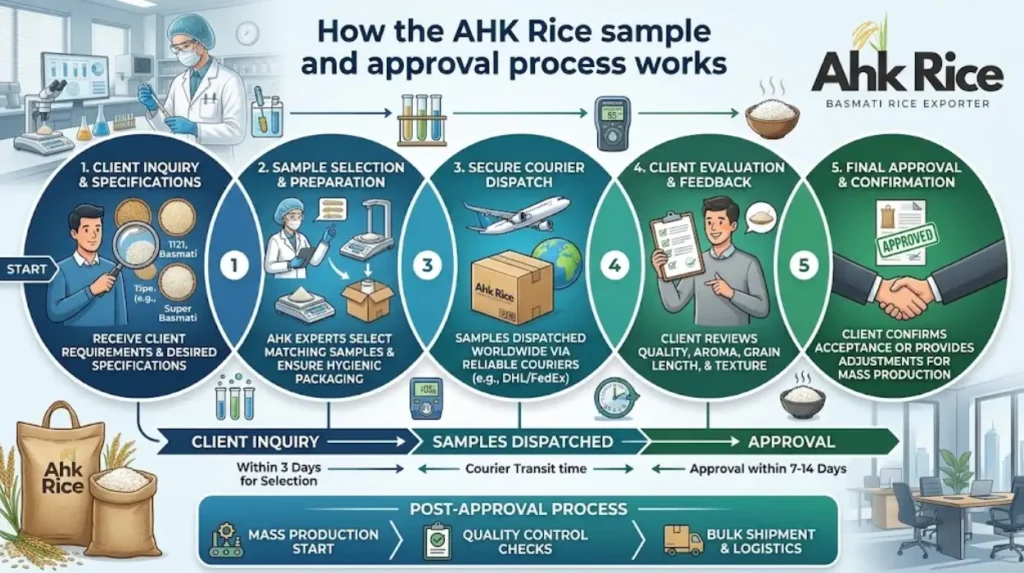
The sample process allows buyers to assess rice quality before committing to a commercial shipment. Importers should agree on the sample specification, courier arrangements, testing requirements, approval criteria, and final purchase terms before authorizing production or container loading.
A practical sample-to-order workflow follows five stages.
Stage 1: Submit the product requirements. The buyer identifies the preferred variety, processing method, grain specification, packaging, target quantity, and US destination. This gives AHK Rice a defined basis for selecting a representative sample.
Stage 2: Confirm sample availability and charges. AHK Rice and the buyer agree on the sample quantity, preparation arrangements, dispatch method, and any applicable fees. For qualifying sample requests, an offer of up to 20 kg of Super Kernel basmati rice may be available; buyers should confirm current eligibility and terms before relying on it.
Stage 3: Arrange courier delivery. The buyer confirms the shipping address and pays the agreed courier charges. Applicable phytosanitary, inspection, or other documentation charges must be clarified in advance. International sample shipments may also require customs declarations and compliance with destination rules.
Stage 4: Test and approve the sample. The buyer evaluates aroma, grain appearance, cooking performance, elongation, texture, and consistency against the agreed specification. Any laboratory testing or additional certification should be discussed separately, including who arranges and pays for it.
Stage 5: Confirm the commercial order. After approval, both parties finalize the price, quantity, packaging, tolerances, shipment window, payment terms, documentation, and Incoterm. The approved specification should be recorded in the purchase contract and used for shipment checks.
There is no universal sample delivery fee. Courier costs vary by parcel weight, destination, service speed, and carrier. Phytosanitary or other charges depend on the sample, required documentation, and applicable rules. AHK Rice should confirm the actual charges before dispatch rather than treating estimates as fixed fees.
A sample approval confirms the buyer’s assessment of the submitted sample. It does not replace agreed commercial inspection procedures or guarantee that every shipment will be identical without appropriate production controls.
How can you start a scheduled basmati rice order with AHK Rice?
Start by submitting the destination, rice specification, order quantity, packaging requirements, and target delivery window. AHK Rice can then assess the requested product and shipment details, clarify the applicable commercial terms, and prepare the information needed for a purchasing decision.
Provide the following information when requesting a quotation:
- Destination: New York, Houston, or Los Angeles, including the preferred port or delivery address.
- Rice specification: Variety, processing type, grain length, broken percentage, moisture limit, and other required quality parameters.
- Quantity: Required metric tonnes, estimated container count, and expected order frequency.
- Packaging: Bag size, packaging material, private-label artwork, and labeling requirements.
- Timing: Target shipment date, preferred arrival window, and any inventory deadlines.
- Commercial terms: Preferred Incoterm, payment terms, inspection arrangements, and documentation requirements.
The buyer should confirm product availability, quotation validity, sample approval requirements, and the proposed shipment schedule before placing the order. Both parties should agree on the process for approving documents and handling changes to the shipment plan.
A recurring procurement schedule can then be developed around sales forecasts, warehouse capacity, and expected replenishment requirements. Actual dispatch dates and vessel bookings must still be confirmed for each shipment.
For importers seeking a more controlled purchasing process, the best next step is to compare the product specification, landed cost, and achievable delivery window before committing to volume. Request a shipment-specific quotation from AHK Riceto establish your rice specification, commercial terms, and proposed delivery schedule.
Frequently Asked Questions
How long does basmati rice shipping take from Karachi to New York?
Ocean transit typically takes approximately 30–45 days, depending on the vessel route and transshipment arrangements.
This estimate covers port-to-port transit rather than the entire purchasing process.
Production, inspection, export clearance, and US customs clearance add time.
Port congestion and vessel schedule changes can also affect arrival dates.
Importers should confirm the latest carrier schedule before committing to a delivery deadline.
How long does it take to ship basmati rice to Houston?
Indicative ocean transit from Karachi to Houston is approximately 25–40 days.
The actual duration depends on the shipping route and available vessel services.
Customs clearance and terminal handling affect when the container becomes available.
Inland transportation adds time when delivery is required beyond the port.
Buyers should confirm the shipment-specific schedule before arranging warehouse receiving.
Can AHK Rice supply basmati rice to Los Angeles?
AHK Rice offers Pakistani basmati rice varieties, including 1121, Super Kernel, and 1509, subject to availability and agreed specifications.
Importers can discuss Steam, raw, and Golden Sella processing requirements.
Packaging options should be confirmed according to order quantity and market requirements.
Shipping arrangements depend on the agreed commercial terms and carrier availability.
US importers must also verify applicable customs and food-import compliance requirements.
How much does a basmati rice sample cost?
Sample costs depend on the requested quantity, courier service, and destination.
An offer of up to 20 kg of Super Kernel basmati rice may be available for qualifying requests, subject to confirmation.
The buyer covers agreed courier charges under this sample arrangement.
Applicable phytosanitary or other documentation charges must be confirmed before dispatch.
Request a sample quotation that clearly identifies all charges and delivery arrangements.
What affects the total cost of importing basmati rice into the USA?
Rice variety, quality specifications, processing method, and packaging influence the product price.
Order quantity and freight rates affect the shipment cost.
The agreed Incoterm determines how transportation costs and responsibilities are allocated.
Customs brokerage, applicable duties, terminal charges, insurance, and inland delivery affect landed cost.
Importers should request an itemized quotation based on their actual shipment requirements.