Pakistani Sella Basmati Rice Demand Across UAE Retail and Hospitality Sectors
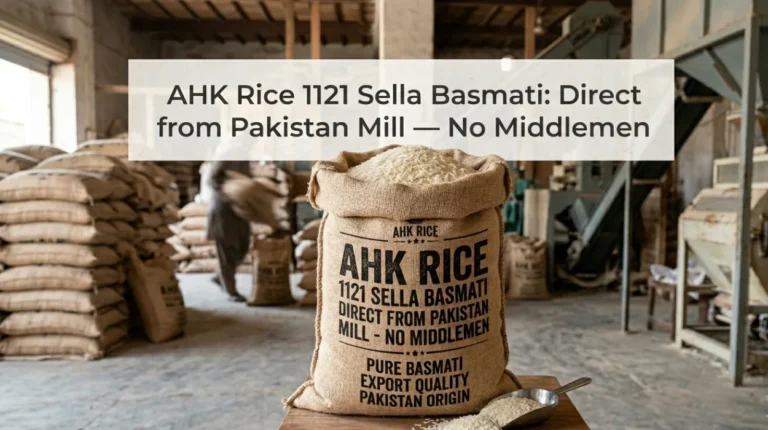
Pakistani Sella Basmati rice demand in UAE retail and hospitality sectors refers to structured import consumption driven by supermarkets, catering companies, and hotels sourcing parboiled long grain rice from Pakistan. Demand concentrates on consistency, grain elongation, and stable cooking performance across bulk service environments.
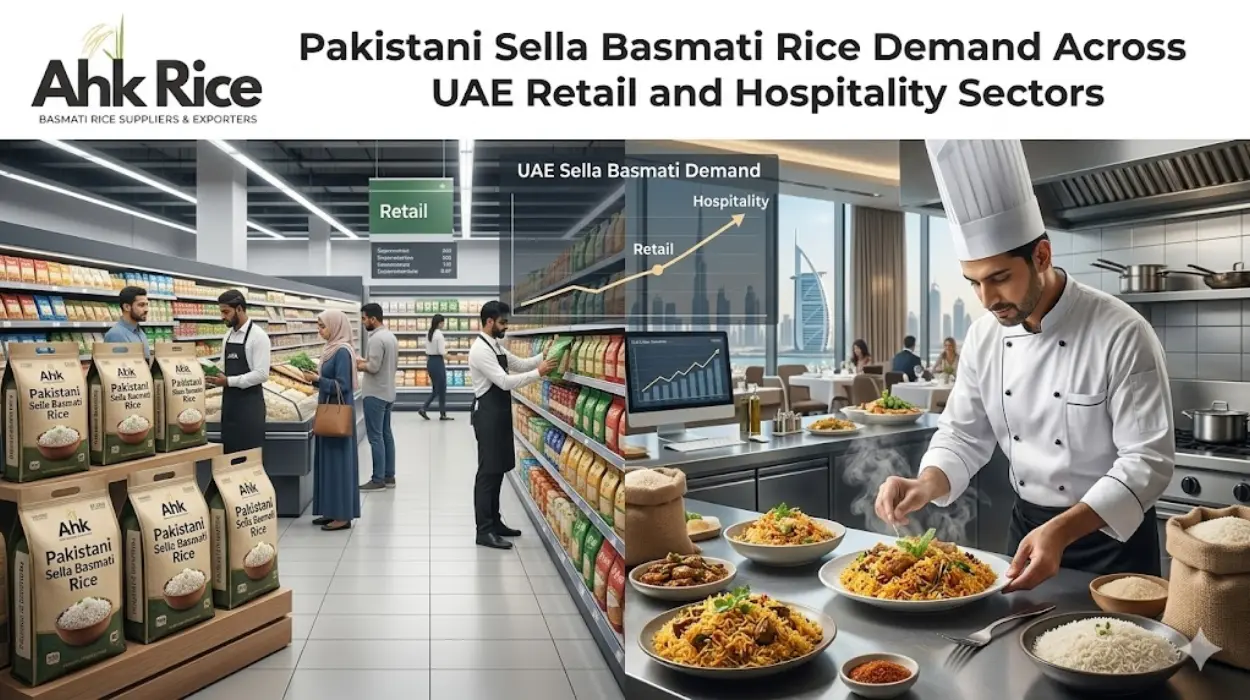
Pakistani Sella Basmati rice demand forms a structured consumption system across UAE food distribution networks. Retail chains source packaged SKUs for households. Hospitality buyers procure bulk volumes for hotels, catering, and restaurants. Demand links directly to grain quality, cooking yield, and storage stability under Gulf climate conditions.
Pakistani Sella Basmati rice supply originates from Punjab cultivation zones where farmers cultivate long grain basmati varieties under controlled irrigation systems. Exporters harvest paddy, then mill, dehusk, parboil, dry, polish, and grade rice into Sella categories. UAE importers evaluate final rice based on elongation and aroma retention.
Retail demand in UAE focuses on branded packs ranging from 1 kg to 5 kg. Hospitality demand focuses on 25 kg to 50 kg polypropylene bags. Both channels require uniform grain size distribution and low breakage ratio. Hotels prioritize cooking expansion ratio for buffet service consistency.
Pakistani Sella Basmati rice maintains relevance in UAE due to its adaptability to large-scale cooking systems. Restaurants require rice that remains separate after steaming. Catering units require predictable yield per kilogram. Retail consumers prioritize aroma and texture consistency across repeated cooking cycles.
With demand structure defined across UAE retail and hospitality channels, the next focus shifts toward how this demand operates through import, distribution, and consumption systems.
How does demand work in UAE retail and hospitality sectors?
Demand works through layered import channels where UAE distributors load Pakistani Sella Basmati rice, dispatch it to warehouses, and supply retail chains and hospitality buyers based on contract volumes, seasonal consumption, and menu-based procurement cycles. Retail absorbs steady demand while hospitality drives bulk fluctuations.
UAE demand operates through a structured import pipeline. Importers source rice from Pakistan, then clear shipments through Dubai or Abu Dhabi ports. Distributors inspect grain quality, verify moisture levels, and allocate stock to retail and hospitality buyers based on contractual forecasting models.
Retail sector demand flows through supermarkets and grocery chains. These outlets procure pre-packed Sella rice in standardized SKUs. Hospitality demand flows through procurement departments in hotels and catering firms. These buyers place bulk orders aligned with occupancy rates and event schedules.
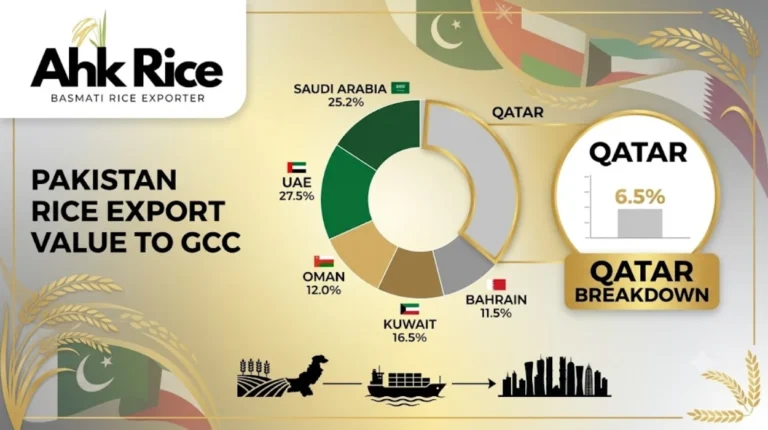
Distribution systems in UAE separate chilled logistics from dry goods logistics. Rice follows dry goods channels. Warehouses maintain temperature-controlled storage to preserve grain integrity. Logistics operators load containers in Pakistan and ship them through maritime routes to Jebel Ali and Khalifa ports.
Seasonal demand peaks during Ramadan, wedding seasons, and tourism spikes. Retail demand increases during household stockpiling cycles. Hospitality demand increases during buffet service expansions and event catering contracts. These cycles create predictable procurement surges across importers.
With UAE demand flow structure established, the next section examines the key components that define quality and trade acceptance standards for Pakistani Sella Basmati rice.
What are the key components of Pakistani Sella Basmati rice quality for UAE buyers?
Key components include grain length of 6.8–8.4 mm, low broken percentage under 5 percent, moisture control at 12–13 percent, parboiling uniformity, color sorting accuracy, and aroma retention stability, which UAE buyers inspect before approving shipments for retail or hospitality distribution.
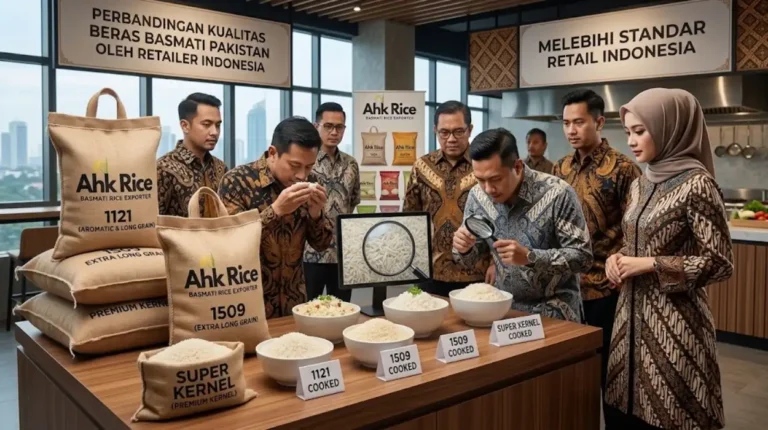
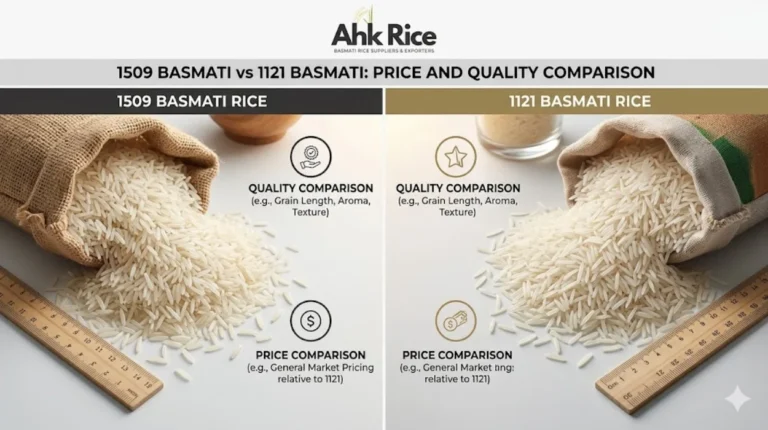
Grain length defines market acceptance. Pakistani Sella Basmati rice maintains long slender grains after processing. Millers grade rice into Super, 1121, and 1509 categories. Each grade reflects elongation capacity and cooking expansion ratio under boiling conditions.
Moisture control stabilizes storage performance. Drying units reduce moisture to controlled thresholds. Warehouses inspect moisture using calibrated meters. Excess moisture leads to fungal risk during shipment to humid Gulf ports. Controlled moisture ensures 12–18 months shelf stability depending on grade.
Parboiling uniformity strengthens grain integrity. Processing plants steam paddy before milling. This locks nutrients into the grain and improves firmness. Uniform parboiling ensures consistent color tone across batches. UAE buyers reject uneven parboiled lots due to inconsistent cooking results.
Color sorting removes impurities. Optical sorters separate discolored grains, husk fragments, and foreign matter. This process ensures visual uniformity in packaged rice. Hospitality buyers prioritize clean appearance for buffet presentation standards.
UAE quality standards for Pakistani Sella Basmati rice buyers acts as a reference point for specification alignment across import inspections and procurement benchmarks.
With quality components established, the next section explains benefits that drive sustained UAE demand for Pakistani Sella Basmati rice.
What are the benefits of Pakistani Sella Basmati rice in UAE markets?
Pakistani Sella Basmati rice provides high cooking yield, extended shelf life up to 18 months, stable grain separation after cooking, and cost-efficient bulk performance, making it suitable for UAE retail distribution and large-scale hospitality kitchen operations requiring consistency and storage resilience.
Cooking yield improves operational efficiency. One kilogram of Sella rice produces higher cooked volume compared to raw basmati. This reduces procurement frequency for hotels. Catering companies optimize cost per plate using higher expansion ratios during buffet preparation.
Shelf life supports Gulf climate logistics. Golden Sella variants maintain quality up to 18 months under controlled storage. Steam variants perform up to 12 months. Retail warehouses in UAE benefit from reduced spoilage risk during long distribution cycles.
Grain separation improves dining experience. Sella rice retains structure after boiling. This prevents clumping in large catering trays. Restaurants maintain visual presentation standards during high-volume service periods.
Cost efficiency supports bulk procurement. Pakistani Sella Basmati rice offers competitive pricing compared to premium basmati origins. UAE importers balance price and quality across retail and hospitality contracts to optimize margins.
With benefits established across performance and logistics, the next section evaluates practical use cases across UAE retail and hospitality environments.
What are the main use cases of Pakistani Sella Basmati rice in UAE retail and hospitality?
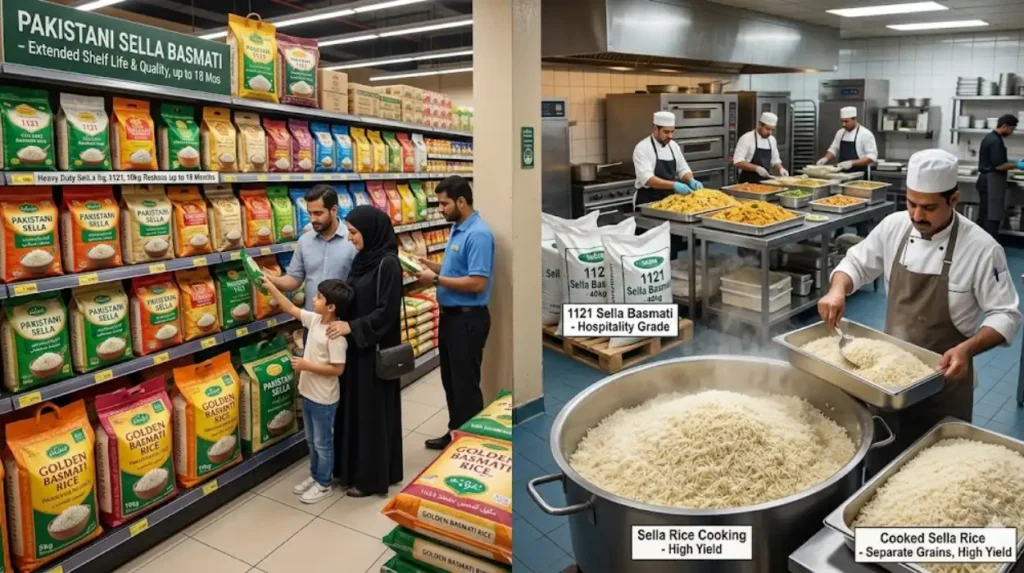
Use cases include supermarket packaged retail sales, hotel buffet rice service, catering event distribution, restaurant à la carte preparation, and institutional feeding programs, where consistent grain quality and predictable cooking expansion define procurement decisions across UAE food service operations.
Retail supermarkets distribute Sella rice in consumer packs. These include 1 kg, 2 kg, and 5 kg formats. Households prefer consistent aroma and long grain appearance. Retail demand remains stable throughout the year with moderate seasonal peaks.
Hotel buffet operations rely on Sella rice for bulk cooking. Kitchens prepare large trays for breakfast, lunch, and dinner services. Rice must remain non-sticky under extended heat lamps. Consistency ensures guest satisfaction in hospitality environments.
Catering companies use Sella rice for weddings and corporate events. Large-scale cooking requires predictable yield and uniform grain structure. Event planners calculate rice quantity based on guest count and portion size.
Restaurant kitchens integrate Sella rice into biryani and pulao menus. Chefs require grains that maintain separation after spice infusion. This improves dish presentation and texture consistency.
Institutional programs such as schools and labor camps use Sella rice for mass feeding. Procurement teams prioritize cost efficiency and storage stability. Bulk bags reduce handling frequency and distribution cost.
With use cases defined, the next section addresses common problems and misconceptions affecting UAE import decisions.
What are the common problems or misconceptions about Pakistani Sella Basmati rice?
Common issues include confusion between Steam and Golden Sella grades, misinterpretation of broken percentage tolerance, inconsistent expectations about aroma intensity, and incorrect assumptions about uniform cooking performance across all Pakistani basmati grades in UAE procurement markets.
Grade confusion occurs between Golden Sella and Steam Sella. Golden Sella uses direct parboiling and produces firmer grains. Steam Sella undergoes controlled steaming, resulting in softer texture. Buyers often misalign grade selection with intended cooking application.
Broken percentage misunderstanding affects procurement decisions. Some buyers assume all basmati grades maintain identical breakage levels. In reality, milling intensity and polishing determine final broken ratio. Exporters grade rice based on strict sorting thresholds.
Aroma expectation mismatch occurs in institutional cooking. Parboiling reduces volatile aroma compared to raw basmati. However, cooking absorption restores mild fragrance. Hotels adjust seasoning to compensate for aroma variation in bulk cooking.
Cooking inconsistency assumptions arise from improper storage handling. Rice exposed to high humidity absorbs moisture and loses uniformity. Warehouses must maintain controlled conditions during storage and dispatch cycles.
With misconceptions clarified, UAE buyers improve procurement accuracy and reduce operational inefficiencies across retail and hospitality supply chains.
Frequently Asked Questions
What is Pakistani Sella Basmati rice demand in UAE?
Pakistani Sella Basmati rice demand in UAE refers to the consumption of parboiled long grain rice by retail supermarkets, hotels, restaurants, and catering companies. It is driven by its cooking consistency, long grain structure, and suitability for bulk food service.
Why is Sella Basmati rice popular in UAE hospitality sector?
It is popular because it offers high cooking yield, non-sticky texture, and stable grain separation. Hotels and catering businesses prefer it for buffet services where large quantities must remain consistent in taste and appearance.
How does UAE import Pakistani Sella Basmati rice?
UAE importers source rice from Pakistan through maritime shipping routes. The rice is processed, packed, and transported via ports like Jebel Ali. Distributors then supply it to retail chains and hospitality buyers based on demand contracts.
What are the main types of Sella Basmati rice used in UAE?
The main types include Golden Sella and Steam Sella. Golden Sella is firmer due to direct parboiling, while Steam Sella has a softer texture. Both are used depending on cooking requirements in retail and hospitality sectors.
What factors affect demand for Sella Basmati rice in UAE?
Demand is influenced by tourism seasons, Ramadan, wedding events, and hotel occupancy rates. Storage stability, grain quality, price competitiveness, and cooking performance also play a major role in purchasing decisions.