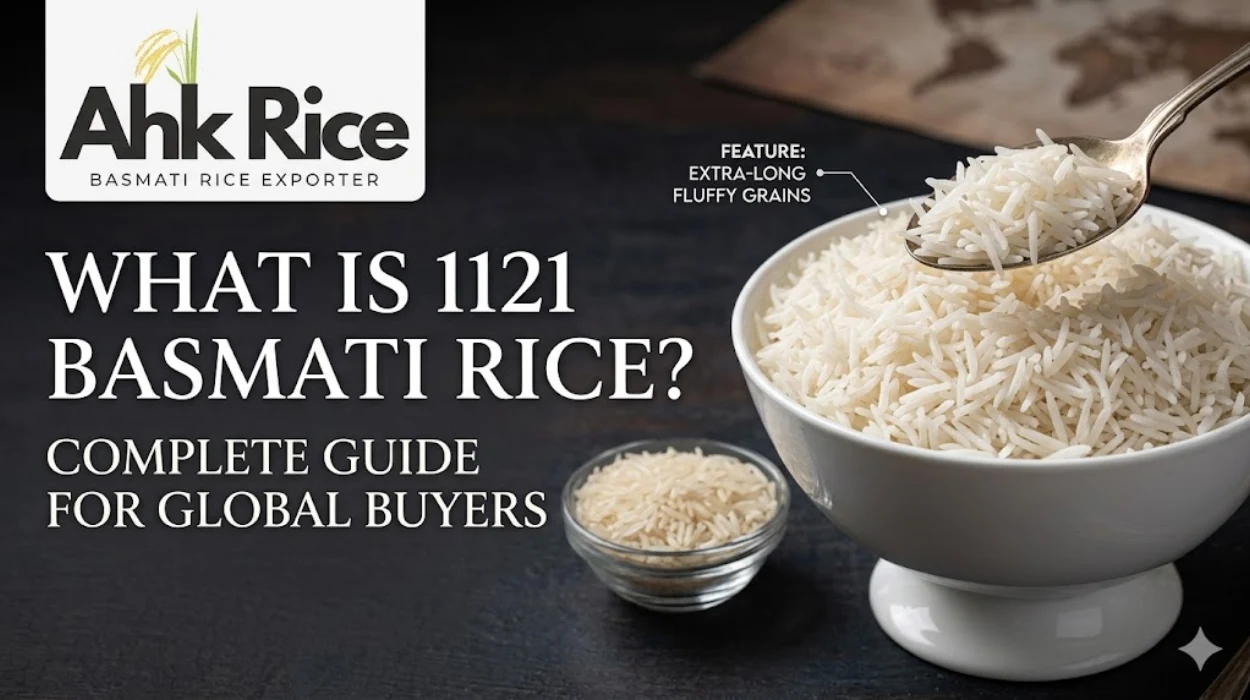
What Is 1121 Basmati Rice? Complete Guide for Global Buyers
1121 Basmati Rice is a long-grain aromatic rice variety with an average grain length of 8.30–8.40 mm after cooking. Here is why: it originates from Punjab cultivation zones, where controlled irrigation, fertile alluvial soil, and strict milling standards produce extra-long kernels with high elongation and strong aroma retention after cooking.
1121 Basmati Rice belongs to the premium basmati segment grown in Pakistan and India. It is cultivated in Punjab regions with high-yield farming systems. Farmers cultivate paddy in controlled water fields and harvest mature grains after full grain development. The rice is known for extreme elongation after cooking.
1121 Basmati Rice is processed through milling, dehusking, polishing, grading, and sorting systems. Each step increases uniformity and export readiness. Exporters such as AHK Rice standardize this variety for international shipment.
With the definition established, the next section explains how this rice is cultivated and processed from field to export shipment.
How does 1121 Basmati rice cultivation and processing work?
1121 Basmati Rice is cultivated in irrigated Punjab fields and processed through nine industrial stages. Here is why: each stage removes impurities, stabilizes grain moisture at 12–13%, and enhances export-grade uniformity required by international buyers.
1121 cultivation begins in fertile alluvial soil zones. Farmers transplant seedlings into flooded fields and maintain controlled irrigation cycles. Growth continues for 135–150 days depending on climate conditions.
Processing begins after harvest and follows strict industrial sequencing.
Cultivation and Processing Steps
- Clean paddy preparation
- Dry field harvesting
- Dehusking separation
- Parboiling stabilization (for Sella types)
- Milling grain refinement
- Polishing surface enhancement
- Length grading separation
- Color sorting inspection
- Final fumigation and packing
1121 rice processing defines export quality consistency. Milling machines remove husk layers without breaking grains. Sorting machines separate broken kernels below 2% tolerance in premium export lots.
With cultivation and processing explained, the next section breaks down the internal components that define 1121 basmati quality.
What are key components of 1121 Basmati Rice?
1121 Basmati Rice consists of grain length, aroma compounds, amylose content, and moisture stability. Here is why: these components directly determine cooking expansion, shelf life, and export classification across global markets.
1121 Basmati Rice shows a kernel length of 8.30–8.40 mm after cooking expansion. This elongation is the key defining attribute for premium classification.
Aroma compounds originate from natural genetic traits and soil composition. These compounds remain stable under proper storage conditions.
Amylose content stays between 20–22%, which allows fluffy texture after cooking. Lower amylose creates sticky rice, but 1121 maintains separation.
Moisture content is stabilized at 12–13% after drying and milling. This level ensures long shelf life during export shipping cycles.
With components understood, the next section explains the benefits for global importers.
What are benefits of 1121 Basmati Rice
1121 Basmati Rice delivers high elongation, strong aroma retention, and cooking volume expansion up to 2.5 times. Here is why: these properties reduce cost per serving for importers and increase plate yield in food service markets.
1121 rice expands significantly after cooking, which improves portion efficiency for restaurants and catering units. This expansion reduces procurement cost per meal.
Aroma retention remains stable in sealed packaging. This ensures consistency across long shipping routes from Pakistan to global destinations.
Uniform grain size improves packaging efficiency. Exporters achieve better container loading ratios due to reduced breakage rates.
Storage stability reaches 12–18 months depending on processing type. Golden Sella variants maintain longer shelf stability than steam variants.
With benefits established, the next section explains how global markets use this rice.
What are use cases of 1121 Basmati Rice in global markets?
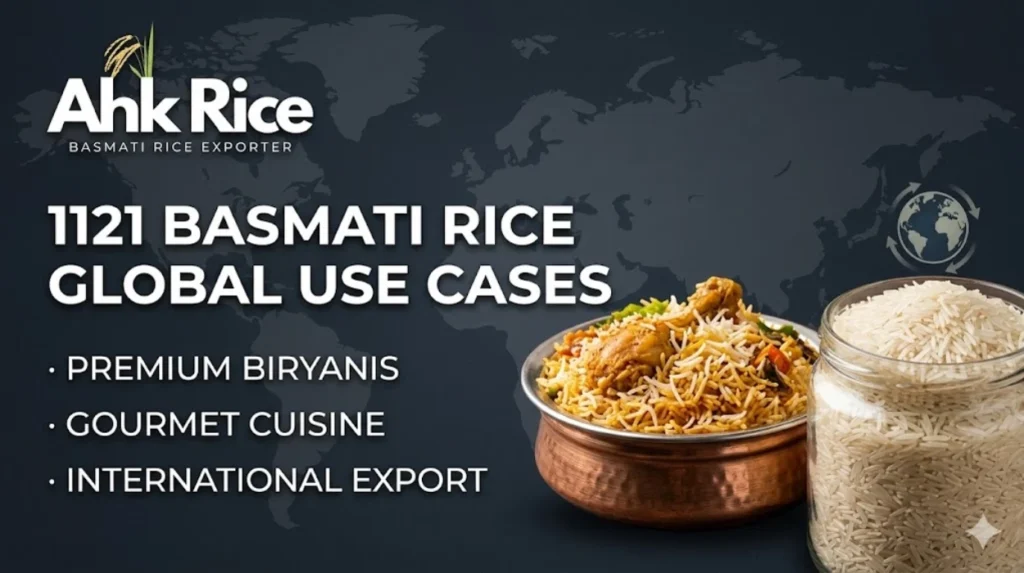
1121 Basmati Rice is used in hospitality, retail packaging, institutional catering, and ethnic food manufacturing. Here is why: its long grain structure and aroma profile match high-demand culinary standards across Middle Eastern, European, and North American markets.
Middle Eastern catering uses 1121 rice in bulk cooking environments. Large-scale kitchens require uniform expansion and consistent aroma retention.
European retail markets package 1121 rice in 1–5 kg consumer packs. Supermarkets prefer consistent grain appearance and certified export quality.
North American food service industries use 1121 rice for fusion cuisine applications. Restaurants demand non-sticky texture and visual grain separation.
Institutional buyers prefer 1121 rice for schools, hospitals, and airline catering due to predictable cooking yield.
For importers comparing grades, provides deeper evaluation: 1121 Basmati vs 1509 Basmati: Which Grade Is Better for Importers?
With use cases defined, the next section addresses common misconceptions.
What are common problems or misconceptions about 1121 Basmati Rice?
1121 Basmati Rice is often confused with hybrid long-grain rice, over-polished rice, and non-aromatic varieties. Here is why: inconsistent labeling and mixed export grading create misunderstanding among new importers.
One misconception assumes all long-grain rice is basmati. Only genetically verified basmati varieties qualify under export certification systems.
Another misconception assumes higher polishing improves quality. Excess polishing reduces aroma retention and weakens grain structure.
Some buyers assume broken percentage does not matter. Export-grade 1121 rice maintains strict broken limits under 2–5% depending on grade class.
Storage errors also reduce quality. High humidity above 14% moisture causes grain discoloration and aroma loss during shipping.
With misconceptions clarified, the next section explains available grades of 1121 basmati rice.
What grades of 1121 Basmati Rice exist?
1121 Basmati Rice exists in White, Steam, and Golden Sella grades with different processing intensity. Here is why: each grade serves distinct market conditions based on cooking method, storage environment, and price sensitivity.
White 1121 Basmati Rice
White 1121 rice is fully milled and polished. It delivers fast cooking and soft texture for retail markets.
Steam 1121 Basmati Rice
Steam 1121 rice is partially parboiled. It retains nutrients and improves grain strength during boiling.
Golden Sella 1121 Basmati Rice
Golden Sella 1121 rice is fully parboiled before milling. It achieves maximum hardness and longest shelf life.
Golden Sella lasts longer than Steam. In 40°C warehouse conditions in UAE, Golden Sella maintains quality for 18 months. Steam requires 12 months consumption.
With grade classification completed, the full structure of 1121 basmati rice becomes clear across cultivation, processing, and export systems.
Frequently Asked Questions
What makes 1121 Basmati Rice different from other rice?
1121 Basmati Rice has longer grain elongation, stronger aroma, and higher cooking expansion than standard long-grain rice varieties.
Which countries import 1121 Basmati Rice?
Major importers include UAE, Saudi Arabia, UK, USA, Canada, and African food distribution markets.
What is the ideal grain length of 1121 Basmati Rice?
The ideal cooked grain length reaches 8.30–8.40 mm, depending on processing method and parboiling level.
Which 1121 Basmati Rice grade lasts the longest?
Golden Sella grade lasts the longest due to parboiling, reaching up to 18 months shelf stability in controlled storage.
Why is 1121 Basmati Rice expensive?
It requires long cultivation cycles, strict grading systems, and high export-quality milling standards.